
Chef Juliette
John Dory (St. Pierre)
John Dory has the delicacy of sole and the firmness of turbot. A light flouring, a quick butter sauté, and nut-brown beurre noisette show exactly why looks never mattered.
A cooking platform built around craft, culture, and the stories behind what we eat.
Created by Chef Juliette
Based on No. 771, Skate, from Le Guide Culinaire (1907) by Auguste Escoffier
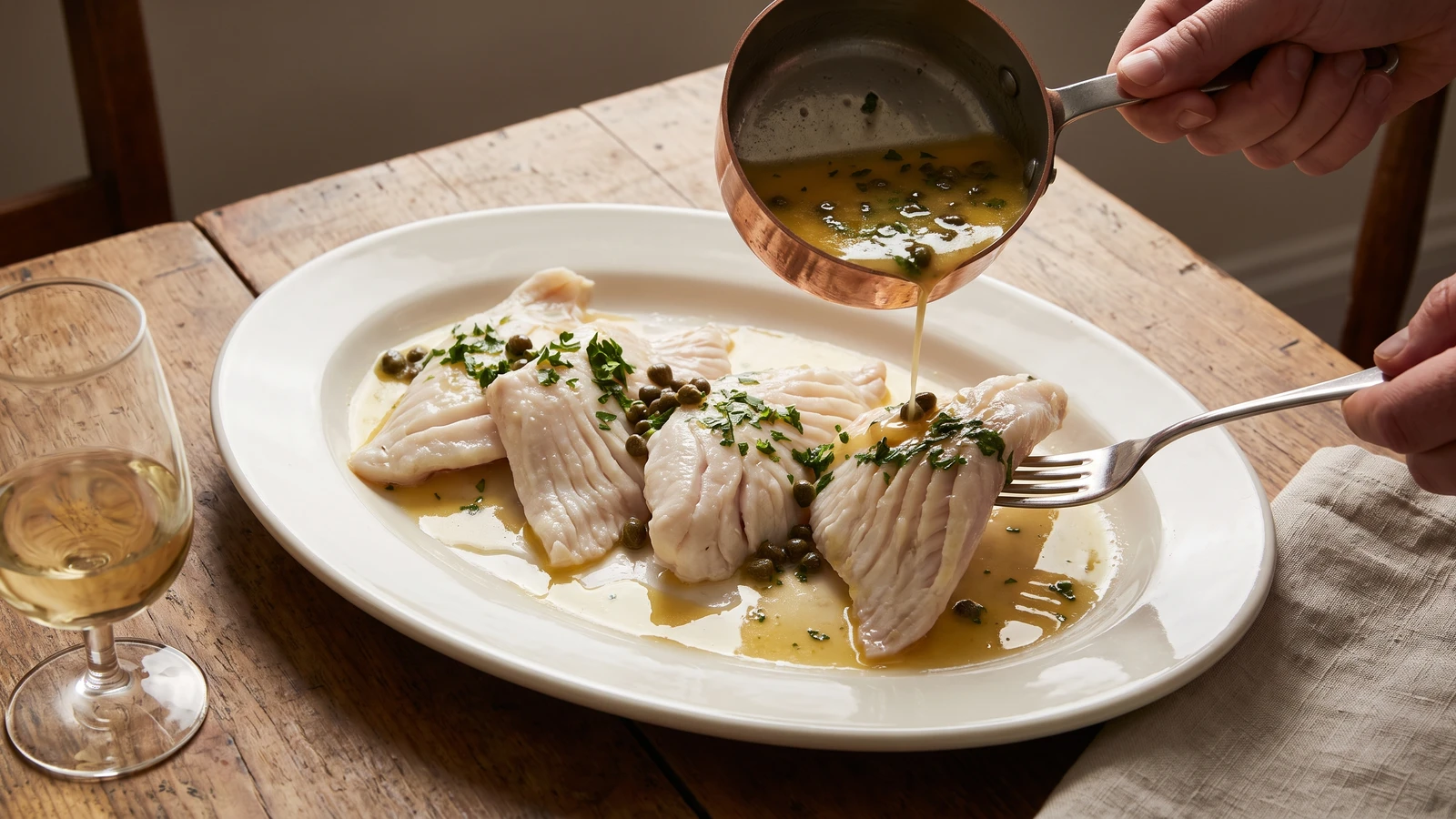
Raie pochée teaches gentle fish cookery: firm, ridged flesh that releases in tender ribbons, covered with a bright caper sauce whose silk comes from roux, poaching liquor, and real butter.
Raie pochée, sauce aux câpres (poached skate with caper sauce), teaches the gentleness that fish cookery demands. The one true thing to know before touching the pan is this: skate wants liquid that barely trembles. A hard boil contracts its beautiful ridged flesh and turns tender ribbons woolly.
The old entry could say only “boiled, with caper sauce” because it assumed a whole crimped skate, a fish kettle, a saucier at the next station, and fish stock never off the fire. At home, four skinless wing portions fit into a wide sauté pan, and their aromatic court-bouillon becomes the liquid for the sauce. I’ve changed the scale and removed the brigade handoff, not the intent. Crimping and separate stations are scaffolding; the gentle poach and the roux-built sauce aux câpres are the dish.
When it is right, the pearly flesh pulls cleanly from the cartilage in moist ribbons, and the pale butter sauce gathers in its ridges with capers in every spoonful. Watch the liquid, not merely the clock. Keeping that court-bouillon below a boil is the step that matters most, and if it runs away from you, ça se rattrape.
Skate belongs to the fish markets of France’s Atlantic and Channel coasts, especially Brittany and Normandy, and traveled naturally from coastal kitchens to Parisian bistro and bourgeois tables. Fishmongers traditionally sold larger skate crimped and ready for the poaching kettle, while smaller specimens were prized for frying. Raie au beurre noir may now be the more famous name, but the classical table commonly served poached skate with sauce aux câpres, exactly as this preparation does.
Quantity
4 portions, about 6 ounces each (680 g total)
cartilage attached
Quantity
2 teaspoons (10 ml / 12 g), divided, plus more as needed
Quantity
6 cups (1.44 L / 1.44 kg)
Quantity
1 cup (240 ml / 240 g)
Quantity
1/4 cup (60 ml / 60 g)
Quantity
1 small (about 4 ounces / 115 g)
thinly sliced
Quantity
1 small (about 2 1/2 ounces / 70 g)
thinly sliced
Quantity
1 stalk (about 2 ounces / 55 g)
thinly sliced
Quantity
1
Quantity
1 teaspoon (5 ml / 3 g)
lightly crushed
Quantity
6 tablespoons (90 ml / 85 g), divided
reserve 4 tablespoons cold and cubed
Quantity
1/4 cup (60 ml / 30 g)
Quantity
1/3 cup (80 ml / 55 g)
drained and rinsed
Quantity
1 tablespoon (15 ml / 15 g)
Quantity
1/4 teaspoon (1.25 ml / 0.5 g)
Quantity
2 tablespoons (30 ml / 8 g)
finely chopped
| Ingredient | Quantity |
|---|---|
| skinless skate wing portionscartilage attached | 4 portions, about 6 ounces each (680 g total) |
| fine sea salt | 2 teaspoons (10 ml / 12 g), divided, plus more as needed |
| cold water | 6 cups (1.44 L / 1.44 kg) |
| dry white wine | 1 cup (240 ml / 240 g) |
| white wine vinegar | 1/4 cup (60 ml / 60 g) |
| yellow onionthinly sliced | 1 small (about 4 ounces / 115 g) |
| carrotthinly sliced | 1 small (about 2 1/2 ounces / 70 g) |
| celerythinly sliced | 1 stalk (about 2 ounces / 55 g) |
| bouquet garni of parsley stems, thyme, and bay leaf | 1 |
| black peppercornslightly crushed | 1 teaspoon (5 ml / 3 g) |
| unsalted butterreserve 4 tablespoons cold and cubed | 6 tablespoons (90 ml / 85 g), divided |
| all-purpose flour | 1/4 cup (60 ml / 30 g) |
| capersdrained and rinsed | 1/3 cup (80 ml / 55 g) |
| fresh lemon juice | 1 tablespoon (15 ml / 15 g) |
| ground white pepper | 1/4 teaspoon (1.25 ml / 0.5 g) |
| flat-leaf parsley leavesfinely chopped | 2 tablespoons (30 ml / 8 g) |
Run your fingers over the skate and trim away any loose membrane or ragged cartilage, then pat every portion dry. It should smell clean and faintly of the sea, never of ammonia. Season both sides with half the salt and leave the portions in the cold while you make the court-bouillon.
Combine the water, wine, vinegar, onion, carrot, celery, bouquet garni, peppercorns, and remaining salt in a wide saucepan. Bring it slowly to a simmer and cook gently for 15 minutes, until the liquid smells properly aromatic rather than merely of wine and vinegar. Strain it into the wide sauté pan, pressing lightly on the vegetables, then let it settle below a simmer.
Lay the skate portions in one layer in the warm court-bouillon, adding a little water if the thickest parts are not covered. Bring the liquid just to a tremble, cover loosely, and poach for 8 to 12 minutes, depending on thickness. Do not let it boil. If bubbles begin breaking hard across the surface, pull the pan from the heat and add a small splash of cold water around the edge; ça se rattrape. The skate is ready when the flesh is opaque, separates from the cartilage in moist ribbons, and reaches 145°F (63°C) at its thickest point.
Lift the skate carefully with a broad fish spatula and let each portion drain for a moment before arranging it on a warm platter. Cover loosely with parchment so the surface stays moist. Measure 1 1/2 cups (360 ml) of the hot poaching liquor for the sauce; keep a little extra nearby in case the sauce needs loosening.
Melt 2 tablespoons (30 ml / 28 g) of the butter in a saucepan over medium-low heat. Stir in the flour and cook this roux for 2 minutes without letting it color; the raw flour smell must disappear, but the sauce should remain pale. Whisk in the measured poaching liquor a little at a time, letting each addition turn smooth before adding the next, then simmer gently for 5 to 7 minutes. If lumps form, take the pan off the heat, whisk in a spoonful of cool poaching liquor, and strain if necessary. Never throw out a sauce for one lump.
Stir the capers, lemon juice, and white pepper into the sauce and simmer for 1 minute. It should be nappé, thick enough to coat the back of a spoon while still flowing freely. If it is thin, simmer a little longer; if it is too tight, add poaching liquor by the spoonful. Take the pan from the heat and whisk in the remaining 4 tablespoons (60 ml / 57 g) of cold butter, a few cubes at a time. If the butter separates into greasy beads, stop adding it and whisk in a teaspoon of cold poaching liquor before continuing. Ça se rattrape.
Stir the parsley into the finished sauce and taste for salt and acidity. Spoon it generously over the skate, following the ridges so the capers settle among the ribbons of flesh, and bring the rest to the table in a warm sauceboat. Serve at once. One cook, one stove, one evening. À table!
1 serving (about 240g)
Culinary guides, cultural storytelling, and the editorial depth that makes cooking meaningful.
Discover Culinary ExplorerChef Juliette
John Dory has the delicacy of sole and the firmness of turbot. A light flouring, a quick butter sauté, and nut-brown beurre noisette show exactly why looks never mattered.

Chef Juliette
Fresh haddock proves its delicacy in the meunière pan: a fine flour crust, moist pearly flakes, and beurre noisette sharpened with lemon and parsley, ready from one skillet in half an hour.

Chef Juliette
Éperlans à l’Anglaise turns small fish into a lesson in disciplined coating: boned smelts under a close, crisp crumb, pan-fried in clarified butter and finished with bright, half-melted maître d’hôtel butter.

Chef Juliette
Tiny smelts, shallot, mushrooms, white wine, gratin sauce, and fine bread raspings meet a fierce oven, where the fish must turn tender in the same breath the buttered crust bronzes.