
Chef Juliette
John Dory (St. Pierre)
John Dory has the delicacy of sole and the firmness of turbot. A light flouring, a quick butter sauté, and nut-brown beurre noisette show exactly why looks never mattered.
A cooking platform built around craft, culture, and the stories behind what we eat.
Created by Chef Juliette
Based on No. 762, Frogs, from Le Guide Culinaire (1907) by Auguste Escoffier
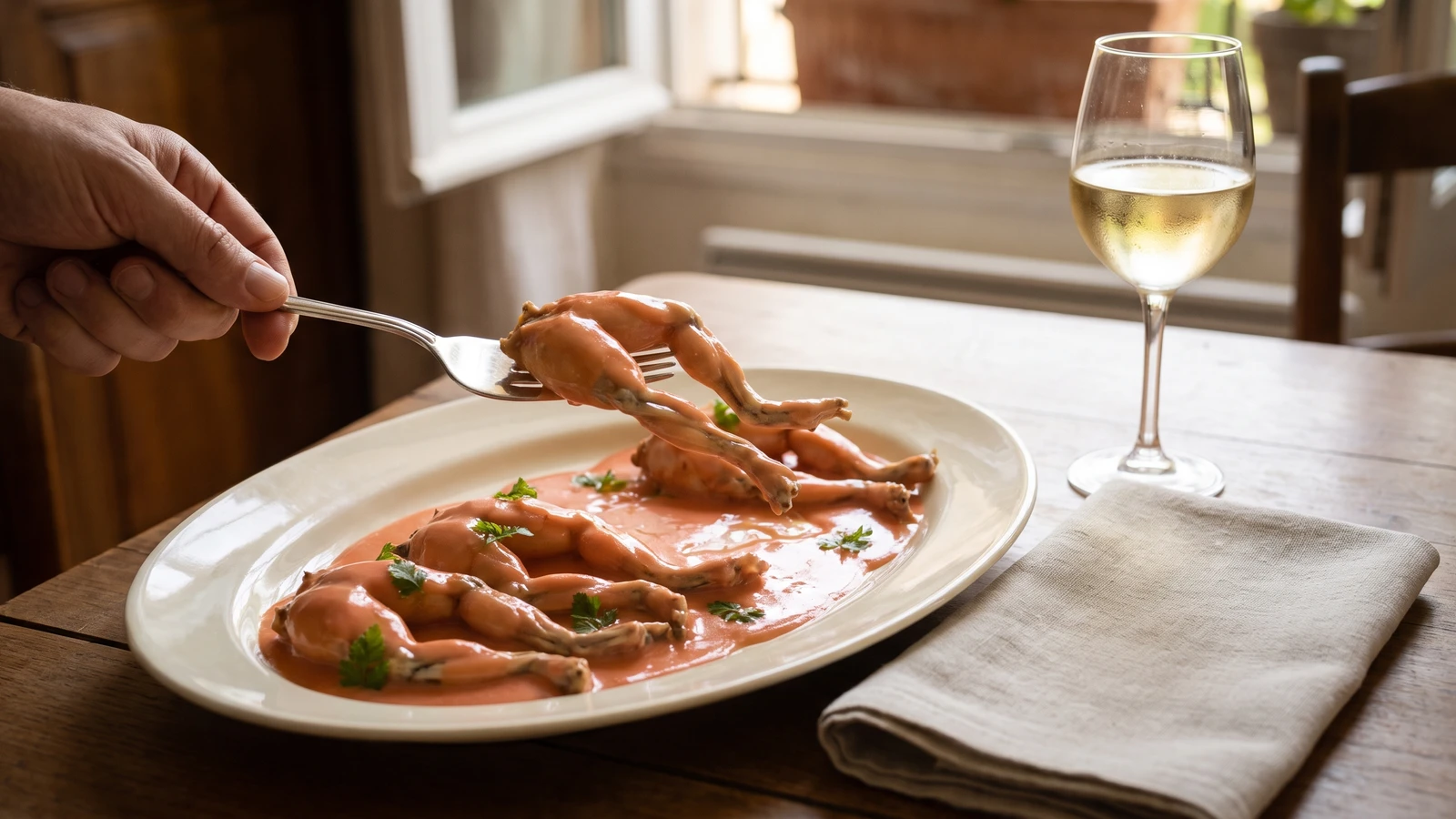
Tender grenouilles beneath a gleaming dawn-pink veil: a grand cold presentation made manageable through gentle poaching, a roux-built sauce aurore, and careful glazing.
Nymphes à l’Aurore (frog legs in a pink cold-set sauce) teaches the discipline of cold saucing. The sauce is a chaud-froid, a warm sauce applied to cold food and allowed to set, and the one true thing to know is this: the grenouilles must be tender, cold, and perfectly dry before that sauce touches them. Moisture makes the veil slide away.
The original preparation assumed a saucier on staff, fish stock never off the fire, finished velouté, and a tureen of clear aspic waiting for service. At home, the aromatic poaching liquor becomes the foundation of both sauce and glaze, while powdered gelatin supplies the clean set once provided by a separate aspic. Full stock production and elaborate clarification were brigade scaffolding, so they go. The gentle poach, pale roux, tomato-tinted reduction, cream, and two careful coats are the dish, so they stay. Twenty-four pairs make four generous portions for one cook, one stove, one evening.
The finished grenouilles should be delicate beneath a smooth coral-pink covering, glossy enough to catch the light but never rubbery or thickly entombed. The decisive moment comes when the cooled sauce falls from the spoon in a heavy ribbon while remaining fluid enough to coat. Meet that moment with cold, thoroughly dried frog legs and the dish will hold beautifully.
Frog legs belong especially to the pond country of the Dombes, just north of Lyon, where grenouilles are more often cooked plainly with butter, parsley, and garlic. Nymphes à l’Aurore belongs instead to the Parisian grand-kitchen table: the coy name softened the ingredient for English diners who recoiled from the word frogs, while sauce aurore, a tomato-tinted velouté, supplied its dawn-pink veil. The presentation carried a regional ingredient into formal cold service without disguising its delicate character.
Quantity
24 pairs (about 2 lb / 900 g)
thawed in the refrigerator if frozen
Quantity
2 cups (480 ml / 475 g)
Quantity
2 cups (480 ml / 480 g)
Quantity
2 (about 3 oz / 80 g)
thinly sliced
Quantity
8
Quantity
2 sprigs
Quantity
1
Quantity
2 teaspoons (10 ml / 12 g)
divided
Quantity
1/2 teaspoon (2.5 ml / 1 g)
lightly crushed
Quantity
3 tablespoons (45 ml / 42 g)
Quantity
1/3 cup (80 ml / 40 g)
Quantity
1/2 cup (120 ml / 120 g)
Quantity
1 cup (240 ml / 240 g)
Quantity
2 tablespoons (30 ml / 30 g)
Quantity
4 teaspoons (20 ml / 12 g)
divided
Quantity
6 tablespoons (90 ml / 90 g)
divided
Quantity
24 small leaves
| Ingredient | Quantity |
|---|---|
| skinned frog legsthawed in the refrigerator if frozen | 24 pairs (about 2 lb / 900 g) |
| dry white wine | 2 cups (480 ml / 475 g) |
| cold water | 2 cups (480 ml / 480 g) |
| shallotsthinly sliced | 2 (about 3 oz / 80 g) |
| parsley stems | 8 |
| thyme | 2 sprigs |
| bay leaf | 1 |
| fine saltdivided | 2 teaspoons (10 ml / 12 g) |
| white peppercornslightly crushed | 1/2 teaspoon (2.5 ml / 1 g) |
| unsalted butter | 3 tablespoons (45 ml / 42 g) |
| all-purpose flour | 1/3 cup (80 ml / 40 g) |
| strained tomato purée or passata | 1/2 cup (120 ml / 120 g) |
| heavy cream | 1 cup (240 ml / 240 g) |
| fresh lemon juice | 2 tablespoons (30 ml / 30 g) |
| unflavored powdered gelatindivided | 4 teaspoons (20 ml / 12 g) |
| cold water for blooming gelatindivided | 6 tablespoons (90 ml / 90 g) |
| chervil leaves | 24 small leaves |
Keep each pair of frog legs joined, trimming only ragged skin or exposed cartilage. Rinse only if the supplier recommends it, then dry the legs thoroughly. Keep them cold while the poaching liquor is prepared. Frog legs are delicate, but they still require complete cooking, so have an instant-read thermometer ready.
Combine the wine, 2 cups (480 ml / 480 g) cold water, shallots, parsley stems, thyme, bay leaf, 1 1/2 teaspoons (7.5 ml / 9 g) salt, and peppercorns in a wide pan. Simmer for 10 minutes to draw out the aromatics, then lower the heat until the liquid barely trembles. Add the frog legs in two batches and poach for 4 to 6 minutes, turning once, until the flesh is opaque and reaches 145°F (63°C) at the thickest part. Do not boil them. A hard boil tightens the meat before the bones have warmed through. Transfer each cooked batch to a wire rack and refrigerate uncovered until completely cold.
Strain the poaching liquor through a fine sieve into a clean saucepan, pressing nothing through, then bring it to a full boil and skim away any foam. Reduce until 2 3/4 cups (660 ml) remain. Measure out 2 cups (480 ml) for the sauce and reserve 3/4 cup (180 ml) for the final glaze. This concentrated liquor replaces the separate stockpot the grand kitchen kept ready.
Bloom 3 teaspoons (15 ml / 9 g) gelatin in 4 tablespoons (60 ml / 60 g) of the cold blooming water. Melt the butter in a heavy saucepan, add the flour, and stir over gentle heat for 2 minutes without allowing the roux to brown. Whisk in the 2 cups (480 ml) reduced poaching liquor a little at a time, bringing each addition smooth before adding the next. Simmer for 8 minutes, stirring along the pan floor, then add the tomato purée and cream. Simmer gently until the sauce is pale coral and coats the back of a spoon, about 5 minutes. Remove it from the heat and whisk in the bloomed gelatin, lemon juice, and remaining 1/2 teaspoon (2.5 ml / 3 g) salt. Strain into a clean bowl.
Set the bowl of sauce over an ice bath and stir steadily until it reaches about 82°F (28°C) and falls from the spoon in a thick, continuous ribbon. This is nappant, thick enough to cover cleanly while still fluid. If the sauce sets around the bowl before the centre thickens, lift it from the ice and whisk until smooth. If it becomes too firm to flow, warm the underside of the bowl briefly over barely warm water. Ça se rattrape.
Blot the chilled frog legs again, especially around the joints. Holding each pair by the bone tips, draw it through the sauce aurore and let the excess fall back into the bowl, then place it on the clean wire rack. Chill for 10 minutes and apply a second thin coat wherever the first looks translucent. If the sauce slides off, either the legs are damp or the sauce is too warm. Blot the legs, cool the sauce to nappant again, and repeat. Do not bury the meat beneath a heavy coat.
Bloom the remaining 1 teaspoon (5 ml / 3 g) gelatin in the remaining 2 tablespoons (30 ml / 30 g) cold water. Warm the reserved 3/4 cup (180 ml) poaching liquor, remove it from the heat, and dissolve the bloomed gelatin in it. Cool until lightly syrupy. Place one chervil leaf on each coated pair and brush gently with the glaze, which should leave a clear shine without disturbing the pink sauce. If the glaze begins setting in the bowl, warm its underside for a few seconds. Refrigerate the finished grenouilles for at least 1 1/2 hours.
Arrange six pairs per person in overlapping arcs on a chilled oval platter, leaving the joined bones easy to grasp. Remove the platter from the refrigerator 10 minutes before serving so the sauce loses its deepest chill but remains firmly set. Serve with plain dressed leaves and good bread at the table, allowing the coral-pink grenouilles to carry the occasion. À table!
1 serving (about 340g)
Culinary guides, cultural storytelling, and the editorial depth that makes cooking meaningful.
Discover Culinary ExplorerChef Juliette
John Dory has the delicacy of sole and the firmness of turbot. A light flouring, a quick butter sauté, and nut-brown beurre noisette show exactly why looks never mattered.

Chef Juliette
Fresh haddock proves its delicacy in the meunière pan: a fine flour crust, moist pearly flakes, and beurre noisette sharpened with lemon and parsley, ready from one skillet in half an hour.

Chef Juliette
Éperlans à l’Anglaise turns small fish into a lesson in disciplined coating: boned smelts under a close, crisp crumb, pan-fried in clarified butter and finished with bright, half-melted maître d’hôtel butter.

Chef Juliette
Tiny smelts, shallot, mushrooms, white wine, gratin sauce, and fine bread raspings meet a fierce oven, where the fish must turn tender in the same breath the buttered crust bronzes.