
Chef Juliette
John Dory (St. Pierre)
John Dory has the delicacy of sole and the firmness of turbot. A light flouring, a quick butter sauté, and nut-brown beurre noisette show exactly why looks never mattered.
A cooking platform built around craft, culture, and the stories behind what we eat.
Created by Chef Juliette
Based on No. 761, Gudgeon, from Le Guide Culinaire (1907) by Auguste Escoffier
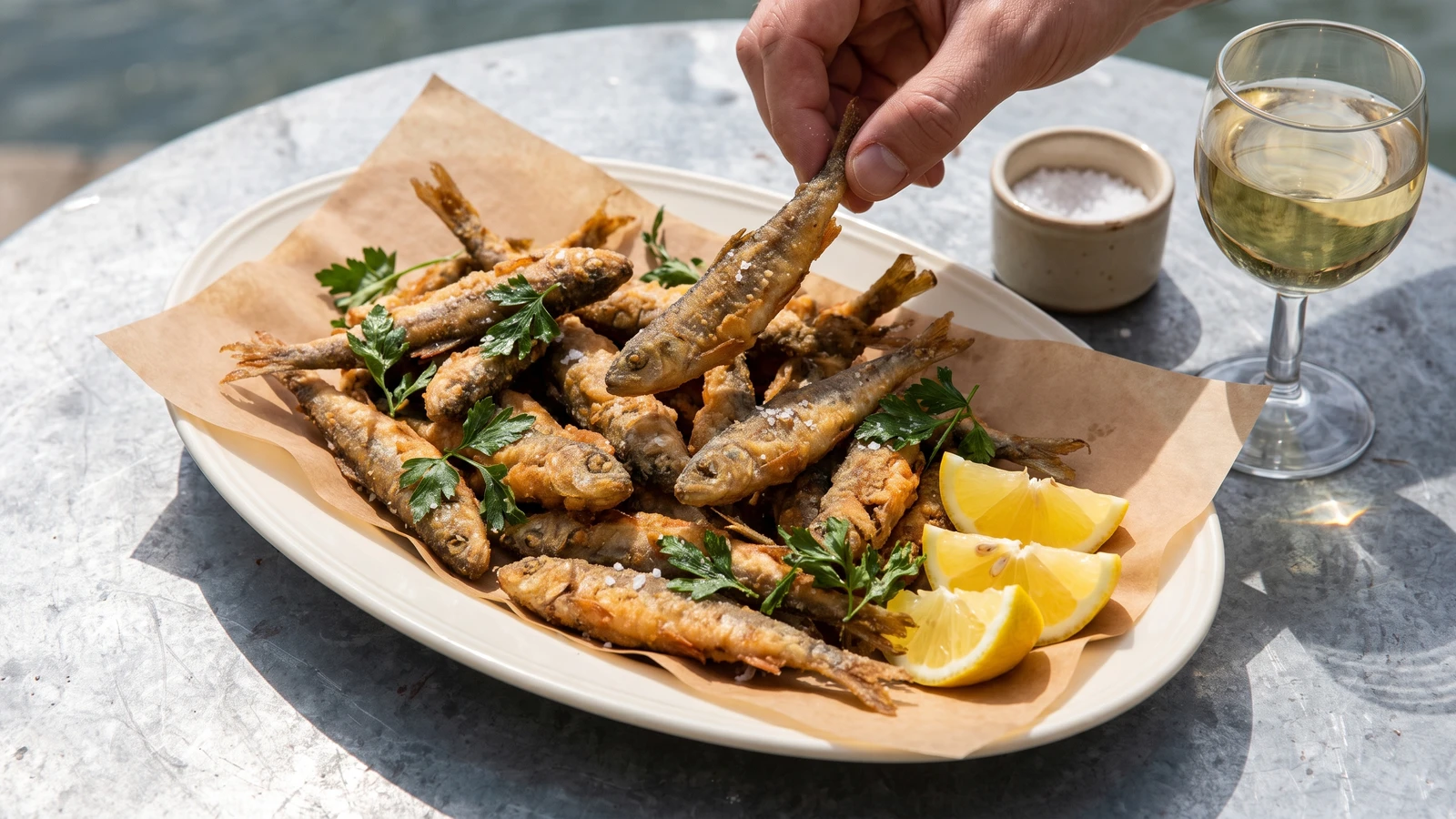
Tiny gudgeon, dried with care and fried whole until deep gold and crisp, teach the clean discipline of friture: dry fish, properly heated oil, small batches, and lemon only at the table.
Friture de goujons (whole-fried gudgeon) teaches the cleanest rule in frying: water and hot fat do not negotiate. The fish must be dry enough that fresh paper comes away clean, then the coating stays whisper-thin and the little bodies crisp before their delicate flesh dries. That is the one true thing to know before you touch the pan.
The old entry offers no recipe, proportions, or brigade apparatus. It notes that gudgeon teem in rivers and calls them uneaten, but French riverside cooks answered abundance with friture. No saucier on staff, stockpot kept warm, or salamander is hidden behind this dish. For the home stove, a heavy pot and thermometer replace the professional frying station, and 1¾ pounds of fish feeds four. The great vat and the hands assigned to drain each batch were scaffolding. Dry fish, stable heat, and small batches are the dish.
Done well, the platter is all deep-gold fish, crisp tails, tender white flesh, fried parsley, and lemon waiting at the edge so it cannot soften the crust. One cook, one stove, one evening. Dry the goujons completely before you flour them; that single step decides the platter.
Friture de goujons belongs to French riverside tables, from the guinguettes of the Seine and Marne to inns along the Saône, where the smallest freshwater catch moved directly from basket to flour to frying fat. The word goujon names the fish, while friture names both the method and, at such tables, the mixed basket of little river fish served crisp. The claim that gudgeon is "never eaten" reflects English neglect rather than French practice; in France, its abundance made it precisely the fish for an unpretentious meal beside the water.
Quantity
1¾ lb (800 g)
each about 3 to 5 inches (8 to 12 cm), scaled, gutted, and gills removed
Quantity
1 cup (240 ml / 125 g)
Quantity
1½ teaspoons (7.5 ml / 9 g)
divided
Quantity
½ teaspoon (2.5 ml / 1 g)
Quantity
6 cups (1.5 L / 1.4 kg)
for deep-frying
Quantity
1 loosely packed cup (240 ml / 30 g)
washed and dried completely
Quantity
2
cut into wedges
| Ingredient | Quantity |
|---|---|
| whole gudgeoneach about 3 to 5 inches (8 to 12 cm), scaled, gutted, and gills removed | 1¾ lb (800 g) |
| all-purpose flour | 1 cup (240 ml / 125 g) |
| fine sea saltdivided | 1½ teaspoons (7.5 ml / 9 g) |
| freshly ground white pepper | ½ teaspoon (2.5 ml / 1 g) |
| refined peanut or sunflower oilfor deep-frying | 6 cups (1.5 L / 1.4 kg) |
| flat-leaf parsley leaves and tender sprigswashed and dried completely | 1 loosely packed cup (240 ml / 30 g) |
| lemonscut into wedges | 2 |
If the gudgeon are not already prepared, scrape away the scales from tail to head, open each belly with the tip of a small knife, and remove the innards and gills without tearing the fish apart. Rinse them briefly in a bowl of cold water, drain, then dry the cavities and skins thoroughly with clean towels. Arrange them uncovered on a wire rack for 15 minutes. Press one with fresh paper before proceeding; if the paper lifts damp, dry the fish again. Water makes the flour pasty, spits in the oil, and prevents a crisp skin.
Heat the oven to 200°F (95°C) and place a wire rack over a rimmed sheet pan inside. Pour the oil into a 5-quart (4.7 L) heavy pot, leaving the pot no more than half full, and heat it to 355°F (180°C). Keep the thermometer clipped in place and a fitted lid nearby. Never leave the oil unattended, and never use water on burning fat; cover the pot and turn off the heat.
Season the gudgeon with 1 teaspoon (5 ml / 6 g) of the salt and all the white pepper. Put the flour in a shallow dish, then coat only enough fish for the first batch. Shake each one firmly so only a fine veil remains; loose flour burns in the pot and a heavy coat turns pasty. If the flour clumps on contact, brush it away, dry the fish again, and recoat it just before frying.
Lower the fish carefully into the oil with a wire skimmer, adding only enough to form a loose single layer. Keep the oil between 345°F and 355°F (175°C and 180°C), moving the fish gently so they do not cling together. Fry for 3 to 4 minutes, until deep gold, rigid enough to lift straight, and crisp through the fins. Break open the thickest fish from the first batch: the flesh must be opaque at the backbone and reach 145°F (63°C) if it is large enough to test. Drain on the rack, season with some of the remaining salt, and hold in the oven for no longer than 10 minutes. If a batch emerges pale and limp because the oil fell below 340°F (170°C), lift it out, return the oil to 355°F (180°C), and refry it for 30 to 45 seconds. Ça se rattrape.
When all the fish are cooked, check the parsley once more for moisture. Lower a small handful into the 345°F (175°C) oil inside the wire skimmer and cover with a splatter screen. Fry for 8 to 12 seconds, just until the sputtering subsides and the leaves turn crisp and dark green, then drain on the rack. Parsley carrying even a little water can spit violently, so if a towel shows dampness, dry it again before it approaches the pot.
Heap the goujons on a warm platter, scatter over the fried parsley, and set the lemon wedges alongside. Squeeze lemon only over the fish you are about to eat, because acid quickly softens the crust. The smallest gudgeon may be eaten whole when their backbones have crisped; with larger specimens, lift the flesh from the backbone at the table. Serve immediately. À table!
1 serving (about 250g)
Culinary guides, cultural storytelling, and the editorial depth that makes cooking meaningful.
Discover Culinary ExplorerChef Juliette
John Dory has the delicacy of sole and the firmness of turbot. A light flouring, a quick butter sauté, and nut-brown beurre noisette show exactly why looks never mattered.

Chef Juliette
Fresh haddock proves its delicacy in the meunière pan: a fine flour crust, moist pearly flakes, and beurre noisette sharpened with lemon and parsley, ready from one skillet in half an hour.

Chef Juliette
Éperlans à l’Anglaise turns small fish into a lesson in disciplined coating: boned smelts under a close, crisp crumb, pan-fried in clarified butter and finished with bright, half-melted maître d’hôtel butter.

Chef Juliette
Tiny smelts, shallot, mushrooms, white wine, gratin sauce, and fine bread raspings meet a fierce oven, where the fish must turn tender in the same breath the buttered crust bronzes.