
Chef Juliette
Shad
Alose grillée teaches the discipline of fire: score the famously bony fish close to the backbone, grill it over steady coals, and finish its rich flesh with parsley-lemon butter.
A cooking platform built around craft, culture, and the stories behind what we eat.
Created by Chef Juliette
Based on No. 759, Sturgeon, from Le Guide Culinaire (1907) by Auguste Escoffier
Esturgeon braisé treats a rare, meaty fish with the patience given to veal: browned in butter, basted gently, and finished with a glossy sauce drawn from its own braising liquor.
Esturgeon braisé (braised sturgeon) teaches one clear principle: sturgeon behaves like a small roast, not a tender fillet. Its dense flesh welcomes browning, a covered braise, and repeated basting, but that strength isn't permission to boil it. Gentle heat leaves the slices succulent and close-grained beneath a sauce tasting of butter, white wine, and the fond from the pan.
The classical entry assumes a saucier, stock never off the fire, and a fish large enough to feed a room. For four, one tied loin goes into a wide covered sauté pan, while good unsalted chicken stock stands in honestly for a household veal stockpot. Repeated straining and prolonged holding were brigade scaffolding, so they go. Browning, basting, reduction, and the final butter emulsion are the dish itself, so they stay. One cook, one stove, one evening.
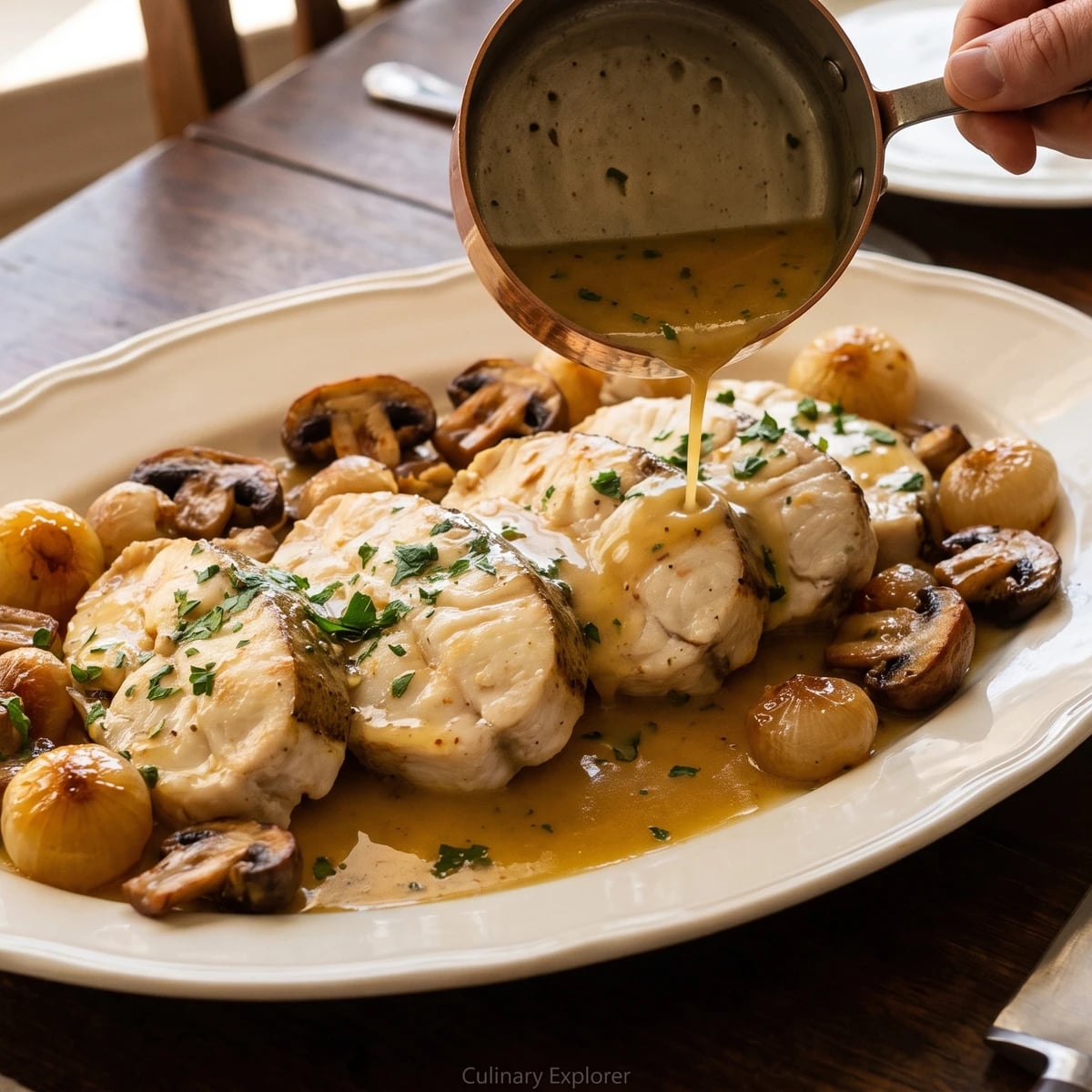
Bring the esturgeon to the table sliced thickly, surrounded by glazed onions and bronze-edged mushrooms, with the sauce pooling rather than painted. Keep the braising liquid at a bare tremble and baste from the pan every few minutes; that gentle, repeated basting is the step that decides the dish.
Sturgeon entered the French larder through the Atlantic estuaries and great rivers, especially the Gironde basin around Bordeaux, where the European sturgeon was prized for generations. In the classical national repertoire, its dense flesh moved from the river market to the grand table and was treated like veal, browned and braised in a large piece rather than poached like a tender flatfish. Its rarity remains real, so a responsible cook uses farmed sturgeon and leaves protected wild fish in the river.
Quantity
1 loin, 2¼ pounds (1 kg)
skin and dark bloodline removed, tied at 1½-inch intervals
Quantity
1½ teaspoons (7.5 ml / 9 g)
divided
Quantity
½ teaspoon (2.5 ml / 1 g)
Quantity
8 tablespoons (120 ml / 113 g)
divided, with 3 tablespoons chilled and cubed
Quantity
4 thin slices (70 g)
Quantity
1 medium (100 g)
cut into small dice
Quantity
1 small (120 g)
cut into small dice
Quantity
1 rib (50 g)
cut into small dice
Quantity
1 large (50 g)
finely sliced
Quantity
1 cup (240 ml / 240 g)
Quantity
2 cups (480 ml / 480 g)
warmed and divided
Quantity
1
Quantity
12 small (180 g)
peeled
Quantity
12 small (225 g)
halved
Quantity
1 tablespoon (15 ml / 15 g)
Quantity
2 tablespoons (30 ml / 8 g)
finely chopped
| Ingredient | Quantity |
|---|---|
| center-cut farmed sturgeon loinskin and dark bloodline removed, tied at 1½-inch intervals | 1 loin, 2¼ pounds (1 kg) |
| fine sea saltdivided | 1½ teaspoons (7.5 ml / 9 g) |
| finely ground white pepper | ½ teaspoon (2.5 ml / 1 g) |
| unsalted butterdivided, with 3 tablespoons chilled and cubed | 8 tablespoons (120 ml / 113 g) |
| unsmoked bacon or salt pork belly | 4 thin slices (70 g) |
| carrotcut into small dice | 1 medium (100 g) |
| yellow onioncut into small dice | 1 small (120 g) |
| celerycut into small dice | 1 rib (50 g) |
| shallotfinely sliced | 1 large (50 g) |
| dry white wine | 1 cup (240 ml / 240 g) |
| unsalted light chicken stockwarmed and divided | 2 cups (480 ml / 480 g) |
| bouquet garni of parsley stems, thyme, and bay leaf | 1 |
| pearl onionspeeled | 12 small (180 g) |
| button or cremini mushroomshalved | 12 small (225 g) |
| fresh lemon juice | 1 tablespoon (15 ml / 15 g) |
| flat-leaf parsleyfinely chopped | 2 tablespoons (30 ml / 8 g) |
Heat the oven to 325°F (165°C). Pat the sturgeon completely dry, then season it with 1 teaspoon of the salt and all the white pepper. Tie the loin at 1½-inch intervals so its thickness stays even, and leave it at room temperature for 20 minutes. An untied tapered loin cooks at two speeds; tying is simple but decisive.
Melt 2 tablespoons of the butter in a wide ovenproof sauté pan over medium heat. Add the mushrooms in one uncrowded layer and brown them until their cut faces turn bronze, then lift them out. Add the pearl onions with ¼ cup of the measured stock and a pinch of the measured salt. Cover for 6 minutes, then uncover and roll them through the reducing liquid until tender and glazed. Set the onions beside the mushrooms.
Melt another 2 tablespoons of butter in the same pan. When its foam subsides, add the sturgeon and brown it over medium heat, turning carefully until every broad surface is golden, about 6 minutes in all. Lift it out without disturbing the brown film underneath. That film is the fond, and the sauce needs every bit of it.
Add 1 tablespoon of butter, then the carrot, yellow onion, celery, shallot, and remaining salt. Cook gently for 6 to 8 minutes, until softened and lightly colored. Pour in the wine and scrape the pan clean with a wooden spoon, then boil until the wine is reduced by half. Add the remaining stock and bouquet garni, and bring the liquid only to a bare simmer. Set the sturgeon on the aromatic vegetables, lay the bacon across its top, and cover the pan.
Transfer the covered pan to the oven and braise for 25 to 35 minutes, opening it every 8 minutes to spoon the liquid over the sturgeon. Begin checking early and remove the fish when its center reaches 140°F (60°C); it will rise to 145°F (63°C) while resting. The liquid should barely tremble. If it begins boiling hard, pull the pan from the oven for 2 minutes, lower the heat to 300°F (150°C), and continue gently. Ça se rattrape if you catch it there; prolonged boiling will dry even this sturdy fish.
Lift the sturgeon onto a warm platter, remove the bacon and twine, and cover the fish loosely. Strain the braising liquid into a small saucepan, pressing the vegetables gently, then skim away excess surface fat. Boil until reduced to about 1 cup and nappant, thick enough to coat the back of a spoon. Take the pan off the heat and whisk in the 3 tablespoons of chilled butter, one cube at a time, followed by the lemon juice. If the sauce separates into greasy beads, put 1 tablespoon of cold water in a clean pan and whisk in the broken sauce little by little. Ça se rattrape. Fold in the mushrooms and pearl onions, then taste for salt.
Cut the esturgeon crosswise into four thick portions and arrange them on the warm platter. Spoon the mushrooms and pearl onions around the fish, pour over enough sauce to glaze each slice generously, and bring the rest in a warm sauceboat. Finish with the chopped parsley. Cooking well is not cooking fancy. À table!
1 serving (about 410g)
Culinary guides, cultural storytelling, and the editorial depth that makes cooking meaningful.
Discover Culinary Explorer
Chef Juliette
Alose grillée teaches the discipline of fire: score the famously bony fish close to the backbone, grill it over steady coals, and finish its rich flesh with parsley-lemon butter.

Chef Juliette
Fresh Mediterranean anchovies, left whole, dried with care, and sent to fierce heat until crisp at the edges and tender within, with lemon waiting at the table.

Chef Juliette
Petites anguilles à la meunière turn the source's plain instruction to fry small eels into supper: crisp flour-dusted edges, rich sweet flesh, and beurre noisette sharpened with lemon.

Chef Juliette
Whole pike takes its blue-grey sheen beneath hot vinegar, poaches gently in court-bouillon, and reaches the table with a caper sauce mounted in cold butter, a river fish treated with discipline, not fuss.