
Chef Juliette
John Dory (St. Pierre)
John Dory has the delicacy of sole and the firmness of turbot. A light flouring, a quick butter sauté, and nut-brown beurre noisette show exactly why looks never mattered.
A cooking platform built around craft, culture, and the stories behind what we eat.
Created by Chef Juliette
Based on No. 754, Fresh Anchovies, from Le Guide Culinaire (1907) by Auguste Escoffier
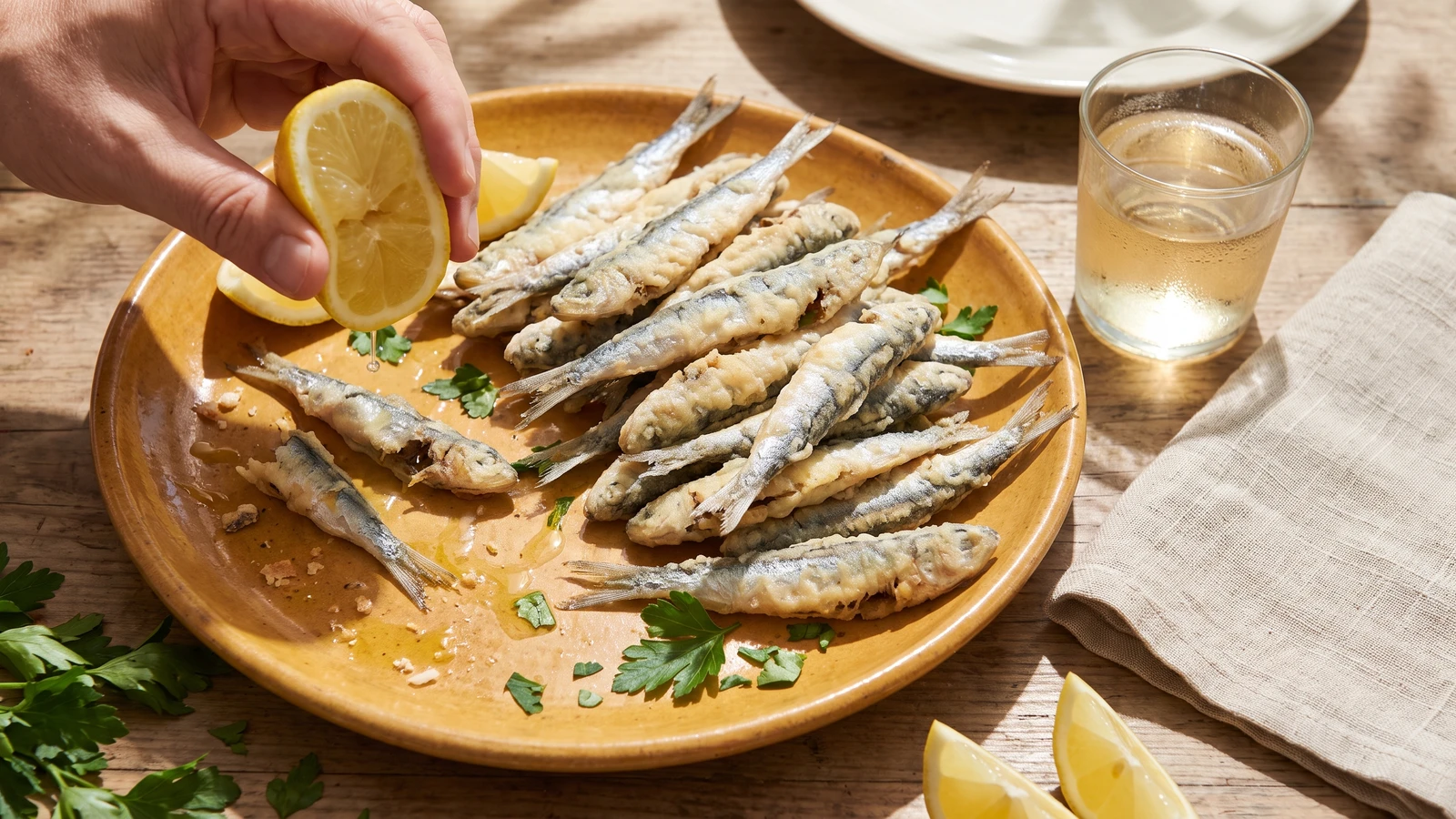
Fresh Mediterranean anchovies, left whole, dried with care, and sent to fierce heat until crisp at the edges and tender within, with lemon waiting at the table.
Anchois frais (fresh anchovies) teach the first law of small-fish cookery: the surface must be dry before it meets fierce heat. Get that right and the skin turns crisp while the flesh stays rich and tender. Leave the fish damp and even excellent anchovies emerge pale and soft.
The old entry assumed a Mediterranean fish market, hands at the fish station to clean the catch, and either a grill or a frying bath already hot. Its scaffolding was manpower and always-ready equipment. At home, the fishmonger cleans thirty-two fish, a deep skillet replaces the frying bath, and a grill basket keeps delicate bodies intact over the fire. The measured flour and oil make the book's brief instruction usable for four people; no stock, built sauce, or saucier belongs here because any of them would bury the catch. One cook, one stove, one evening.
Frying gives a fine golden shell; grilling leaves the skin bronzed and the flesh more plainly itself. Both honor the entry, and neither forgives delay once cooked. Before you touch the heat, dry every anchovy inside and out. That is the step that decides the dish.
Anchois frais belong to the Mediterranean ports of Provence and the Côte d’Azur, where the catch could move from boat to grill or frying pan before its delicate flesh softened. Inland France knew anchovies chiefly salted or packed in oil because preservation, not seasoning, made the fish travel. Fresh anchovies are not merely cured anchovies awaiting salt: cooked whole, they are mild and rich, close cousins to the other petits poissons served along the Mediterranean coast.
Quantity
32 (about 1½ lb / 680 g; 4 to 5 inches / 10 to 13 cm long)
gutted but left whole
Quantity
1 teaspoon (5 ml / 6 g)
divided
Quantity
½ teaspoon (2.5 ml / 1 g)
Quantity
¾ cup (180 ml / 90 g)
for frying
Quantity
3 cups (720 ml / 660 g)
for frying
Quantity
2 tablespoons (30 ml / 27 g)
for grilling
Quantity
2
one halved and one cut into wedges
Quantity
¼ cup (60 ml / 15 g)
roughly chopped
| Ingredient | Quantity |
|---|---|
| small fresh anchoviesgutted but left whole | 32 (about 1½ lb / 680 g; 4 to 5 inches / 10 to 13 cm long) |
| fine sea saltdivided | 1 teaspoon (5 ml / 6 g) |
| freshly ground black pepper | ½ teaspoon (2.5 ml / 1 g) |
| all-purpose flour (optional)for frying | ¾ cup (180 ml / 90 g) |
| refined olive oil (optional)for frying | 3 cups (720 ml / 660 g) |
| extra-virgin olive oil (optional)for grilling | 2 tablespoons (30 ml / 27 g) |
| lemonsone halved and one cut into wedges | 2 |
| flat-leaf parsley leavesroughly chopped | ¼ cup (60 ml / 15 g) |
Ask the fishmonger to remove the gills and viscera while leaving each anchovy whole through the backbone; the heads may remain if you like their handsome look on the platter. If cleaning them yourself, open each belly with the tip of a small knife, remove the innards and gills, and rinse only when necessary. Handle them gently. Fresh anchovy flesh bruises under an impatient thumb.
Lay the cleaned anchovies between clean kitchen towels and blot the bellies as carefully as the skins. Transfer them to a rack and refrigerate uncovered for twenty minutes, then blot once more. Do not salt yet, because salt draws water back to the surface. Dry fish browns; wet fish softens. This is the dish.
For anchois frais frits, pour the refined olive oil into a deep 10-inch / 25 cm skillet and heat it to 350°F / 180°C. Set a wire rack over a tray beside the stove. For anchois frais grillés, heat a grill, plancha, or broiler-safe cast-iron pan until fiercely hot, then oil a fish basket or the pan lightly. The high heat cooks these small fish before their flesh has time to dry.
For the fried method, mix the flour with ¾ teaspoon (3.75 ml / 4.5 g) of the salt and the pepper. Fariner, coat lightly in flour, six anchovies at a time, shaking away every loose trace, then lower them into the oil away from you. Fry without crowding for 2 to 3 minutes, turning once, until fine-bubbled, pale gold, and crisp at the fins. Drain on the rack and restore the oil to 350°F / 180°C before the next batch. If a batch emerges pale and limp, the oil cooled too far. Ça se rattrape: reheat it fully and return those fish for 20 to 30 seconds, just until the crust firms.
For the grilled method, coat the anchovies with the extra-virgin olive oil, then season with the remaining salt and the pepper. Arrange them in a single layer in the fish basket or on the hot pan and cook for about 2 minutes per side, until the skins are bronze, the bellies opaque, and the fish release cleanly. If they cling, do not tug. Give them another 20 seconds, then ease a thin spatula underneath; the browned skin releases when it is ready.
Pile the anchois frais loosely on a warm platter and squeeze the halved lemon lightly over them. Scatter with the parsley and bring the remaining lemon wedges to the table. Serve at once, while fried anchovies still crackle delicately at the fins or grilled ones retain their bronzed skins. Waiting is the only finishing sauce that ruins them. À table!
1 serving (about 180g)
Culinary guides, cultural storytelling, and the editorial depth that makes cooking meaningful.
Discover Culinary ExplorerChef Juliette
John Dory has the delicacy of sole and the firmness of turbot. A light flouring, a quick butter sauté, and nut-brown beurre noisette show exactly why looks never mattered.

Chef Juliette
Fresh haddock proves its delicacy in the meunière pan: a fine flour crust, moist pearly flakes, and beurre noisette sharpened with lemon and parsley, ready from one skillet in half an hour.

Chef Juliette
Éperlans à l’Anglaise turns small fish into a lesson in disciplined coating: boned smelts under a close, crisp crumb, pan-fried in clarified butter and finished with bright, half-melted maître d’hôtel butter.

Chef Juliette
Tiny smelts, shallot, mushrooms, white wine, gratin sauce, and fine bread raspings meet a fierce oven, where the fish must turn tender in the same breath the buttered crust bronzes.