Chef Juliette
Bouillabaisse à la Marseillaise
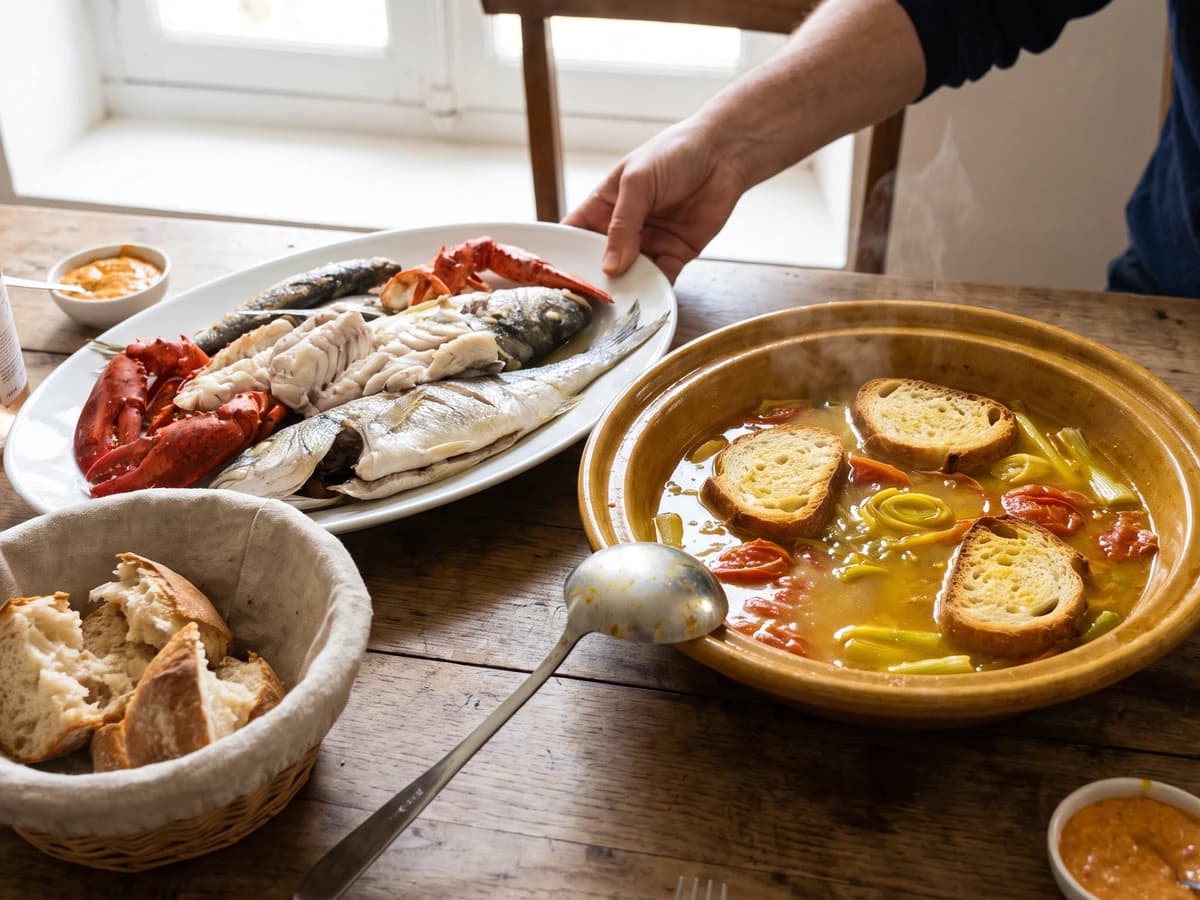
Marseille's great fish stew, saffron-gold and garlic-scented, proves that a hard boil can be the careful choice: it binds olive oil into broth before the whole pot meets bread.
A cooking platform built around craft, culture, and the stories behind what we eat.

Created by Chef Juliette
Based on No. 736, Potage de Santé, from Le Guide Culinaire (1907) by Auguste Escoffier
Potage de Santé turns sieved potato, white consommé, butter-melted sorrel, and a gentle liaison into a pale, restorative soup whose silk depends on one rule: once the yolks enter, it must never boil.
Potage de Santé (the health soup) teaches the gentle discipline behind every cream-bound potage: once the liaison, the yolk-and-cream binding, goes in, the soup must never boil. Keep that one truth before you touch the pan and the reward is silken potato, the clean acidity of sorrel, and butter gleaming at the rim. C'est la même grammaire: heat gives body, restraint keeps it smooth.
The source formula assumed a stock never off the fire, a fine tamis, and enough hands to manage the potatoes, sorrel, and liaison separately. At home, prepared white consommé, a sturdy fine-mesh sieve, and two saucepans do the same work. The little service formula has been doubled proportionally to make about two quarts. Separate holding pans are brigade scaffolding and can go; sieving the potato, melting the sorrel in butter, and finishing off the heat with liaison and butter are the dish, so they stay. One cook, one stove, one evening.
Press the potatoes through while they're still hot, because cooling sets their starch and makes the purée heavy. Then give the final liaison your full attention: temper it slowly, return it over the gentlest heat, and never permit a boil.
Potage de Santé sits in the classical French potage repertoire rather than belonging to a single province; its clearest home is the cuisine bourgeoise refined in Parisian kitchens, where gentle purées served as restorative suppers. Its name is practical, not a medical claim: potatoes supplied body, sorrel brought a tart green edge, and an ordinary liaison made the bowl sustaining. The grand kitchen added white consommé, fine sieving, flute roundels, and chervil pluches, but the method remained domestic in spirit.
Quantity
6 medium (about 1¾ lb / 800 g)
peeled and quartered
Quantity
2 quarts (1.9 L / 1.9 kg)
for boiling
Quantity
1 tablespoon (15 ml / 18 g)
for the potato water, plus only if needed at the finish
Quantity
6 cups (1.42 L / 1.42 kg)
Quantity
¼ cup tightly packed (60 ml / 25 g)
finely shredded
Quantity
1 tablespoon (15 ml / 14 g)
for melting the sorrel
Quantity
4
Quantity
¾ cup (180 ml / 180 g)
for the ordinary liaison
Quantity
2 tablespoons (30 ml / 30 g)
only if needed to rescue the liaison
Quantity
4 tablespoons (60 ml / 57 g)
cut into small cubes
Quantity
1 long crisp roll (about 4 oz / 115 g)
cut into 24 very thin roundels
Quantity
2 tablespoons loosely packed (30 ml / 4 g)
picked into delicate shreds
| Ingredient | Quantity |
|---|---|
| floury potatoespeeled and quartered | 6 medium (about 1¾ lb / 800 g) |
| cold waterfor boiling | 2 quarts (1.9 L / 1.9 kg) |
| fine sea saltfor the potato water, plus only if needed at the finish | 1 tablespoon (15 ml / 18 g) |
| prepared white consommé, preferably chicken | 6 cups (1.42 L / 1.42 kg) |
| fresh sorrel leavesfinely shredded | ¼ cup tightly packed (60 ml / 25 g) |
| unsalted butterfor melting the sorrel | 1 tablespoon (15 ml / 14 g) |
| large egg yolks | 4 |
| heavy creamfor the ordinary liaison | ¾ cup (180 ml / 180 g) |
| cold heavy cream (optional)only if needed to rescue the liaison | 2 tablespoons (30 ml / 30 g) |
| cold unsalted buttercut into small cubes | 4 tablespoons (60 ml / 57 g) |
| French soup-flutecut into 24 very thin roundels | 1 long crisp roll (about 4 oz / 115 g) |
| fresh chervil pluchespicked into delicate shreds | 2 tablespoons loosely packed (30 ml / 4 g) |
Bring the water and salt to a brisk boil in a heavy saucepan. Add the quartered potatoes, return the water quickly to the boil, and cook uncovered at a steady pace for 15 to 18 minutes. They're ready when a knife passes through the centre without resistance and the corners begin to soften, but before the pieces collapse into the water. Drain thoroughly and leave them in the hot colander for 2 minutes so excess moisture escapes.
Set a sturdy fine-mesh sieve over the cleaned saucepan and press the hot potatoes through with a flexible scraper. Work in small amounts, scraping the underside of the sieve as the fine purée gathers there. Don't use a food processor or immersion blender; fast blades overwork potato starch and turn this delicate soup elastic. If the potatoes cool and resist the sieve, warm them gently over a pan of hot water before continuing.
Warm the white consommé in the second saucepan. Whisk one cup into the potato purée until completely smooth, then add the remainder in several additions. This gradual dilution prevents small lumps from escaping into the finished soup. Bring it to a bare simmer for 4 to 5 minutes, stirring along the bottom. It should pour like light cream and coat a spoon thinly; if it seems loose, correct it now with another minute of gentle simmering, because reducing after the liaison is added risks curdling it.
Melt the tablespoon of butter in the emptied consommé saucepan over medium-low heat. Add the shredded sorrel and turn it through the butter for 2 to 3 minutes, until it collapses into a soft, dark green tangle and its raw sharpness mellows. It will lose its bright colour. This looks alarming and is exactly right. Fold the buttered sorrel through the simmering potato base, then lower the heat.
Whisk the egg yolks and ¾ cup cream together in a heatproof bowl. Remove the soup from the heat, then whisk about 1 cup of it into the liaison in a thin stream. Pour the tempered liaison back into the saucepan while whisking constantly. Return the pan to the lowest heat and stir for 2 to 3 minutes, until the soup reaches about 165°F (74°C), gains a little body, and shows no bubbles. If fine grains appear, lift the pan off the heat at once and whisk in the 2 tablespoons of cold rescue cream. Ça se rattrape: pass the soup through a clean fine sieve and do not return it to the boil.
Keep the saucepan off the heat. Monter au beurre, finish by whisking in the cold butter, one cube at a time, letting each disappear before adding the next. The finished surface should look smooth and carry a quiet butter sheen, never an oily slick. Taste before adding more salt, since a properly seasoned white consommé may have supplied all the soup needs. If the potage has tightened too far, loosen it with a tablespoon of hot water at a time.
Ladle the potage into warm soup plates. Float three very thin French soup-flute roundels on each serving and scatter over the chervil pluches. Serve immediately while the bread remains crisp and the liaison is at its silkiest. À table!
1 serving (about 265g)
Culinary guides, cultural storytelling, and the editorial depth that makes cooking meaningful.
Discover Culinary ExplorerChef Juliette
Marseille's great fish stew, saffron-gold and garlic-scented, proves that a hard boil can be the careful choice: it binds olive oil into broth before the whole pot meets bread.
Chef Juliette
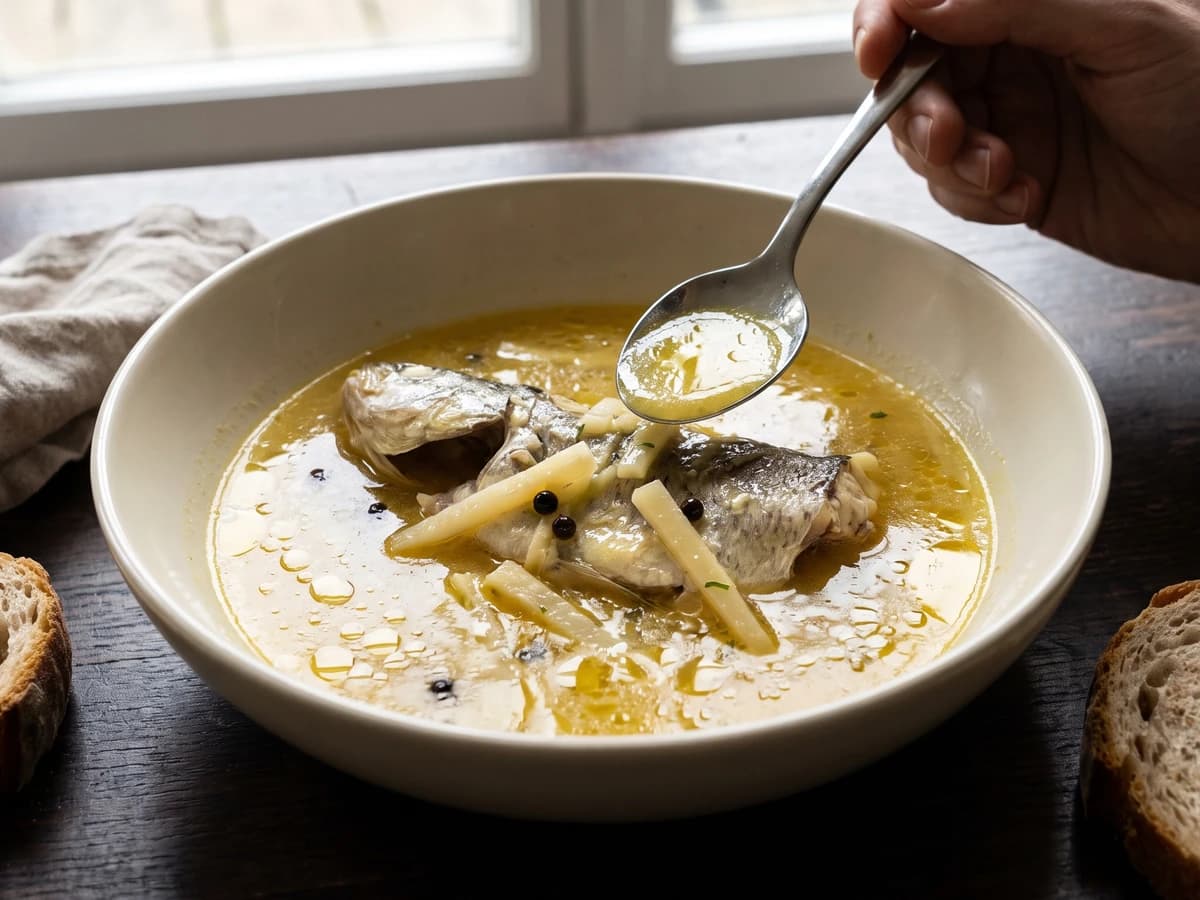
Waterzoi asks fresh, bone-in river fish to thicken its own buttery broth, with parsley root and pepper for company. No flour, no stockpot, just a brisk simmer watched closely.
Chef Juliette
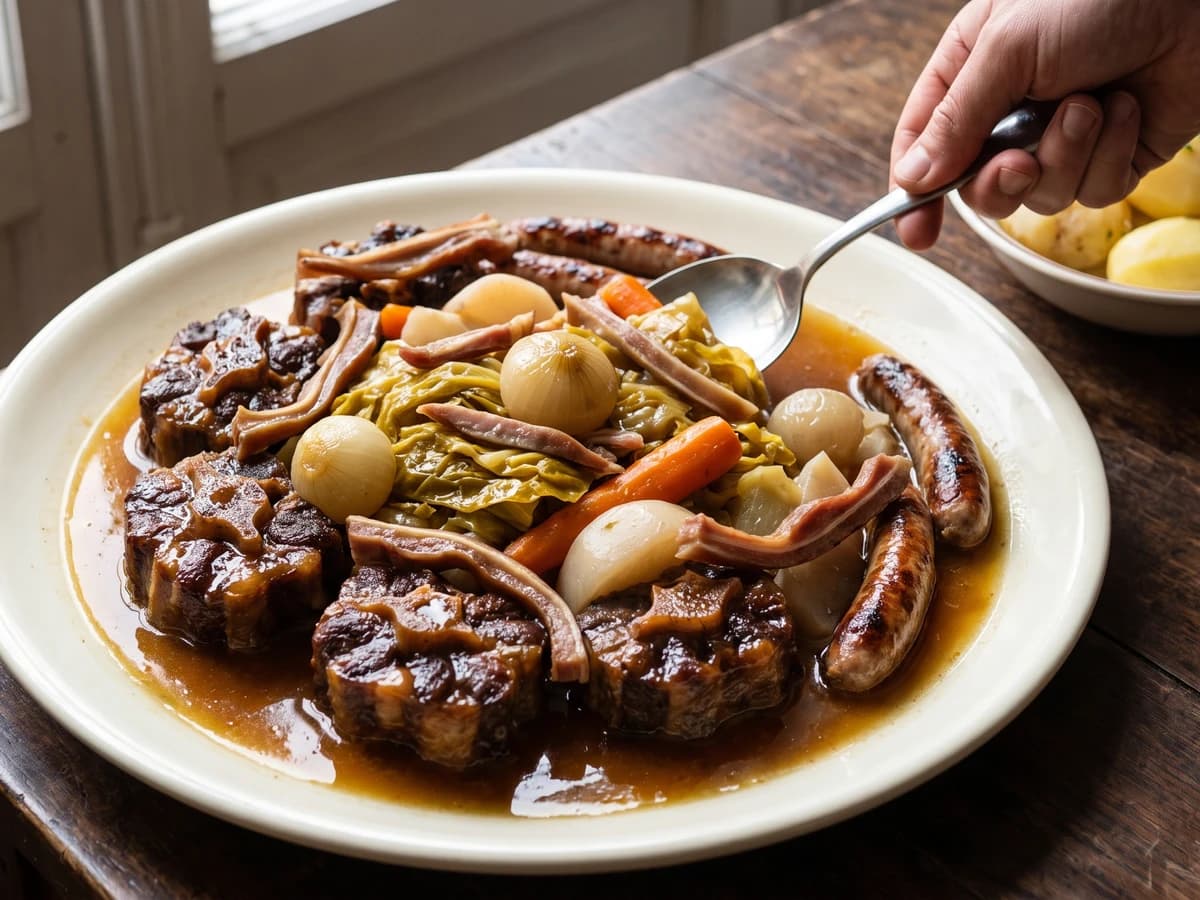
Queue de Bœuf en Hochepot gathers oxtail, pig's trotter and ear, cabbage, roots, and grilled chipolatas around a clear, gelatin-rich broth whose quiet simmer keeps every piece tender and distinct.
Chef Juliette
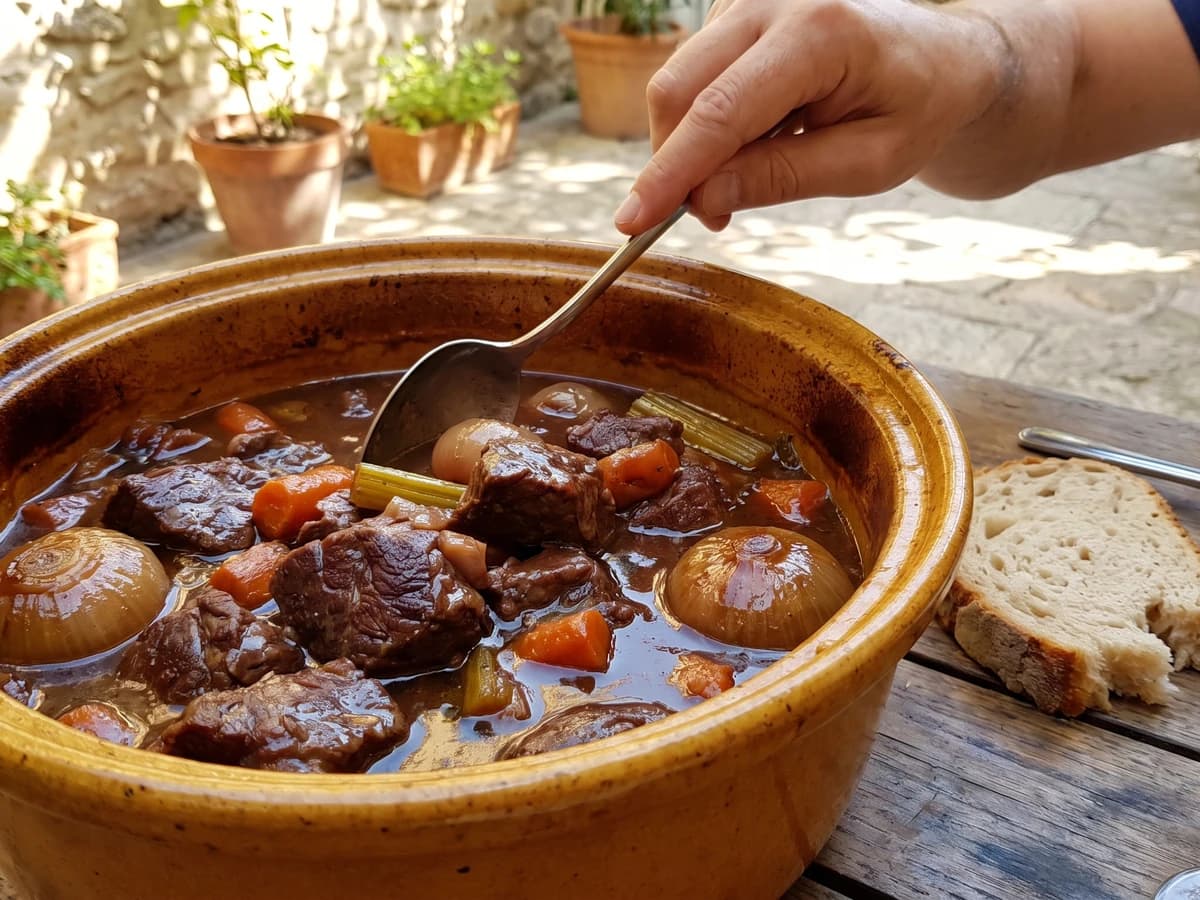
Beef shoulder larded with bacon, sharpened by red wine and vinegar, then sealed with garlic, vegetables, and dry lemon peel until the low oven turns it yielding and the gravy darkly glossy.