Culinary Explorer

A cooking platform built around craft, culture, and the stories behind what we eat.
Discover Culinary Explorer
Potage Miss Betsy

Potage Miss Betsy

Created by Chef Juliette

Based on No. 730, Potage Miss Betsy, from Le Guide Culinaire (1907) by Auguste Escoffier

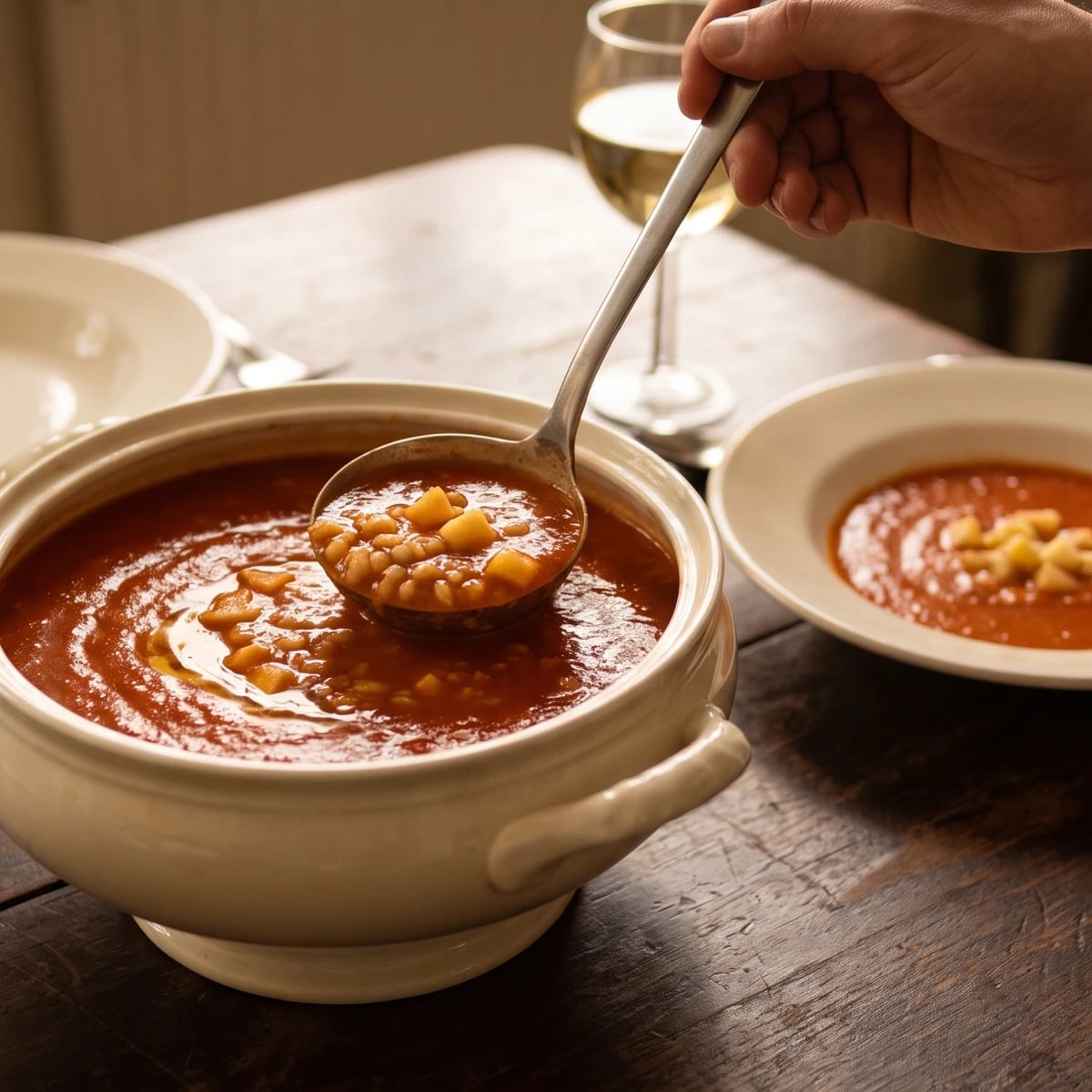
A loose, tomato-red barley potage scented with curry and finished with butter-glossed apple dice, proof that one classical base can change character without losing its structure.

Soups & Stews
French
Comfort Food
Dinner Party
10 min
Active Time
20 min cook30 min total
YieldAbout 2 quarts

Potage Miss Betsy (curried tomato-barley soup with buttered apple) teaches controlled variation. Its parent is Potage à l’Aurore (No. 715); Miss Betsy leaves that finished base intact and changes only its aromatic character and garnish. The one true thing to know before touching a pan is that curry must season the potage without burying it, while the apple remains a distinct garnish rather than dissolving into sauce.

The original formula assumed Potage à l’Aurore (No. 715) already waiting, a saucier within reach, and a stockpot never off the fire. Your equivalent is one completed batch from its own entry and a single saucepan. The formula already makes roughly two quarts, a sensible home pot, so the proportions need no false downsizing. The extra hands and second stewpan are brigade scaffolding that can go; the carefully cooked barley base, measured curry, and apple cooked in real butter are the dish and must stay. One cook, one stove, one evening.

Keep the apple dice pale, butter-glossed, and just tender. Brown or collapse them and their sweetness takes over; hold their shape and they punctuate each spoonful against the tomato, barley, and restrained warmth of curry. That brief cooking in butter is the step that decides the dish.

Potage Miss Betsy belongs to the named potages of the cosmopolitan grand-hotel table between Paris and London, not to the cooking of a single French region. It is a direct variation on Potage à l’Aurore (No. 715), preserving the established base while changing its flavoring and garnish. Curry with apple records the Anglo-Indian influence carried through British dining rooms into classical French kitchens, although the identity of Miss Betsy is less securely recorded than the formula bearing her name.

The technique, the tradition, and the story behind every dish.

Discover Culinary Explorer

Ingredients

Potage à l’Aurore

Quantity

1 batch, about 2 quarts (1.9 L / about 2 kg) Potage à l’Aurore (No. 715)

unsalted butter

Quantity

1½ tablespoons (22.5 ml / 21 g)

divided

firm tart apple, such as Reinette or Granny Smith

Quantity

2 tablespoons (30 ml / 25 g)

peeled, cored, and cut into 5 mm dice

mild curry powder

Quantity

2 teaspoons (10 ml / 4 g)

hot water (optional)

Quantity

Up to ½ cup (120 ml / 120 g)

Equipment Needed

  • 4-quart (3.8 L) heavy saucepan
  • Small heatproof bowl and slotted spoon
  • Whisk and long-handled ladle

Instructions

  1. 1

    Ready the Aurore base

    Stir the finished Potage à l’Aurore (No. 715) gently from the bottom so the barley is evenly distributed. Measure about 1 cup into a jug for tempering the curry and keep the remainder nearby. If the refrigerated base looks very thick, wait until it is warm before judging it; cold barley always appears tighter than it will be at the table.

  2. 2

    Cook the apple dice

    Melt 1 tablespoon of the butter in a heavy saucepan over medium-low heat. Add the apple dice and cook for 3 to 4 minutes, turning gently, until they are butter-glossed and tender at the edges but still hold their neat shape. Do not seek browning. If they begin taking colour before they soften, lower the heat and add 1 teaspoon of the measured water; ça se rattrape. Transfer the apples and their buttery juices to a small bowl.

  3. 3

    Wake the curry

    Melt the remaining butter in the same saucepan over low heat, then add the curry powder. Stir for 20 to 30 seconds, just until its fragrance opens and the butter turns deep gold. Curry burns quickly, so stop before it darkens. If the spice begins catching, pull the pan from the heat and immediately whisk in 2 tablespoons of the reserved Potage à l’Aurore (No. 715); the cool liquid arrests the cooking and smooths the paste.

  4. 4

    Temper and warm

    Whisk the rest of the reserved cup of Potage à l’Aurore (No. 715) into the curry paste in three additions, making each one smooth before adding the next. Stir in the remaining base and warm over medium-low heat for 8 to 10 minutes, scraping the pan floor so no barley settles and catches. Hold the soup at the barest simmer. If it becomes thicker than a loose potage, add hot water a tablespoon at a time; the source is plain that this soup must not be heavy.

  5. 5

    Return the garnish

    Fold in the apple dice with every trace of their butter and warm them for 1 minute without boiling. Taste for balance: tomato and barley should arrive first, curry next, with apple appearing in small sweet, buttery intervals. Ladle into warmed soup plates or bring the potage to the table in a soupière. À table!

Chef Tips

  • The times for this entry begin with finished Potage à l’Aurore (No. 715), exactly as the cross-reference intends. Complete that component first; replacing it with an improvised tomato soup would remove the barley structure that makes Miss Betsy itself.
  • Keep the apple at 2 tablespoons. It replaces the original celery measure for measure, and the modest quantity is deliberate: apple is the garnish, not the body of the soup.
  • The formula names curry but gives no amount. Two teaspoons is a restrained home-scale measure for a fresh, mild blend; an old or weak powder tastes dusty rather than gentle, so replace it instead of adding it by the fistful.
  • No cream and no roux belong here. The barley has already given the potage its body, and further thickening works against the source instruction that the soup remain loose.
  • The source treats Miss Betsy and Aurore as variable members of one family. Once this version is understood, peas with their cooking liquor, French beans, asparagus tips, or buttered sorrel can lead sister potages, but they are not additions to this particular bowl. C’est la même grammaire.
  • For a dinner table, pour a barely off-dry Vouvray. Its apple note meets the garnish, while its acidity keeps pace with tomato and curry.

Advance Preparation

  • Potage à l’Aurore (No. 715) can be completed up to 2 days ahead, cooled promptly, and kept covered in the refrigerator. Stir it from the bottom before measuring because the barley settles.
  • The apple dice may be cooked in butter up to 4 hours ahead and refrigerated separately. Return them only for the final minute of warming so they keep their shape.
  • Finished Potage Miss Betsy keeps for up to 3 days under refrigeration. Reheat it gently and loosen the barley with hot water as needed; a hard boil makes the potage unnecessarily thick.

Frequently Asked Questions

Nutrition Information

1 serving (about 250g)

Calories
275 calories
Total Fat
20 g
Saturated Fat
12 g
Trans Fat
0 g
Unsaturated Fat
7 g
Cholesterol
75 mg
Sodium
760 mg
Total Carbohydrates
17 g
Dietary Fiber
1 g
Sugars
5 g
Protein
6 g

Note: Chef personas and recipes are created with AI assistance. Cook with care: follow safe food-handling practices, check doneness with a thermometer when needed, and adapt for allergies and your kitchen.

Where cooking meets culture.

Culinary guides, cultural storytelling, and the editorial depth that makes cooking meaningful.

Discover Culinary Explorer

More from Soups - Thick Soups

Browse the full collection