
Chef Juliette
Purée de Carottes, otherwise Crécy
Purée de Carottes, otherwise Crécy, turns carrots, butter, rice, and white consommé into a silken soup. The lesson is simple and absolute: blend for smoothness, then sieve for finesse.
A cooking platform built around craft, culture, and the stories behind what we eat.
Created by Chef Juliette
Based on No. 695a, Cold Chicken Velouté for Suppers, from Le Guide Culinaire (1907) by Auguste Escoffier
Strong chicken consommé, white roux, and thin cream become a chilled supper velouté only through patient skimming, two strainings, and a final consistency light enough to leave the palate clean.
Velouté froid de volaille teaches a severe and useful lesson: cold magnifies every trace of grease and every excess of flour. The one truth to know before touching the pan is that this velouté must finish thinner than instinct suggests. It should flow like a thickened consommé, not sit on the tongue like cold sauce.
The original formula assumed a saucier at the pan, a stockpot never off the fire, brigade quantities, and a silk sieve waiting for both strainings. Here, six cups of consommé become the working moistening, three more preserve the original half-volume replenishing ratio, and a final cold cup corrects the body only if needed. A heavy saucepan, measured additions, damp cheesecloth, and an ice bath do the work at home. What changed is the scale and equipment, not the proportions or the method: one cook, one stove, one evening.
The hand-off between separate cooks was brigade scaffolding and can go. The roux blanc, the ninety-minute dépouillement, complete degreasing, cream added only after the first straining, and a second straining when cold are the dish itself. Hold your attention for the last adjustment, because a cold spoon tells the truth the hot pan cannot.
Velouté froid de volaille belongs to the formal supper service of Parisian grand kitchens, where chilled soups were poured into cups as light opening courses rather than carried to the table in a family tureen. It passed naturally into the bourgeois make-ahead repertoire once dependable household chilling made its careful cooling practical beyond a staffed kitchen. Despite the name, it is neither a chicken purée nor a spoon-thick cream soup: it is clarified consommé given restrained body with roux and cream, then refined until no grease or heaviness remains.
Quantity
10 cups (2.4 L / about 2.4 kg)
completely degreased; divide into 6 cups for moistening, 3 cups for replenishing, and up to 1 cup for final thinning
Quantity
3 tablespoons (45 ml / 43 g)
Quantity
6 tablespoons plus 1 teaspoon (95 ml / 50 g)
Quantity
3/4 cup (180 ml / 180 g)
| Ingredient | Quantity |
|---|---|
| very strong, clear chicken consommécompletely degreased; divide into 6 cups for moistening, 3 cups for replenishing, and up to 1 cup for final thinning | 10 cups (2.4 L / about 2.4 kg) |
| unsalted butter | 3 tablespoons (45 ml / 43 g) |
| plain flour | 6 tablespoons plus 1 teaspoon (95 ml / 50 g) |
| very fresh light cream, 18 to 20 percent fat | 3/4 cup (180 ml / 180 g) |
Chill the finished chicken consommé until every trace of fat has set on its surface, then lift that fat away completely. Measure 6 cups (1.4 L) for moistening the roux, place 3 cups (710 ml) in a small saucepan to keep hot for replenishing, and reserve the remaining 1 cup (240 ml) in the refrigerator. Cold reveals grease without mercy, so begin with consommé that looks clear rather than merely skimmed.
Melt the butter in a heavy 4-quart saucepan over gentle heat without letting it colour. Add the flour and stir constantly for 3 minutes to make a roux blanc (white roux). It should become smooth and faintly sandy, with the raw flour smell gone but no golden colour at all; browning would cloud the velouté and change its quiet flavour.
Warm the 6 cups of consommé until just below a simmer. Take the roux blanc off the heat for a minute, then whisk in the first cup of consommé a small ladleful at a time, smoothing each addition before the next. Once the mixture is fluid, whisk in the remainder in a steady stream. Return it to the heat and bring it to a full boil. If lumps appear, don't pour it out. Ça se rattrape: take the pan off the heat, whisk vigorously or use an immersion blender briefly, pass the liquid through a fine-mesh sieve, and return it to the clean pan.
Lower the heat to a steady uncovered simmer and begin the dépouillement, the long removal of foam, flour impurities, and rising fat. Skim the surface with a shallow ladle every few minutes for 1 hour 30 minutes. As the liquid reduces, add the 3 cups of hot consommé gradually, about 1/2 cup (120 ml) at a time, keeping the level near its starting point. Avoid a violent boil, which churns the impurities back through the soup. If the surface becomes cloudy, lower the heat, leave it untouched for two minutes, and skim again once the foam gathers. The long dépouillement is the dish, not brigade ceremony, and it must stay.
Dampen two layers of cheesecloth with cold water, wring them well, and use them to line a fine-mesh sieve over a large heatproof metal bowl. Pour the velouté through without pressing or scraping. This replaces the silk sieve of the grand kitchen honestly. Stir in the fresh light cream until the colour is even and the surface carries a quiet ivory sheen.
Set the bowl into a larger bowl filled generously with ice and cold water. Stir slowly but continuously with a flexible spatula, sweeping the bottom and sides, until the velouté is fully cold, ideally 40°F (4°C), refreshing the ice as needed. Continuous stirring prevents a skin, keeps the roux and cream evenly suspended, and cools the soup safely. If a skin begins to form, lift it away, whisk the surface gently, and keep stirring; the second straining will catch what remains.
Pass the cold velouté through a freshly rinsed, cheesecloth-lined sieve a second time. Test it from a cold spoon: it should pour in a clean ribbon and leave only a sheer film, with the body of thickened consommé rather than cream soup. If it coats the tongue or pastes the mouth, stir in the reserved cold consommé 1 tablespoon (15 ml) at a time, testing after each addition. You may not need all of it. This cold adjustment is the one step that decides the dish.
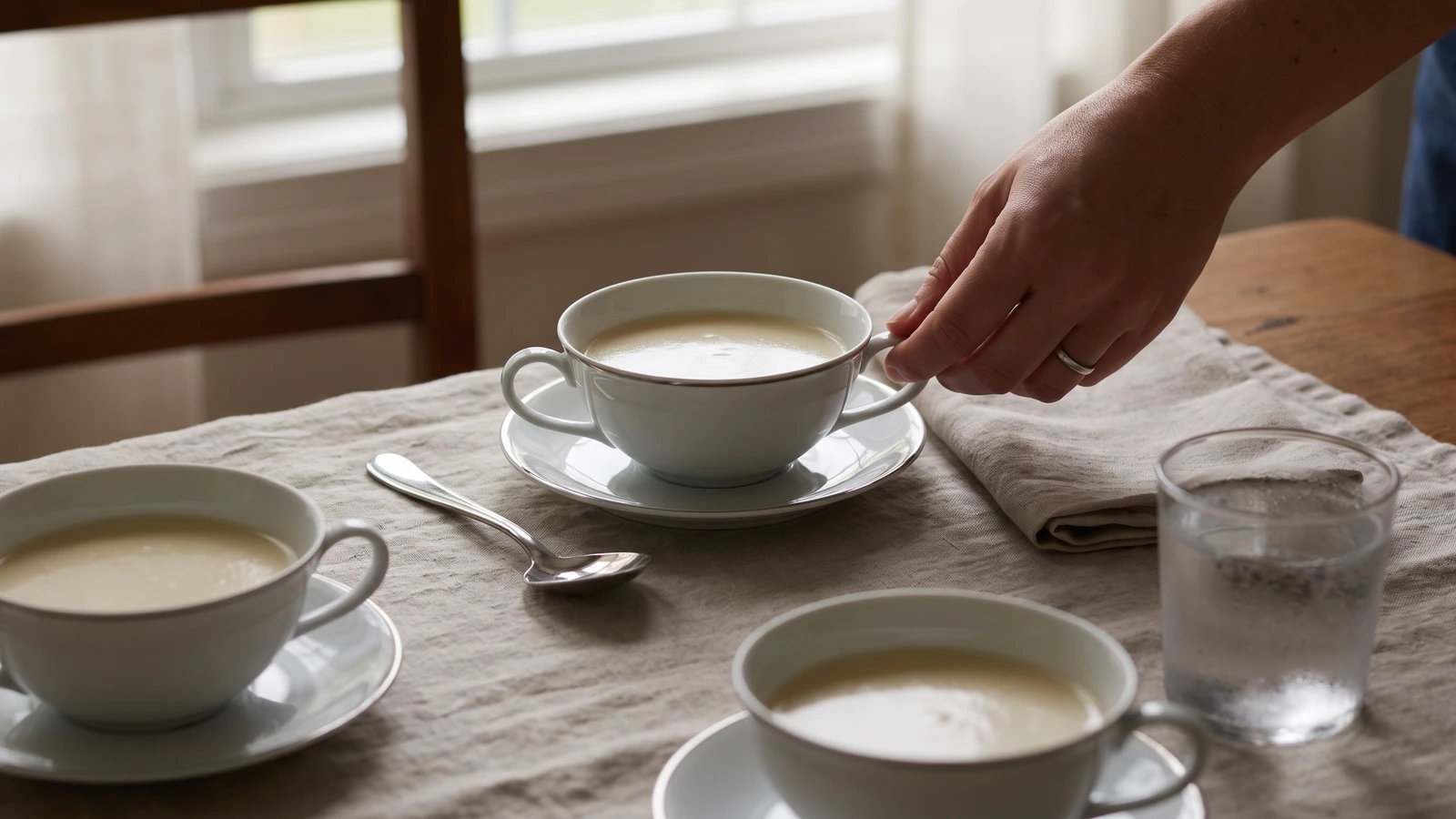
Cover and refrigerate the finished velouté for at least 2 hours. Chill the serving cups for 20 minutes, stir the soup slowly without beating in air, and pour 3/4 to 1 cup (180 to 240 ml) into each. Serve it cold and without garnish, as the velouté stands. Its pleasure is the clean chicken depth, the restrained touch of cream, and a texture that leaves the palate ready for supper. À table!
1 serving (about 240g)
Culinary guides, cultural storytelling, and the editorial depth that makes cooking meaningful.
Discover Culinary ExplorerChef Juliette
Purée de Carottes, otherwise Crécy, turns carrots, butter, rice, and white consommé into a silken soup. The lesson is simple and absolute: blend for smoothness, then sieve for finesse.

Chef Juliette
Purée Crécy meets tender tapioca poached in white consommé, then butter brings the two together. Velours earns its name from the spoon: glossy, softly pearled, and entirely itself.

Chef Juliette
Purée de Céleri-rave turns knobby celeriac into an ivory, butter-glossed soup, its bitterness blanched away, its body supplied by potato, and its sweetness clarified by a patient half-hour of skimming.

Chef Juliette
A pale-green Flamande purée built on fresh Brussels sprouts, butter, white consommé, and potato, passed smooth and milk-finished, with crisp bread dice for the necessary bite.