Chef Juliette
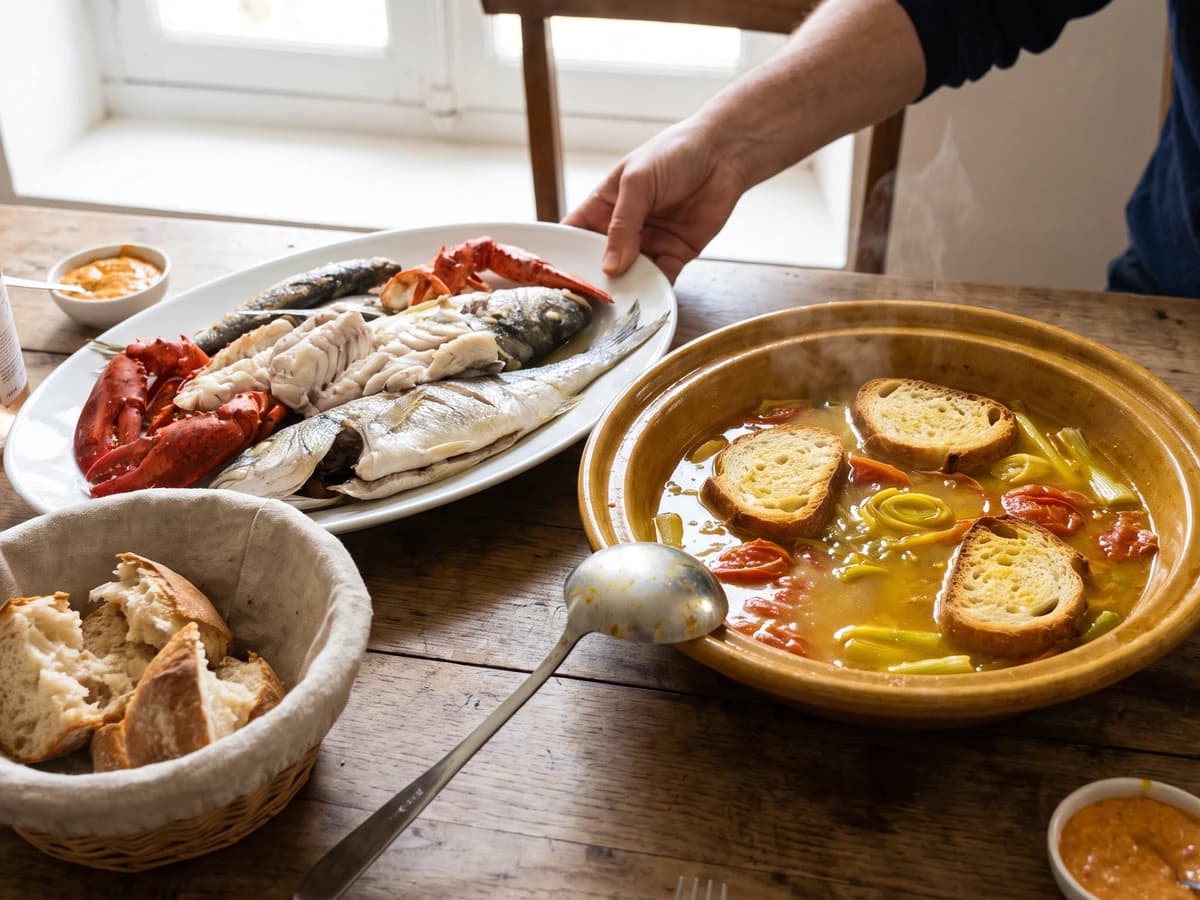
Bouillabaisse à la Marseillaise
Marseille's great fish stew, saffron-gold and garlic-scented, proves that a hard boil can be the careful choice: it binds olive oil into broth before the whole pot meets bread.
A cooking platform built around craft, culture, and the stories behind what we eat.

Created by Chef Juliette
Based on No. 693, Velouté Marie Stuart, from Le Guide Culinaire (1907) by Auguste Escoffier
A classical poultry velouté softened with barley cream, enriched by a careful liaison of yolks and cream, and finished with tiny brunoise and pearl barley cooked separately in white consommé.
Velouté Marie Stuart (silken poultry-and-barley soup) teaches the gentlest finish in the classical soup family: a liaison, the yolk-and-cream binding, gives richness only if you refuse to boil it. Barley does two jobs. Cooked down and puréed, it gives the velouté its quiet, velvety body; cooked separately in white consommé, it returns as a tender pearl among the brunoise.
The original entry assumed a saucier on staff, white poultry stock never off the fire, barley cream already passed through a tamis, and separate garnish pots waiting for service. At home, an immersion blender and fine sieve replace the tamis, and two small pans share the work. Here the preparation is scaled to about two quarts, with the cooked brunoise and pearl barley held in equal measure. The service choreography is brigade scaffolding and can go. The blond roux, barley cream, liaison, and two-part garnish are the dish and stay. One cook, one stove, one evening.
When it is right, the soup is ivory and glossy, thick enough to veil a spoon but still fluid enough to settle quietly in the bowl. Temper the liaison patiently, then keep the finished velouté below a simmer. That is the step that decides it.
Velouté Marie Stuart belongs to the French grand-kitchen repertoire, where royal names often identified refined compositions and their garnishes rather than regional origins. Mary Stuart's close connection to the French court supplied the name, while pearl barley made the Scottish allusion legible inside a thoroughly French poultry velouté. It is not a Scottish farmhouse soup carried south; barley appears first as the soup's silken body and again as the visible grain.
Quantity
½ cup (120 ml / 100 g)
rinsed
Quantity
1½ tablespoons (22 ml / 18 g)
rinsed
Quantity
8½ cups (2 L / 2 kg)
divided
Quantity
2 cups (475 ml / 475 g)
Quantity
4 tablespoons (60 ml / 57 g)
Quantity
½ cup (120 ml / 60 g)
Quantity
¼ cup (60 ml / 40 g)
cut brunoise-fashion into even 3 mm dice
Quantity
1 tablespoon (15 ml / 14 g)
Quantity
4
Quantity
1 cup (240 ml / 240 g)
Quantity
2 tablespoons (30 ml / 30 g)
Quantity
3 tablespoons (45 ml / 43 g)
cut into small cubes
Quantity
2 teaspoons (10 ml / 12 g), or as needed
Quantity
¼ teaspoon (1.25 ml / 0.6 g)
| Ingredient | Quantity |
|---|---|
| fine pearl barley for the barley creamrinsed | ½ cup (120 ml / 100 g) |
| fine pearl barley for the garnishrinsed | 1½ tablespoons (22 ml / 18 g) |
| unsalted white chicken stockdivided | 8½ cups (2 L / 2 kg) |
| white chicken consommé | 2 cups (475 ml / 475 g) |
| unsalted butter for the roux | 4 tablespoons (60 ml / 57 g) |
| all-purpose flour | ½ cup (120 ml / 60 g) |
| mixed carrot, turnip, celery, and white leekcut brunoise-fashion into even 3 mm dice | ¼ cup (60 ml / 40 g) |
| unsalted butter for the brunoise | 1 tablespoon (15 ml / 14 g) |
| large egg yolks | 4 |
| heavy cream for the liaison | 1 cup (240 ml / 240 g) |
| cold heavy cream for rescue (optional) | 2 tablespoons (30 ml / 30 g) |
| cold unsalted butter for finishingcut into small cubes | 3 tablespoons (45 ml / 43 g) |
| fine sea salt | 2 teaspoons (10 ml / 12 g), or as needed |
| finely ground white pepper | ¼ teaspoon (1.25 ml / 0.6 g) |
Combine the ½ cup pearl barley with 3 cups (710 ml / 710 g) of the white chicken stock in a small saucepan. Bring it just to a simmer, cover loosely, and cook gently for 40 to 45 minutes, stirring more often as it thickens, until the grains have opened and will crush against the pan with a spoon. If the bottom begins to catch, add a little of the remaining stock and lower the heat. Purée directly in the pan with an immersion blender, then press the thick barley cream through a fine sieve. The old kitchen used a tamis and a strong arm; the sieve gives the same smooth result at home.
While the barley cream cooks, place the 1½ tablespoons pearl barley in another small saucepan with the white chicken consommé. Hold it at a bare simmer for 25 to 35 minutes, until each pearl is fully tender but still distinct. Drain it, reserving every drop of consommé, and moisten the barley with a spoonful of that liquid so it does not dry into a clump. The consommé is not decorative language here; it seasons the grain from within.
Cut the carrot, turnip, celery, and leek brunoise-fashion, into even 3 mm dice. Melt the tablespoon of butter over low heat, add the vegetables with a pinch of salt, and cook for 2 minutes without allowing them to colour. Add 2 tablespoons (30 ml / 30 g) of the reserved consommé, cover, and cook gently for 6 to 8 minutes, until tender but still holding their tiny shapes. Set aside in their buttery cooking juices.
Warm the remaining 5½ cups (1.3 L / 1.3 kg) white chicken stock in a separate pan or heatproof jug. Melt the 4 tablespoons butter in a heavy 4-quart saucepan, stir in the flour, and cook over medium-low heat for 3 to 4 minutes. This is a roux blond, a pale cooked flour-and-butter foundation: it should smell faintly nutty but remain ivory, because browned roux would muddy both the flavour and colour. Add the warm stock in small additions, whisking each one smooth before the next, then simmer very gently for 25 minutes, skimming the surface. If the roux forms lumps, stop adding liquid and whisk firmly with a small ladleful of hot stock; if a few remain, strain them out. Ça se rattrape.
Whisk the barley cream into the poultry velouté and simmer for 10 minutes, stirring along the bottom so the grain cannot catch. Pass the soup through a fine sieve into a clean saucepan. It should coat the back of a spoon with a thin, opaque veil, not sit on it like porridge. Before adding the liaison, adjust the base to about 7 cups (1.65 L): reduce it gently if thin, or add reserved consommé if too thick. Make this correction now, because the finished liaison must never be boiled down.
Whisk the egg yolks and 1 cup heavy cream together in a bowl. Whisk in about 1½ cups (355 ml / 355 g) of the hot velouté, a ladleful at a time, then take the saucepan off the burner and slowly stir the tempered liaison back into it. Return the pan to the lowest heat and stir constantly until the soup grows slightly fuller and reaches 165 to 170°F (74 to 77°C). Never let it bubble. If the first tiny flecks of curd appear, pull the pan off the heat, blend in the reserved 2 tablespoons cold cream, and strain immediately. Ça se rattrape, provided you act before the yolks fully scramble.
Remove the velouté from the heat. Whisk in the cold butter one cube at a time until each disappears and the surface takes on a quiet gloss. This is monter au beurre, finishing with cold butter to round the texture and flavour. Season with the remaining salt as needed and the white pepper. If the soup has tightened, loosen it with reserved consommé by the spoonful; once the liaison is in, gentle heat only.
Warm the brunoise and cooked pearl barley together with a spoonful of reserved consommé, then drain them well. Fold most of the garnish through the velouté and ladle it into warmed bowls, distributing the remaining barley and brunoise over the surface. The garnish should look generous but remain delicate, little vegetables and tender pearls suspended in ivory soup. Serve at once. À table!
1 serving (about 240g)
Culinary guides, cultural storytelling, and the editorial depth that makes cooking meaningful.
Discover Culinary ExplorerChef Juliette
Marseille's great fish stew, saffron-gold and garlic-scented, proves that a hard boil can be the careful choice: it binds olive oil into broth before the whole pot meets bread.
Chef Juliette
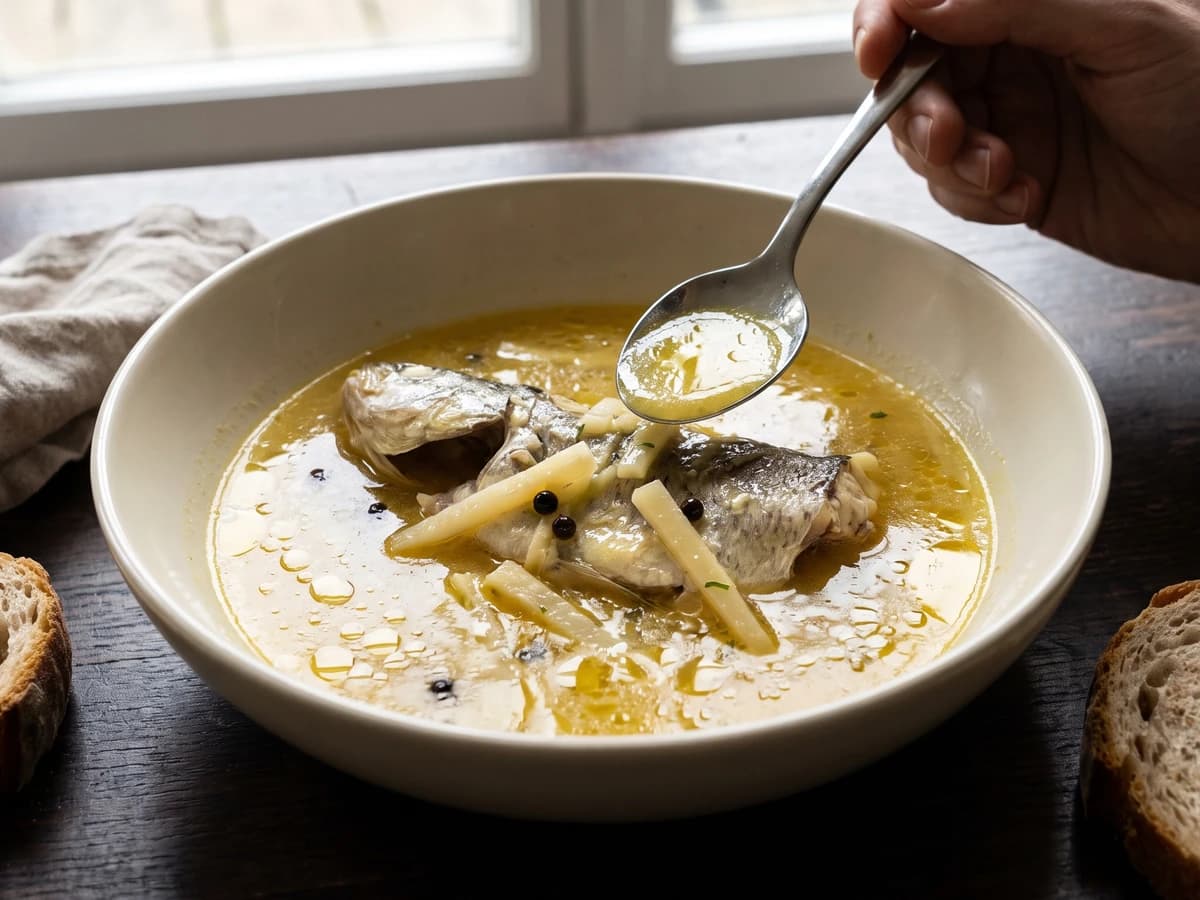
Waterzoi asks fresh, bone-in river fish to thicken its own buttery broth, with parsley root and pepper for company. No flour, no stockpot, just a brisk simmer watched closely.
Chef Juliette
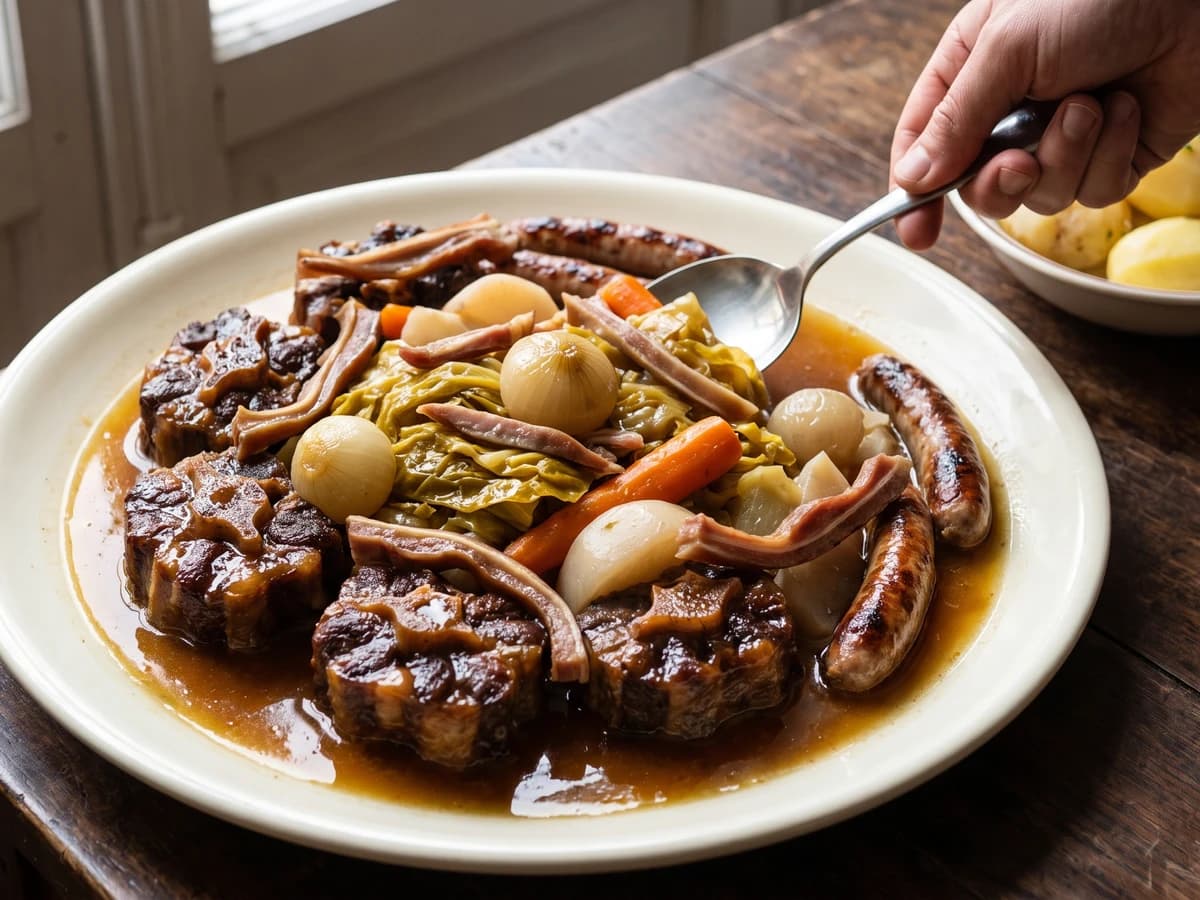
Queue de Bœuf en Hochepot gathers oxtail, pig's trotter and ear, cabbage, roots, and grilled chipolatas around a clear, gelatin-rich broth whose quiet simmer keeps every piece tender and distinct.
Chef Juliette
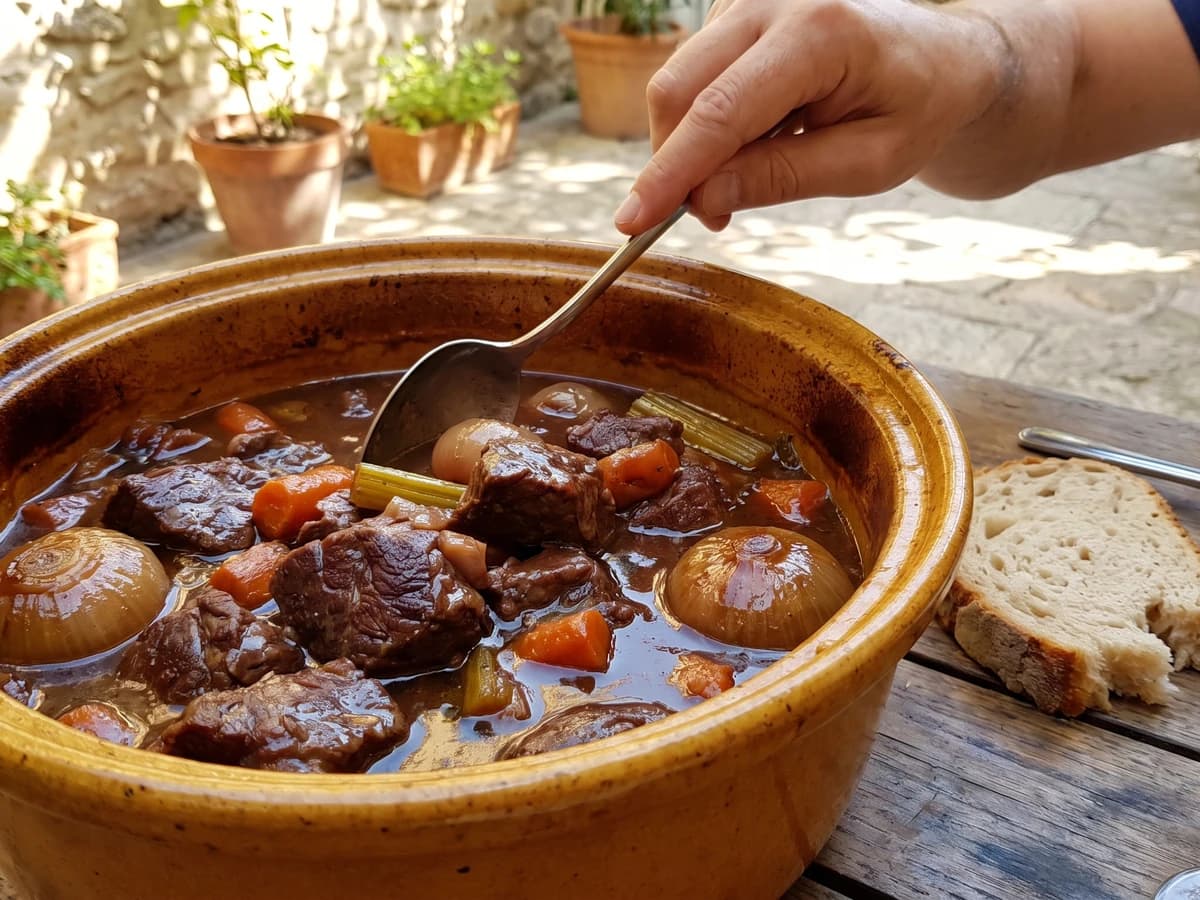
Beef shoulder larded with bacon, sharpened by red wine and vinegar, then sealed with garlic, vegetables, and dry lemon peel until the low oven turns it yielding and the gravy darkly glossy.