Culinary Explorer

A cooking platform built around craft, culture, and the stories behind what we eat.
Discover Culinary Explorer
Velouté Isoline

Velouté Isoline

Created by Chef Juliette

Based on No. 691, Velouté Isoline, from Le Guide Culinaire (1907) by Auguste Escoffier

Silken poultry velouté, coral crayfish butter, and translucent perles du Japon meet in one precise finish, a dinner-party soup whose luxury depends on gentle heat, not complicated work.

Soups & Stews
French
Dinner Party
Special Occasion
15 min
Active Time
35 min cook50 min total
YieldAbout 2 quarts, 8 to 10 first-course servings

Velouté Isoline (poultry velouté finished with crayfish butter and small tapioca pearls) teaches the art of finishing. The one true thing to know before touching a pan is this: after the liaison ordinaire (the egg-and-cream finish) and Crayfish Butter go in, the soup must never boil. Gentle heat keeps the liaison smooth and the shellfish butter bright; a boil turns silk to grain and sends the butter floating.

The old entry assumed a saucier at hand, Poultry Velouté prepared, a White Consommé pot never off the fire, Ordinary Liaison mixed, and Crayfish Butter ready. Your honest home equivalent is to make those finished preparations ahead from their own formulas, then assemble them in one saucepan at service. The book gives a one-quart base; here it becomes one and a half quarts so the liaison, butter, and pearls bring the finished yield to about two quarts, with every stated finishing ratio kept. One cook, one stove, one evening.

Separate holding pots and a dedicated saucier are brigade scaffolding; they can go. Poaching the perles du Japon in White Consommé, tempering the liaison, and whisking in the full measure of Crayfish Butter are the dish, and they stay. Watch the heat when the liaison enters. That step decides Isoline.

Velouté Isoline belongs to the Parisian grand-kitchen family of named potages, each built on a canonical soup and distinguished by a precise liaison, finishing butter, and garnish. Its signatures, Crayfish Butter and perles du Japon, show the repertory at its most cosmopolitan: despite the name, the pearls are tapioca rather than rice, and their purpose is delicate texture, not Japanese seasoning. The formula passed easily into bourgeois dinner service because its distinction comes from foundations prepared ahead and a careful last-minute finish.

The technique, the tradition, and the story behind every dish.

Discover Culinary Explorer

Ingredients

prepared Poultry Velouté

Quantity

6 cups (1.4 L / about 1.45 kg)

prepared Ordinary Liaison

Quantity

¾ cup (180 ml / about 185 g)

chilled

prepared Crayfish Butter

Quantity

½ cup plus 1 tablespoon (135 ml / 128 g)

cool and cut into small pieces

perles du Japon (small tapioca pearls)

Quantity

4½ tablespoons (68 ml / 42 g)

prepared White Consommé

Quantity

4 cups (960 ml / about 960 g)

divided

Equipment Needed

  • 4-quart heavy-bottomed saucepan
  • 2-quart saucepan for poaching the pearls
  • Flat whisk
  • Fine-mesh sieve
  • Instant-read thermometer
  • 2½-quart soupière or warmed shallow soup plates

Instructions

  1. 1

    Poach the pearls

    Reserve ½ cup of the White Consommé, then bring the remainder to a bare simmer in a small saucepan. Sprinkle in the perles du Japon while stirring so they remain separate. Poach at the gentlest tremble, stirring along the pan floor every few minutes, until the pearls are translucent with only a pinprick of white at their centres, 18 to 25 minutes depending on their size. If they clump, loosen them immediately with a whisk; if the pan grows dry before they soften, add reserved consommé a spoonful at a time. Ça se rattrape.

    Use small tapioca pearls, not instant tapioca powder or large boba pearls. The finished garnish should be delicate enough to pass easily from a soup spoon.
  2. 2

    Drain without rinsing

    Lift the tender pearls into a fine-mesh sieve and let them drain thoroughly. Do not rinse them; the White Consommé has seasoned them from within, and washing would throw that work down the sink. Keep the pearls covered and warm while you finish the velouté.

  3. 3

    Warm the velouté

    Pour the Poultry Velouté into a heavy saucepan and warm it over medium-low heat, whisking around the edges where thick soups catch first. Bring it only to a bare simmer and hold it there for 3 minutes. It should nappe, coating the back of a spoon with a light, even veil. If it is too thick, loosen it with a little reserved White Consommé; if it is thin, reduce it now, before the liaison enters.

  4. 4

    Temper the liaison

    Take the saucepan off the heat. Put the Ordinary Liaison in a heatproof bowl and whisk in about 2 cups of hot Poultry Velouté in four gradual additions. Pour the tempered liaison back into the saucepan, set it over the lowest heat, and stir continuously until the soup gains a little body and reaches 170 to 176°F (77 to 80°C), about 3 to 5 minutes. Never let it boil. If graininess appears, pour the soup at once into a cool bowl, whisk firmly, and pass it through a fine sieve; caught early, it will smooth again.

  5. 5

    Mount the butter

    Remove the pan from the heat and let it stand for 30 seconds. Add the Crayfish Butter a few pieces at a time, whisking each addition completely into the velouté before adding more. This is monter au beurre, mounting with butter: you are building an emulsion, not merely melting fat. The surface should become glossy with an even coral blush and no orange beads. If it looks oily, stop adding butter and whisk in 1 tablespoon of cool reserved White Consommé, then continue in smaller additions. We don't apologize for butter.

  6. 6

    Finish with pearls

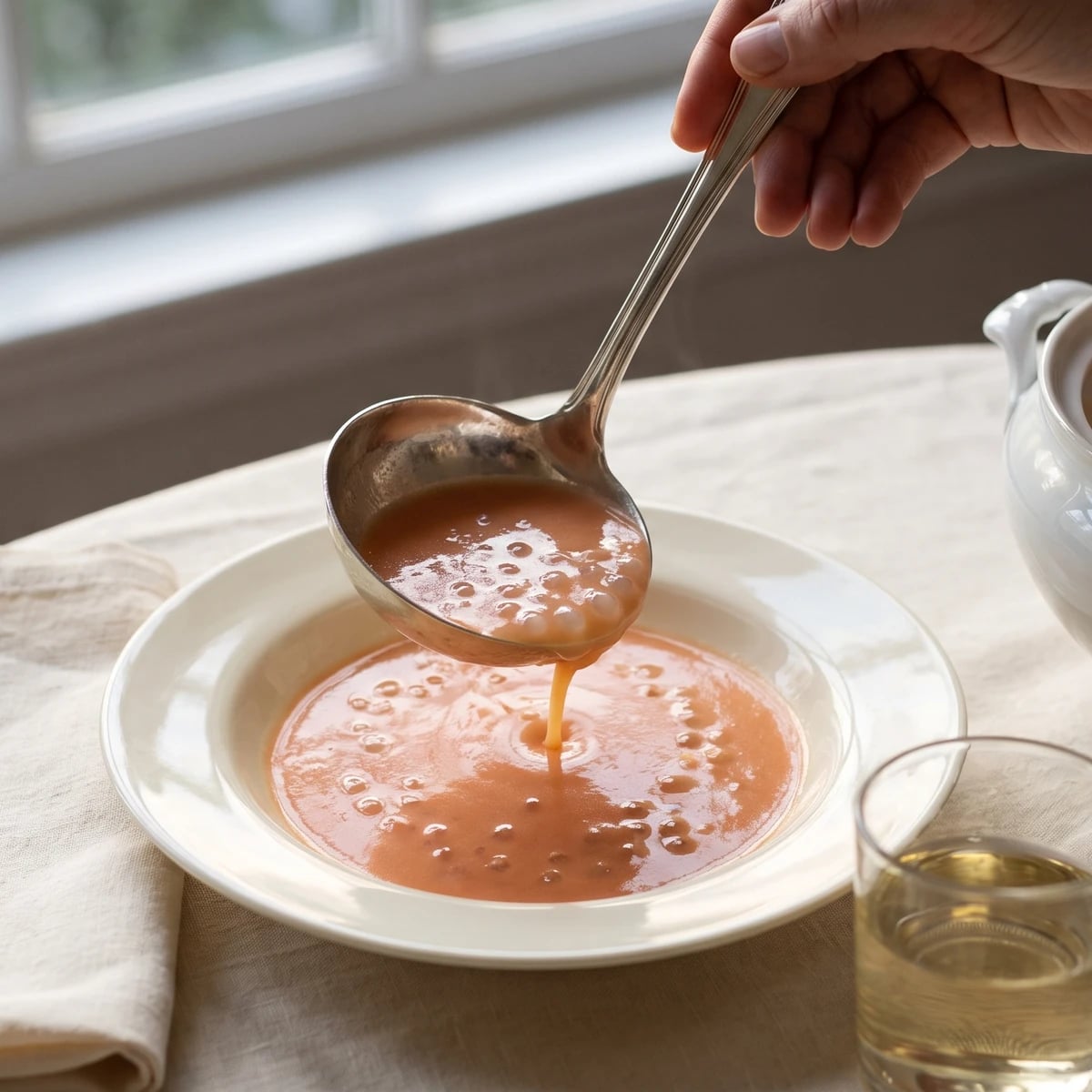
    Fold the drained perles du Japon into the finished Isoline. Return the pan to the lowest heat for 1 to 2 minutes, stirring gently, just until the pearls are hot. Do not simmer. The soup should remain silken and lightly coat every pearl; if the pearls tighten it more than expected, loosen it with the last spoonfuls of reserved White Consommé.

  7. 7

    Serve at once

    Warm a soupière or shallow soup plates with hot water, then dry them well. Ladle in the Isoline while its surface is still glossy and the pearls remain suspended throughout, giving each guest a generous spoonful of the garnish. Bring it straight to the table. À table!

Chef Tips

  • Crayfish Butter does the defining work, so use a properly prepared one with a clean, sweet shellfish aroma and a strong coral colour. Plain butter cannot replace it; that would remove the identity of Isoline.
  • Keep an instant-read thermometer beside the saucepan if egg liaison makes you nervous. The useful range is 170 to 176°F (77 to 80°C): hot enough to bind, safely below a boil.
  • Cook the perles du Japon in plenty of White Consommé and drain them only when tender. Undercooked pearls have a chalky centre; overcooked ones collapse and thicken the soup instead of garnishing it.
  • Serve small first-course portions with dry Champagne or a restrained white Burgundy. The wine needs acidity for the butter and enough composure to leave the crayfish alone.

Advance Preparation

  • The Poultry Velouté, White Consommé, and Crayfish Butter may be prepared up to 2 days ahead and kept separately chilled. Bring the velouté and consommé toward room temperature before service so reheating stays gentle.
  • Prepare the Ordinary Liaison on the day of service and keep it cold until tempering. Do not combine it with the velouté ahead of time.
  • Poach the perles du Japon no more than 30 minutes before finishing the soup. Hold them warm under cover; a long rest makes tapioca swell and turn sticky.
  • Once the liaison and Crayfish Butter have been added, serve within 20 minutes. Leftovers can be reheated over very low heat while whisking, but they must never return to a boil.

Frequently Asked Questions

Nutrition Information

1 serving (about 215g)

Calories
305 calories
Total Fat
25 g
Saturated Fat
14 g
Trans Fat
1 g
Unsaturated Fat
10 g
Cholesterol
105 mg
Sodium
1050 mg
Total Carbohydrates
12 g
Dietary Fiber
0 g
Sugars
1 g
Protein
8 g

Note: Chef personas and recipes are created with AI assistance. Cook with care: follow safe food-handling practices, check doneness with a thermometer when needed, and adapt for allergies and your kitchen.

Where cooking meets culture.

Culinary guides, cultural storytelling, and the editorial depth that makes cooking meaningful.

Discover Culinary Explorer

More from Soups - Thick Soups

Browse the full collection