
Chef Juliette
Purée de Carottes, otherwise Crécy
Purée de Carottes, otherwise Crécy, turns carrots, butter, rice, and white consommé into a silken soup. The lesson is simple and absolute: blend for smoothness, then sieve for finesse.
A cooking platform built around craft, culture, and the stories behind what we eat.
Created by Chef Juliette
Based on No. 689, Velouté de Homard à la Persane, from Le Guide Culinaire (1907) by Auguste Escoffier
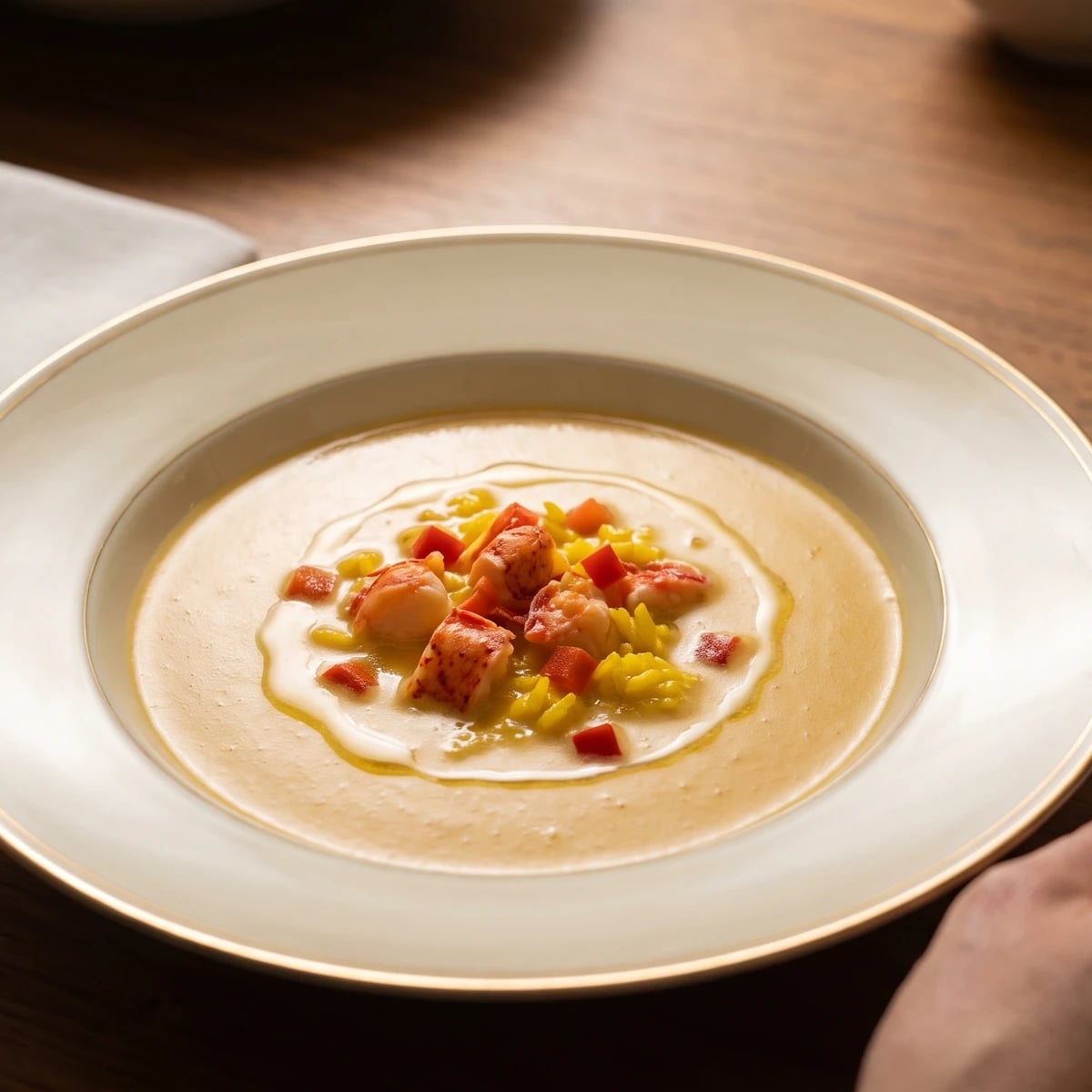
Lobster shells, blond roux, and a careful cream liaison become a golden velouté, with tender lobster, red pimento dice, and saffron pilaff carrying the Persane garnish.
Velouté de Homard à la Persane (Persian-style lobster velouté) teaches one true thing: the deepest lobster flavour lives in the shell. The tender meat is the garnish, added only at the end; simmer it through the soup and you get expensive little erasers while the broth remains timid.
The old formula sent the cook back to an Orientale base already waiting, with a saucier tending the roux, a shellfish stockpot never off the fire, and a mortar and tamis, a fine sieve, ready for the shells. At home we make those elements sequentially in one pot, snipping rather than pulverizing the shells and pressing their essence through a sturdy sieve. Separate stations were brigade scaffolding and can go. The shell extraction, blond roux, curry, cream-and-yolk liaison, and prescribed garnish are the dish, so every one stays. One cook, one stove, one evening.
The finished velouté should be golden ivory and perfectly smooth, with coral lobster, red pimento, and a few saffron-yellow grains appearing in each spoonful. The moment that decides it is the liaison: once the yolks and cream enter, the soup must never boil. Keep that heat gentle and the whole canon behaves.
Velouté de Homard à la Persane belongs to the codified Parisian grand-kitchen table, where à la Persane identified a garnish and seasoning vocabulary rather than a claim of Persian regional origin. It carries the curry-scented Orientale lobster velouté into a new service with diced lobster, red pimento, and a restrained measure of saffron pilaff, each kept distinct in the pale soup. Its variation rule is pure classical grammar: replace lobster with the equivalent quantity of crayfish, shrimp, or crab, then let the garnish name the new velouté.
Quantity
2 (about 1¼ pounds / 570 g each)
humanely dispatched and cut into sections by the fishmonger
Quantity
8 tablespoons plus 1 teaspoon (125 ml / 118 g)
divided
Quantity
1 cup (240 ml / 150 g)
thinly sliced
Quantity
½ cup (120 ml / 65 g)
thinly sliced
Quantity
½ cup (120 ml / 45 g)
thinly sliced and washed
Quantity
2 tablespoons (30 ml / 32 g)
Quantity
2 teaspoons (10 ml / 5 g)
Quantity
¼ cup (60 ml / 57 g)
Quantity
1 cup (240 ml / 240 g)
Quantity
8 cups plus 2 tablespoons (1.92 L / 1.92 kg)
divided
Quantity
1
Quantity
⅓ cup (80 ml / 42 g)
Quantity
1½ cups (360 ml / 355 g)
divided
Quantity
3
Quantity
1 tablespoon (15 ml / 12 g)
Quantity
1 small pinch (about 1/16 teaspoon / 0.05 g)
Quantity
1 tablespoon (15 ml / 15 g)
cut into small dice
Quantity
to taste
| Ingredient | Quantity |
|---|---|
| whole raw lobstershumanely dispatched and cut into sections by the fishmonger | 2 (about 1¼ pounds / 570 g each) |
| unsalted butterdivided | 8 tablespoons plus 1 teaspoon (125 ml / 118 g) |
| yellow onionthinly sliced | 1 cup (240 ml / 150 g) |
| carrotthinly sliced | ½ cup (120 ml / 65 g) |
| leek, white and pale green partsthinly sliced and washed | ½ cup (120 ml / 45 g) |
| tomato paste | 2 tablespoons (30 ml / 32 g) |
| mild curry powder | 2 teaspoons (10 ml / 5 g) |
| Cognac | ¼ cup (60 ml / 57 g) |
| dry white wine | 1 cup (240 ml / 240 g) |
| unsalted fish stockdivided | 8 cups plus 2 tablespoons (1.92 L / 1.92 kg) |
| bouquet garni of parsley stems, thyme, and bay leaf | 1 |
| all-purpose flour | ⅓ cup (80 ml / 42 g) |
| heavy creamdivided | 1½ cups (360 ml / 355 g) |
| large egg yolks | 3 |
| long-grain white rice | 1 tablespoon (15 ml / 12 g) |
| saffron threads | 1 small pinch (about 1/16 teaspoon / 0.05 g) |
| drained red pimentocut into small dice | 1 tablespoon (15 ml / 15 g) |
| fine salt and ground white pepper | to taste |
Have the fishmonger dispatch the lobsters and cut each into tail, claw, knuckle, and body sections, discarding the stomach sac and feathery gills. Keep every clean shell and any juices. This is not a job to leave half-finished: raw lobster must remain cold and should be cooked as soon as you return home.
Melt 3 tablespoons of the butter in a heavy stockpot over medium-high heat. Add the lobster sections and cook, turning them, until the shells glow red and the tail meat is just opaque, about 6 minutes. Transfer the tails and claws to a tray. Add the onion, carrot, leek, bodies, and small legs to the pot, then cook for 8 minutes, stirring and pressing the shells against the pot until the vegetables soften and a rust-coloured fond forms underneath.
When the tails and claws are cool enough to handle, remove their meat in large pieces, cut it into neat dice, cover, and refrigerate. Snip the empty shells into several pieces with kitchen shears and return them to the pot. Stir in the tomato paste and curry powder for 2 minutes, just until fragrant. Take the pot off the flame before adding the Cognac, then return it to the heat and scrape up the fond. Add the wine and reduce it by two-thirds. Pour in 7 cups of the fish stock, add the bouquet garni, and hold the liquid at a quiet simmer for 35 minutes. Longer is not better here; overcooked lobster shells can turn the stock chalky and bitter.
Remove the bouquet garni, then pass the shell broth through a fine-mesh sieve into a clean bowl, pressing firmly with the back of a ladle. Do not put the shells into a home blender; sharp fragments are hard on both machine and cook. Measure 6½ cups of broth. If you have more, reduce it gently; if you have less, add enough of the reserved fish stock to reach that measure. The broth should taste distinctly of lobster before cream ever touches it.
Melt 1 teaspoon of butter in the smallest saucepan you own. Add the rice and stir for 1 minute so every grain is lightly coated. Crumble in the saffron, add 2 tablespoons of fish stock and a pinch of salt, then cover tightly and cook over the lowest heat for 12 minutes. Rest it off the heat for 5 minutes and fluff it with a fork. You need exactly 2 tablespoons of cooked riz pilaf, or pilaff rice, for the garnish. If the grain is still firm, add a teaspoon of stock, cover, and cook for another 2 minutes. Ça se rattrape.
Rinse and dry the stockpot. Melt 4 tablespoons of butter over medium-low heat, add the flour, and stir continuously for about 4 minutes, until the roux turns pale straw and smells faintly of toasted biscuit without browning deeply. Whisk in the measured lobster broth a little at a time, making the first additions slowly so the roux stays smooth. Bring the velouté to a bare simmer and cook for 20 minutes, skimming the surface when needed. If lumps appear, don't surrender the pot: blend the soup briefly with an immersion blender and pass it through the sieve. Ça se rattrape.
Whisk the egg yolks with 1¼ cups of the cream in a large bowl. Remove the velouté from the heat and slowly whisk about 2 cups of the hot soup into the liaison, then pour everything back into the pot. Set it over the lowest heat and stir constantly for 3 to 5 minutes, until it lightly coats the back of a spoon. Never let it boil. If the soup begins to look grainy, pull it off the heat at once, whisk in the reserved ¼ cup cold cream, blend briefly, and strain. Caught early, it will return to silk.
Remove the velouté from the heat and whisk in the remaining tablespoon of butter. Season with fine salt and white pepper, remembering that lobster and fish stock may already carry salt. Put the diced lobster, the tablespoon of pimento dice, and 2 tablespoons of saffron pilaff into a small saucepan with one ladleful of velouté. Warm them over the gentlest heat for 1 minute, without boiling, then divide the garnish among warm soup plates and ladle over the velouté. The lobster should remain tender, the pimento red, and the saffron grains distinct. À table!
1 serving (about 250g)
Culinary guides, cultural storytelling, and the editorial depth that makes cooking meaningful.
Discover Culinary Explorer
Chef Juliette
Purée de Carottes, otherwise Crécy, turns carrots, butter, rice, and white consommé into a silken soup. The lesson is simple and absolute: blend for smoothness, then sieve for finesse.

Chef Juliette
Purée Crécy meets tender tapioca poached in white consommé, then butter brings the two together. Velours earns its name from the spoon: glossy, softly pearled, and entirely itself.

Chef Juliette
Purée de Céleri-rave turns knobby celeriac into an ivory, butter-glossed soup, its bitterness blanched away, its body supplied by potato, and its sweetness clarified by a patient half-hour of skimming.

Chef Juliette
A pale-green Flamande purée built on fresh Brussels sprouts, butter, white consommé, and potato, passed smooth and milk-finished, with crisp bread dice for the necessary bite.