Chef Juliette
Bouillabaisse à la Marseillaise
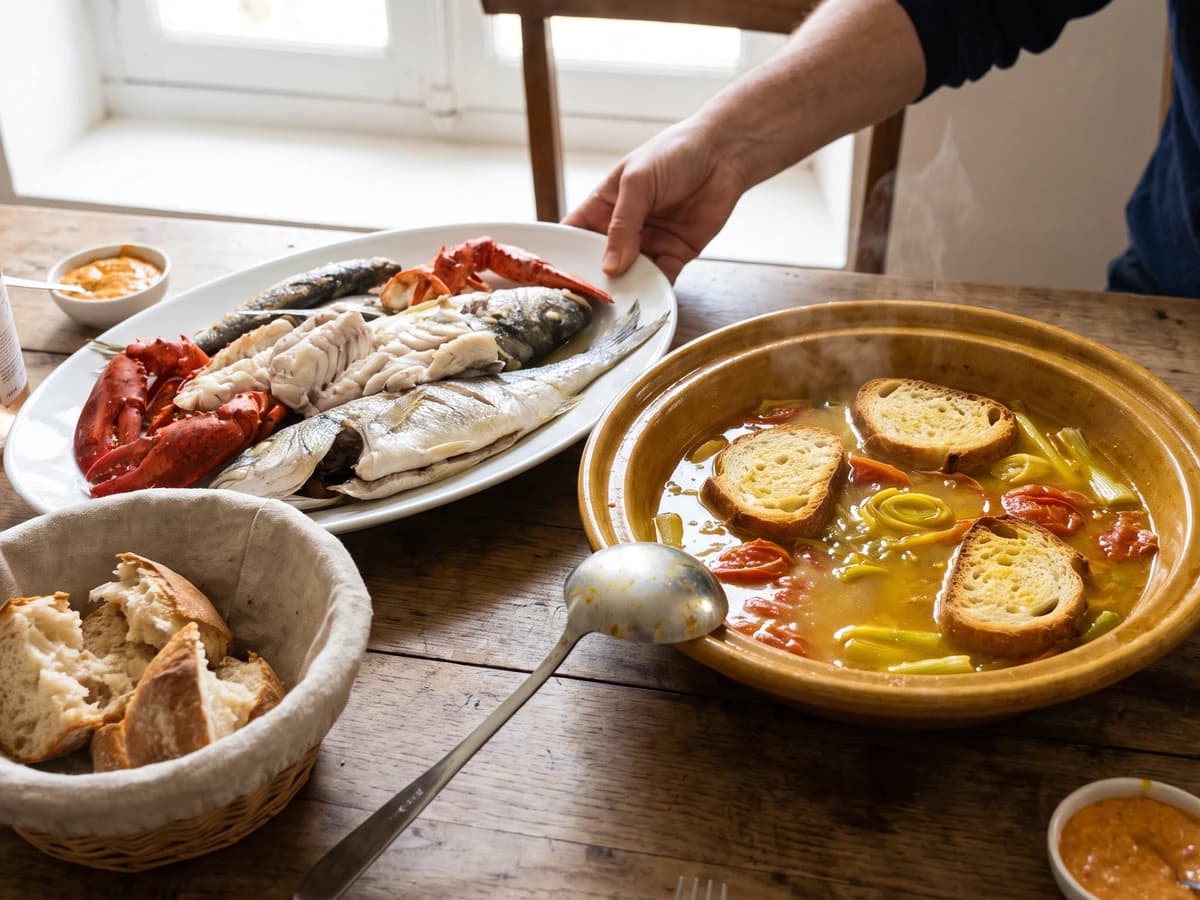
Marseille's great fish stew, saffron-gold and garlic-scented, proves that a hard boil can be the careful choice: it binds olive oil into broth before the whole pot meets bread.
A cooking platform built around craft, culture, and the stories behind what we eat.
Created by Chef Juliette
Based on No. 683, Velouté aux Grenouilles, otherwise Sicilienne, from Le Guide Culinaire (1907) by Auguste Escoffier
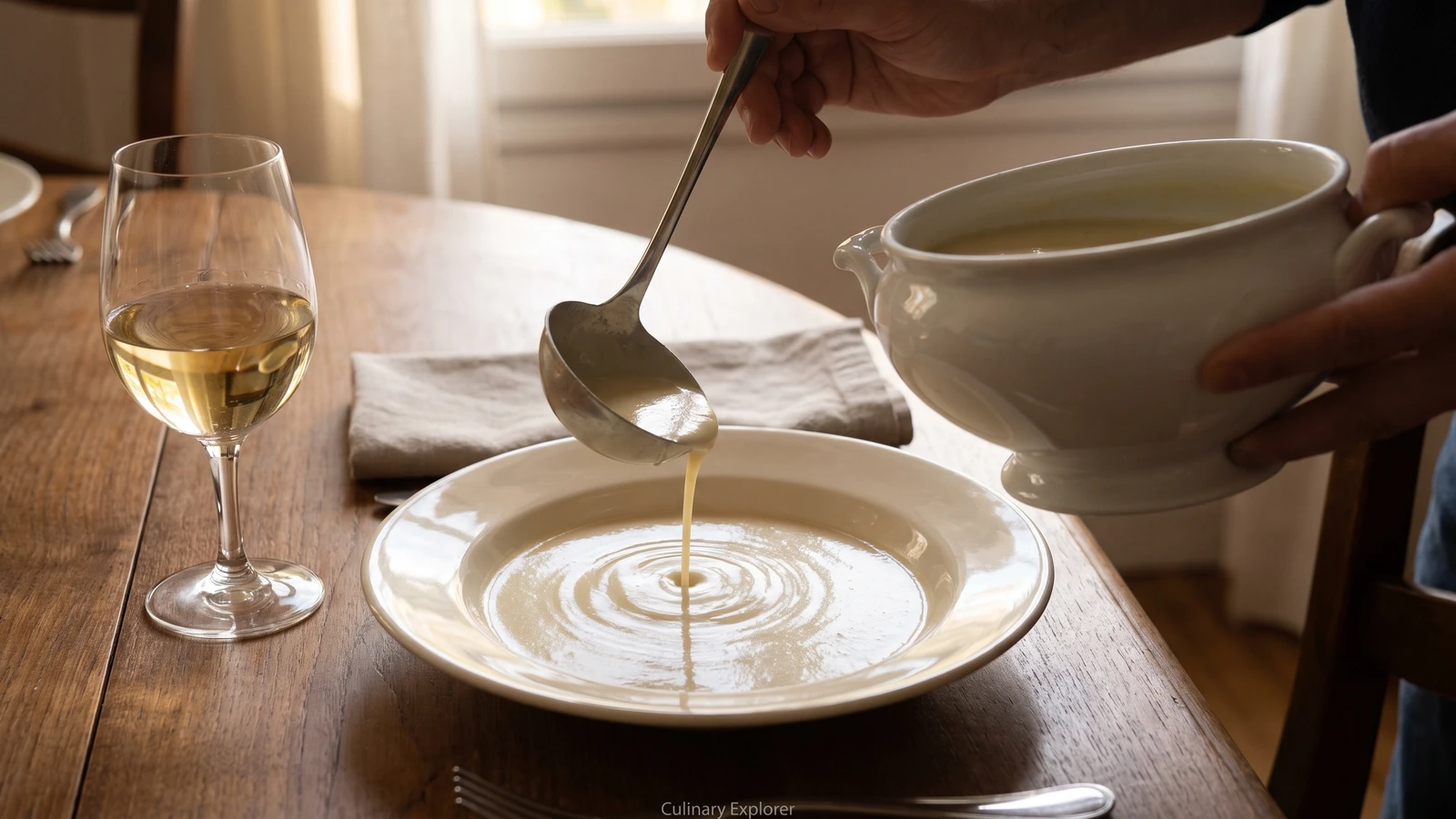
A pale, silken Sicilienne that teaches restraint: frogs' legs poached without colour, pounded into fine fish velouté, strained smooth, then finished with liaison and cold butter. No garnish. The flavour carries.
Velouté aux Grenouilles, dite Sicilienne (frog's-leg velouté), teaches the discipline of keeping a pale soup pale. Before you touch a pan, know this: the frogs' legs must poach gently in butter, white wine, and lemon without taking a spot of colour. Their delicacy is the whole point, and browning would speak over it.
The source assumes a saucier at the stove, fish stock never off the fire, delicate fish velouté already made, a mortar strong enough to pound the cooked legs, and a tammy waiting beside it. At home, one prepared batch of thin fish velouté, a blender, and a fine-mesh sieve do the same honest work. This version doubles the compact formula to make about two quarts, enough for eight first-course bowls, while preserving its proportions: thirty-six frogs' legs within the doubled range of thirty to forty, twice the wine, twice the lemon, and the full measure of best butter. The separate sauce station and the mortar are brigade scaffolding; the colourless poach, brief simmer, straining, liaison, and final butter are the dish and stay. One cook, one stove, one evening.
What reaches the bowl is ivory, smooth, quietly lemony, and glossy with butter, with no garnish because there is nowhere for weak flavour to hide. The last step decides it: temper the liaison (egg-yolk-and-cream binding) below a boil, then mount the butter off the heat. If the yolks catch or the butter oils, ça se rattrape, and the method puts the rescue exactly where you need it.
Velouté aux Grenouilles, also catalogued as Sicilienne, belongs to the Parisian grand-kitchen repertory of named potages, while its frogs recall the pond country of the Dombes north of Lyon, where grenouilles have fed local tables for generations. The formula carries that freshwater delicacy into formal soup service by puréeing the poached flesh into fish velouté, passing it perfectly smooth, and finishing it with liaison and butter. Sicilienne here does not authorize tomato, olive oil, or a southern garnish; the entry is deliberately plain, and its French classification rests on method rather than decoration.
Quantity
6 cups (1.42 L / about 1.45 kg)
Quantity
36 legs (18 pairs; about 1½ lb / 680 g)
trimmed, thawed if frozen, and patted dry
Quantity
2 tablespoons (30 ml / 28 g)
Quantity
¼ cup (60 ml / 60 g)
Quantity
⅓ cup (80 ml / 80 g)
from about 2 lemons
Quantity
6
for the ordinary liaison
Quantity
¾ cup (180 ml / 180 g)
cold and divided
Quantity
14 tablespoons (210 ml / 200 g)
very cold and cut into small cubes
Quantity
as needed
| Ingredient | Quantity |
|---|---|
| prepared delicate, rather thin fish velouté | 6 cups (1.42 L / about 1.45 kg) |
| frogs' legstrimmed, thawed if frozen, and patted dry | 36 legs (18 pairs; about 1½ lb / 680 g) |
| unsalted butter for tossing | 2 tablespoons (30 ml / 28 g) |
| dry white wine | ¼ cup (60 ml / 60 g) |
| fresh lemon juicefrom about 2 lemons | ⅓ cup (80 ml / 80 g) |
| large egg yolksfor the ordinary liaison | 6 |
| heavy creamcold and divided | ¾ cup (180 ml / 180 g) |
| best-quality unsalted buttervery cold and cut into small cubes | 14 tablespoons (210 ml / 200 g) |
| fine sea salt | as needed |
Reserve a teaspoon of the tossing butter, then melt the remainder in a wide sauté pan over medium-low heat. Add the frogs' legs in two batches and turn them through the butter for 1 to 2 minutes, just until their surfaces lose their raw translucence. They must not brown. If the butter foam begins to tan, lift the pan from the heat immediately and add a spoonful of the measured wine to cool it; use the reserved butter for the second batch.
Return all the legs to the pan and add the remaining white wine and the lemon juice. Cover and hold the liquid at the faintest tremble for 10 minutes, turning the legs once. The flesh should be opaque, firm but not tight, and at least 145°F (63°C) at the thickest joint. If the liquid threatens to disappear, add a tablespoon of water and lower the heat. A hard boil toughens the meat and drives away the delicate wine aroma.
Lift the legs from their liquor and let them cool only until they can be handled. Reserve every drop of the poaching liquid. Strip the meat meticulously from the bones and run your fingers through it twice; a home blender must never receive the bones that a professional mortar and tammy once managed together. Blend the meat, reserved liquor, and 1 cup of the measured fish velouté until completely smooth. If the blades turn without catching the purée, add another ladleful of velouté, not water.
Whisk the frog purée into the remaining fish velouté in a heavy saucepan. Bring it slowly to a bare simmer and cook for 7 to 8 minutes, stirring the bottom often so the fine purée cannot catch. The soup should move freely rather than sit in mounds; if the prepared velouté was too thick, loosen it with boiling water one tablespoon at a time. Keep the simmer quiet. Vigorous boiling muddies both the flavour and the colour.
Pass the soup through a fine-mesh chinois or sturdy fine sieve into a clean saucepan, pressing with a ladle or flexible spatula. Stop pressing when only dry fibres or hard grit remain. Taste a spoonful for texture; if there is the least graininess, pass it a second time. This replaces the tammy, and it is not fussy work. The perfectly smooth body is part of the dish.
Reserve 2 tablespoons of the cold cream. Whisk the yolks with the remaining cream in a bowl, then slowly whisk in about 1 cup of the hot soup. Take the saucepan off the heat and whisk in this tempered liaison. Return it to the lowest heat and stir continuously until the soup reaches 165 to 170°F (74 to 77°C) and lightly veils the spoon. Never let it boil. If the first tiny grains appear, lift the pan off the heat, whisk in the reserved cold cream, and pass the soup through the clean sieve once more. Ça se rattrape.
Keep the saucepan completely off the heat. Add the cold butter several cubes at a time, whisking gently until each addition disappears before the next goes in. The velouté should become glossy and slightly fuller without turning heavy. If yellow beads of butter begin to float, stop adding butter, whisk 1 tablespoon of cold water in a clean bowl, then whisk in the oily soup one ladle at a time until the emulsion closes; return it to the saucepan without reheating. Taste for salt and serve immediately in warmed bowls, absolutely plain. No herbs, croutons, or decorative frog leg. The flavour carries. À table!
1 serving (about 240g)
Culinary guides, cultural storytelling, and the editorial depth that makes cooking meaningful.
Discover Culinary ExplorerChef Juliette
Marseille's great fish stew, saffron-gold and garlic-scented, proves that a hard boil can be the careful choice: it binds olive oil into broth before the whole pot meets bread.
Chef Juliette
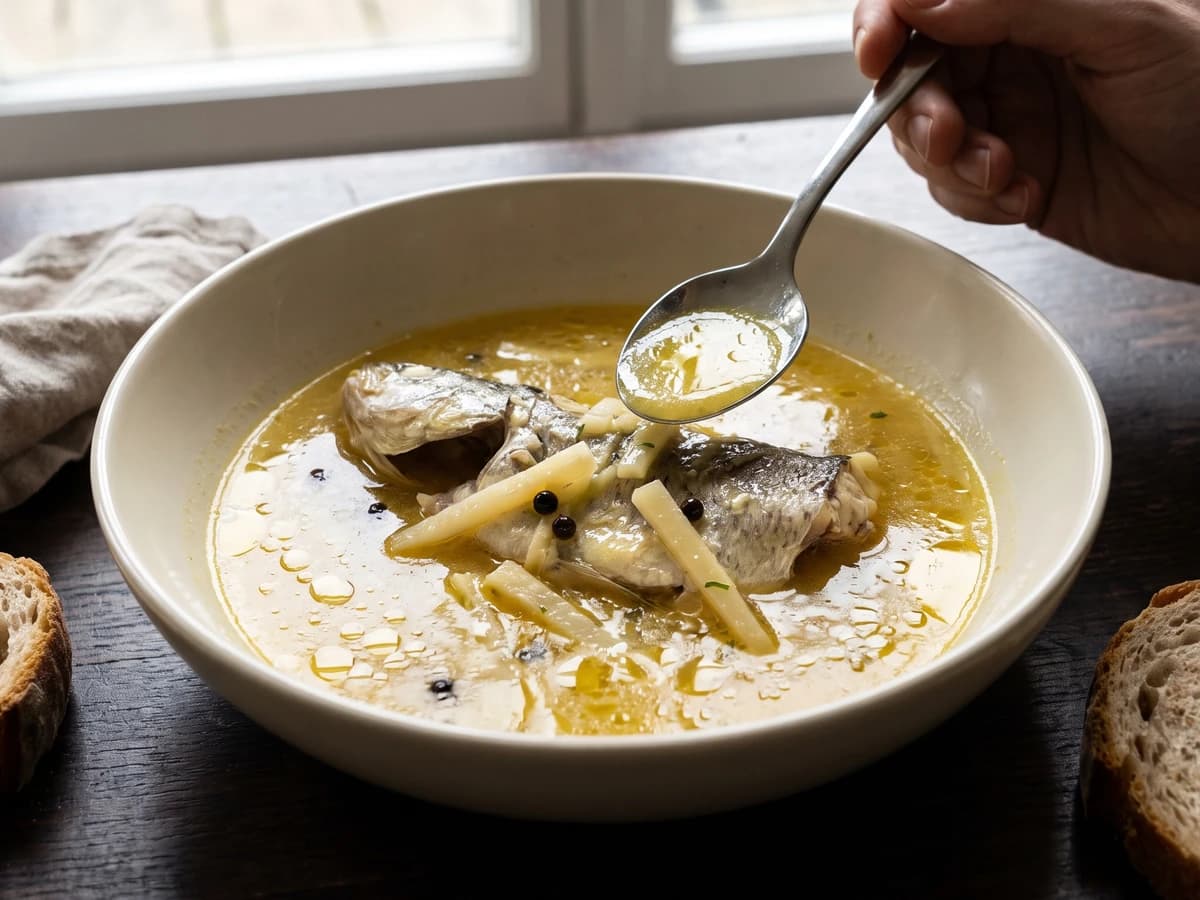
Waterzoi asks fresh, bone-in river fish to thicken its own buttery broth, with parsley root and pepper for company. No flour, no stockpot, just a brisk simmer watched closely.
Chef Juliette
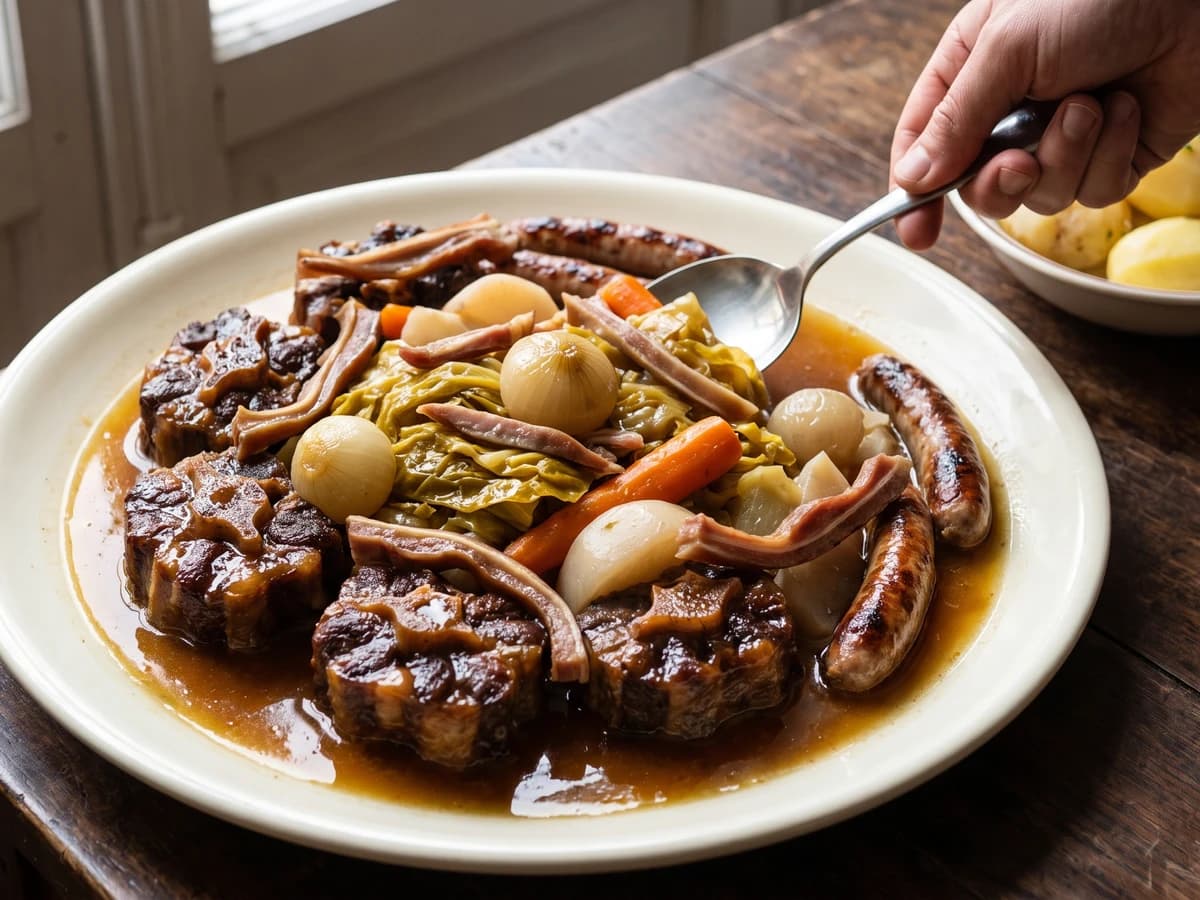
Queue de Bœuf en Hochepot gathers oxtail, pig's trotter and ear, cabbage, roots, and grilled chipolatas around a clear, gelatin-rich broth whose quiet simmer keeps every piece tender and distinct.
Chef Juliette
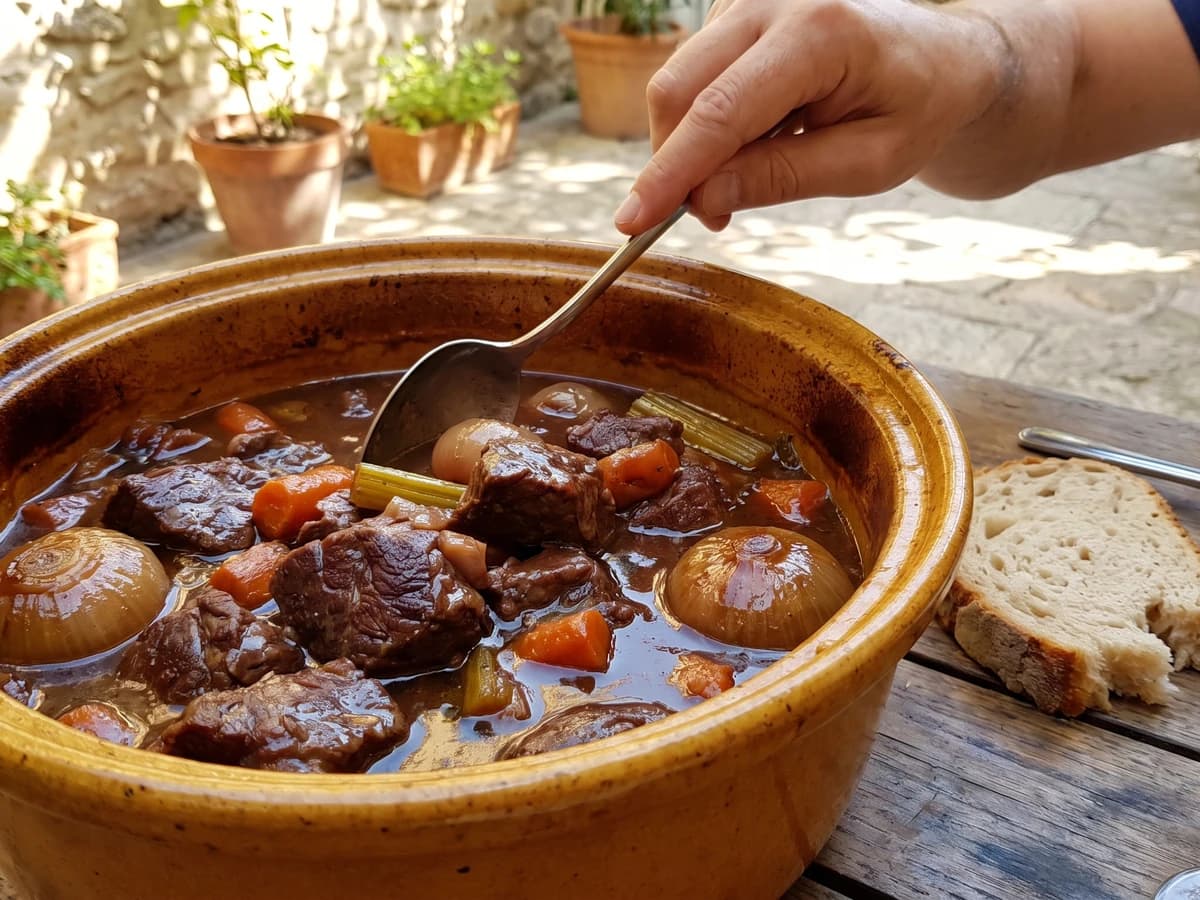
Beef shoulder larded with bacon, sharpened by red wine and vinegar, then sealed with garlic, vegetables, and dry lemon peel until the low oven turns it yielding and the gravy darkly glossy.