
Chef Juliette
Purée de Carottes, otherwise Crécy
Purée de Carottes, otherwise Crécy, turns carrots, butter, rice, and white consommé into a silken soup. The lesson is simple and absolute: blend for smoothness, then sieve for finesse.
A cooking platform built around craft, culture, and the stories behind what we eat.
Created by Chef Juliette
Based on No. 674, Velouté aux Carottes, otherwise Nivernaise, from Le Guide Culinaire (1907) by Auguste Escoffier
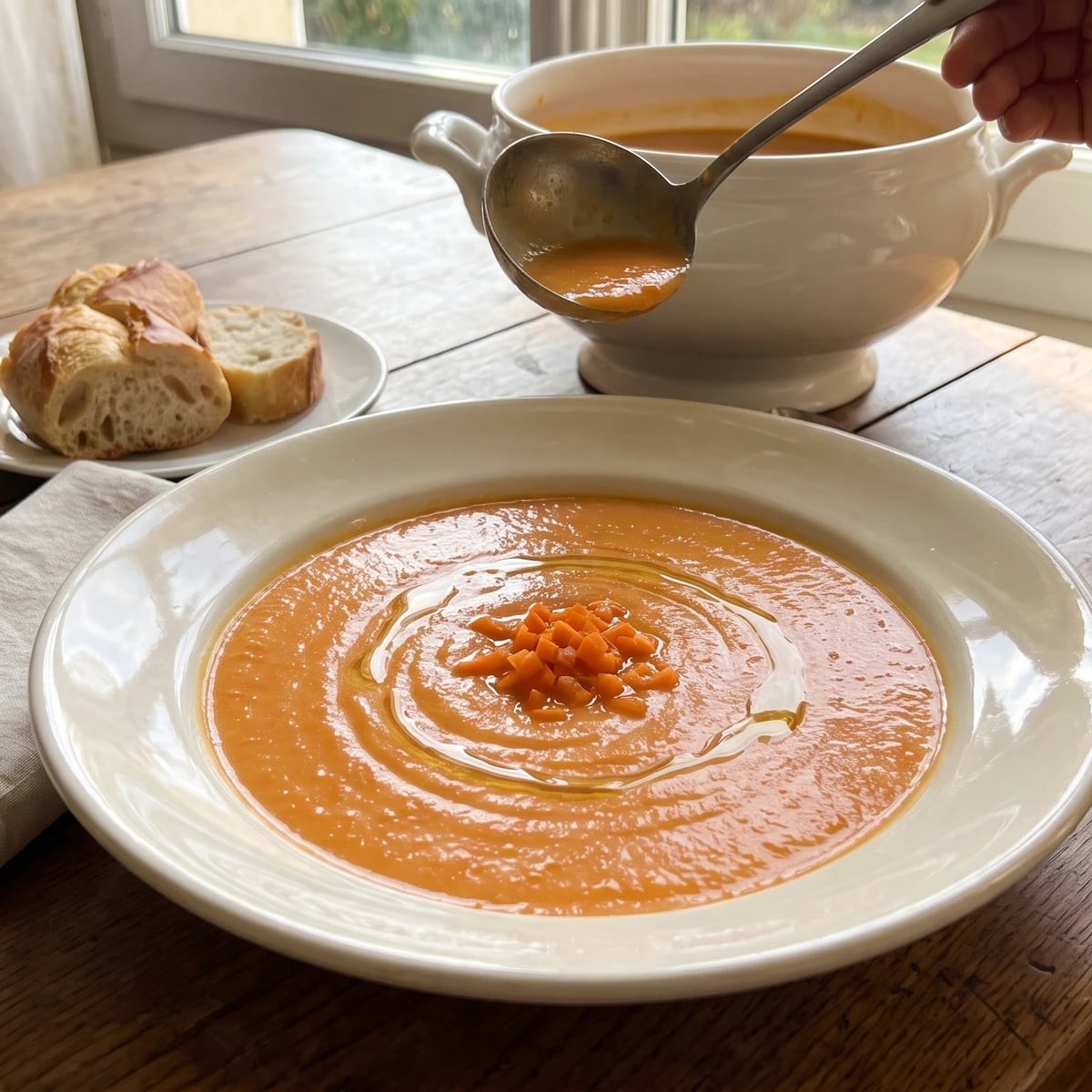
Sweet carrots, butter, velouté, and consommé become a coral-gold soup, strained to silk, bound with liaison, and finished with a fine brunoise that keeps the carrot vivid.
Velouté aux Carottes, ou Nivernaise (silken carrot soup), teaches one of the canon's quietest rules: draw sweetness from a vegetable without allowing it to brown. The one true thing to know before you touch the pan is this: Nivernaise should taste of red carrot made deeper by butter, not of roasted carrot. Keep the color clear, and the finished soup will glow coral-gold rather than sink into beige.
The brigade formula assumed a saucier at the stove, ordinary thin velouté and white consommé drawn from pots never off the fire, and a tammy waiting to turn cooked carrots into silk. At home, frozen batches of those two finished components replace the standing stockpots, while an immersion blender followed by a fine-mesh sieve replaces the tammy. The compact formula is doubled to make about two quarts for a generous home table. Separate stations and a cloth sieve were scaffolding; the butter stew, the velouté cook, the fine sieving, and the liaison are the dish, so they stay. One cook, one stove, one evening.
Finished correctly, Nivernaise is smooth but not heavy, sweet but plainly savory, with tiny cubes of carrot showing their color through the glossy surface. The step that decides it comes first: étuver the carrots gently, covered and pale, and don't let one browned edge write a different soup.
Velouté aux Carottes carries the name Nivernaise from the Nivernais around Nevers, where the regional name traveled into the national classical kitchen and became attached to this carrot-led preparation. It is not merely a rustic purée: the defining practice is to stew the carrots in butter, complete their cooking in velouté, sieve them finely, and restore visible color with brunoise. The direction to use only the red outer flesh reflects large storage carrots with pale, coarse cores, a distinction less obvious in many carrots now sold for the home kitchen.
Quantity
2 lb (about 8 cups sliced / 910 g)
peeled and thinly sliced, using only the colored outer flesh if the cores are pale and woody
Quantity
3 tablespoons (45 ml / 30 g)
cut brunoise-fashion into 2 mm dice
Quantity
4 tablespoons (60 ml / 57 g)
Quantity
1/4 teaspoon (1.25 ml / 1.5 g)
Quantity
1/2 teaspoon (2.5 ml / 2 g)
Quantity
4 cups (960 ml / 980 g)
warmed
Quantity
2 cups (480 ml / 480 g)
warmed
Quantity
3/4 cup (180 ml / 180 g)
cold
Quantity
4
Quantity
4 tablespoons (60 ml / 57 g)
cut into small cubes
Quantity
1 tablespoon (15 ml / 15 g)
only if needed to rescue the liaison
| Ingredient | Quantity |
|---|---|
| deeply colored red-orange carrotspeeled and thinly sliced, using only the colored outer flesh if the cores are pale and woody | 2 lb (about 8 cups sliced / 910 g) |
| deeply colored carrot fleshcut brunoise-fashion into 2 mm dice | 3 tablespoons (45 ml / 30 g) |
| unsalted butter | 4 tablespoons (60 ml / 57 g) |
| fine table salt | 1/4 teaspoon (1.25 ml / 1.5 g) |
| caster sugar | 1/2 teaspoon (2.5 ml / 2 g) |
| ordinary thin veloutéwarmed | 4 cups (960 ml / 980 g) |
| white consomméwarmed | 2 cups (480 ml / 480 g) |
| heavy creamcold | 3/4 cup (180 ml / 180 g) |
| large egg yolks | 4 |
| cold unsalted buttercut into small cubes | 4 tablespoons (60 ml / 57 g) |
| cold water (optional)only if needed to rescue the liaison | 1 tablespoon (15 ml / 15 g) |
Cut the soup carrots into thin, even slices so they soften at the same pace. If a carrot has a pale, fibrous core, quarter it lengthwise and trim that core away, preserving the deeply colored outer flesh the preparation calls for. Cut the garnish brunoise-fashion, into precise 2 mm dice, and keep it separate.
Étuver, to stew gently without browning, is the principle that decides this soup. Melt the first 4 tablespoons of butter in a heavy saucepan over medium-low heat. Add the sliced carrots, salt, and sugar, turn everything through the butter, then cover and cook gently for 12 to 15 minutes, stirring twice. The carrots should soften at their edges and release their perfume while remaining bright. If the butter threatens to color, add a tablespoon of the measured consommé and lower the heat. If brown flecks have already formed, transfer the carrots to a clean pan without scraping up the browned residue and continue there. Ça se rattrape.
Pour in the warm ordinary thin velouté and stir from the bottom until the base is completely even. Bring it only to a quiet simmer, cover partially, and cook for 20 to 25 minutes, stirring every few minutes, until a carrot slice collapses under light pressure from a spoon. Thin velouté contains enough flour to catch if neglected. If it begins sticking, pour the unscorched soup immediately into a clean saucepan and leave the bottom behind; never scrape a burnt film into the soup.
While the sliced carrots finish cooking, put the carrot brunoise in a small saucepan with 1/2 cup of the measured white consommé. Simmer gently for 5 to 7 minutes, just until tender while the dice remain distinct. Drain through a small sieve, reserve the brunoise, and return its cooking liquid to the remaining consommé.
Blend the soup until no visible carrot fibers remain, using an immersion blender directly in the pan. Press it through a fine-mesh sieve with a flexible scraper, working in small amounts and scraping the smooth purée from the underside. The blender replaces the labor of rubbing everything through a tammy, but it does not replace the final sieve. That sieving is the dish, not brigade scaffolding; it separates a true velouté from an ordinary carrot purée.
Return the sieved soup to a clean saucepan and whisk in the remaining white consommé, including the liquid used for the brunoise. Bring the soup to one clear boil while whisking across the bottom, then lower the heat at once. This brief boil integrates the consommé and cooks the sieved base fully. The texture should pour in a smooth ribbon rather than sit like mashed vegetables; if it is too thick, loosen it with a little hot water, and if it is thin, simmer it before proceeding. Once the liaison enters, boiling is forbidden.
Liaison, the yolk-and-cream binding, gives Nivernaise its final body. Whisk the cold cream and egg yolks together in a bowl. Take the soup off the heat, then whisk about 1 cup of hot soup gradually into the liaison. Pour the tempered mixture back into the saucepan while whisking. Return it to very low heat and stir continuously until it reaches 160°F (71°C) and lightly coats the spoon, never allowing it to boil. If the first fine flecks of yolk appear, lift the pan off the heat, add the cold water, blend briefly, and pass the soup through the clean sieve. Ça se rattrape.
Monter au beurre, to finish with cold butter, completes the soup. Keep the saucepan off the heat and whisk in the cold butter a few cubes at a time, adding each portion only after the last has disappeared. The surface should become glossy without showing oily rings. If the butter separates, whisk in a teaspoon of cold water until the emulsion gathers again. We don't apologize for butter.
Warm the serving bowls, then ladle in the Nivernaise and divide the cooked carrot brunoise among them so its vivid color remains visible against the silken soup. Serve immediately, while the liaison is supple and the butter still gives the surface its quiet gleam. À table!
1 serving (about 240g)
Culinary guides, cultural storytelling, and the editorial depth that makes cooking meaningful.
Discover Culinary Explorer
Chef Juliette
Purée de Carottes, otherwise Crécy, turns carrots, butter, rice, and white consommé into a silken soup. The lesson is simple and absolute: blend for smoothness, then sieve for finesse.

Chef Juliette
Purée Crécy meets tender tapioca poached in white consommé, then butter brings the two together. Velours earns its name from the spoon: glossy, softly pearled, and entirely itself.

Chef Juliette
Purée de Céleri-rave turns knobby celeriac into an ivory, butter-glossed soup, its bitterness blanched away, its body supplied by potato, and its sweetness clarified by a patient half-hour of skimming.

Chef Juliette
A pale-green Flamande purée built on fresh Brussels sprouts, butter, white consommé, and potato, passed smooth and milk-finished, with crisp bread dice for the necessary bite.