
Chef Juliette
Purée de Carottes, otherwise Crécy
Purée de Carottes, otherwise Crécy, turns carrots, butter, rice, and white consommé into a silken soup. The lesson is simple and absolute: blend for smoothness, then sieve for finesse.
A cooking platform built around craft, culture, and the stories behind what we eat.
Created by Chef Juliette
Based on No. 645, Purée d’Oseille et de Tapioca à la Crème, from Le Guide Culinaire (1907) by Auguste Escoffier
Three ounces of tapioca give this sorrel cream soup its quiet body, then egg yolks and fresh cream turn it satin-smooth. The lesson is timing: boil before the liaison, never after.
Purée d’Oseille et de Tapioca à la Crème (sorrel and tapioca cream soup) teaches the order of enrichment. Tapioca builds the body, while the liaison, an egg-yolk-and-cream binding, gives the final velvet. Know this before you touch the pan: the soup must reach its boil before the liaison goes in, and it must never boil afterward.
The source sends its cook to Purée d’Oseille et de Vermicelle à la Crème (No. 642), replacing the vermicelli with exactly three ounces of tapioca. It assumed a saucier to guard the milk, a tammy and spare hands to rub the purée through, and, if the consommé route were chosen, white stock never off the fire. Here we take the source’s milk route and use one heavy saucepan, an immersion blender, and a fine-mesh sieve. The tammy and extra hands are brigade scaffolding; the twenty-five-minute poach, butter-cooked sorrel, and last-minute liaison are the dish.
The finished purée should be pale green and ivory, gently tart beneath the cream, with no visible pearls and no heaviness on the tongue. Watch the liaison. Temper it slowly, keep it below a simmer, and the soup arrives glossy and supple, made by one cook, one stove, one evening.
Purée d’Oseille et de Tapioca à la Crème belongs to the Parisian classical potage and bourgeois dining-room repertoire rather than to one rural province. French cooks had long softened sharp garden sorrel with dairy, while grand kitchens organized the idea into parallel purées thickened with rice, vermicelli, or tapioca, passed through a tammy, and enriched just before service. The surprising point is that the tapioca was not meant to remain as visible pearls: it supplied invisible body after sieving, while the liaison supplied the satin finish.
Quantity
1 formula: Purée d’Oseille et de Vermicelle à la Crème (No. 642), with tapioca replacing vermicelli
Quantity
½ cup (120 ml / 85 g), exactly 3 oz by weight
Quantity
2⅓ cups (560 ml / 575 g)
Quantity
4 packed cups (950 ml / 120 g), enough for 4 tbsp (60 ml / about 70 g) cooked sorrel
stems removed, washed and thoroughly dried
Quantity
2 tbsp (30 ml / 28 g)
Quantity
4½ cups (1.07 L / 1.10 kg)
Quantity
2
Quantity
½ cup plus 1 tbsp (140 ml / 140 g)
Quantity
1¼ tsp (6 ml / 7 g), divided
| Ingredient | Quantity |
|---|---|
| governing method reference, not a finished ingredient | 1 formula: Purée d’Oseille et de Vermicelle à la Crème (No. 642), with tapioca replacing vermicelli |
| small-pearl tapioca | ½ cup (120 ml / 85 g), exactly 3 oz by weight |
| whole milk for poaching | 2⅓ cups (560 ml / 575 g) |
| fresh sorrel leavesstems removed, washed and thoroughly dried | 4 packed cups (950 ml / 120 g), enough for 4 tbsp (60 ml / about 70 g) cooked sorrel |
| unsalted butter | 2 tbsp (30 ml / 28 g) |
| whole milk or light cream for finishing | 4½ cups (1.07 L / 1.10 kg) |
| large egg yolks | 2 |
| very fresh heavy cream | ½ cup plus 1 tbsp (140 ml / 140 g) |
| fine sea salt | 1¼ tsp (6 ml / 7 g), divided |
Use Purée d’Oseille et de Vermicelle à la Crème (No. 642) as the governing method: weigh exactly three ounces of tapioca in place of its vermicelli, and keep the remaining sequence intact. Separate the poaching milk from the finishing dairy, reserve a little finishing milk for adjustments, and have the sieve set over a heatproof bowl before cooking begins. Once the tapioca thickens, orderly hands matter.
Melt the butter in the heavy saucepan over medium-low heat without letting it brown. Add the dry sorrel and ¼ teaspoon of the salt, then turn the leaves through the butter until they collapse completely. Continue cooking for 5 to 7 minutes, stirring, until the loose moisture has evaporated and the sorrel forms a soft purée. Its bright green will settle into olive green. This is natural, not a mistake. Measure 4 tablespoons (60 ml / about 70 g) and set them aside.
Wipe the saucepan clean, add the 2⅓ cups of poaching milk, and bring it just to the boil over medium heat. Sprinkle in the tapioca gradually while whisking so the pearls remain separate, then lower the heat until the milk barely trembles. Poach for 25 minutes, stirring frequently and scraping the corners, until the pearls are translucent and the milk has thickened. If the tapioca clumps, take the pan off the heat and whisk in 2 tablespoons of cool finishing milk at a time until the pearls separate. Ça se rattrape. If milk catches on the bottom, transfer the unscorched portion to a clean pan without scraping.
Stir the measured cooked sorrel into the tapioca and poach gently for 2 minutes so their flavors join. Add about 1 cup of the finishing milk to loosen the mixture, then pulse briefly with an immersion blender. Do not run the blender continuously, or the tapioca can turn gluey. Press the hot purée through the fine-mesh sieve with a flexible spatula. If it refuses to pass, loosen it with another spoonful of hot finishing milk rather than forcing a stiff paste through dry.
Return the strained purée to the clean saucepan. Add enough remaining finishing milk or light cream to bring the base to about 7½ cups (1.78 liters), stirring until perfectly smooth. Season with most of the remaining salt. Bring the soup to one clean boil while stirring the bottom constantly, then immediately remove it from the heat. It should coat a spoon lightly and run from it in a broad ribbon. If it stands heavily, add reserved milk; if it runs like plain milk, simmer it briefly before proceeding. This is the final boil.
Whisk the egg yolks and heavy cream together in a heatproof bowl until smooth. While whisking constantly, add 1 cup of the hot purée in a thin stream, followed by a second cup. Take the saucepan off direct heat and whisk the tempered liaison back into the remaining soup. The residual heat should thicken it slightly without a simmer. If you must warm it, use the lowest heat and stop at 165°F to 170°F (74°C to 77°C). If fine curds appear, lift the pan off the heat at once, whisk in ¼ cup (60 ml / about 62 g) cold reserved milk, and strain again. Ça se rattrape at the first sign; a hard boil cannot be undone.
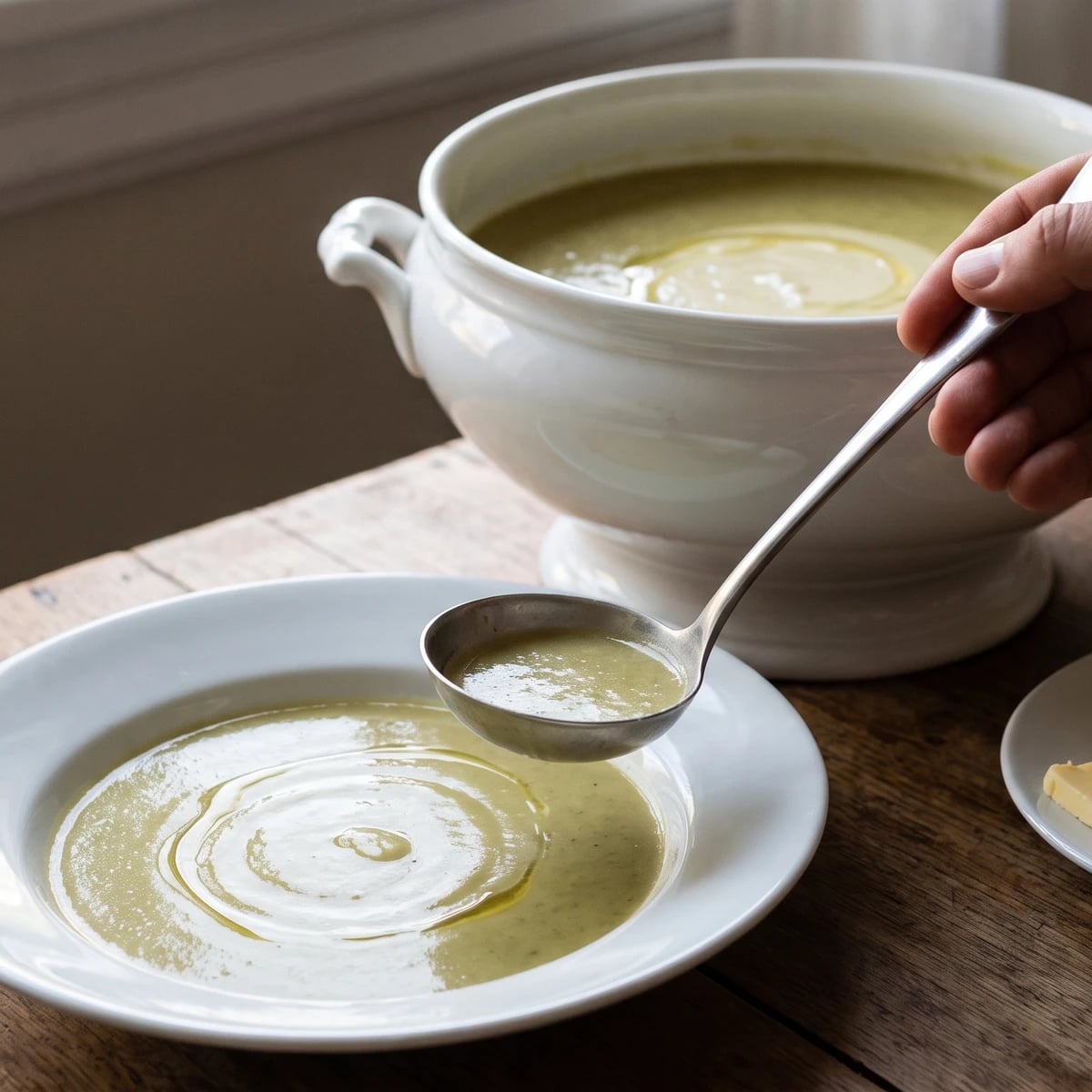
Taste and add the remaining salt only as needed. The sorrel should arrive first as a clean, lemony tartness, followed by milk and cream, while the tapioca remains invisible except for the purée’s gentle body. Ladle it into warmed bowls immediately, with no added herb or oil to distract from the source preparation. À table!
1 serving (about 245g)
Culinary guides, cultural storytelling, and the editorial depth that makes cooking meaningful.
Discover Culinary Explorer
Chef Juliette
Purée de Carottes, otherwise Crécy, turns carrots, butter, rice, and white consommé into a silken soup. The lesson is simple and absolute: blend for smoothness, then sieve for finesse.

Chef Juliette
Purée Crécy meets tender tapioca poached in white consommé, then butter brings the two together. Velours earns its name from the spoon: glossy, softly pearled, and entirely itself.

Chef Juliette
Purée de Céleri-rave turns knobby celeriac into an ivory, butter-glossed soup, its bitterness blanched away, its body supplied by potato, and its sweetness clarified by a patient half-hour of skimming.

Chef Juliette
A pale-green Flamande purée built on fresh Brussels sprouts, butter, white consommé, and potato, passed smooth and milk-finished, with crisp bread dice for the necessary bite.