Chef Juliette
Bouillabaisse à la Marseillaise
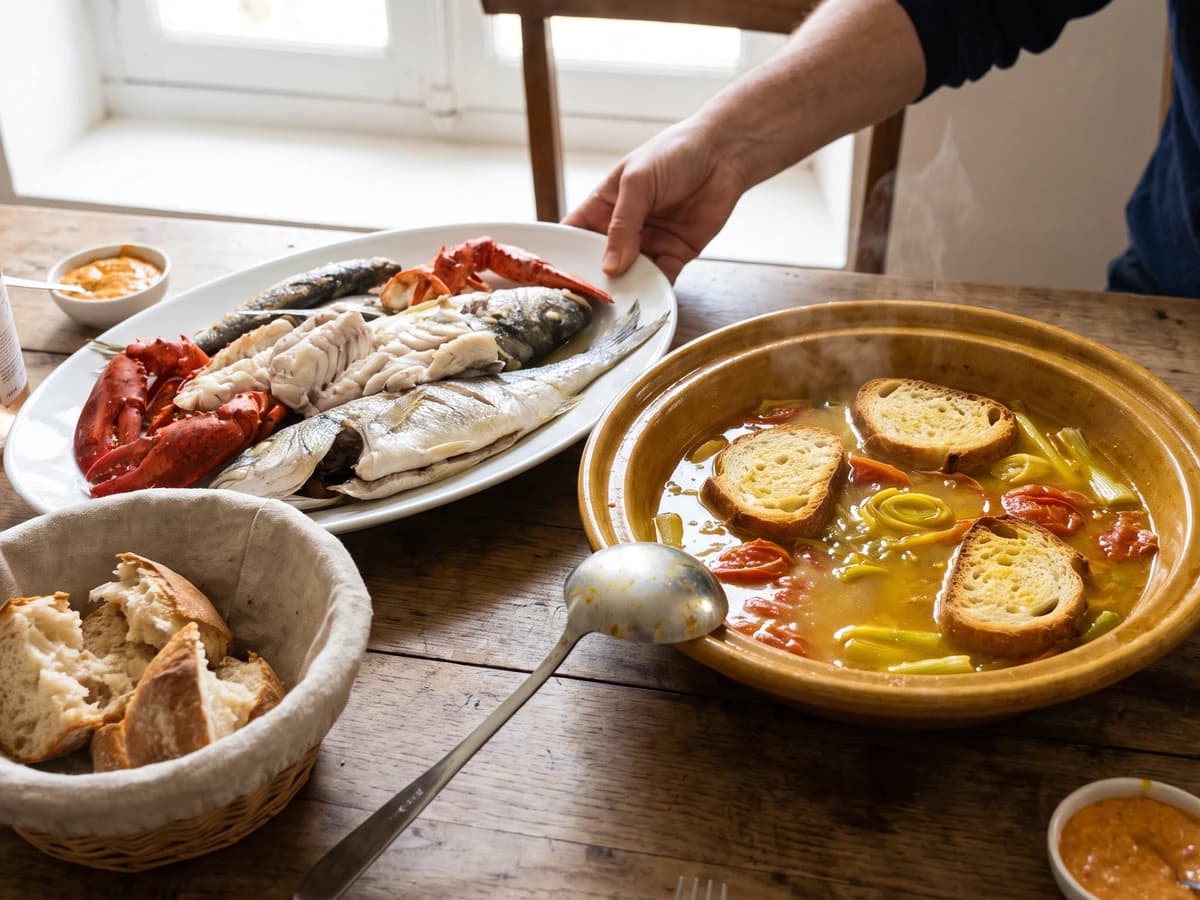
Marseille's great fish stew, saffron-gold and garlic-scented, proves that a hard boil can be the careful choice: it binds olive oil into broth before the whole pot meets bread.
A cooking platform built around craft, culture, and the stories behind what we eat.
Created by Chef Juliette
Based on No. 639, Purée de Haricots Rouges, otherwise Condé, from Le Guide Culinaire (1907) by Auguste Escoffier
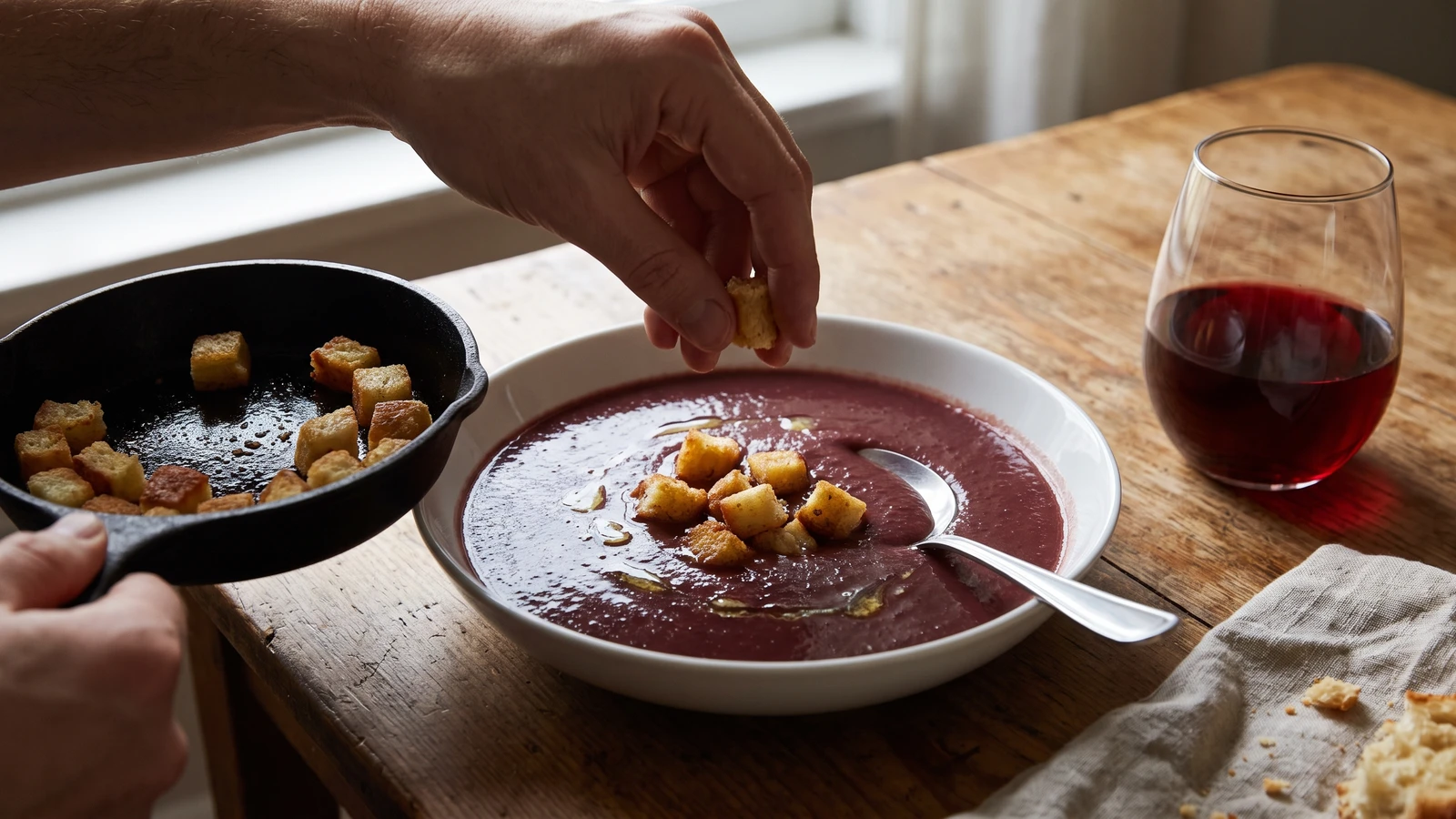
A whole bottle of red wine gives this classical red-bean purée its garnet depth; the beans simmer with aromatics, pass through a sieve, then take butter and crisp croûtons at the table.
Purée de Haricots Rouges, dite Condé (red-bean purée), teaches one true thing before you touch the pan: the wine is a cooking liquor, not a final splash. A whole bottle goes in hot and stays with the beans through their long simmer, giving the finished purée its garnet colour, gentle acidity, and deep fruit. Remove that wine and you haven't simplified Condé, you've removed its soul.
The original kitchen expected a saucier, white consommé always ready, a mortar, and a tamis (fine sieve) large enough for brigade work. At home, use unsalted light chicken stock if white consommé isn't waiting, because its clarity disappears inside the purée, while its clean body still matters. An immersion blender replaces the mortar, followed by a sturdy fine-mesh sieve. I also soak the beans so packaged kidney beans of uncertain age can soften in an acidic wine liquor, and give them the required ten-minute rolling boil before the gentle cook. Those are honest home adjustments. The whole bottle, the aromatic bundle, the slow simmer, the sieving, and the final butter stay exactly where they belong. One cook, one stove, one evening.
Pounding beans in a mortar was brigade scaffolding and can go. Cooking them until they surrender completely, then forcing the purée through the tamis, is the dish and must stay. The finished Condé should pour in a broad, glossy ribbon, rich but unmistakably a soup, with butter-fried bread dice cracking pleasantly under the spoon. The step that decides everything is tenderness: don't drain the beans until one crushes into a smooth paste between two fingers.
Purée Condé belongs to the Parisian classical potage repertoire, where cooks turned the economical dried red bean into a smooth first course with wine, consommé, butter, and a tamis. In the language of the canon, Condé came to signal red-bean preparations, an aristocratic kitchen name attached to a pantry staple rather than a claim that the soup arose in Burgundy or Lyon. This formula's whole bottle of red wine is its defining practice, not a decorative flourish.
Quantity
2½ cups (600 ml / 455 g)
sorted and rinsed
Quantity
4 quarts (3.8 liters / 3.8 kilograms), divided, plus more if needed
Quantity
⅔ cup (160 ml / 85 g)
sliced
Quantity
1
peeled
Quantity
1
Quantity
1
tied
Quantity
1 bottle, 3⅛ cups (750 ml / 745 g)
Quantity
2 to 3 cups (480 to 720 ml / 480 to 720 g)
Quantity
6 tablespoons (90 ml / 85 g)
cubed
Quantity
4 cups (960 ml / 140 g)
cut into ½-inch dice
Quantity
4 tablespoons (60 ml / 57 g)
Quantity
2 teaspoons (10 ml / 12 g), divided, plus more as needed
Quantity
½ teaspoon (2.5 ml / 1 g), plus more as needed
| Ingredient | Quantity |
|---|---|
| dried red kidney beanssorted and rinsed | 2½ cups (600 ml / 455 g) |
| cold water | 4 quarts (3.8 liters / 3.8 kilograms), divided, plus more if needed |
| carrotssliced | ⅔ cup (160 ml / 85 g) |
| small yellow onionpeeled | 1 |
| whole clove | 1 |
| small bouquet garni (parsley, thyme, and bay)tied | 1 |
| dry red wine | 1 bottle, 3⅛ cups (750 ml / 745 g) |
| white consommé, or unsalted light chicken stock | 2 to 3 cups (480 to 720 ml / 480 to 720 g) |
| cold unsalted butter for finishingcubed | 6 tablespoons (90 ml / 85 g) |
| day-old firm white breadcut into ½-inch dice | 4 cups (960 ml / 140 g) |
| unsalted butter for frying | 4 tablespoons (60 ml / 57 g) |
| fine sea salt | 2 teaspoons (10 ml / 12 g), divided, plus more as needed |
| finely ground white pepper | ½ teaspoon (2.5 ml / 1 g), plus more as needed |
Put the sorted beans in a large bowl with 2 quarts (1.9 liters) of the cold water and leave them for 8 hours. They will swell to more than twice their dry size. Drain, rinse well, and discard the soaking water. This added soak doesn't replace the long wine simmer; it gives beans of uneven age a fair chance to soften once the acidic wine enters the pot.
Put the soaked beans in a heavy pot with the remaining 2 quarts (1.9 liters) of cold water. Bring the water up gradually, then hold it at a full rolling boil for 10 minutes, skimming away the grey foam as it rises. Red kidney beans require this hard boil to neutralize their natural lectin before gentle cooking; a low simmer alone is not enough.
While the beans boil, heat the entire bottle of red wine in a separate saucepan until it reaches a lively boil. Stick the clove into the onion, then add the onion, carrots, bouquet garni, and 1 teaspoon of the salt to the beans. Pour in the boiling wine and let the pot return to a boil before lowering the heat. The wine goes in hot so the cooking never stops; this detail belongs to the dish and must stay.
Partly cover the pot and maintain the gentlest steady simmer for 1¾ to 2½ hours. Stir along the bottom occasionally and add boiling water if the beans cease to be generously covered. They are ready only when one crushes between two fingers without a grainy centre and smears like a paste. If they remain firm at the expected time, don't drain them and don't raise the heat. Add a little boiling water and continue gently. Ça se rattrape; the clock doesn't decide when a bean is cooked.
Set a colander over a large bowl and drain the beans, reserving every drop of the wine-dark cooking liquor. Remove and discard the onion, clove, carrots, and bouquet garni. Return the hot beans to the pot, add ½ cup (120 ml) of their liquor, and blend until no whole bean remains. Press the purée through a sturdy fine-mesh sieve with a flexible spatula or the back of a ladle, working in small batches. If the skins clog the mesh, loosen that batch with another spoonful of liquor. Keep pressing until only dry skins remain; this passage through the tamis is what turns crushed beans into Condé.
Return the sieved purée to a clean pot and stir in 2 cups (480 ml) of the white consommé or light chicken stock. Bring it to a bare simmer, then add more consommé a little at a time until the soup pours from the spoon in a broad ribbon and measures about 2 quarts. If it becomes too thin, simmer it uncovered until it regains body; if it stands like mashed beans, add more stock or reserved cooking liquor. Skim the surface, then season with the remaining salt and the white pepper.
Melt the frying butter in a broad skillet over medium heat. Add the bread dice in one layer and toss them patiently until every face is crisp and deep butter-gold, 6 to 8 minutes. Work in two batches if the pan is crowded. Drain briefly on a clean cloth or paper, then keep the croûtons uncovered so they remain crisp.
Take the soup off the heat. Whisk in the cold finishing butter a few cubes at a time until the Condé gleams and feels round on the tongue. This is monter au beurre, finishing with butter to form a soft emulsion. Don't boil it afterward. If butter beads appear on the surface, stop and whisk in 1 tablespoon of hot consommé before continuing one cube at a time. Ça se rattrape. Taste once more, ladle into warm bowls, and scatter the croûtons over each serving at the last moment. À table!
1 serving (about 260g)
Culinary guides, cultural storytelling, and the editorial depth that makes cooking meaningful.
Discover Culinary ExplorerChef Juliette
Marseille's great fish stew, saffron-gold and garlic-scented, proves that a hard boil can be the careful choice: it binds olive oil into broth before the whole pot meets bread.
Chef Juliette
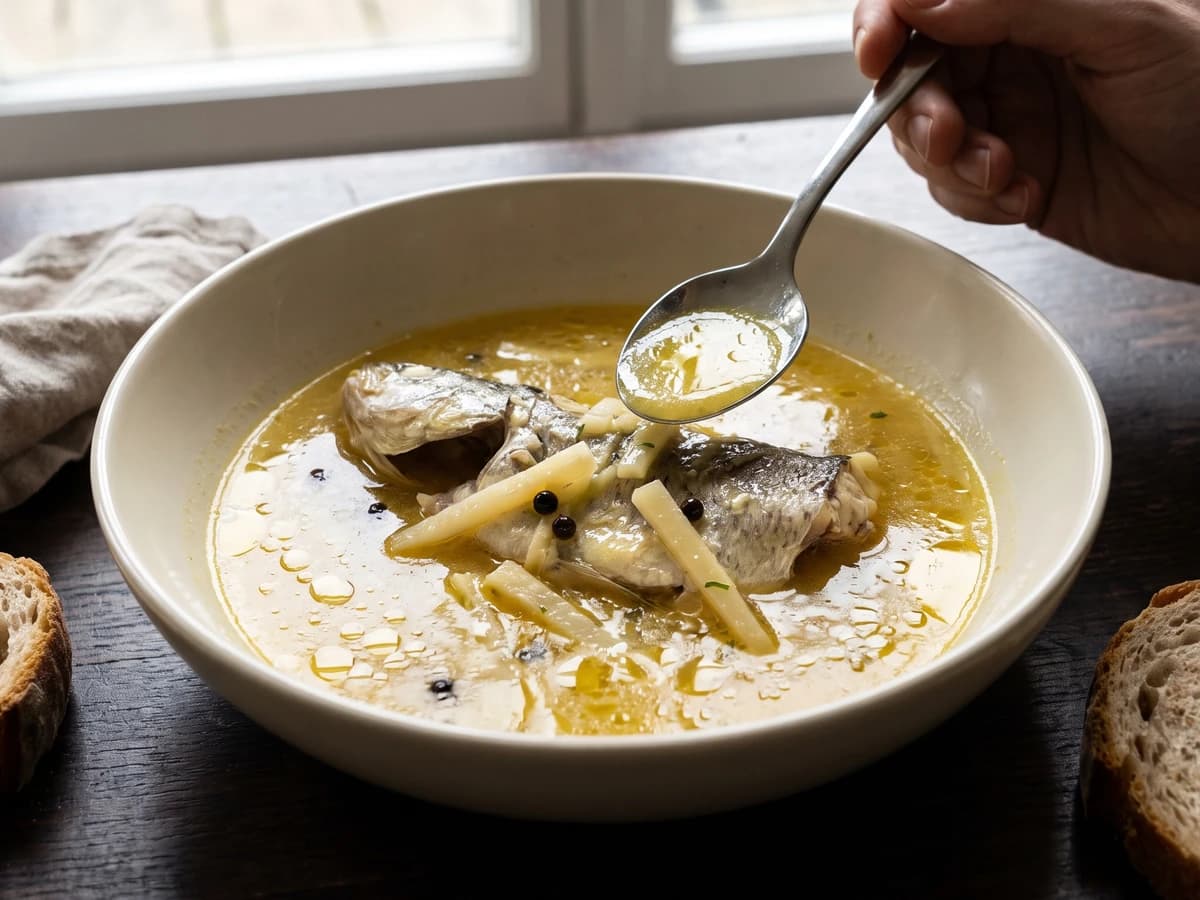
Waterzoi asks fresh, bone-in river fish to thicken its own buttery broth, with parsley root and pepper for company. No flour, no stockpot, just a brisk simmer watched closely.
Chef Juliette
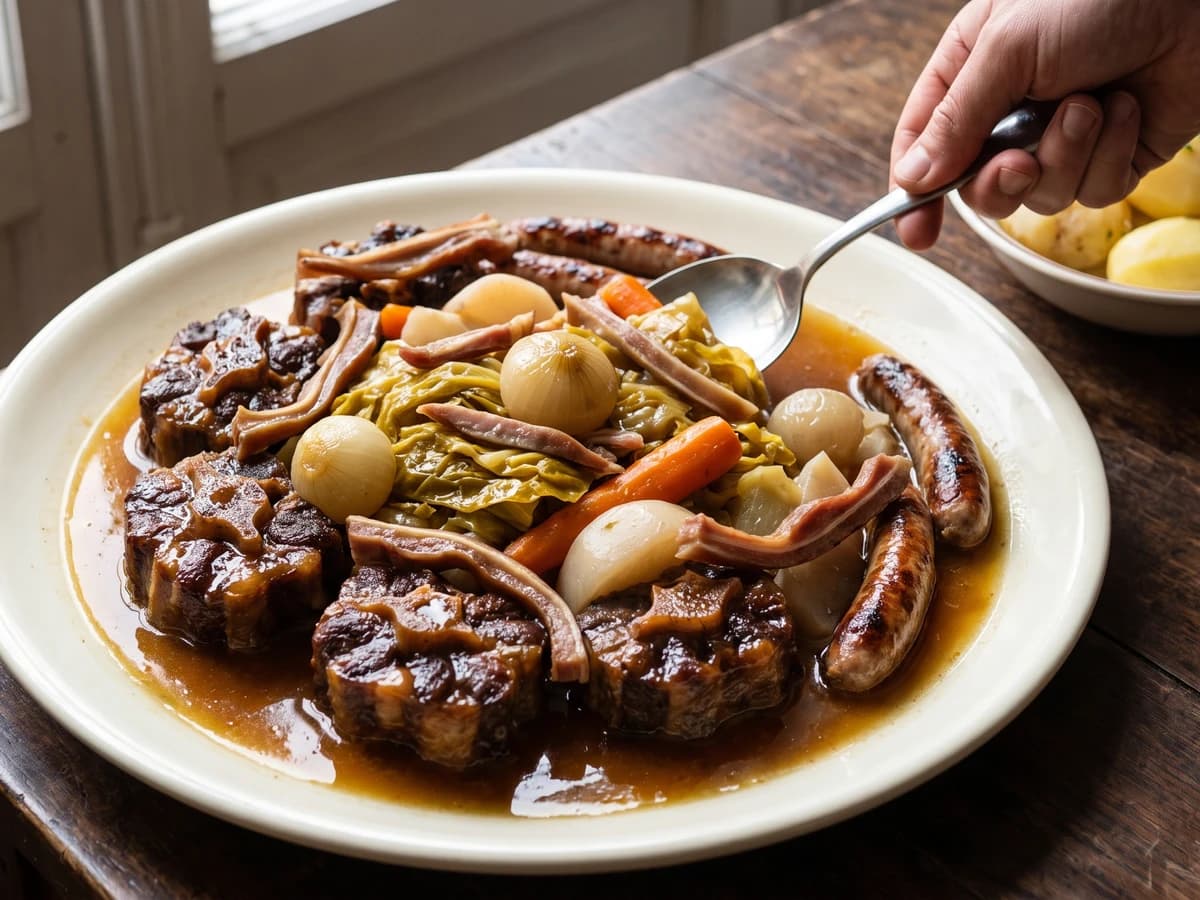
Queue de Bœuf en Hochepot gathers oxtail, pig's trotter and ear, cabbage, roots, and grilled chipolatas around a clear, gelatin-rich broth whose quiet simmer keeps every piece tender and distinct.
Chef Juliette
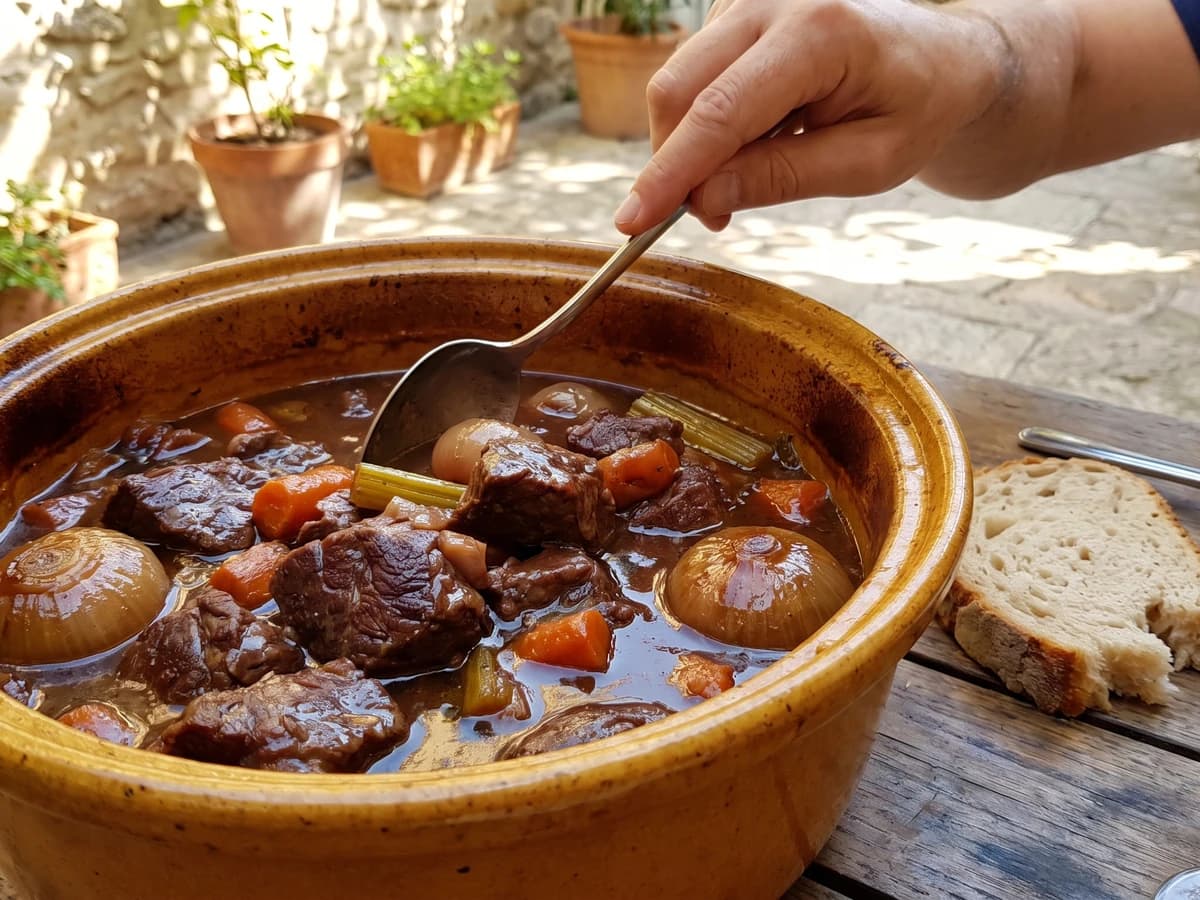
Beef shoulder larded with bacon, sharpened by red wine and vinegar, then sealed with garlic, vegetables, and dry lemon peel until the low oven turns it yielding and the gravy darkly glossy.