Chef Juliette
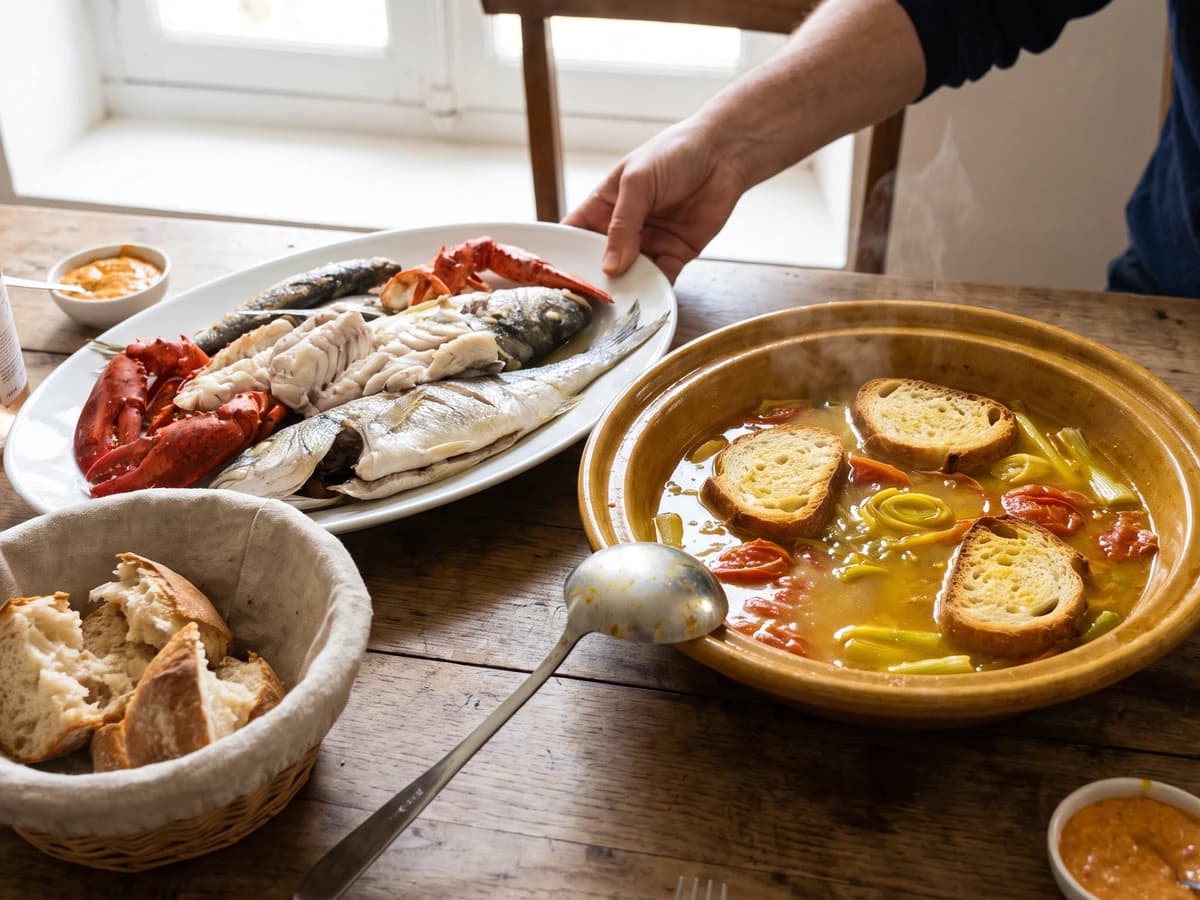
Bouillabaisse à la Marseillaise
Marseille's great fish stew, saffron-gold and garlic-scented, proves that a hard boil can be the careful choice: it binds olive oil into broth before the whole pot meets bread.
A cooking platform built around craft, culture, and the stories behind what we eat.
Created by Chef Juliette
Based on No. 629, Gelee de Volaille à la Napolitaine, from Le Guide Culinaire (1907) by Auguste Escoffier
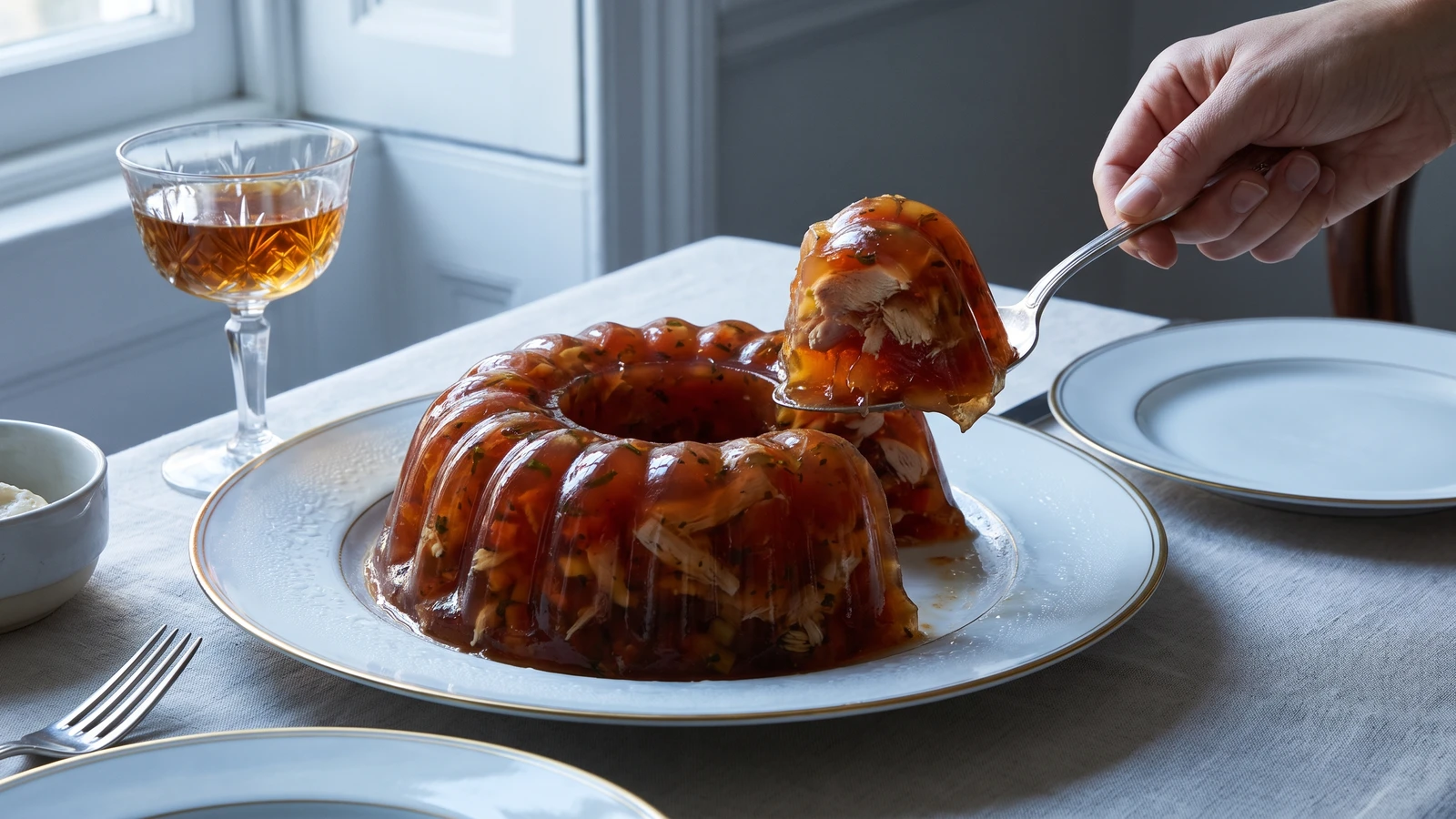
A clear, tender chicken jelly carrying the tomato-bright depth of Consommé Portugaise and the round perfume of port or old Marsala, made ahead and unmoulded cold for a generous first course.
Gelée de Volaille à la Napolitaine (a clear chicken jelly with port or old Marsala) teaches the fine distinction between a tender set and a rubber one. The gelée should tremble when the platter moves, yield cleanly to a spoon, and melt almost at once on the tongue. The one true thing to know before touching a pan is that you must test the set cold. Warm liquid cannot tell you what the finished texture will be.
The original recipe assumed that Consommé Portugaise already stood ready, built from poultry stock kept constantly at hand and clarified under a saucier's eye. It also assumed enough natural gelatin in that stock to hold a large service mold. Your honest home equivalent is the same finished Consommé Portugaise, brought in whole from its own preparation, strengthened with a measured amount of unflavored gelatin, and set in one manageable mold. Repeated clarification and ranks of little service molds were brigade scaffolding, so they can go. The clear consommé, the delicate set, and the book's finish of one port wine-glass per quart must stay.
That finish gives two wine-glasses for this home batch, either port or old Marsala, stirred in away from the heat so its perfume remains alive. One cook, one stove, one evening of work, then the cold does the rest. Before filling the mold, chill one spoonful and judge it: the gelée should quiver, not bounce.
Gelée de Volaille à la Napolitaine belongs to the Parisian grand-kitchen repertory of cold consommés and buffet aspics, where clarified poultry broth could appear as a first course rather than merely coating another dish. Its structure comes from Consommé Portugaise, whose tomato character gives the clear jelly a warm tint, while the Napolitaine finish is the final glass of fortified wine, particularly old Marsala. The title is French menu language rather than proof of a household soup from Naples; its true home is the French cold table, where clarity and a tender set displayed the saucier's command.
Quantity
2 quarts (1.9 L / about 1.9 kg)
completely cold and finely strained
Quantity
3 tablespoons plus 2 teaspoons (55 ml / 35 g)
use 32 g initially and reserve 3 g
Quantity
2 port wine-glasses, 1/2 cup (120 ml / about 125 g)
Quantity
1 tablespoon (15 ml / 15 g)
for correcting a weak set
Quantity
as needed
| Ingredient | Quantity |
|---|---|
| prepared Consommé Portugaisecompletely cold and finely strained | 2 quarts (1.9 L / about 1.9 kg) |
| unflavored powdered gelatinuse 32 g initially and reserve 3 g | 3 tablespoons plus 2 teaspoons (55 ml / 35 g) |
| port or old Marsala | 2 port wine-glasses, 1/2 cup (120 ml / about 125 g) |
| cold water (optional)for correcting a weak set | 1 tablespoon (15 ml / 15 g) |
| fine salt (optional) | as needed |
Rinse a smooth 2 1/2-quart mold with very cold water, drain it without drying, and place it in the refrigerator with the serving platter. Put a small saucer in the freezer for the set test. The thin film of water helps the finished gelée release without coating its clear surface in oil.
Pour 1 cup (240 ml / about 240 g) of the cold prepared Consommé Portugaise into a wide bowl. Reserve 1 teaspoon (5 ml / 3 g) of the gelatin, then sprinkle the remaining 32 g evenly over the consommé. Do not empty it into one mound, which leaves dry pellets trapped inside. Let it stand for 10 minutes, until every grain has swollen and the mixture resembles a soft, opaque sponge.
Warm the remaining prepared Consommé Portugaise in a 3-quart saucepan over gentle heat to 60 to 65°C, hot enough to dissolve gelatin but nowhere near a simmer. Remove the pan from the heat, add the bloomed gelatin, and stir slowly until the liquid is perfectly clear. Stir in the 2 port wine-glasses of port or old Marsala, exactly one glass for each quart as the source directs. Taste a chilled teaspoonful rather than the warm liquid; cold mutes seasoning, so add a small pinch of salt only if the cold sample tastes flat.
Spoon 2 tablespoons (30 ml / about 30 g) onto the frozen saucer and chill it for 8 to 10 minutes. Push it with the tip of a spoon. It should wrinkle gently, part cleanly, and tremble when the saucer moves. If it remains liquid, ça se rattrape: sprinkle the reserved 1 teaspoon (5 ml / 3 g) gelatin over the cold water, leave it for 5 minutes, then dissolve it in 1/2 cup (120 ml / about 120 g) of the warm gelée and stir that mixture back into the pan. Test again before proceeding.
Pass the gelée through a fine sieve lined with damp muslin into a clean metal bowl, letting it run without pressing. Set the bowl over ice and stir slowly until the liquid feels cool but remains fluid. If it begins to thicken around the bowl before you can pour it, set the bowl briefly over barely warm water and stir until fluid again. Pour it down the side of the chilled mold to avoid bubbles, then lift away any surface foam with the edge of a spoon.
Refrigerate the mold until the surface has set, about 30 minutes, then cover it without letting the covering touch the gelée. Chill for at least 6 hours, preferably overnight. The finished gelée should be quite clear and firm enough to unmold, yet soft enough to quiver rather than stand rigid.
Dip the mold into warm water for 5 seconds, dry the outside, and invert it onto the chilled platter. If it does not release, repeat the dip for only 2 seconds; too long in the water melts the outer detail. Serve the gelée very cold, using a broad spoon so each portion keeps its trembling shape. No stray herbs or decorative vegetables belong on it. Clarity is its finish. À table!
1 serving (about 185g)
Culinary guides, cultural storytelling, and the editorial depth that makes cooking meaningful.
Discover Culinary ExplorerChef Juliette
Marseille's great fish stew, saffron-gold and garlic-scented, proves that a hard boil can be the careful choice: it binds olive oil into broth before the whole pot meets bread.
Chef Juliette
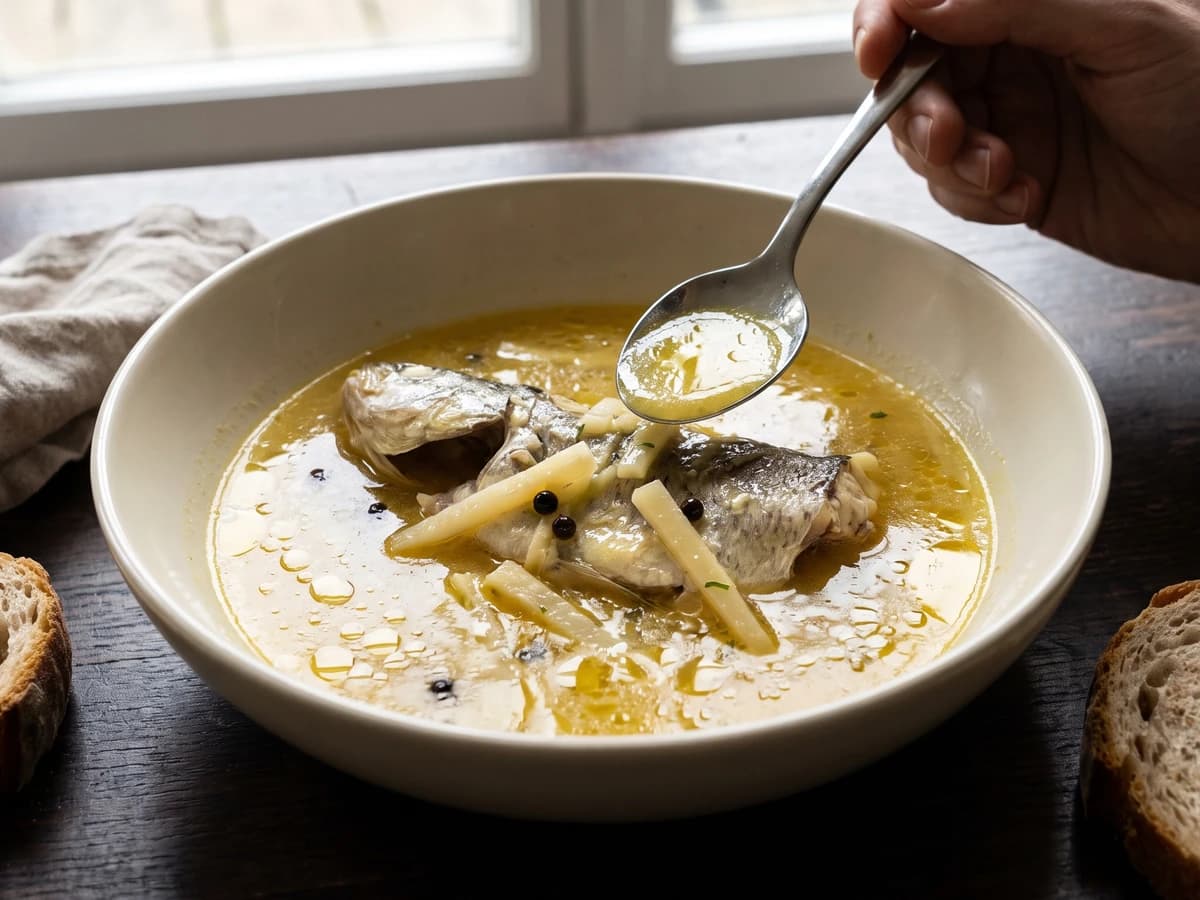
Waterzoi asks fresh, bone-in river fish to thicken its own buttery broth, with parsley root and pepper for company. No flour, no stockpot, just a brisk simmer watched closely.
Chef Juliette
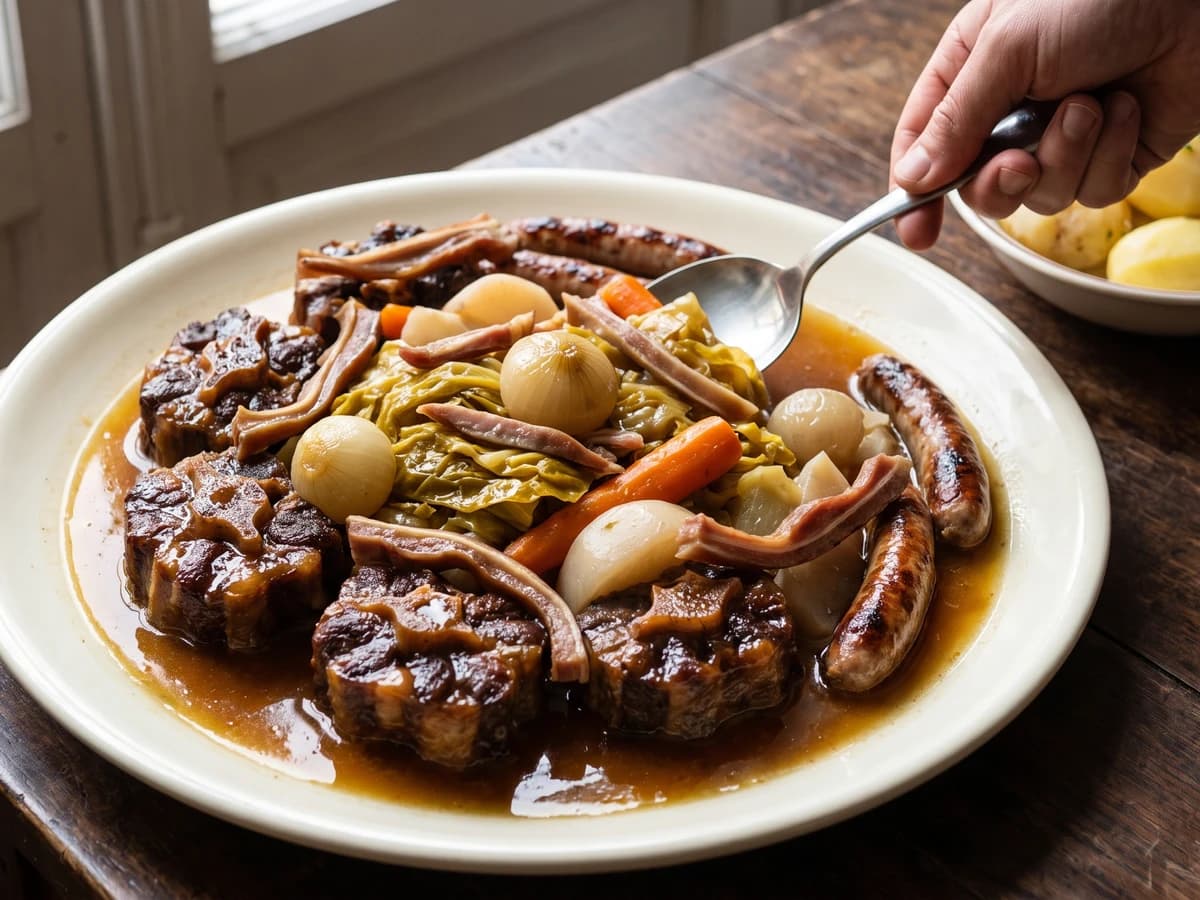
Queue de Bœuf en Hochepot gathers oxtail, pig's trotter and ear, cabbage, roots, and grilled chipolatas around a clear, gelatin-rich broth whose quiet simmer keeps every piece tender and distinct.
Chef Juliette
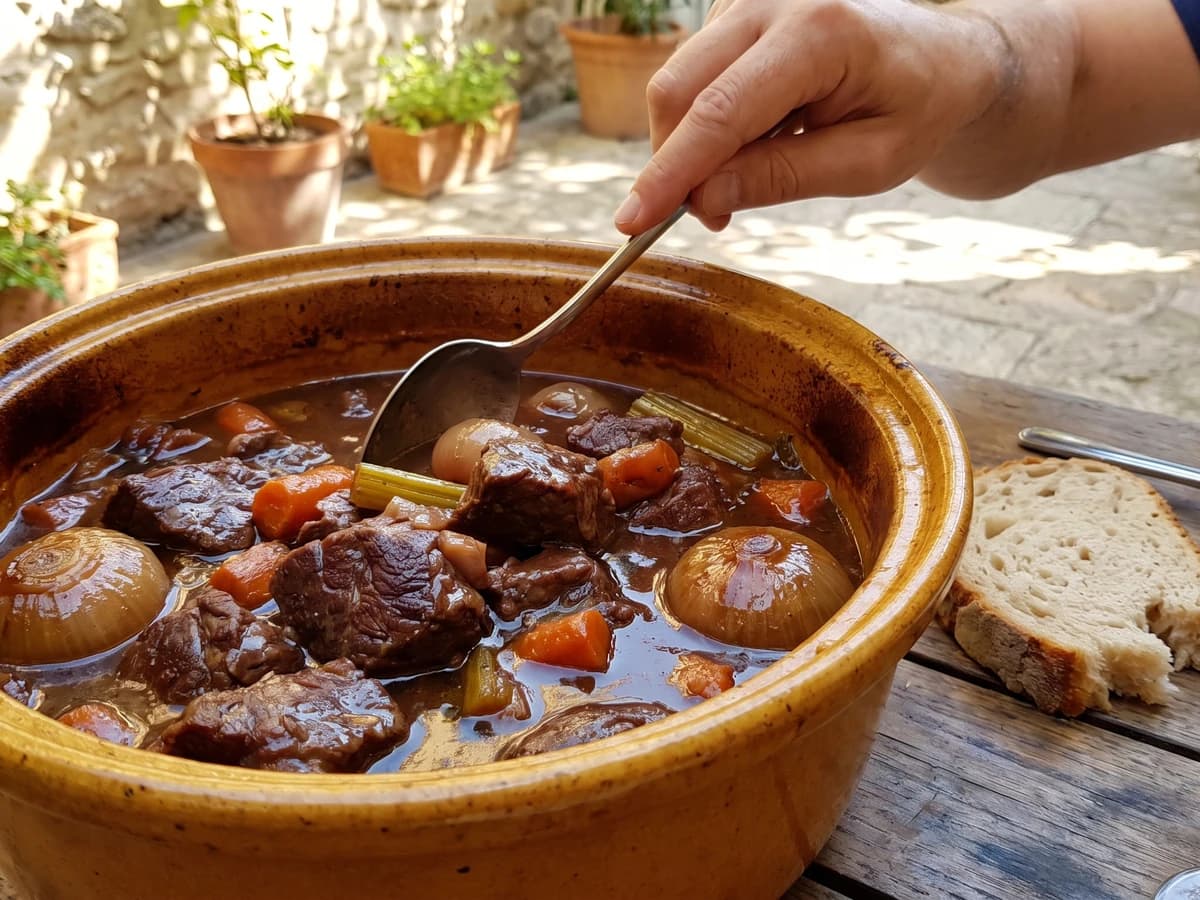
Beef shoulder larded with bacon, sharpened by red wine and vinegar, then sealed with garlic, vegetables, and dry lemon peel until the low oven turns it yielding and the gravy darkly glossy.