
Chef Juliette
Consommé Alexandra
A clear chicken consommé gains the faintest body from tapioca, then carries fine chicken julienne, long grooved quenelles, and lettuce chiffonade, each garnish distinct beneath the shimmering golden broth.
A cooking platform built around craft, culture, and the stories behind what we eat.
Created by Chef Juliette
Based on No. 625, Consommé à la Madrilène, from Le Guide Culinaire (1907) by Auguste Escoffier
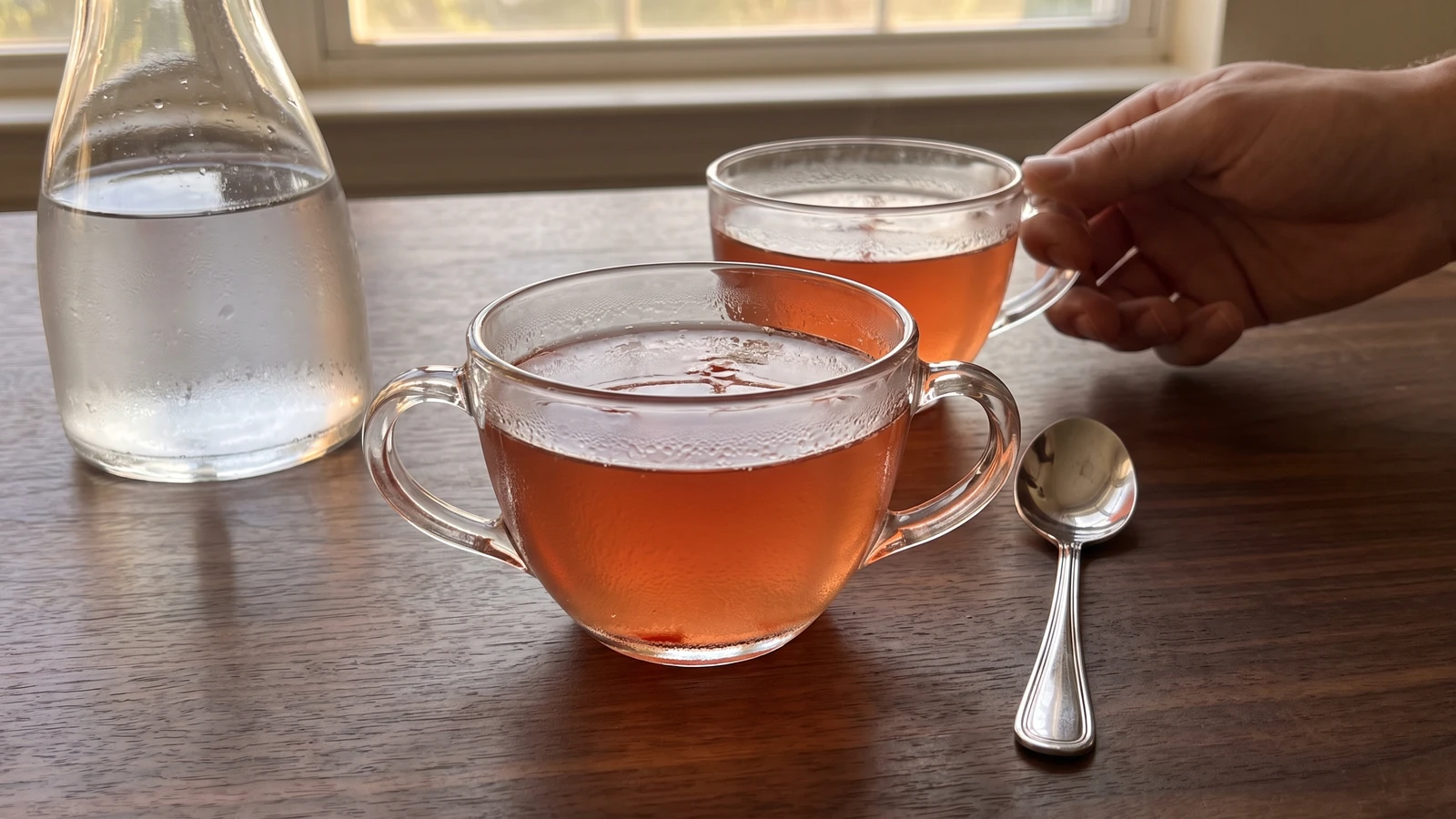
Raw tomato and red capsicum join the clarification, not the bowl, leaving this chilled consommé rose-amber, deeply savory, and perfectly clear: a lesson in patient heat and colder service.
Consommé à la Madrilène (Madrid-style clarified broth) teaches the discipline behind every clear soup: clarity is decided while the pot is still cold. Once the raft has risen, the liquid may tremble but it must never boil. The tomato and capsicum should leave their fragrance and rose-amber color behind without a visible fragment.
The classical formula assumed a saucier on staff and a stock never off the fire. A home kitchen offers one heavy pot, a damp cloth, and a bowl of ice, which are honest equivalents. We begin with 9 cups of stock so the raft can keep its share and still leave about 2 quarts, while the source proportion stays exact: 4 ounces of raw tomato and 1 ounce of capsicum for every quart. Multiple stockpots and repeated passings are brigade scaffolding, so they can go. The beef-and-egg clarification is the dish, so it stays. One cook, one stove, one evening of attention, then the refrigerator takes the watch.
Your reward is a consommé with the depth of beef, the fresh acidity of tomato, and the quiet sweetness of red capsicum, all held in a broth clear enough to catch the light. Bring the cold pot up slowly, stir until the raft forms, then stop. That is the step that decides the Madrilène.
Consommé à la Madrilène belongs to French classical nomenclature, where à la Madrilène points toward the tomato and sweet capsicum associated with Madrid rather than naming a customary household soup of the city. It traveled through formal French dining rooms as both a clear cold consommé and a lightly jellied one, prized for the contradiction of red produce yielding transparent broth. In this formula the distinction is exact: tomato and capsicum flavor the clarification itself, then disappear with the raft.
Quantity
9 cups (2.13 L / about 2.13 kg)
unsalted and thoroughly degreased
Quantity
1¾ cups loosely packed (415 ml / 14 oz / 400 g)
kept cold
Quantity
4 large, plus 2 large if reclarifying
Quantity
1½ cups (355 ml / 9 oz / 255 g)
cored and finely chopped
Quantity
scant ½ cup (110 ml / 2¼ oz / 64 g)
seeded and finely chopped
Quantity
up to 2 teaspoons (10 ml / 12 g)
| Ingredient | Quantity |
|---|---|
| cold, rich beef stock for consomméunsalted and thoroughly degreased | 9 cups (2.13 L / about 2.13 kg) |
| very lean ground beefkept cold | 1¾ cups loosely packed (415 ml / 14 oz / 400 g) |
| egg whites | 4 large, plus 2 large if reclarifying |
| ripe raw tomatoescored and finely chopped | 1½ cups (355 ml / 9 oz / 255 g) |
| red capsicumseeded and finely chopped | scant ½ cup (110 ml / 2¼ oz / 64 g) |
| fine sea salt | up to 2 teaspoons (10 ml / 12 g) |
Begin with the stock at refrigerator temperature and completely free of surface fat. Lift off any hardened fat, then pass the stock through a fine sieve and measure it only after any reduction or degreasing. Nine cups of stock take precisely 9 ounces of raw tomato and 2¼ ounces of capsicum, preserving the classical proportion of 4 ounces and 1 ounce respectively for every quart. The extra starting cup allows for the liquid held by the raft, leaving about 2 quarts for the table.
Loosen 4 egg whites with a fork until fluid but not foamy. Mix them thoroughly with the cold ground beef, tomato, and capsicum, then work in 1 cup of the measured stock to loosen the mixture. Put this clarification into a heavy 6-quart pot and stir in the remaining stock. Everything must be cold when it meets the heat, because the slowly tightening proteins need time to gather the particles that would otherwise cloud the consommé. It will look alarming. It is exactly right.
Set the pot over medium-low heat and stir steadily along the bottom with a flat wooden spoon so the clarification cannot catch. As the liquid approaches a simmer, the beef and egg white will rise into a solid raft. Stop stirring the instant that raft forms, open a small chimney through its center with the spoon handle, and lower the heat. Hold the liquid at a bare tremble, about 185 to 190°F (85 to 88°C), for 35 to 40 minutes. Let the broth circulate through the chimney, but never permit a hard boil. If the raft breaks apart, cut the heat and leave the pot untouched for 10 minutes. Ça se rattrape: strain gently, chill the cloudy broth completely, whisk the 2 reserved whites with 1 cup of it, return that mixture to the rest, and repeat the slow clarification.
Take the pot off the heat and let it stand for 10 minutes. Line a fine sieve or chinois with clean muslin rinsed in cold water, then ladle the consommé through the chimney and into the cloth. When the liquid runs low, tip the pot very gently and stop before the raft or bottom sediment reaches the sieve. Never press the solids. Pressure squeezes every captured particle back into the broth and undoes the work.
Taste the consommé while it is warm and add the salt gradually until the tomato, sweet capsicum, and beef taste distinct but balanced. Set the bowl in a larger bowl filled with equal parts ice and water, then stir gently every few minutes until the consommé falls below 70°F (21°C). Refrigerate until it reaches 40°F (4°C), cover, and continue chilling for at least 6 hours or overnight. Lift away any final speck of fat from the cold surface and taste again, because cold quiets seasoning; add a small pinch of salt if the broth has gone flat.
Chill the consommé cups for 30 minutes. If the Madrilène remains liquid, pour it directly into the cold cups. If the stock's natural gelatin gives it a soft set, do not warm it; loosen it gently with a cold whisk into a clear, trembling gel and spoon it in. Serve immediately, without garnish, as cold as the kitchen allows. À table!
1 serving (about 240g)
Culinary guides, cultural storytelling, and the editorial depth that makes cooking meaningful.
Discover Culinary ExplorerChef Juliette
A clear chicken consommé gains the faintest body from tapioca, then carries fine chicken julienne, long grooved quenelles, and lettuce chiffonade, each garnish distinct beneath the shimmering golden broth.

Chef Juliette
Crystal-clear chicken consommé poured over jewel-like dice of truffle, tomato, and pea royale, with fine chicken and mushroom: a formal first course made practical for one careful home cook.

Chef Juliette
Consommé Andalouse sets a jewel-clear chicken broth around tomato royale, ham julienne, separate grains of rice, and fragile egg threads, a lesson in precision whose final pour must be swift and gentle.

Chef Juliette
A crystal-clear consommé set with jewel-like vegetable and truffle pearls, tender chicken quenelles, peas, and asparagus royale, where precision in the garnish makes a formal soup feel generous rather than fussy.