Chef Juliette
Bouillabaisse à la Marseillaise
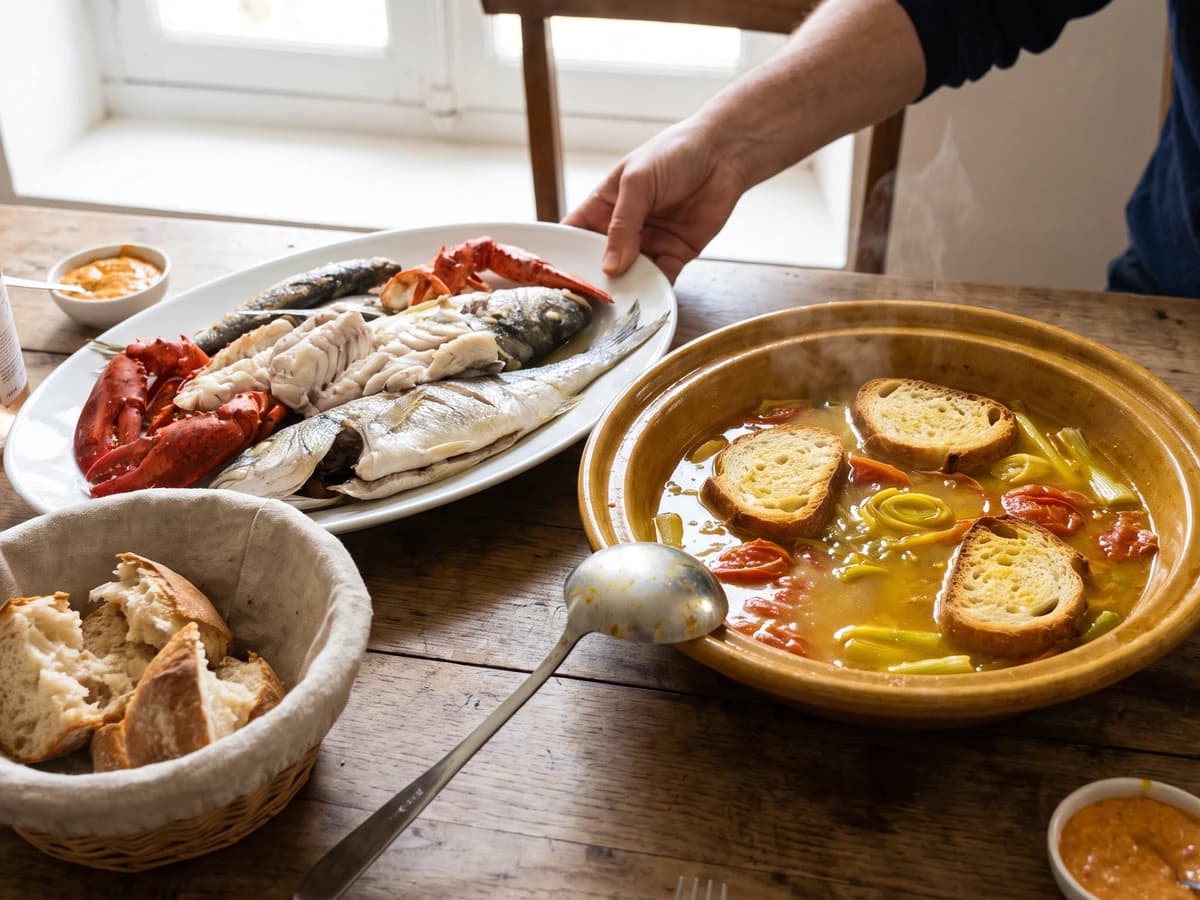
Marseille's great fish stew, saffron-gold and garlic-scented, proves that a hard boil can be the careful choice: it binds olive oil into broth before the whole pot meets bread.
A cooking platform built around craft, culture, and the stories behind what we eat.

Created by Chef Juliette
Based on No. 613, Consommé Souveraine, from Le Guide Culinaire (1907) by Auguste Escoffier
Consommé Souveraine turns clarity into ceremony: lucid chicken broth, pale quenelles enclosing a cold brunoise heart, green peas, and chervil, all balanced on the gentlest eight-minute poach.
Consommé Souveraine (clear chicken broth with stuffed oval chicken dumplings) teaches the discipline of separation. The broth must arrive lucid, so the vegetables and quenelles are cooked away from its final quart; clarity is not decoration here, it is the dish's first flavor. Inside each quenelle sits a cold heart of brunoise, very fine vegetable dice, hidden beneath a continuous dome of chicken forcemeat.
The original assumed a saucier, chicken consommé never far from the fire, prepared forcemeat, and enough hands to mould ten identical quenelles. At home, a chilled food processor replaces the mortar, one pass through a fine sieve replaces repeated pounding, and a wide buttered sauté pan becomes the poaching station. That is brigade scaffolding, and it can go. The cold brunoise, the sealed forcemeat, the gentle eight-minute poach, and the boiling consommé poured over everything at service are the dish itself, and they stay. One cook, one stove, one evening.
When it is right, the broth gleams amber around pale, tender quenelles, with peas showing green beneath the surface and chervil just releasing its fragrance. The one step that decides everything is keeping the forcemeat thoroughly cold while the cream enters; protect that emulsion and the rest becomes careful assembly.
Consommé Souveraine belongs to the Parisian grande cuisine repertoire, where a consommé's second name identified its garnish and fixed the service as precisely as a sauce name. Souveraine pairs clarified chicken broth with chicken forcemeat quenelles enclosing a cooked brunoise, plus peas and chervil; the title names that formal garnish rather than proving a royal origin. From grand dining rooms it passed to bourgeois celebration tables, where the arrival of a full soup tureen made clear broth ceremonial without changing its disciplined foundation.
Quantity
1 quart plus ¼ cup (4¼ cups / 1.02 litres / about 1.02 kg)
divided
Quantity
2 tablespoons (30 ml / 18 g)
cut brunoise-fashion into 2 mm dice
Quantity
1 tablespoon (15 ml / 12 g)
cut brunoise-fashion into 2 mm dice
Quantity
1 tablespoon (15 ml / 8 g)
cut brunoise-fashion into 2 mm dice
Quantity
1½ packed cups (355 ml / 250 g)
sinew removed, cut into 2.5 cm pieces and thoroughly chilled
Quantity
1 (2 tablespoons / 30 ml / 30 g)
thoroughly chilled
Quantity
⅔ cup (160 ml / 160 g)
thoroughly chilled
Quantity
1 teaspoon (5 ml / 6 g)
Quantity
⅛ teaspoon (0.6 ml / 0.3 g)
Quantity
1 teaspoon (5 ml / 5 g)
softened
Quantity
4 cups (960 ml / 960 g), or enough to cover the quenelles
for poaching
Quantity
2 tablespoons (30 ml / 30 g)
fresh or frozen
Quantity
1 teaspoon (5 ml / 0.3 g)
delicate picked leaf shreds
| Ingredient | Quantity |
|---|---|
| prepared chicken consommédivided | 1 quart plus ¼ cup (4¼ cups / 1.02 litres / about 1.02 kg) |
| carrotcut brunoise-fashion into 2 mm dice | 2 tablespoons (30 ml / 18 g) |
| turnipcut brunoise-fashion into 2 mm dice | 1 tablespoon (15 ml / 12 g) |
| tender leek whitecut brunoise-fashion into 2 mm dice | 1 tablespoon (15 ml / 8 g) |
| skinless boneless chicken breastsinew removed, cut into 2.5 cm pieces and thoroughly chilled | 1½ packed cups (355 ml / 250 g) |
| large egg whitethoroughly chilled | 1 (2 tablespoons / 30 ml / 30 g) |
| heavy creamthoroughly chilled | ⅔ cup (160 ml / 160 g) |
| fine sea salt | 1 teaspoon (5 ml / 6 g) |
| finely ground white pepper | ⅛ teaspoon (0.6 ml / 0.3 g) |
| unsalted buttersoftened | 1 teaspoon (5 ml / 5 g) |
| waterfor poaching | 4 cups (960 ml / 960 g), or enough to cover the quenelles |
| petits poisfresh or frozen | 2 tablespoons (30 ml / 30 g) |
| chervil pluchesdelicate picked leaf shreds | 1 teaspoon (5 ml / 0.3 g) |
Put the extra ¼ cup of chicken consommé in a small saucepan and add the carrot, turnip, and leek cut brunoise-fashion. Hold them at a bare simmer for 4 to 5 minutes, until tender but still distinct beneath the teeth; a hard boil frays those tiny edges. Drain thoroughly through a fine sieve, spread the brunoise on a cold plate, and chill it completely. Wet or warm vegetables will loosen the forcemeat from inside, so do not shape the quenelles until the brunoise is cold and dry.
Chill the food processor bowl and blade for 15 minutes. Add the cold chicken, salt, and white pepper, then pulse until the meat becomes very fine and tacky, scraping down the bowl twice. Add the cold egg white and process just until absorbed. With the motor running, pour in the cold cream in a thin, steady thread; stop as soon as the farce mousseline, the silky cream-bound chicken forcemeat, looks smooth, glossy, and softly firm. Press it once through a fine-mesh sieve, set the bowl over ice, and chill for 20 minutes. Poach a teaspoonful in barely trembling water: it should hold cleanly and feel tender. If it feathers, leaks fat, or slumps, it became warm. Stop, chill it thoroughly over ice, pulse it two or three times, and test again. Ça se rattrape.
Butter a wide sauté pan lightly. Keep the forcemeat bowl over ice and set a cup of hot water beside you. Line a dessertspoon with a thin, even coat of forcemeat, leaving no bare patch. Put about ½ teaspoon of cold brunoise in the centre, keeping it clear of the edges, then cover it with another layer of forcemeat and shape a smooth dome. Dip a second dessertspoon into the hot water, slide it beneath the quenelle, and transfer the quenelle to the buttered pan. Repeat until you have ten large quenelles. Patch any exposed brunoise with cold forcemeat; the seal must be continuous. If the mixture begins to slump, return the whole pan and bowl to the cold for 10 minutes. Patience, not flour.
Heat the water until it barely trembles, about 82 to 85°C (180 to 185°F), then pour it carefully down the side of the sauté pan so the quenelles are covered without being disturbed. Set the pan over low heat and poach for 8 minutes, maintaining that gentle tremble throughout. Do not boil them. Boiling can split the seams and toughen the forcemeat; if the water surges, lift the pan off the heat and add a splash of cool water before continuing. A quenelle whose seam starts to open can still be saved: stop moving it, lower the heat, and let the chicken set around the opening. At 8 minutes the quenelles should feel lightly springy, and the centre of a test quenelle should reach 74°C (165°F). Lift them out with a slotted spoon and drain well.
Fill the soup tureen with hot water, let it stand for a minute, then empty and dry it. Blanch the petits pois in the quenelle poaching water for 30 seconds if frozen or up to 1 minute if fresh, then drain them. Arrange the ten quenelles and peas in the warmed tureen. Meanwhile, bring the full quart of chicken consommé to a clean boil in a separate saucepan. Skim the surface rather than stirring it; if a few fat beads appear, touch them with the corner of a clean paper towel and lift them away at once.
Pour the boiling chicken consommé over the quenelles and peas without splashing the sides of the tureen. Add the chervil pluches at the last moment so their fragrance stays bright, then carry the tureen straight to the table. Give each guest two or three quenelles and enough clear consommé to surround them generously. À table!
1 serving (about 370g)
Culinary guides, cultural storytelling, and the editorial depth that makes cooking meaningful.
Discover Culinary ExplorerChef Juliette
Marseille's great fish stew, saffron-gold and garlic-scented, proves that a hard boil can be the careful choice: it binds olive oil into broth before the whole pot meets bread.
Chef Juliette
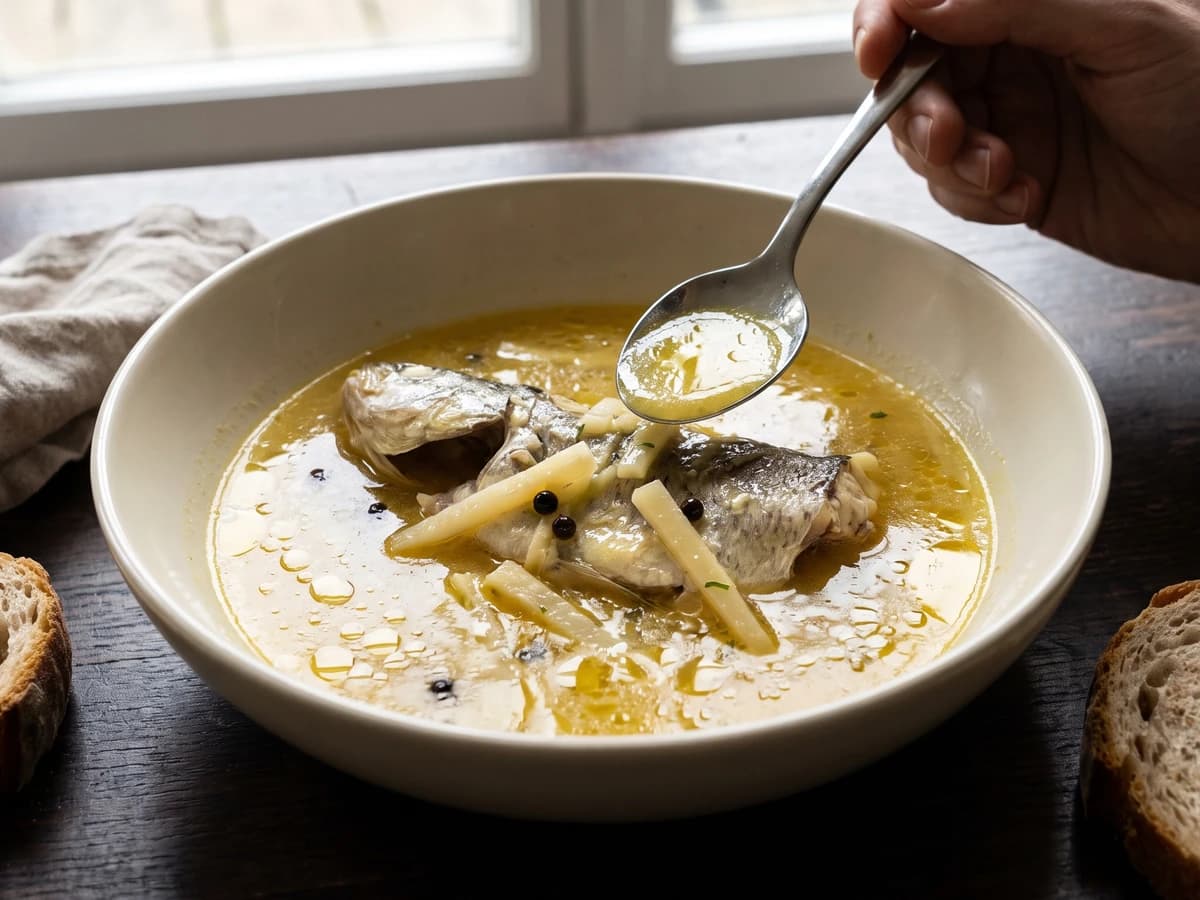
Waterzoi asks fresh, bone-in river fish to thicken its own buttery broth, with parsley root and pepper for company. No flour, no stockpot, just a brisk simmer watched closely.
Chef Juliette
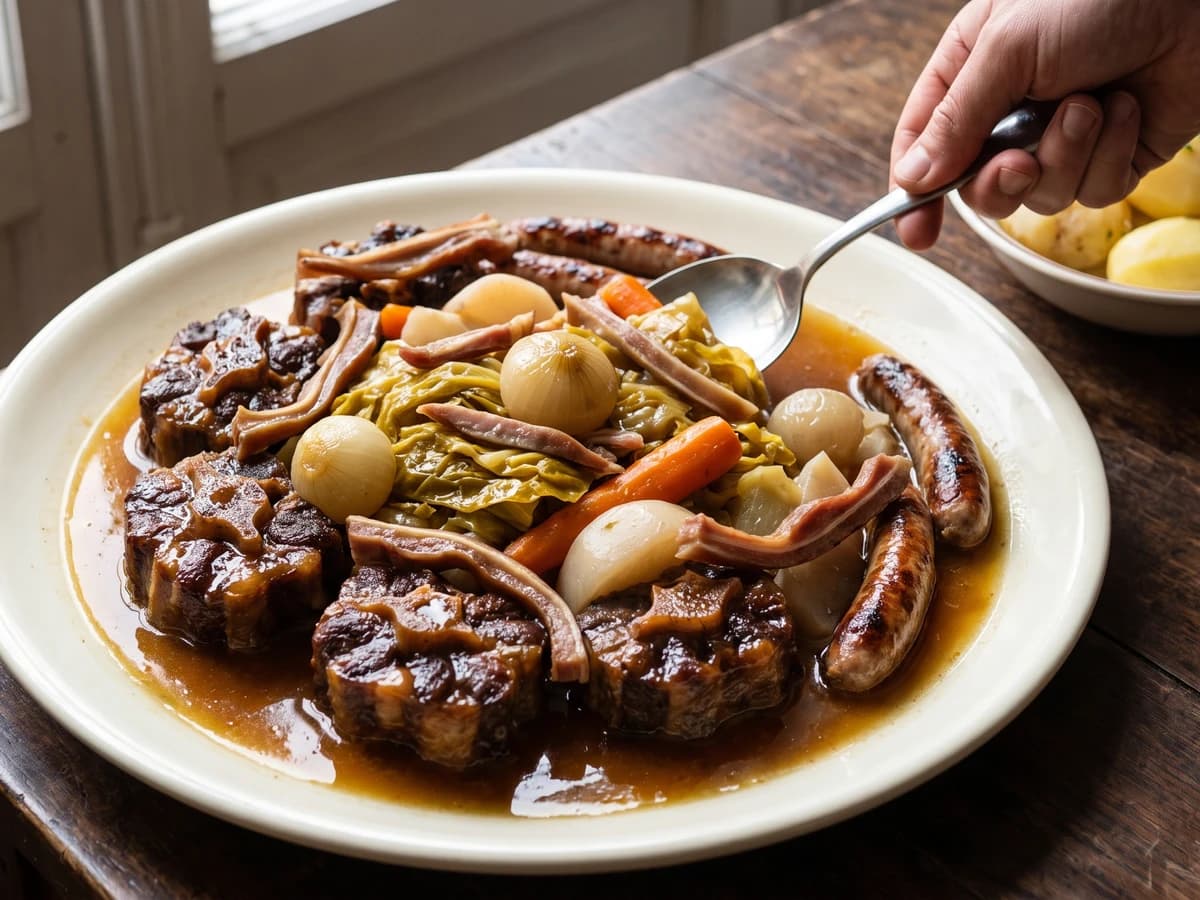
Queue de Bœuf en Hochepot gathers oxtail, pig's trotter and ear, cabbage, roots, and grilled chipolatas around a clear, gelatin-rich broth whose quiet simmer keeps every piece tender and distinct.
Chef Juliette
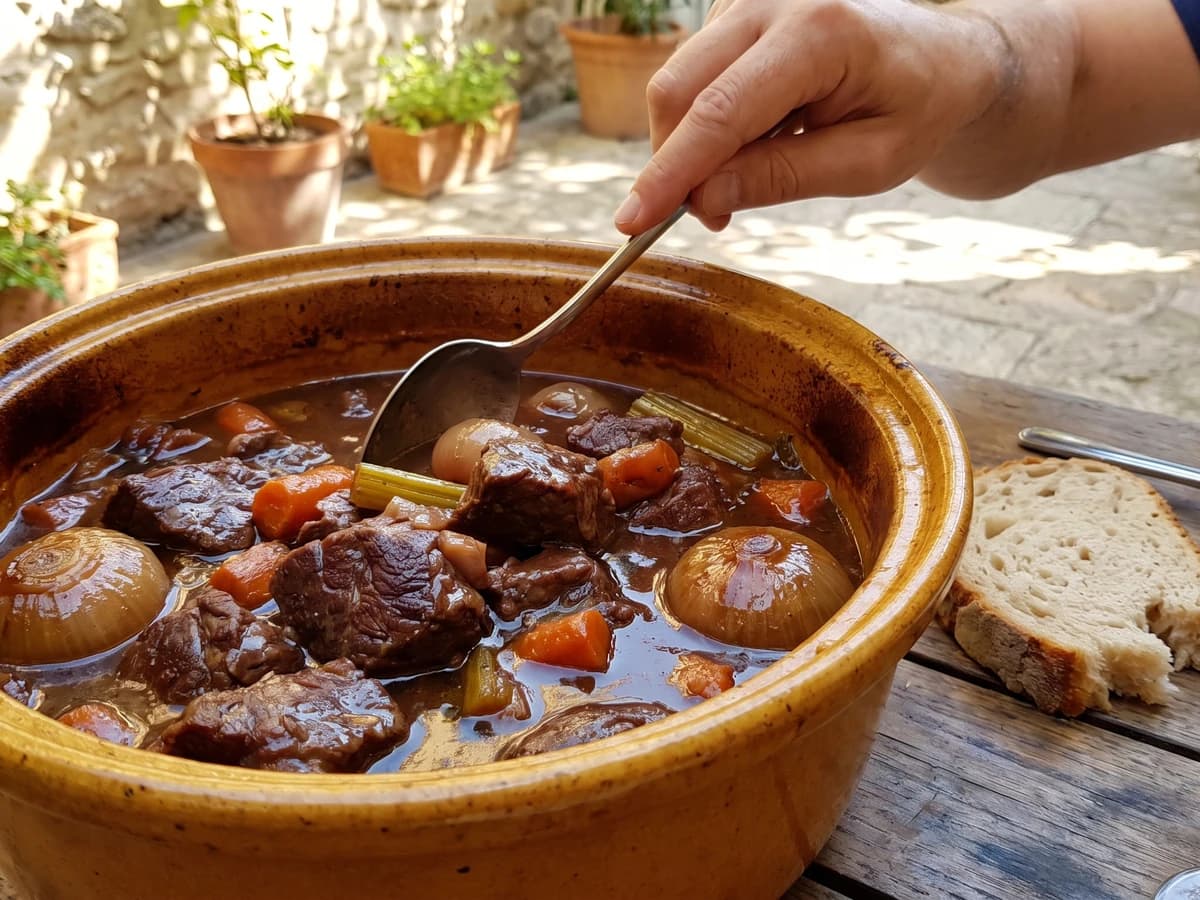
Beef shoulder larded with bacon, sharpened by red wine and vinegar, then sealed with garlic, vegetables, and dry lemon peel until the low oven turns it yielding and the gravy darkly glossy.