Chef Juliette
Bouillabaisse à la Marseillaise
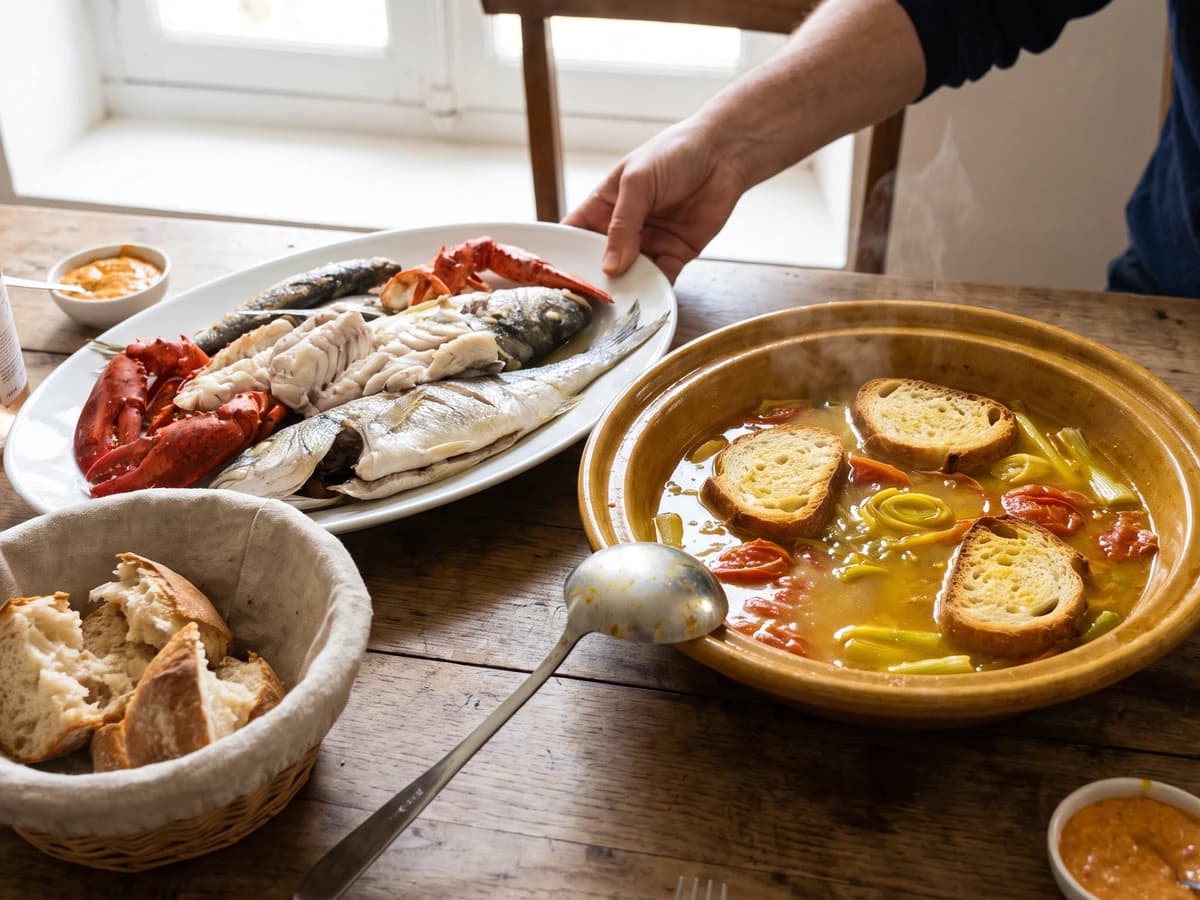
Marseille's great fish stew, saffron-gold and garlic-scented, proves that a hard boil can be the careful choice: it binds olive oil into broth before the whole pot meets bread.
A cooking platform built around craft, culture, and the stories behind what we eat.
Created by Chef Juliette
Based on No. 607, Consommé Richelieu, from Le Guide Culinaire (1907) by Auguste Escoffier
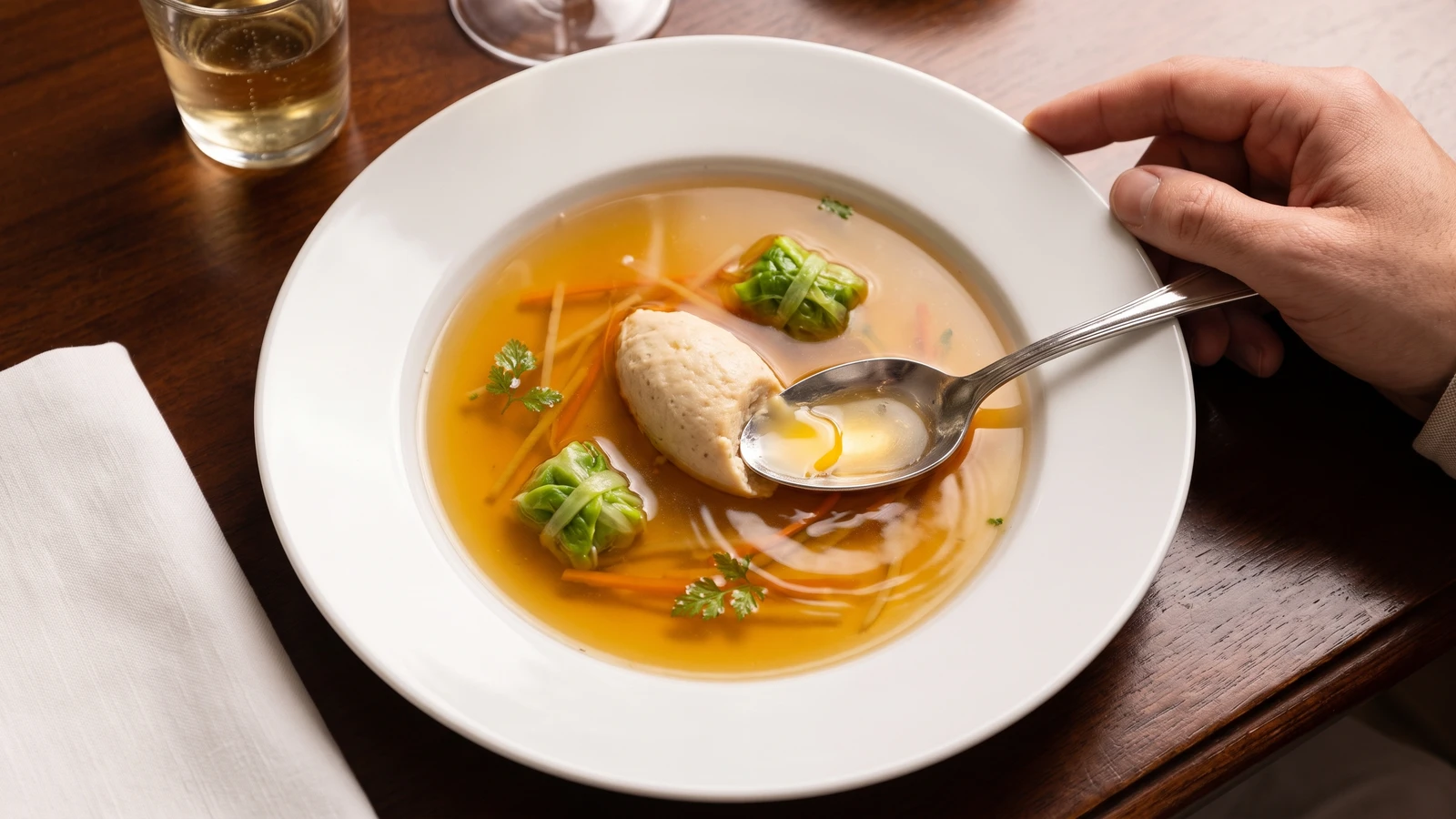
A brilliant beef consommé bearing chicken quenelles with a warm liquid center, tender lettuce paupiettes, coarse carrot-turnip julienne, and chervil: clarity outside, generosity within, made for a celebratory table.
Consommé Richelieu (clear beef broth with liquid-cored chicken quenelles) teaches that refinement is built on control, not fuss. The broth must remain brilliant enough to reveal every carrot and turnip matchstick, while each pale quenelle hides reduced chicken aspic that runs soft when cut. Know one thing before touching a pan: cold shapes the garnishes, and gentle heat preserves them.
The original kitchen assumed a saucier, clarified beef consommé never far from the fire, naturally gelatinous chicken aspic, and hands practiced at moulding rows of quenelles with coffee-spoons. Your honest equivalents are consommé prepared ahead, a food processor in place of mortar and pestle, and a little gelatin to restore the setting power often missing from modern chicken stock. The book gives its garnish for one quart; here the same ratio is carried into a two-quart home tureen, enough for eight first courses. One cook, one stove, one evening.
Making ranks of garnishes for continuous service was brigade scaffolding, so that goes. The clear broth, fine chicken forcemeat, liquid core, lettuce paupiettes, and separate gentle poaching are the dish, so every one stays. Seal each aspic core completely before it meets the water. A pinhole is the one failure that cannot improve in the pan, and patching it while everything is cold is the step that matters most.
Consommé Richelieu belongs to the named consommé repertoire of Parisian grand cuisine, where a perfectly clear beef broth took its identity from an exact garnish rather than from changing the broth itself. The Richelieu combination joins liquid-hearted chicken quenelles, lettuce paupiettes, coarse carrot-and-turnip julienne, and chervil pluches in one composed first course. What can appear ornamental is really a declaration of technique: several textures enter the bowl while the consommé remains transparent.
Quantity
8 cups (1.9 L / 1.9 kg)
fully clarified and thoroughly degreased
Quantity
3/4 cup (180 ml / 180 g)
for the aspic core
Quantity
1 tablespoon (15 ml / 15 g)
Quantity
1/2 teaspoon (2.5 ml / 1.5 g)
Quantity
10 ounces (285 g)
cubed and very cold
Quantity
2 teaspoons (10 ml / 12 g)
divided
Quantity
1/8 teaspoon (0.6 ml / 0.3 g)
Quantity
1 (about 2 tablespoons / 30 ml / 30 g)
cold
Quantity
1/2 cup (120 ml / 120 g)
very cold
Quantity
1 1/2 tablespoons (22 ml / 21 g)
softened and divided
Quantity
12 rectangles, each about 4 by 3 inches (10 by 7.5 cm)
Quantity
2 tablespoons (30 ml / 20 g)
cut into a coarse julienne
Quantity
2 tablespoons (30 ml / 25 g)
cut into a coarse julienne
Quantity
4 cups (960 ml / 960 g)
for poaching the quenelles
Quantity
2 teaspoons (10 ml / 1 g)
| Ingredient | Quantity |
|---|---|
| highly seasoned beef consomméfully clarified and thoroughly degreased | 8 cups (1.9 L / 1.9 kg) |
| strong unsalted chicken stockfor the aspic core | 3/4 cup (180 ml / 180 g) |
| cold water | 1 tablespoon (15 ml / 15 g) |
| unflavored powdered gelatin | 1/2 teaspoon (2.5 ml / 1.5 g) |
| boneless, skinless chicken breastcubed and very cold | 10 ounces (285 g) |
| fine saltdivided | 2 teaspoons (10 ml / 12 g) |
| ground white pepper | 1/8 teaspoon (0.6 ml / 0.3 g) |
| large egg whitecold | 1 (about 2 tablespoons / 30 ml / 30 g) |
| heavy creamvery cold | 1/2 cup (120 ml / 120 g) |
| unsalted buttersoftened and divided | 1 1/2 tablespoons (22 ml / 21 g) |
| tender butter-lettuce rectangles | 12 rectangles, each about 4 by 3 inches (10 by 7.5 cm) |
| carrotcut into a coarse julienne | 2 tablespoons (30 ml / 20 g) |
| turnipcut into a coarse julienne | 2 tablespoons (30 ml / 25 g) |
| waterfor poaching the quenelles | 4 cups (960 ml / 960 g) |
| fresh chervil pluches | 2 teaspoons (10 ml / 1 g) |
Put the chicken stock in a small saucepan and reduce it gently to 1/4 cup (60 ml), skimming any froth. While it reduces, sprinkle the gelatin over the cold water and leave it to bloom for 5 minutes. Remove the reduced stock from the heat, dissolve in the gelatin, and strain it into a shallow dish. Chill for 45 to 60 minutes, until firm enough to chop into tiny pieces. If it remains soft, ça se rattrape: melt it gently, add another small pinch of gelatin, and chill it again.
Chill the food-processor bowl and blade, then process the chicken with 1 teaspoon of the salt and the white pepper until the meat becomes smooth and sticky. Add the egg white and process again. With the machine running, pour in three-quarters of the cold cream in a thin stream; reserve the rest for adjustment. Press the farce de volaille, the smooth chicken forcemeat, through a fine-mesh sieve into a bowl set over ice. Poach a teaspoonful in barely simmering water until cooked through, then taste it. If it is rubbery, work in a spoonful of the reserved cream. If it looks loose or greasy, stop and chill it over ice for 10 minutes before mixing again. Warm forcemeat separates, but ça se rattrape while it is still in the bowl.
Trim the lettuce into 12 neat rectangles, removing any thick central rib without tearing the leaf. Cut the carrots and turnips julienne-fashion, meaning coarse match-shaped rods, and measure 2 tablespoons of each after cutting. Keep the lettuce under a barely damp towel and the vegetables covered separately.
Butter a wide sauté pan with 1 teaspoon of the butter. Dip a small coffee-spoon or demitasse spoon into hot water, then line its bowl with a thin coating of cold forcemeat. Place about 1/4 teaspoon of finely chopped aspic in the center, keeping it away from every edge, and cover it completely with more forcemeat to make a small dome. Slide a second hot-water-dipped spoon underneath and release the quenelle into the buttered pan. Form 24 in all, keeping the bowl of forcemeat over ice. Inspect every seam before poaching; if any aspic shows, patch it with cold forcemeat now.
Spread each lettuce rectangle with a thin, even layer of forcemeat, leaving a narrow bare edge. Roll it snugly into a paupiette, a small scroll with the forcemeat enclosed, and set it seam-side down on a chilled plate. Make 12. The rolls should be compact but not squeezed, since forcemeat expands slightly as it cooks.
Melt the remaining butter in a small saucepan over low heat. Add the carrot and turnip julienne and stew them for 3 minutes without browning; they should glisten but keep their color. Add 1 cup (240 ml) of the consommé, cover, and cook at a bare simmer until just tender, about 5 minutes. Lift out the vegetables with a slotted spoon. Skim the liquid carefully and strain it back into the remaining consommé only if it is still brilliant. If butter droplets remain, draw one edge of a folded paper towel lightly across the surface to collect them.
Pour 1 cup (240 ml) of the consommé into a small straight-sided pan and bring it just below a simmer. Add the lettuce paupiettes seam-side down, cover, and poach gently for 6 to 8 minutes, until the chicken layer is opaque and reaches 165°F (74°C). Do not let the liquid boil, or the rolls may open and cloud it. Lift them out and keep them covered. Strain the poaching consommé through a damp fine cloth or coffee filter before returning it to the main pot.
Five minutes before serving, add the water and remaining teaspoon of salt to the sauté pan holding the quenelles, pouring down the side so the water reaches halfway up their domes. Bring it to the barest tremble, cover, and poach for 5 minutes, working in two pans or batches if they are crowded. The quenelles are ready when swollen slightly, firm outside, and opaque through the chicken shell. Cut open one tester to confirm the shell has reached 165°F (74°C); its aspic center should have melted. If a quenelle leaks, remove it promptly and strain the water before continuing. The others are not lost.
Warm a two-quart soup tureen with hot water, then dry it. Bring the beef consommé to a full boil and make one final check for grease; its surface should shimmer without oily beads. Arrange the julienne, lettuce paupiettes, and drained stuffed quenelles in the tureen. Pour in the boiling consommé and scatter over the chervil pluches, the small picked shreds and leaves. Serve immediately, before the quenelles cool and their liquid hearts begin to set. À table!
1 serving (about 315g)
Culinary guides, cultural storytelling, and the editorial depth that makes cooking meaningful.
Discover Culinary ExplorerChef Juliette
Marseille's great fish stew, saffron-gold and garlic-scented, proves that a hard boil can be the careful choice: it binds olive oil into broth before the whole pot meets bread.
Chef Juliette
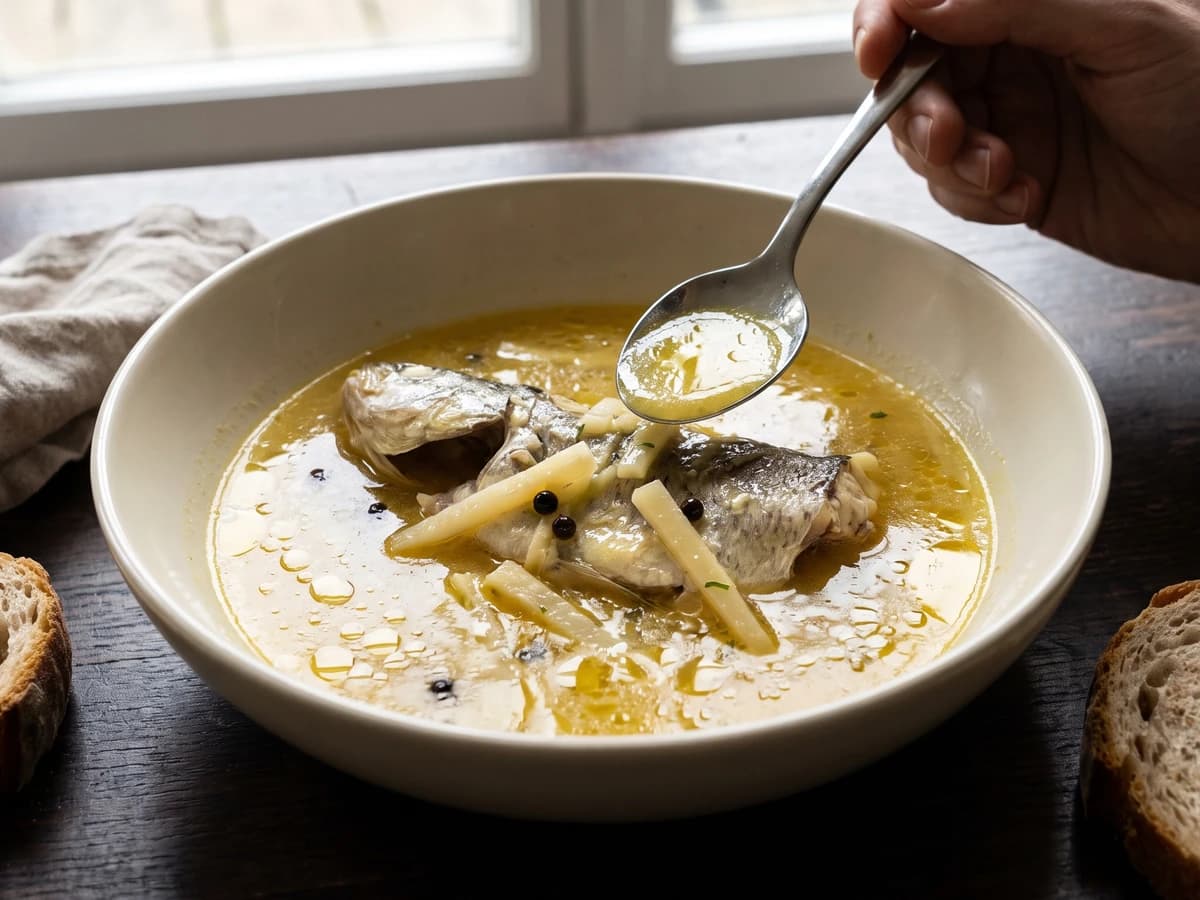
Waterzoi asks fresh, bone-in river fish to thicken its own buttery broth, with parsley root and pepper for company. No flour, no stockpot, just a brisk simmer watched closely.
Chef Juliette
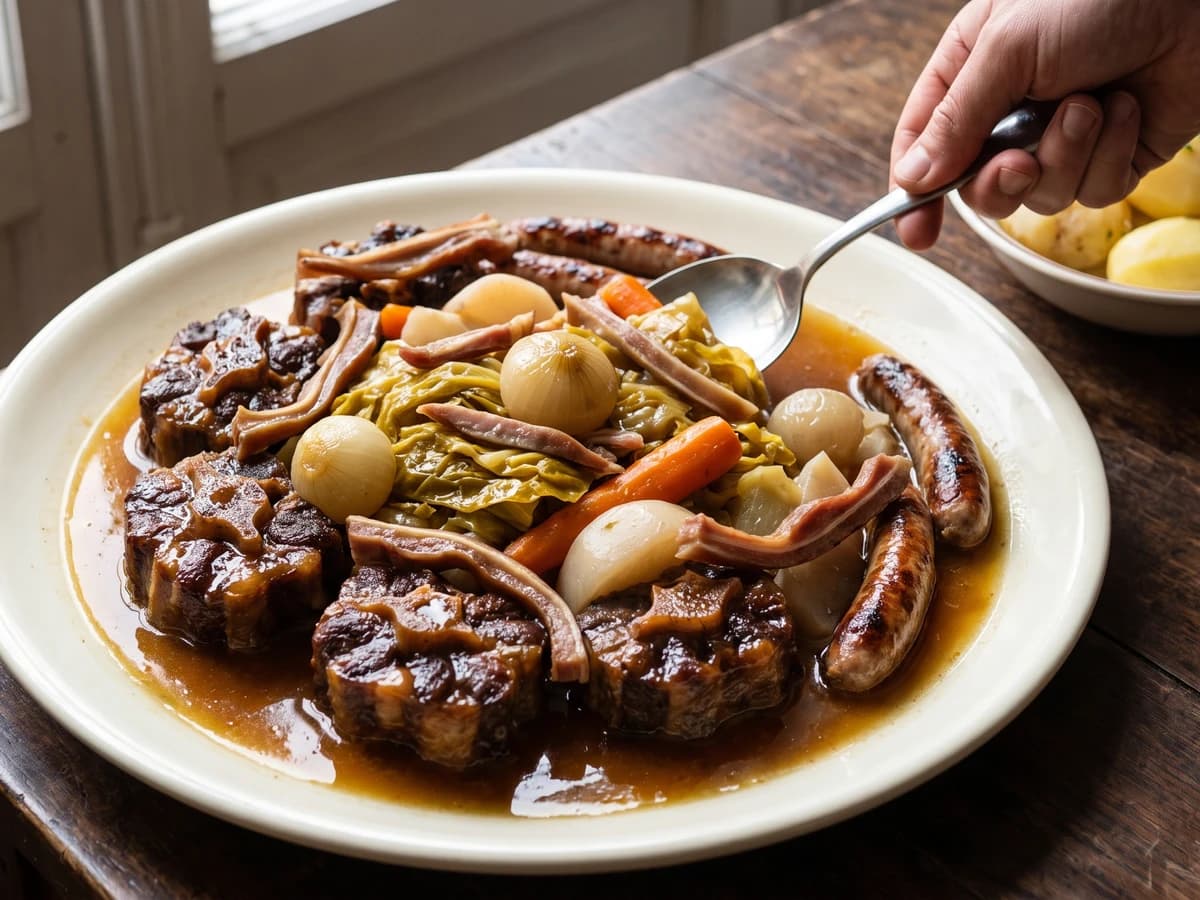
Queue de Bœuf en Hochepot gathers oxtail, pig's trotter and ear, cabbage, roots, and grilled chipolatas around a clear, gelatin-rich broth whose quiet simmer keeps every piece tender and distinct.
Chef Juliette
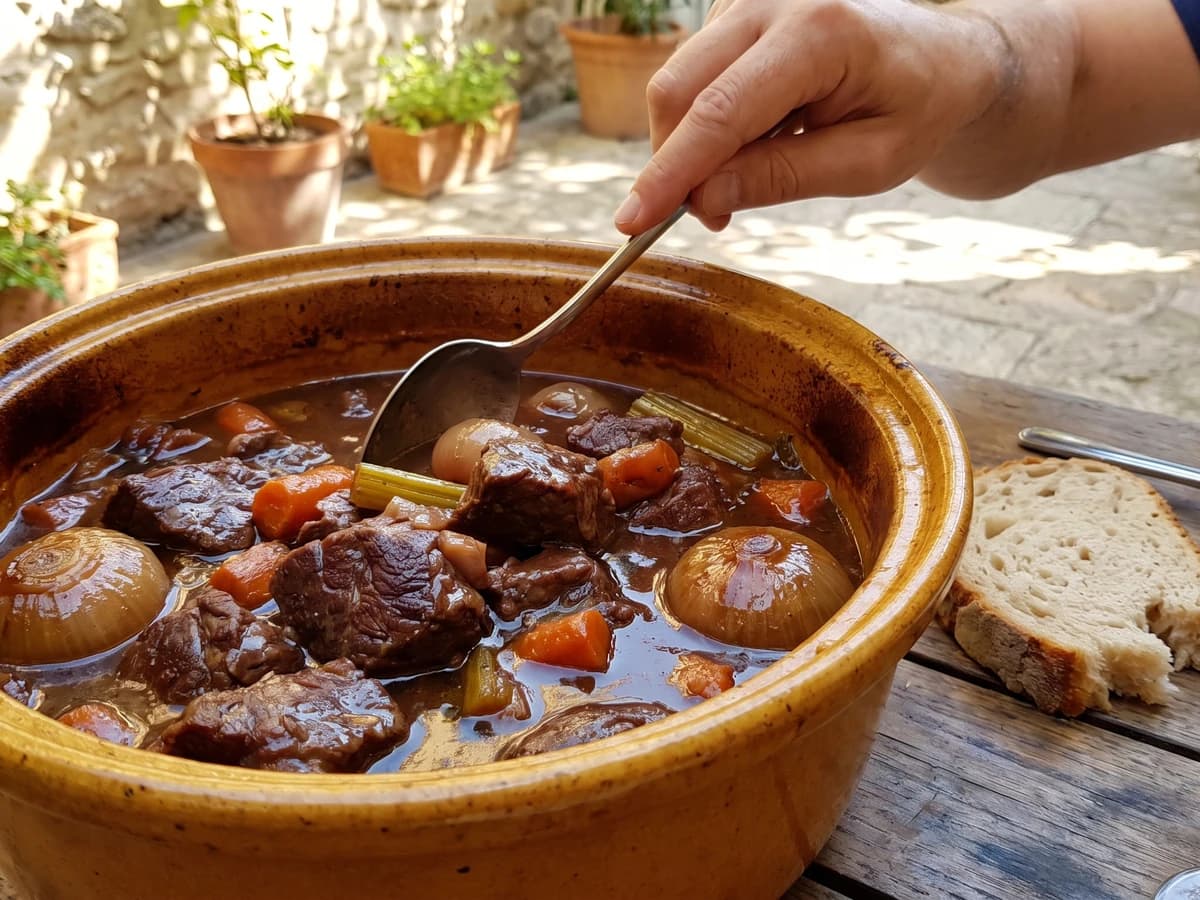
Beef shoulder larded with bacon, sharpened by red wine and vinegar, then sealed with garlic, vegetables, and dry lemon peel until the low oven turns it yielding and the gravy darkly glossy.