Chef Juliette
Bouillabaisse à la Marseillaise
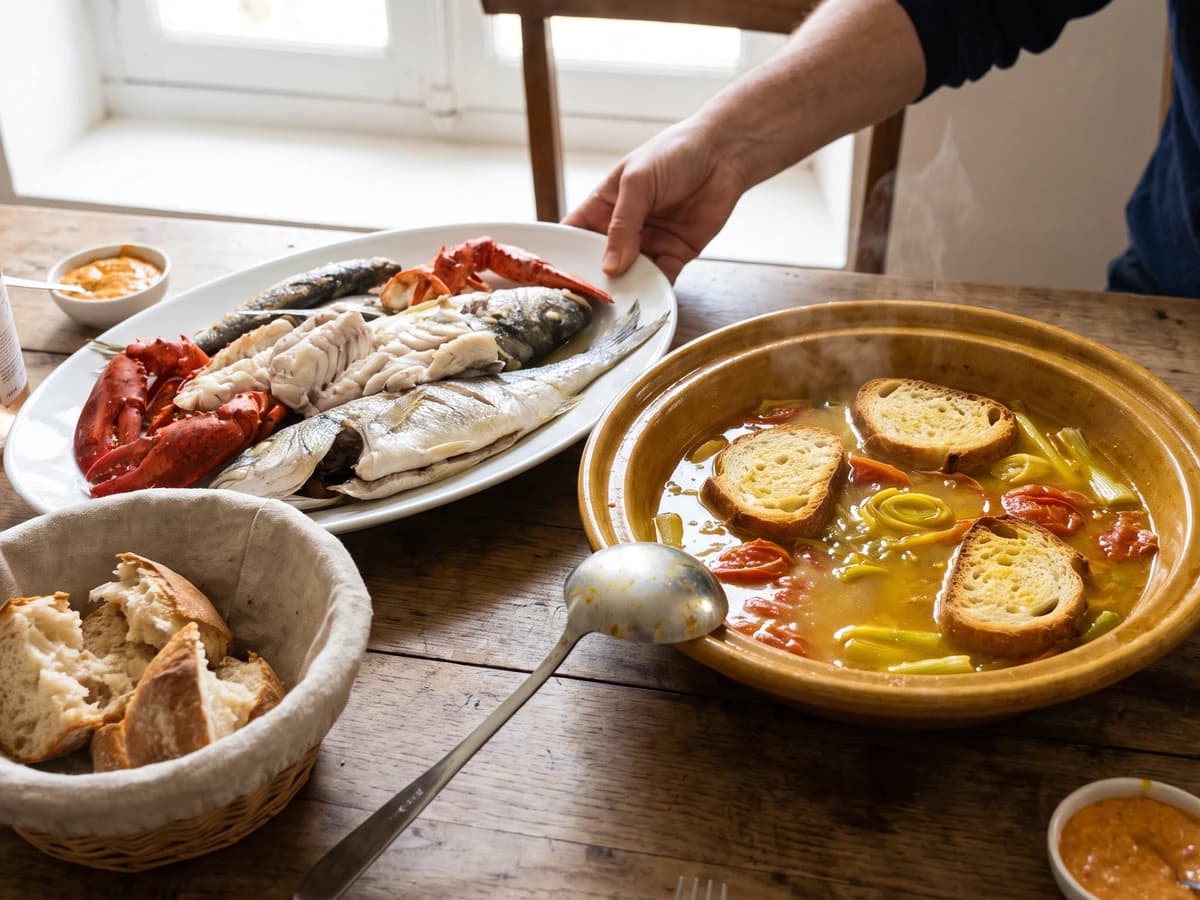
Marseille's great fish stew, saffron-gold and garlic-scented, proves that a hard boil can be the careful choice: it binds olive oil into broth before the whole pot meets bread.
A cooking platform built around craft, culture, and the stories behind what we eat.
Created by Chef Juliette
Based on No. 606, Consommé Renaissance, from Le Guide Culinaire (1907) by Auguste Escoffier
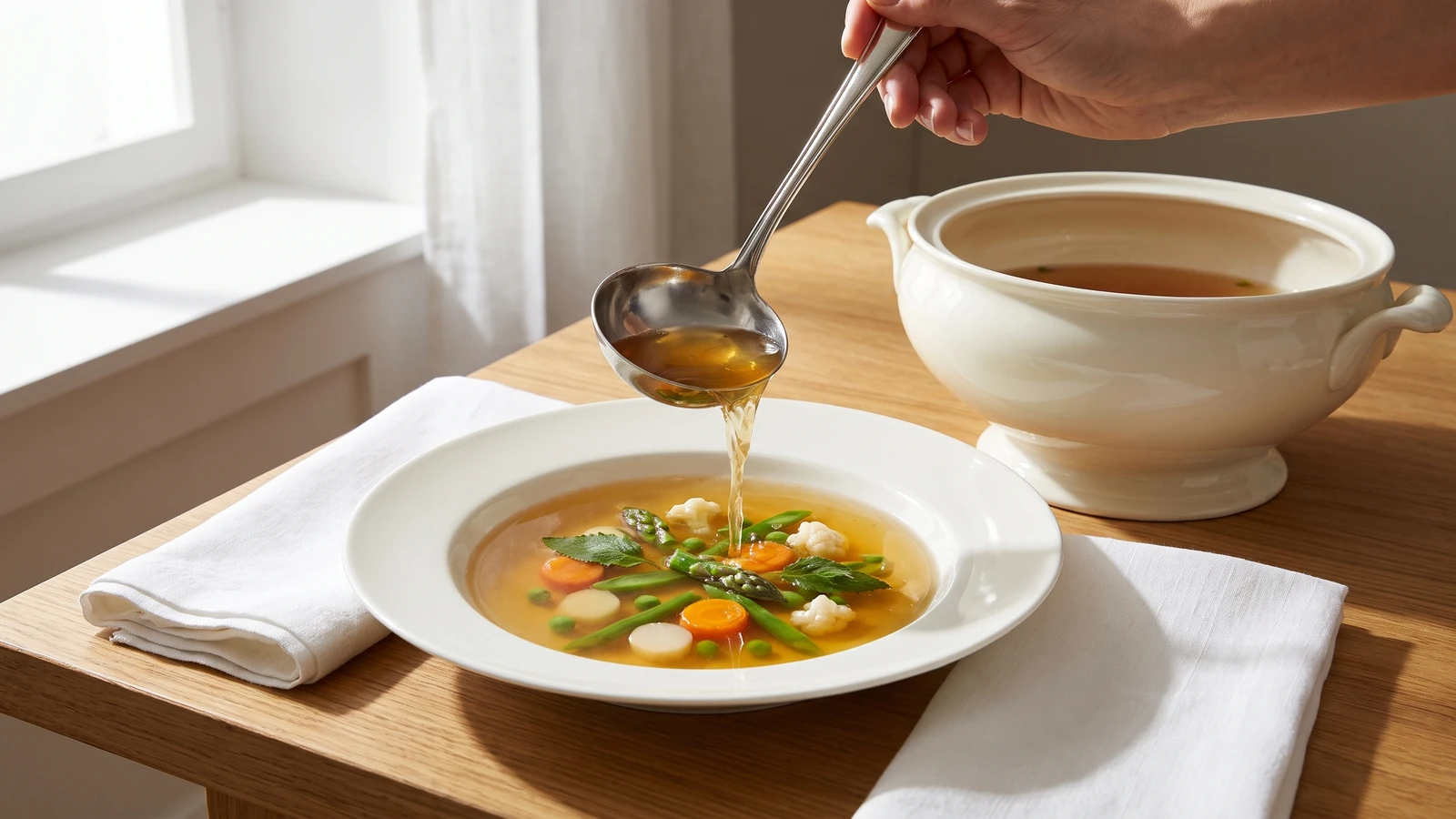
Crystal-clear chicken consommé carrying green herb royale leaves and a jewelled spring garden, with every pea, bean, asparagus tip, cauliflower bud, and vegetable pearl cooked separately so the broth stays brilliant.
Consommé Renaissance (clear chicken broth with spring vegetables and herb royale) teaches one true thing: clarity is protected by separation. The vegetables may share the bowl, but they must never share their cooking time. Each is cooked alone to its proper tenderness, drained meticulously, and introduced to the consommé only when the tureen is ready.
The original kitchen assumed a saucier on staff, a stock never off the fire, Dariole-moulds for the royale, and grooved cutters waiting in a drawer. Your honest equivalents are prepared clear consommé, four small ramekins, the smallest melon baller you own, and a little leaf cutter or sharp paring knife. There is no salamander work to replace because nothing here should brown. The brigade's procession of small saucepans is scaffolding, so one blanching pan used in sequence will do; cooking every garnish separately is the dish and must stay.
This recipe doubles the book's one-quart proportion for eight first-course bowls, keeping every garnish in lockstep: four moulds of royale, two tablespoons each of carrot, turnip, peas, beans, and asparagus, then twenty-four tiny cauliflower florets. One cook, one stove, one evening. The step that matters most is simple: pull each vegetable from the water the instant it becomes tender, then drain it until not one stray drop can dull the broth.
Consommé Renaissance belongs to the formal Parisian grand-kitchen repertory, where a perfectly clarified broth displayed the saucier's discipline and an elaborate garnish showed the precision of the vegetable station. Its title is ornamental rather than proof that the soup came from Renaissance court cookery; classical garnish names often identified a prescribed composition, not a documented birthplace. The combination traveled naturally to bourgeois dinner tables because the costly brigade could disappear while the essential method, clear broth and separately cooked garnishes, remained intact.
Quantity
2 quarts (1.9 liters / 1.9 kg)
well clarified
Quantity
1½ cups (360 ml / 45 g)
loosely packed
Quantity
½ cup (120 ml / 15 g)
loosely packed
Quantity
2 tablespoons (30 ml / 4 g)
Quantity
3 tablespoons (45 ml / 42 g)
divided
Quantity
3 tablespoons (45 ml / 24 g)
Quantity
1 cup (240 ml / 240 g)
Quantity
4
Quantity
2 tablespoons (30 ml / 36 g)
divided between seasoning and blanching water
Quantity
⅛ teaspoon (0.6 ml / 0.3 g)
Quantity
1 (about 180 g)
peeled, with the deep red-orange outer flesh reserved for cutting
Quantity
1 (about 150 g)
peeled
Quantity
2 tablespoons (30 ml / 30 g)
Quantity
⅓ cup (80 ml / 40 g)
trimmed and cut into lozenges to yield 2 tablespoons
Quantity
8 (about 120 g)
tips cut to yield 2 tablespoons
Quantity
24 (about ⅓ cup / 35 g)
Quantity
2 generous pinches (about 2 ml / 0.2 g)
| Ingredient | Quantity |
|---|---|
| prepared clear chicken consomméwell clarified | 2 quarts (1.9 liters / 1.9 kg) |
| flat-leaf parsley leavesloosely packed | 1½ cups (360 ml / 45 g) |
| chervil leavesloosely packed | ½ cup (120 ml / 15 g) |
| tarragon leaves | 2 tablespoons (30 ml / 4 g) |
| unsalted butterdivided | 3 tablespoons (45 ml / 42 g) |
| plain flour | 3 tablespoons (45 ml / 24 g) |
| light chicken stock | 1 cup (240 ml / 240 g) |
| large eggs | 4 |
| fine sea saltdivided between seasoning and blanching water | 2 tablespoons (30 ml / 36 g) |
| finely ground white pepper | ⅛ teaspoon (0.6 ml / 0.3 g) |
| large straight carrotpeeled, with the deep red-orange outer flesh reserved for cutting | 1 (about 180 g) |
| medium white turnippeeled | 1 (about 150 g) |
| very green peas | 2 tablespoons (30 ml / 30 g) |
| fine French beanstrimmed and cut into lozenges to yield 2 tablespoons | ⅓ cup (80 ml / 40 g) |
| slender asparagus spearstips cut to yield 2 tablespoons | 8 (about 120 g) |
| very small white cauliflower florets | 24 (about ⅓ cup / 35 g) |
| chervil Pluches | 2 generous pinches (about 2 ml / 0.2 g) |
Melt 2 tablespoons of the butter in a small saucepan over gentle heat. Stir in the flour and cook this roux for 2 minutes without letting it colour; it should smell softly of biscuit, never raw flour. Whisk in the light chicken stock a little at a time, then simmer for 5 to 7 minutes, stirring, until the velouté is smooth and thick enough to hold a deep trail from the spoon. Scrape it into a bowl and let it cool until merely lukewarm.
Bring a saucepan of well-salted water to a boil and prepare a bowl of iced water. Drop in the parsley, chervil leaves, and tarragon for 10 seconds, just until they collapse and turn vivid green, then lift them straight into the iced water. Drain and squeeze them very dry. Blend the herbs with one-third of the velouté until perfectly smooth, then mix this green purée into the remaining velouté. If the purée looks fibrous, press it through a fine sieve; the royale should cut like satin, not show stems.
Heat the oven to 300°F (150°C). Use the remaining tablespoon of butter to coat four 3-ounce ramekins, the home equivalent of Dariole-moulds. Beat the whole eggs only until combined, without whipping in air, then stir them into the cooled herb velouté with ¼ teaspoon of the measured salt and the white pepper. Pass the mixture through a fine sieve, divide it among the ramekins, and cover each loosely with foil. Set them in a roasting pan and add hot water to come halfway up their sides. Bake for 25 to 30 minutes, until the edges are set and the centres give a gentle wobble. If the royale begins to puff or show bubbles, pull out the pan, add a little cool water to the bain-marie, and lower the oven slightly. Ça se rattrape, provided the centre remains supple. Cool, then chill until firm.
With an 8 to 10 mm fluted melon baller, cut exactly 2 tablespoons of pellets from the white turnip and 2 tablespoons from the deep red-orange outer flesh of the carrot, avoiding the pale woody core. Cut the French beans on a sharp diagonal into small lozenges and measure 2 tablespoons. Measure 2 tablespoons of asparagus heads, 2 tablespoons of peas, and count 24 tiny cauliflower florets. Uniform size is not decoration alone; it lets each measured garnish cook evenly.
Return the blanching water to a lively boil and keep the iced water ready. Cook each vegetable separately, lifting every batch into the ice as soon as it is tender: turnip pellets for 2 to 3 minutes, cauliflower for about 90 seconds, carrot pellets for 90 seconds to 2 minutes, bean lozenges for about 90 seconds, asparagus heads for 60 to 90 seconds, and peas for 30 to 45 seconds. Taste one piece from every batch; the times are guides, the vegetable decides. If a green batch turns soft or olive, replace that small measured portion and cook it again. Ça se rattrape. Drain everything separately on a clean towel until completely dry.
Run a thin knife around each cold royale and unmould it onto a board. Slice it about ¼ inch thick, then cut small leaves with a fluted aspic cutter. A sharp paring knife can make simple pointed leaves if no cutter is available. Work while the royale is cold; if it bends or tears, return it to the refrigerator for 15 minutes before continuing. Keep the finished leaves covered and chilled.
Pour the clear chicken consommé into a spotless saucepan and warm it gently, skimming away any beads of fat. Taste it hot and correct the salt sparingly; a cold broth that seems seasoned can taste flat at serving temperature. If a veil of sediment appears, let the consommé stand for 5 minutes, then pour it carefully through damp cheesecloth without disturbing what settled. Bring it to a clean boil only when the tureen is ready, and do not whisk or simmer the garnish in it.
Warm a soup tureen or eight shallow soup bowls with hot water, then dry them thoroughly. Arrange the royale leaves, carrot and turnip pellets, peas, bean lozenges, asparagus heads, and cauliflower evenly inside. Pour the boiling consommé over the garnish at once and finish with the chervil Pluches. Carry it directly to the table while the broth is brilliant and every green still looks alive. À table!
1 serving (about 300g)
Culinary guides, cultural storytelling, and the editorial depth that makes cooking meaningful.
Discover Culinary ExplorerChef Juliette
Marseille's great fish stew, saffron-gold and garlic-scented, proves that a hard boil can be the careful choice: it binds olive oil into broth before the whole pot meets bread.
Chef Juliette
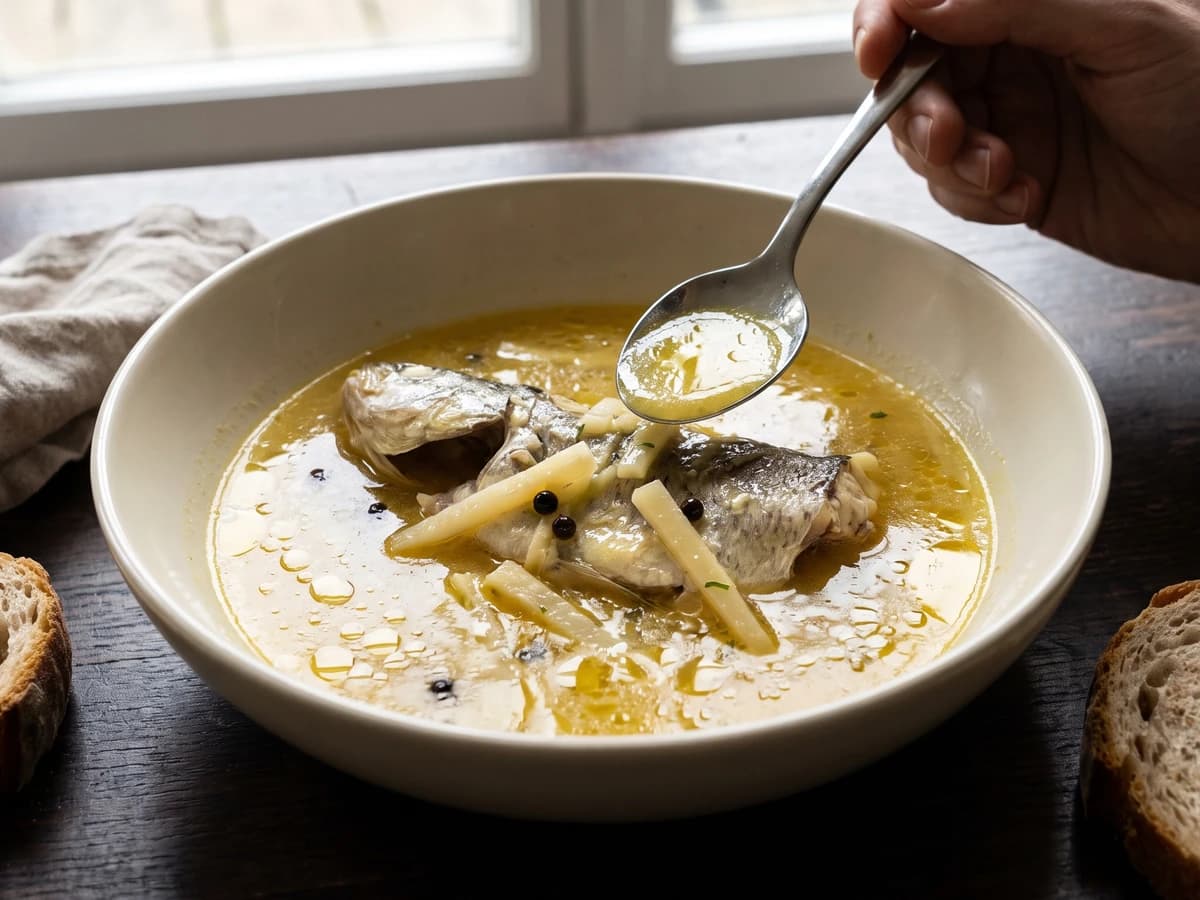
Waterzoi asks fresh, bone-in river fish to thicken its own buttery broth, with parsley root and pepper for company. No flour, no stockpot, just a brisk simmer watched closely.
Chef Juliette
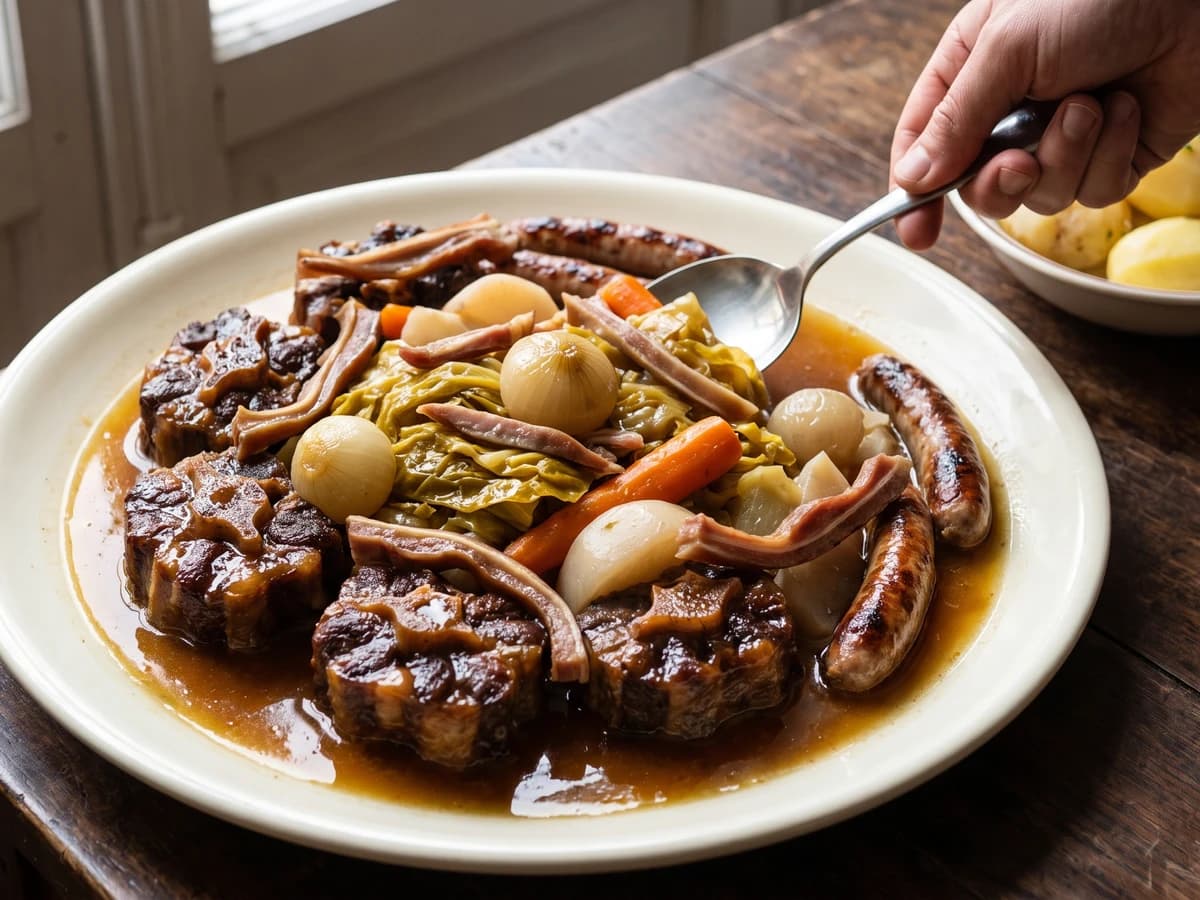
Queue de Bœuf en Hochepot gathers oxtail, pig's trotter and ear, cabbage, roots, and grilled chipolatas around a clear, gelatin-rich broth whose quiet simmer keeps every piece tender and distinct.
Chef Juliette
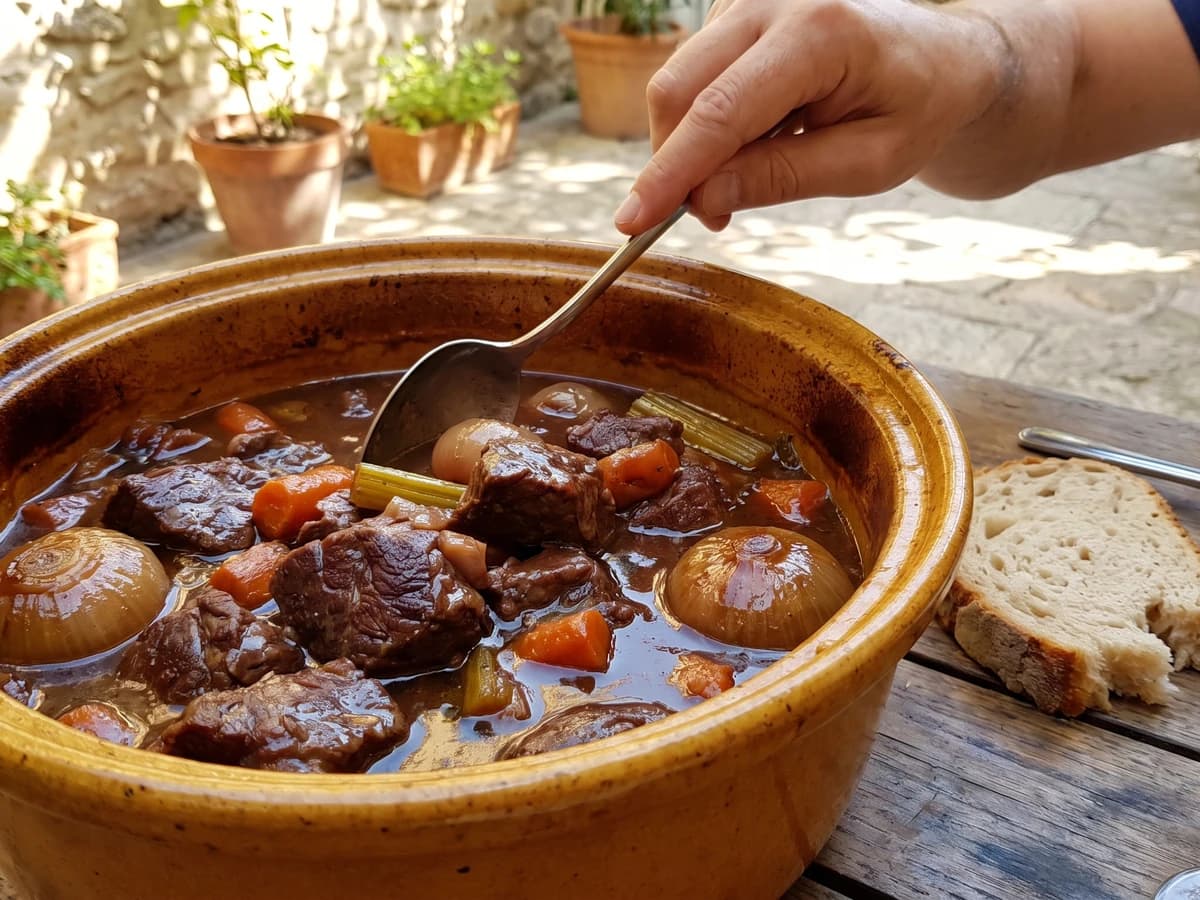
Beef shoulder larded with bacon, sharpened by red wine and vinegar, then sealed with garlic, vegetables, and dry lemon peel until the low oven turns it yielding and the gravy darkly glossy.