Chef Juliette
Bouillabaisse à la Marseillaise
Marseille's great fish stew, saffron-gold and garlic-scented, proves that a hard boil can be the careful choice: it binds olive oil into broth before the whole pot meets bread.
A cooking platform built around craft, culture, and the stories behind what we eat.

Created by Chef Juliette
Based on No. 6, Special Consommés for Suppers, from Le Guide Culinaire (1907) by Auguste Escoffier
A supper consommé has no garnish to hide behind: clarify it until jewel-clear, perfume it with restraint, and for cold service let it set just firmly enough to melt on the tongue.
Consommés Spéciaux pour Soupers (special supper consommés) teach the discipline of leaving nowhere for weakness to hide. Because the consommé is drunk from a cup without garnish, the stock must taste complete before clarification begins. Clarity refines a good foundation; it cannot give character to a thin one. The perfume should arrive quietly after the first sip, never enter the room ahead of the broth.
The brigade formula assumed a saucier, a stockpot never off the fire, several roast game birds when the menu called for them, and enough guests to justify the labor. Here, twelve cups of gelatin-rich stock become about eight cups of finished consommé in one heavy pot. One roast partridge carcass replaces several whole birds, and a single raft performs the clarification. The repeated handling belonged to brigade service and can go. The heavier meat clarification, restrained perfume, perfect clarity, and tender cold set are the dish, so they stay. One cook, one stove, one evening.
Choose one character only: celery for Consommé au Céleri, a restrained pinch of curry for Consommé à l’Indienne, or roast partridge for Consommé au Fumet de Perdreau, its fumet being the essence extracted from the game. Do not combine them. The step that decides everything is the slow raising of the clarification: stir while the stock is cold and warming, then stop completely when the raft gathers.
Consommés spéciaux pour soupers belong to the formal supper table of Paris, where a late meal called for clear broth in handled cups rather than a garnished soup in plates. Grand kitchens distinguished them from dinner consommés by working the perfume into the clarification itself, whether celery, curry à l’Indienne, or a partridge fumet, so the cup needed nothing floating in it. The misconception is that cold consommé should stand like aspic; for supper service it is prized only when it forms a tender jelly that melts as soon as it meets the mouth.
Quantity
12 cups (2.84 L / 2.84 kg)
thoroughly defatted
Quantity
1½ pounds (680 g)
very finely minced
Quantity
6 (about ¾ cup / 180 ml / 180 g)
5 for the raft and 1 reserved for rescue
Quantity
1 medium (about 3½ ounces / 100 g)
coarsely grated
Quantity
1 medium (about 4 ounces / 115 g)
washed and finely sliced
Quantity
1 small (about 5 ounces / 140 g)
finely sliced
Quantity
1 small (about 4 ounces / 115 g)
crushed
Quantity
1
Quantity
8
lightly crushed
Quantity
2 teaspoons (10 ml / 12 g), plus more to finish
Quantity
1½ cups (360 ml / 180 g)
roughly chopped
Quantity
½ teaspoon (2.5 ml / 1 g)
Quantity
1 carcass (about 12 ounces / 340 g)
chopped
Quantity
1 to 2¼ teaspoons (5 to 11 ml / 3 to 7 g)
Quantity
2 tablespoons (30 ml / 30 g)
Quantity
up to 1 cup (240 ml / 240 g)
| Ingredient | Quantity |
|---|---|
| cold, unsalted, gelatin-rich chicken stockthoroughly defatted | 12 cups (2.84 L / 2.84 kg) |
| lean beef shin or top roundvery finely minced | 1½ pounds (680 g) |
| large egg whites5 for the raft and 1 reserved for rescue | 6 (about ¾ cup / 180 ml / 180 g) |
| carrotcoarsely grated | 1 medium (about 3½ ounces / 100 g) |
| leek, white and pale green parts onlywashed and finely sliced | 1 medium (about 4 ounces / 115 g) |
| onionfinely sliced | 1 small (about 5 ounces / 140 g) |
| ripe tomatocrushed | 1 small (about 4 ounces / 115 g) |
| bouquet garni of parsley stems, thyme, and bay leaf | 1 |
| black peppercornslightly crushed | 8 |
| fine sea salt | 2 teaspoons (10 ml / 12 g), plus more to finish |
| celery stalks for Consommé au Céleri (optional)roughly chopped | 1½ cups (360 ml / 180 g) |
| mild curry powder for Consommé à l’Indienne (optional) | ½ teaspoon (2.5 ml / 1 g) |
| roasted partridge carcass with meat scraps for Consommé au Fumet de Perdreau (optional)chopped | 1 carcass (about 12 ounces / 340 g) |
| unflavored powdered gelatin for cold service (optional) | 1 to 2¼ teaspoons (5 to 11 ml / 3 to 7 g) |
| cold water for blooming gelatin (optional) | 2 tablespoons (30 ml / 30 g) |
| boiling water for correcting flavor or consistency (optional) | up to 1 cup (240 ml / 240 g) |
Choose exactly one variation. Use the chopped celery for Consommé au Céleri, the mild curry powder for Consommé à l’Indienne, or the chopped roast partridge carcass and scraps for Consommé au Fumet de Perdreau. The quantity should look modest because subtlety is the point; combining the perfumes would blur the consommé rather than enrich it.
Loosen 5 egg whites with a whisk without beating them into foam. In an 8-quart heavy pot, combine them thoroughly with the minced beef, carrot, leek, onion, tomato, bouquet garni, peppercorns, salt, and your chosen perfume. Work the mixture with a spoon or clean hand until the meat is evenly broken apart, then add the very cold stock gradually while stirring. Keep the sixth egg white refrigerated for rescue.
Set the pot over medium-low heat and stir continuously with a flat-ended spoon, scraping the floor so no egg or meat catches. Take 20 to 30 minutes to bring it toward a simmer. When the liquid reaches about 122 to 131°F (50 to 55°C) and grey curds begin gathering across the surface, stop stirring completely. Let the proteins join into a raft, then open a 2-inch hole at one side with the ladle. If a strong bubble tears a small opening, pull the pot from the heat at once and lower the burner; the raft usually closes as the boil subsides. If it breaks apart broadly, do not discard the broth. Strain it, chill it fully, and reclarify with the reserved white as directed below. Ça se rattrape.
Return the pot to the lowest heat and keep the liquid beneath the raft at 185 to 194°F (85 to 90°C), with only an occasional bubble passing through the opening. Simmer for 45 to 60 minutes. Every 10 minutes, draw a ladleful of clear broth through the opening and pour it gently over the raft; this washes flavor through the filter without breaking it. Never let the pot boil and never stir again. The finished liquid visible through the opening should be a deep, transparent amber.
Rinse a double layer of cheesecloth in hot water, wring it well, and use it to line a fine sieve over a clean pot. Ladle the consommé slowly from the opening in the raft, stopping before the sediment at the bottom reaches the ladle. Let gravity do the work. Do not pour the whole pot or press the solids, because pressure drives fine particles back into the broth. If the consommé is cloudy after a broken raft, chill it completely, whisk the reserved egg white with 1 cup (240 ml) of the cold broth, combine it with the remainder, and repeat the slow heating and straining, simmering the new raft for 20 minutes.
Lay a strip of clean paper towel briefly across the surface to lift any last beads of fat, then taste. The consommé should taste first of concentrated stock and only afterward of celery, curry, or partridge. If the perfume announces itself too loudly, dilute it with boiling water, ¼ cup (60 ml) at a time, tasting after each addition. Correct the salt only after this adjustment. For cold service, season a shade more brightly because chilling softens both aroma and salt.
For hot service, warm the consommé gently to about 180°F (82°C) without boiling it. Heat the handled cups with hot water, dry them, and fill each with 6 to 8 fluid ounces (180 to 240 ml). Serve the consommé absolutely clear and without garnish. That bare cup is not unfinished; it is the finished idea. À table!
For cold service, chill 2 tablespoons of consommé in a small cup over ice for 10 minutes. It should hold a trembling line when tipped but collapse immediately against the tongue. If it remains fully liquid, bloom 1 teaspoon (3 g) gelatin when the stock almost sets, or the full 2¼ teaspoons (7 g) when it does not set at all, in the cold water for 5 minutes. Dissolve it in 1 cup (240 ml) of hot consommé, stir this gently into the batch, and test again. If the sample becomes rubbery, loosen the batch with boiling water, ¼ cup (60 ml) at a time. Pour into cups, cover, and chill for at least 4 hours. Set them out for 5 to 10 minutes before serving so the jelly softens enough to drink and melts at once in the mouth.
1 serving (about 240g)
Culinary guides, cultural storytelling, and the editorial depth that makes cooking meaningful.
Discover Culinary ExplorerChef Juliette
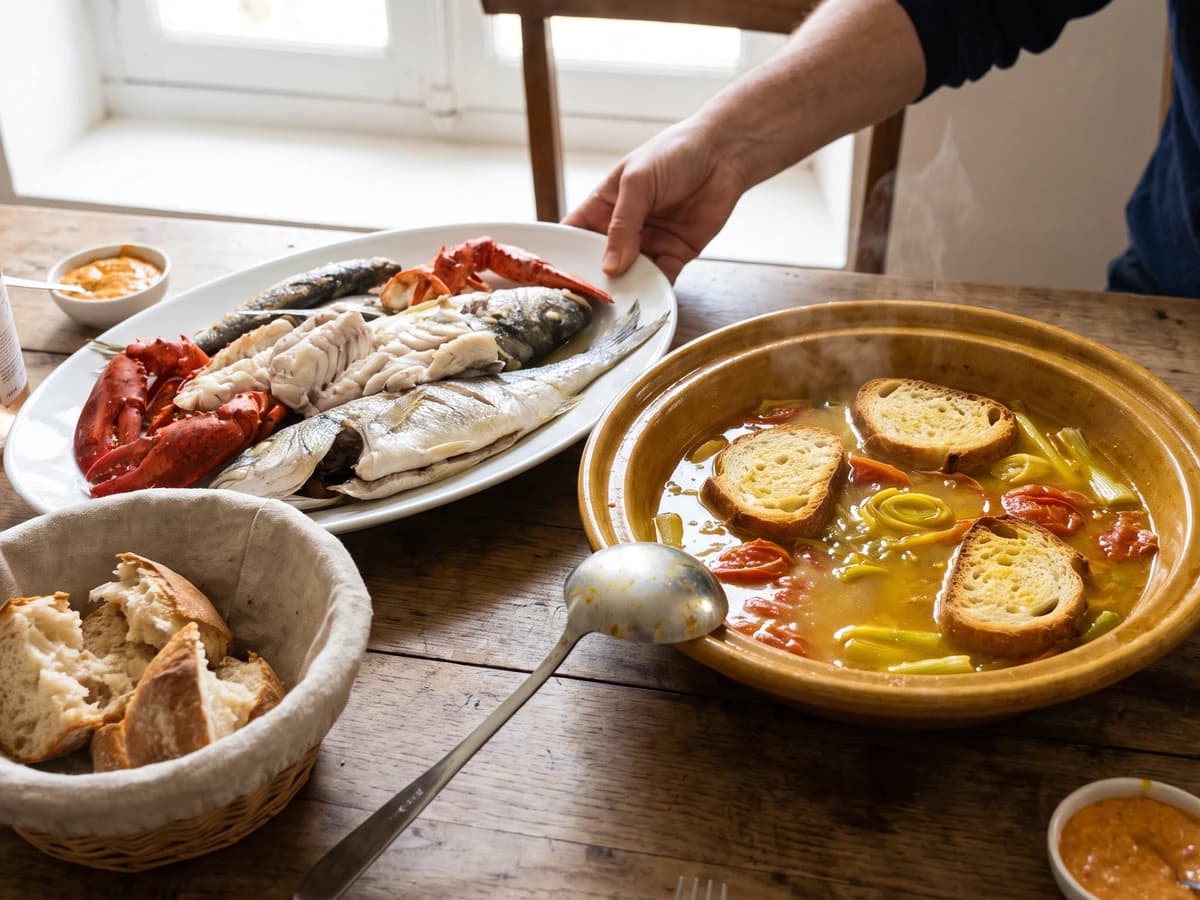
Marseille's great fish stew, saffron-gold and garlic-scented, proves that a hard boil can be the careful choice: it binds olive oil into broth before the whole pot meets bread.
Chef Juliette
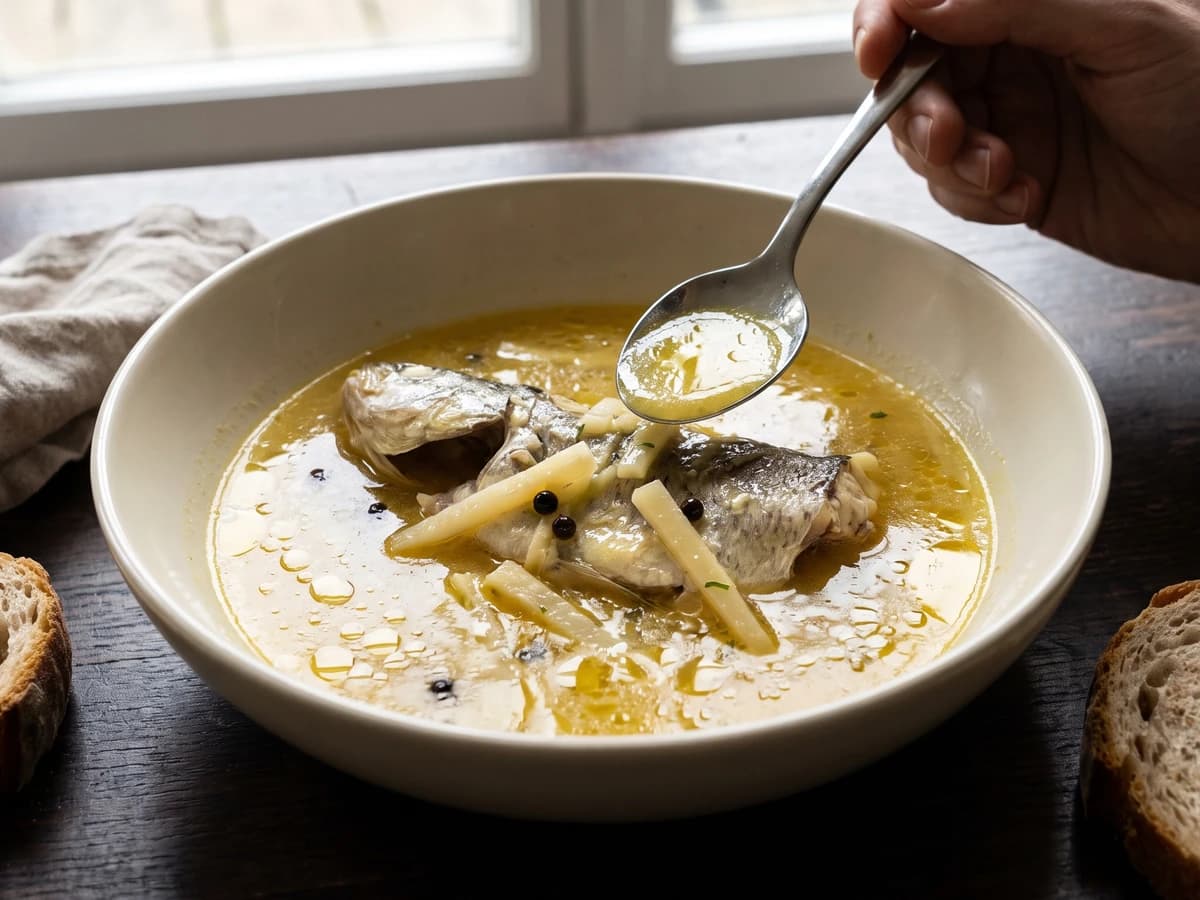
Waterzoi asks fresh, bone-in river fish to thicken its own buttery broth, with parsley root and pepper for company. No flour, no stockpot, just a brisk simmer watched closely.
Chef Juliette
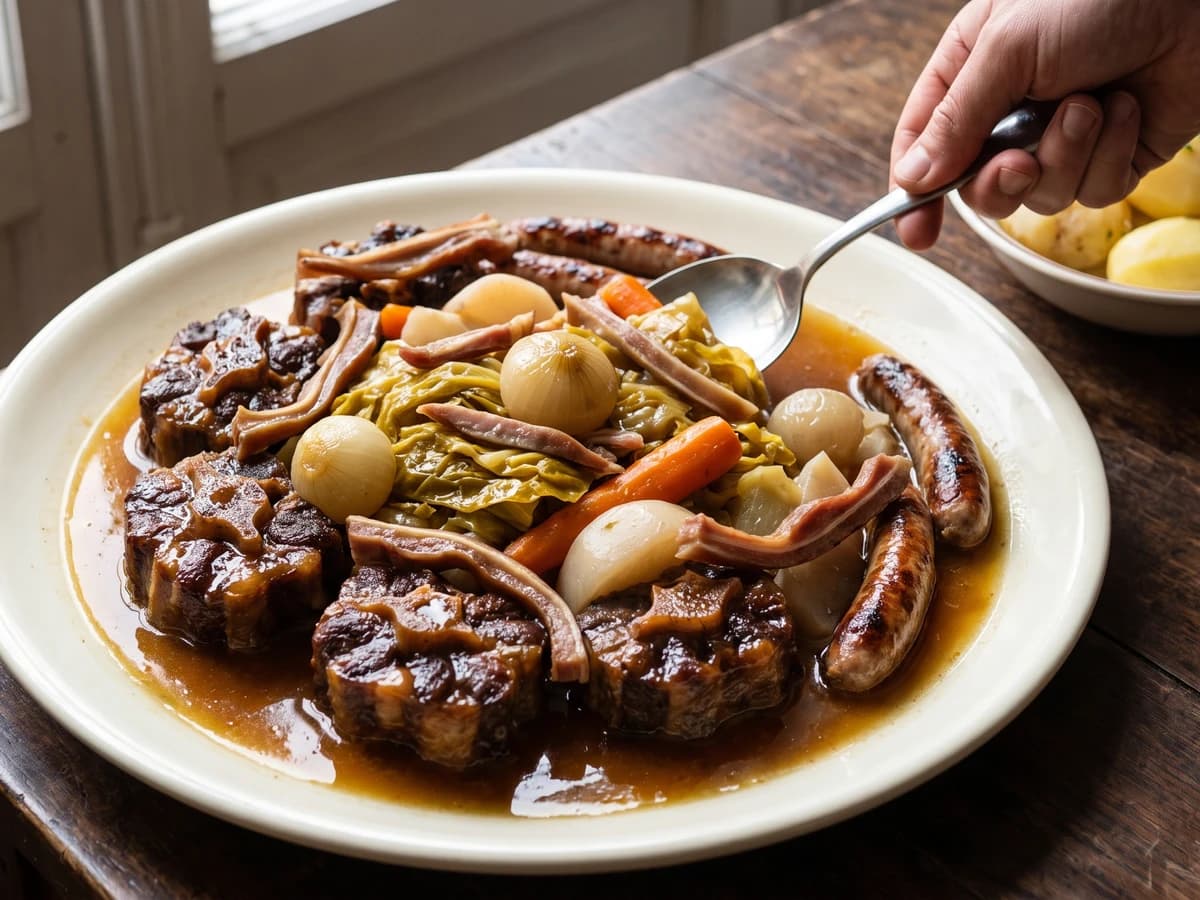
Queue de Bœuf en Hochepot gathers oxtail, pig's trotter and ear, cabbage, roots, and grilled chipolatas around a clear, gelatin-rich broth whose quiet simmer keeps every piece tender and distinct.
Chef Juliette
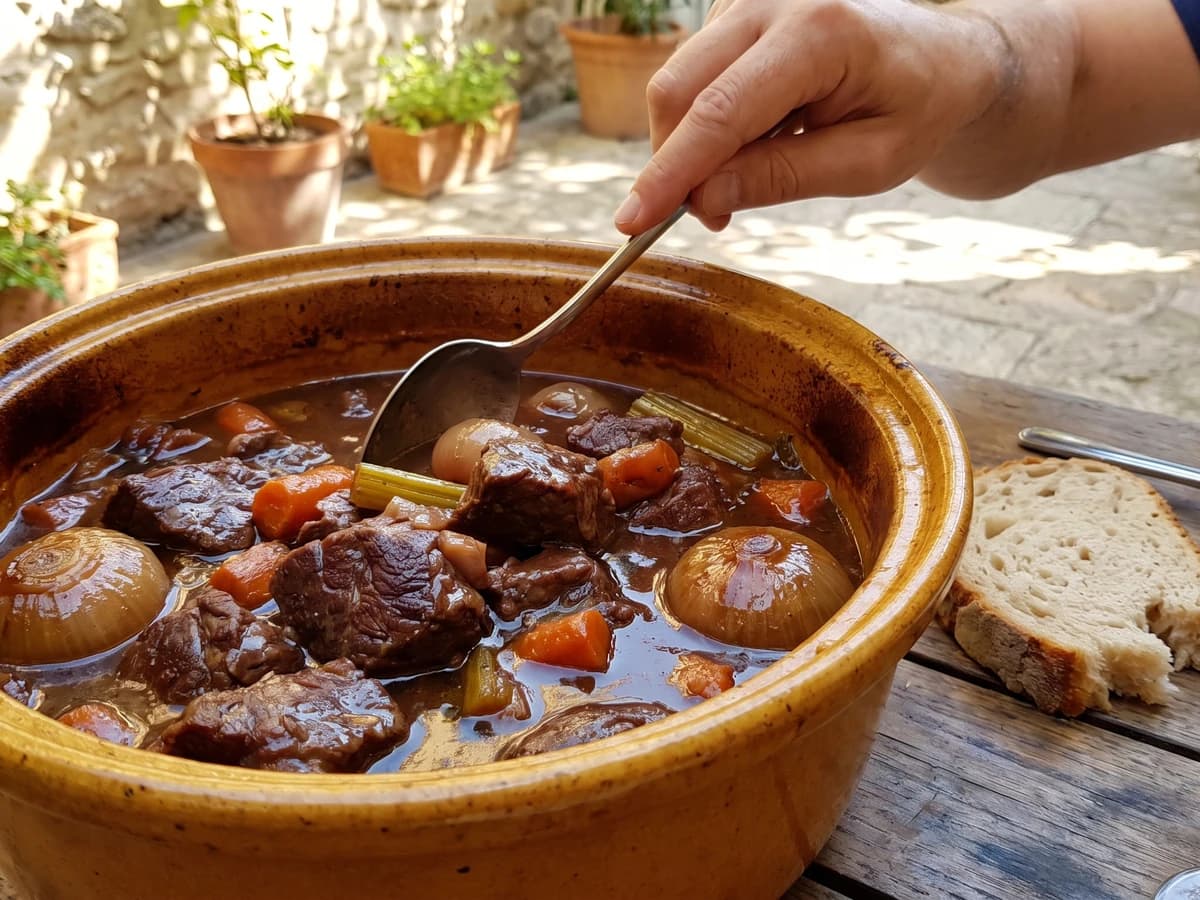
Beef shoulder larded with bacon, sharpened by red wine and vinegar, then sealed with garlic, vegetables, and dry lemon peel until the low oven turns it yielding and the gravy darkly glossy.