Culinary Explorer

A cooking platform built around craft, culture, and the stories behind what we eat.
Discover Culinary Explorer
Consommé D’Orléans

Consommé D’Orléans

Created by Chef Juliette

Based on No. 594, Consommé D’Orléans, from Le Guide Culinaire (1907) by Auguste Escoffier

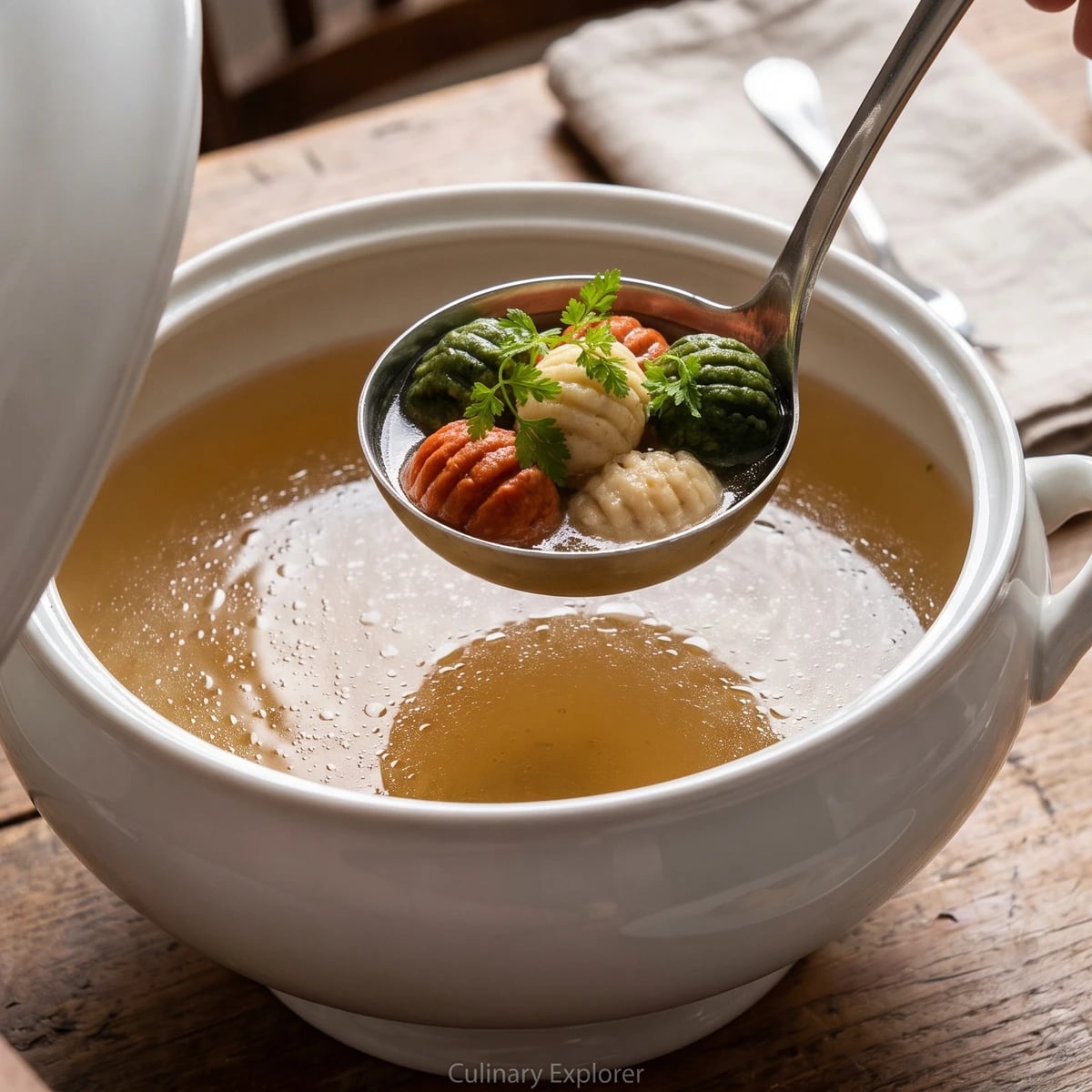
A clear consommé with a silken tapioca body and sixty tiny grooved chicken quenelles, ivory, tomato red, and spinach green, made for a dinner table that still enjoys a little ceremony.

Soups & Stews
French
Dinner Party
Special Occasion
Make Ahead
1 hr 30 min
Active Time
45 min cook3 hr total
YieldAbout 2 quarts (8 first-course servings)

Consommé D’Orléans (clarified chicken broth with three-colour quenelles) teaches one true thing: gentle heat preserves both clarity and tenderness. The consommé must remain limpid while its tapioca liaison, a light binding, gives it barely perceptible body; the quenelles must poach without boiling so they stay delicate and keep their grooves.

The source assumed a stockpot never off the fire, a saucier to bind and strain, and spare hands to groove thirty quenelles for every quart. A salamander has no work in this soup; the burden was labor and timing, not fierce heat. At home, a finished consommé made ahead replaces the perpetual stockpot, a food processor replaces the mortar, and a damp fine cloth replaces the kitchen linen. The large service brigade goes, but the clear broth, exact three-colour division, grooved shapes, tapioca ratio, and last-minute poach stay. Those are the dish.

The book gives a one-quart service formula that grand kitchens multiplied as needed. This home batch fixes service at two quarts for eight first courses, doubling its proportions exactly to sixty quenelles and six tablespoons of cooked tapioca. Test-poach one plain quenelle before you divide and colour the farce. That single step tells you whether everything that follows will hold.

Consommé D’Orléans belongs to the named-garnish vocabulary of Parisian classical kitchens, where one clear consommé could take on a new identity through its liaison and precisely composed garnish. The title points toward Orléans, but this is not a rustic Loiret household soup; it is a formal service preparation distinguished by poultry quenelles coloured with tomato and spinach. Tapioca supplies an almost invisible body, while chervil pluches, the tender leaf shreds used for soups, give the restrained final freshness.

The technique, the tradition, and the story behind every dish.

Discover Culinary Explorer

Ingredients

finished chicken consommé

Quantity

8 cups (1.9 L / 1.9 kg)

clear, defatted, and lightly seasoned

boneless, skinless chicken breast

Quantity

12 ounces (340 g)

sinew removed, cut into 1-inch pieces, and thoroughly chilled

unsalted butter

Quantity

2 tablespoons (30 ml / 28 g)

softened but still cool

large egg white

Quantity

1

thoroughly chilled

heavy cream

Quantity

1/2 cup (120 ml / 120 g)

thoroughly chilled

additional heavy cream (optional)

Quantity

2 tablespoons (30 ml / 30 g)

thoroughly chilled, for correcting the test quenelle

additional egg white (optional)

Quantity

1

beaten, for correcting the test quenelle

fine sea salt

Quantity

1 1/4 teaspoons (6 ml / 7 g)

ground white pepper

Quantity

1/8 teaspoon (0.6 ml / 0.3 g)

freshly grated nutmeg

Quantity

1 small pinch (about 0.1 g)

very red double-concentrated tomato purée

Quantity

1 1/2 tablespoons (22 ml / 25 g)

spinach leaves

Quantity

2 packed cups (475 ml / 60 g)

tough stems removed

unsalted butter for the trays

Quantity

1 tablespoon (15 ml / 14 g)

softened

small-pearl tapioca

Quantity

3 tablespoons dry (45 ml / 30 g), yielding exactly 6 tablespoons cooked (90 ml / about 90 g)

poached until completely translucent

chervil pluches

Quantity

2 loose pinches (about 1 g)

tender leaves picked into small shreds

Equipment Needed

  • Food processor with chilled bowl and blade
  • Sturdy fine-mesh sieve
  • Fine reusable soup cloth or unscented flour-sack towel
  • Piping bag with 1/2-inch (12 mm) open-star tip
  • Two buttered trays
  • Two wide sauté pans for the last-minute poach
  • Instant-read thermometer
  • Soup tureen

Instructions

  1. 1

    Prepare the spinach

    Drop the spinach into boiling water for 20 to 30 seconds, just until it collapses and turns a clear deep green. Drain immediately, cool under cold running water, and squeeze it with both hands until no more water escapes. Chop it to a smooth purée, then press it through a fine sieve. Wet spinach loosens the green forcemeat and dulls its colour, so squeeze without mercy.

  2. 2

    Make the farce

    Chill the food-processor bowl and blade before beginning. Process the cold chicken with the salt until it becomes smooth, sticky, and begins to gather around the blade. Add the cool butter, egg white, white pepper, and nutmeg, then process again until fully incorporated. With the motor running, add the 1/2 cup of cold cream in three additions, stopping as soon as the farce de volaille, the ordinary chicken forcemeat, becomes smooth and softly glossy. If the bowl loses its chill, stop and refrigerate everything for 15 minutes. Warm forcemeat separates; patience, not speed.

    Press the finished farce through a sturdy fine-mesh sieve. The food processor replaces the old mortar, but this single sieve pass stays because the quenelles should feel smooth rather than fibrous.
  3. 3

    Test and correct

    Hold a small pan of water between 175 and 180°F (80 and 82°C), with only an occasional tremor at the surface. Shape 1 1/2 teaspoons of plain farce into an oval and poach it for about 5 minutes, until firm and cooked through to 165°F (74°C). Taste it. If it feathers at the edges, lower the water temperature first; if a second test still feathers, chill the farce and beat in the reserved egg white 1 teaspoon at a time. If it is firm and bouncy, beat in additional cold cream 1 tablespoon at a time. If the mixture looks greasy, chill it until the butter firms, then pulse briefly with a spoonful of cold cream. Ça se rattrape.

  4. 4

    Make three colours

    Weigh the corrected farce and divide it equally among three chilled bowls. Leave the first portion plain. Fold the tomato purée thoroughly into the second, keeping the colour even and free of red streaks. Fold the spinach purée into the third. Test-poach a marble-sized piece of each coloured farce; tomato and spinach both introduce moisture, so if either feathers, mix in a little beaten egg white and test again. Cover and chill all three portions for 30 minutes.

  5. 5

    Groove the quenelles

    Butter two trays lightly. Fit a piping bag with a 1/2-inch (12 mm) open-star tip and pipe twenty ridged, 1 1/2-inch (4 cm) lengths of the plain farce. Cut each length cleanly and taper both ends with damp fingers so it resembles a small grooved olive. Repeat with the tomato and spinach farces, washing the bag and tip well between colours. You should have sixty quenelles, twenty of each colour. If you have no star tip, shape them between two damp teaspoons and draw three shallow lengthwise grooves with a damp fork. Cover and refrigerate.

  6. 6

    Poach the tapioca

    Cook the dry tapioca in plenty of gently simmering water until every pearl is translucent and very soft, following the timing required by its size. Drain without rinsing, then measure exactly 6 tablespoons of cooked tapioca. Bring the chicken consommé just below a simmer, add the measured tapioca, and hold it there for 10 minutes, stirring gently once or twice. The original proportion is three tablespoons of cooked tapioca for every quart of consommé, and that liaison must remain light.

  7. 7

    Strain to clarity

    Dampen a clean, unscented flour-sack cloth or fine reusable soup cloth and use it to line a fine sieve over a clean saucepan. Pass the tapioca-bound consommé through by gravity, without squeezing or scraping the cloth. It should emerge clear, pale gold, and only slightly more silken than before. If fine sediment clouds it, let it settle for 5 minutes and pass it through a freshly dampened cloth once more. If the tapioca has made it too thick, loosen it spoonful by spoonful with hot consommé, or hot water if none remains, until it pours freely.

  8. 8

    Poach before serving

    Ten minutes before serving, heat two wide pans of water to 180°F (82°C). Slide the chilled quenelles gently from their trays into the water, dividing them between the pans so they do not touch. Poach at the barest tremble for 5 to 6 minutes, turning once, until they feel lightly springy and reach 165°F (74°C) at the centre. Never let the water boil. If their surfaces begin to crack, lower the heat immediately; the inside will finish cooking in the retained heat. Lift them out with a slotted spoon and drain briefly on a clean towel.

  9. 9

    Fill the tureen

    Warm the soup tureen and bowls with hot water, then dry them. Arrange all sixty quenelles in the tureen, distributing the three colours evenly, and pour the hot consommé gently around them rather than directly onto their grooves. Scatter over the chervil pluches. Ladle seven or eight mixed quenelles into each bowl with enough consommé to surround them generously. Serve at once. À table!

Chef Tips

  • The consommé is the foundation, not background. It must be clear, well flavoured, and completely defatted while cold. An ordinary carton of cloudy stock cannot carry this garnish; prepare or obtain a true finished chicken consommé and make it ahead.
  • Keep the chicken, processor bowl, butter, egg white, and cream cold. Temperature protects the forcemeat emulsion, and the test poach tells you more than any clock or written ratio can.
  • Double-concentrated canned tomato purée gives the red quenelles colour without excess water. Thawed frozen leaf spinach may replace fresh spinach if it is squeezed thoroughly dry; the classical pantry has always understood preserved vegetables.
  • The ridges are not fussy decoration. They catch the golden consommé and distinguish these quenelles from plain spoon-shaped ones, so use the star tip or score them carefully with a fork.
  • Serve this as a first course with a restrained dry Loire white. The soup is delicate, and a heavily oaked wine will walk straight across it in muddy boots.

Advance Preparation

  • Prepare the finished chicken consommé up to 3 days ahead, chill it promptly, and remove every trace of solidified fat before reheating. It may also be frozen well ahead.
  • The three coloured forcemeats can be shaped on buttered trays, covered closely, and refrigerated for up to 24 hours. Keep them below 40°F (4°C) and poach them only shortly before service.
  • The tapioca-bound consommé can be strained several hours ahead. Reheat it gently without boiling; if it has tightened while standing, loosen it with a little hot consommé or water and check the seasoning again.

Frequently Asked Questions

Nutrition Information

1 serving (about 320g)

Calories
190 calories
Total Fat
12 g
Saturated Fat
7 g
Trans Fat
0 g
Unsaturated Fat
4 g
Cholesterol
70 mg
Sodium
840 mg
Total Carbohydrates
6 g
Dietary Fiber
0 g
Sugars
1 g
Protein
16 g

Note: Chef personas and recipes are created with AI assistance. Cook with care: follow safe food-handling practices, check doneness with a thermometer when needed, and adapt for allergies and your kitchen.

Where cooking meets culture.

Culinary guides, cultural storytelling, and the editorial depth that makes cooking meaningful.

Discover Culinary Explorer