Culinary Explorer

A cooking platform built around craft, culture, and the stories behind what we eat.
Discover Culinary Explorer
Consommé aux Œufs de Fauvette

Consommé aux Œufs de Fauvette

Created by Chef Juliette

Based on No. 592, Consommé aux Œufs de Fauvette, from Le Guide Culinaire (1907) by Auguste Escoffier

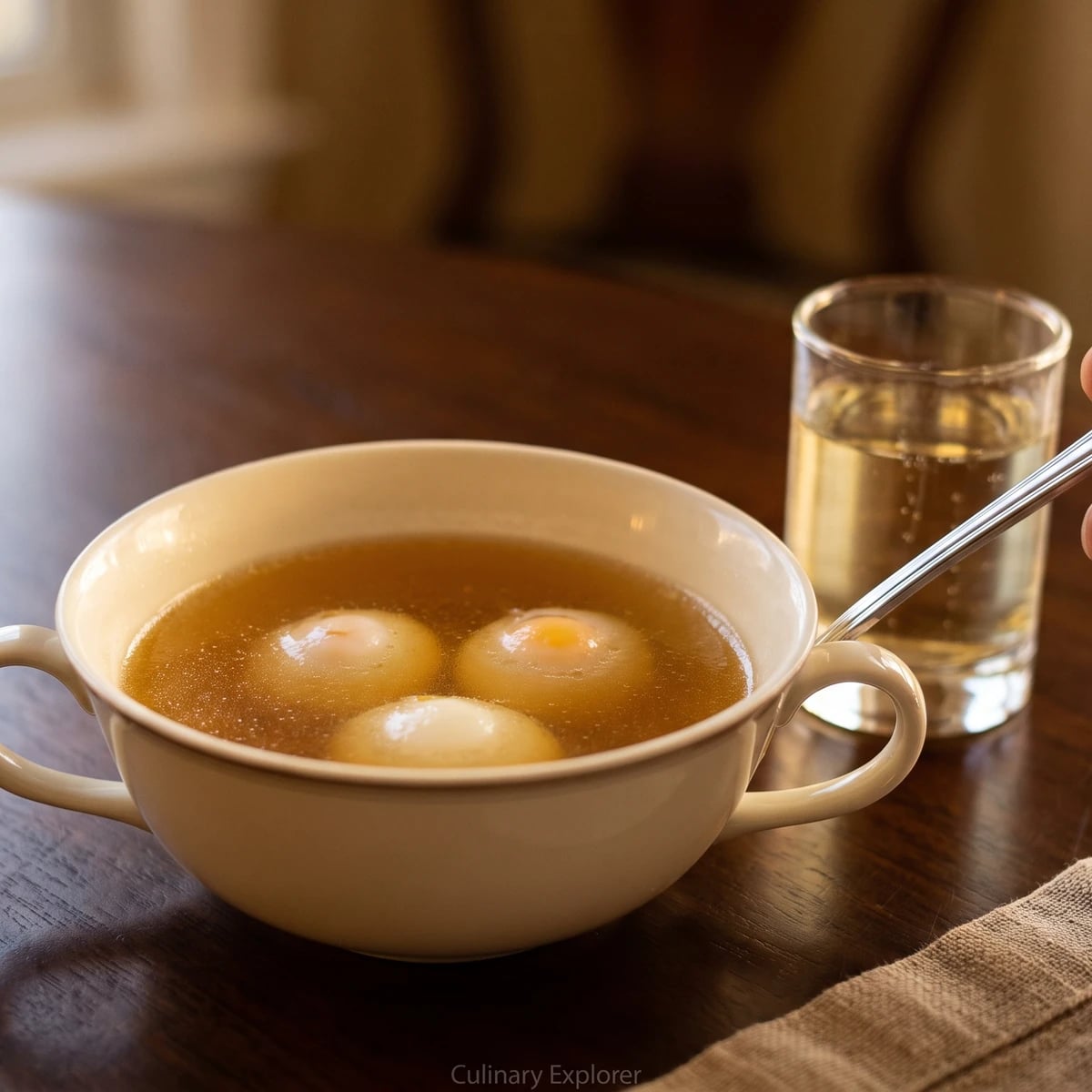
Consommé aux Œufs de Fauvette teaches the sternest kindness in the canon: disturb the raft and clarity vanishes; tend it gently and chicken becomes amber light around tiny poached quail eggs.

Soups & Stews
French
Dinner Party
Special Occasion
Celebration
45 min
Active Time
2 hr 30 min cook3 hr 15 min total
YieldAbout 2 quarts, 8 first-course servings

Consommé aux Œufs de Fauvette (clear chicken broth with tiny bird eggs) teaches the cleanest lesson in soup making: clarity comes from a raft held still, not from forcing broth through finer cloth. Once the proteins have gathered the stock's fat and particles, one hard boil can scatter them through the pot again. The one true thing to know before touching a pan is simple: after the raft rises, stop stirring.

The original assumed a saucier on staff, chicken stock never off the fire, and ready access to the eggs of very small birds. Your home equivalent is a single pot of cold, gelatin-rich stock clarified with lean chicken and egg whites, then garnished with farmed quail eggs, the closest responsible match in scale and delicacy. The permanent stockpot and access to small wild birds' eggs were brigade scaffolding, and they go; clarification and individual poaching are the dish, and they stay. Scaled to about two quarts, this is one cook, one stove, one evening.

When it is right, the consommé is deep amber yet transparent enough to reveal the ivory eggs beneath its surface, with a concentrated chicken flavor and just enough gelatin to give the broth presence on the lips. Bring the cold clarification mixture up slowly, then guard the raft from a boil. That is the step that decides everything.

Consommé aux Œufs de Fauvette comes from the formal grand-kitchen table, where French cooks dedicated exacting dishes to celebrated performers; this one honored the singer Adelina Patti. Fauvette means warbler, and the garnish was literal, small birds' eggs poached and set in exceptionally clear chicken consommé, not a molded royale or a poetic name for another garnish. Farmed quail eggs preserve the scale and delicacy at today's table while leaving wild songbirds and their nests alone.

The technique, the tradition, and the story behind every dish.

Discover Culinary Explorer

Ingredients

cold, unsalted, gelatin-rich chicken stock

Quantity

16 cups (3.8 L / 3.8 kg)

thoroughly defatted

very lean ground chicken

Quantity

1½ pounds (680 g)

kept cold

large egg whites

Quantity

8 (about 1 cup / 240 g)

divided, with 2 held in reserve

yellow onion

Quantity

1 cup (240 ml / 150 g)

finely diced

leek, white and pale green parts

Quantity

1 cup (240 ml / 100 g)

thoroughly washed and finely sliced

carrot

Quantity

¾ cup (180 ml / 90 g)

finely diced

celery

Quantity

½ cup (120 ml / 55 g)

finely diced

ripe tomato

Quantity

1 cup (240 ml / 180 g)

seeded and chopped

parsley stems

Quantity

8

fresh thyme

Quantity

4 sprigs

bay leaf

Quantity

1

black peppercorns

Quantity

1 teaspoon (5 ml / 3 g)

lightly crushed

quail eggs

Quantity

30

24 for serving and 6 spare

white wine vinegar

Quantity

2 tablespoons (30 ml / 30 g)

water

Quantity

6 cups (1.4 L / 1.4 kg)

for poaching

fine sea salt

Quantity

to taste

Equipment Needed

  • 8-quart or larger heavy stockpot
  • Flat-edged wooden spoon
  • Instant-read thermometer
  • Fine-mesh strainer
  • Fine muslin or double-layer cheesecloth
  • Wide saucepan for poaching
  • Small slotted spoon
  • Quail-egg scissors or small serrated knife
  • 8 consommé cups or small soup bowls

Instructions

  1. 1

    Chill and defat

    Begin with stock that is thoroughly cold. Lift away every visible piece of set fat, then blot the surface with a clean paper towel. Taste a warmed spoonful: it should be distinctly chicken-rich but only lightly seasoned, because the final reduction will concentrate its salt. If the stock is already salty, do not proceed with it; clarification removes particles, not salt.

    A well-made stock sets to a loose jelly in the cold. That gelatin gives the finished consommé its quiet body without flour, roux, or any other thickener.
  2. 2

    Mix the clarification

    In an 8-quart or larger heavy pot, combine the cold ground chicken with 6 egg whites. Work them together with a wooden spoon, then mix in the onion, leek, carrot, celery, tomato, parsley stems, thyme, bay leaf, and peppercorns. Stir in about 2 cups of the cold stock until loose, then add the remaining stock. Everything must begin cold so the proteins can gather the impurities gradually instead of setting into useless little flakes.

  3. 3

    Raise the raft

    Set the pot over medium-low heat and stir continuously with a flat-edged wooden spoon, scraping the floor and corners so the chicken cannot catch. After 20 to 30 minutes, the mixture will approach 120°F (49°C), look alarmingly curdled, and begin rising into a pale cap. This is the raft. Once it covers the surface, stop stirring completely and lower the heat. Make a 2-inch opening in its center with the spoon handle to form a chimney.

  4. 4

    Clarify without boiling

    Hold the liquid between 180°F and 190°F (82°C and 88°C) for 50 to 60 minutes. It should barely tremble beneath the raft, never boil. Every 10 minutes, draw a ladleful of broth from the chimney and pour it gently over the raft so the liquid continues filtering through the proteins. If the pot boils and the raft breaks, take it off the heat at once and let it settle for 10 minutes. Strain without pressing, chill the cloudy broth quickly, whisk the 2 reserved whites with 1 cup of it, then return everything to a clean pot and repeat the slow heating process for 20 minutes. Ça se rattrape.

    A thermometer is useful, but your eyes tell the truth: a few lazy movements beneath the raft are right. Rolling bubbles are not.
  5. 5

    Strain without pressure

    Dampen a double layer of fine muslin or cheesecloth and use it to line a fine-mesh strainer set over a clean pot. Ladle the consommé through the chimney and into the cloth, working slowly so the raft remains intact. Stop before the last cloudy liquid and solids tumble into the strainer. Never press the raft; pressing returns the very particles it has collected. If a few fine specks remain, pass the broth once more through freshly dampened cloth.

  6. 6

    Reduce and season

    Bring the strained consommé to the barest simmer and reduce it to 8 cups (1.9 L), skimming away any bubbles or beads of fat that appear. Only now add salt, a little at a time. The finished broth should taste concentrated but clean, with no single vegetable announcing itself, and it should leave a delicate body on the lips. Keep it hot at about 185°F (85°C), but do not let it boil.

  7. 7

    Poach the quail eggs

    Bring the water and vinegar to a quiet poaching temperature, about 180°F (82°C), in a wide saucepan. Open each quail egg into its own small cup, using quail-egg scissors or the point of a serrated knife to cut through the tough inner membrane. Slide in 4 to 6 eggs at a time and poach for 45 to 60 seconds, until the whites are set but the yolks remain yielding. Lift them into cold water with a slotted spoon. If an egg grows a ragged tail, the water was moving too strongly; trim the tail with kitchen scissors and keep the egg. It is perfectly good.

    For guests who should avoid soft yolks, poach their eggs for about 90 seconds, until firm through the center.
  8. 8

    Warm and serve

    Warm 8 consommé cups or small soup bowls with hot water. Reheat the poached quail eggs for 20 seconds in clean hot water, drain them well, and place 3 in each cup. Ladle 1 cup of the hot consommé around them without splashing. Add nothing else. The tiny eggs are the garnish and the perfectly clear chicken broth is the whole point. À table!

Chef Tips

  • Use unsalted stock with real gelatin and a clean chicken flavor. A heavily salted packaged broth becomes harsh as it reduces, and no amount of clarification can remove that salt.
  • The title remains Consommé aux Œufs de Fauvette because the word carries the dish's history, but do not gather or buy wild songbird eggs. Farmed quail eggs are legal, obtainable, and close enough in size to preserve the original intention honestly.
  • Quail shells have a stubborn membrane. Proper quail-egg scissors make quick work of them, but the pointed end of a small serrated knife will open them neatly enough. Crack each into a cup before poaching so no shell reaches the pan.
  • Do not decorate the cups with herbs, diced vegetables, or drops of fat. This consommé was conceived as perfect chicken broth with tiny eggs, and embellishment only hides the standard you worked to achieve.
  • Serve with a dry, fine-bubbled Champagne if wine is wanted. Its acidity clears the palate without talking over the consommé.

Advance Preparation

  • The chicken stock can be made up to 3 days ahead, chilled quickly, and refrigerated. Its fat is easiest to remove once it has set firmly on the cold surface.
  • Clarify the consommé up to 2 days ahead. Cool it promptly in an ice bath, refrigerate below 40°F (4°C), then lift away any final specks of fat before reheating it gently.
  • The quail eggs may be poached up to 4 hours before serving and refrigerated in cold water. Drain and warm them for about 20 seconds in clean hot water just before they enter the cups.
  • Freeze unused consommé in tightly covered portions for up to 2 months. Thaw it in the refrigerator and heat without boiling so its clarity remains intact.

Frequently Asked Questions

Nutrition Information

1 serving (about 265g)

Calories
110 calories
Total Fat
3 g
Saturated Fat
1 g
Trans Fat
0 g
Unsaturated Fat
2 g
Cholesterol
245 mg
Sodium
820 mg
Total Carbohydrates
4 g
Dietary Fiber
0 g
Sugars
2 g
Protein
17 g

Note: Chef personas and recipes are created with AI assistance. Cook with care: follow safe food-handling practices, check doneness with a thermometer when needed, and adapt for allergies and your kitchen.

Where cooking meets culture.

Culinary guides, cultural storytelling, and the editorial depth that makes cooking meaningful.

Discover Culinary Explorer