Chef Juliette
Bouillabaisse à la Marseillaise
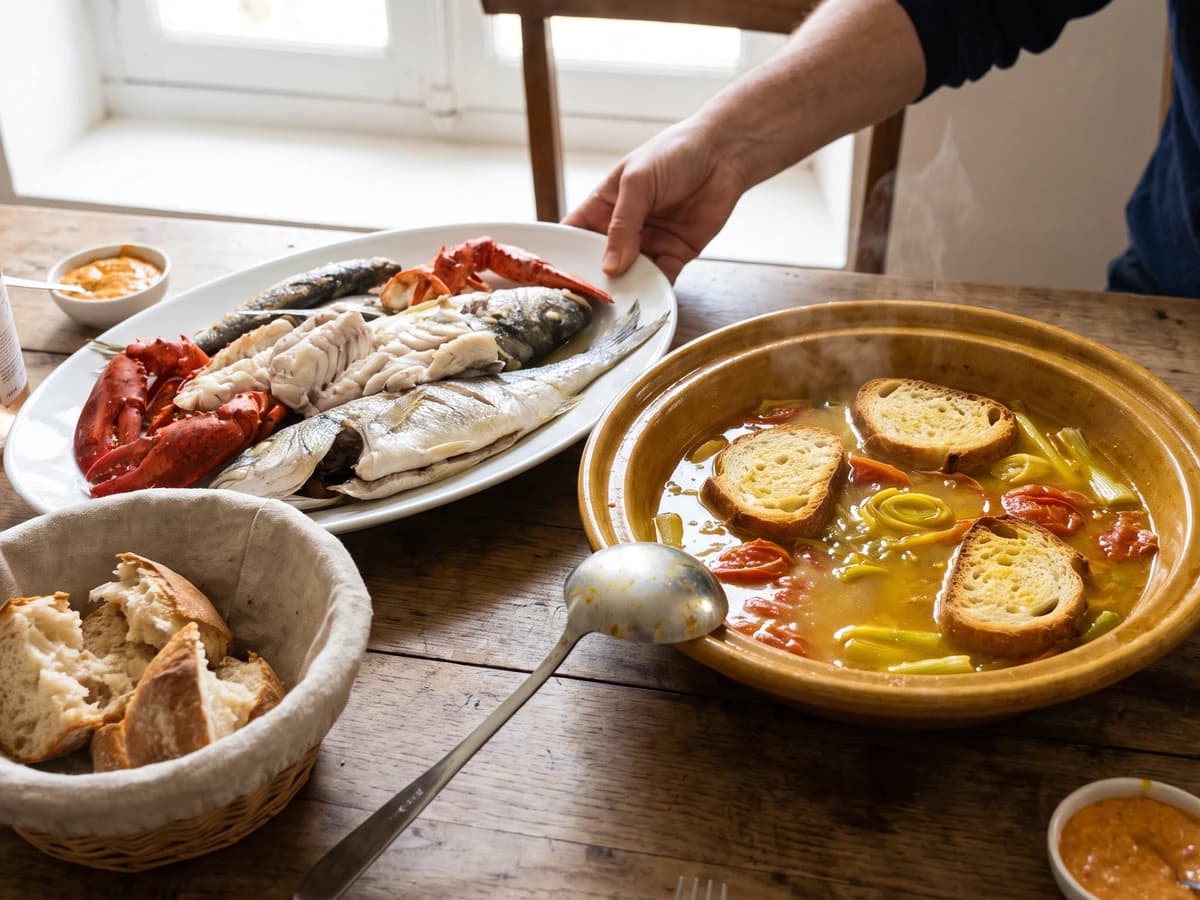
Marseille's great fish stew, saffron-gold and garlic-scented, proves that a hard boil can be the careful choice: it binds olive oil into broth before the whole pot meets bread.
A cooking platform built around craft, culture, and the stories behind what we eat.

Created by Chef Juliette
Based on No. 590, Consommé Nesselrode, from Le Guide Culinaire (1907) by Auguste Escoffier
Clear hazel-hen consommé, chestnut-and-salmis royale cut into fluted rounds, and fine juliennes of roast game and mushrooms: a formal autumn soup made workable for one careful home cook.
Consommé Nesselrode (clear game broth with chestnut royale) teaches the discipline of clarity. The broth must remain bright enough to reveal every fluted round and fine julienne beneath it, so the one true thing to know before touching a pan is this: every garnish must be smoothly set, cleanly cut, and free of crumbs before it meets the consommé.
The original assumed a saucier on staff, hazel-hen stock never off the fire, finished game salmis sauce, and ranks of baba-moulds, the small tapered cylinders used for individual royales. Your honest home equivalent is a properly finished game consommé prepared with hazel-hen fumet (a concentrated game essence), four straight-sided ramekins, and one fluted biscuit cutter. The book calls for one quart; for a dinner-party soupière I have made about two quarts, doubling every garnish measure rather than padding the broth and weakening its character. One cook, one stove, one evening.
Keeping several pots hot through service and molding scores of individual portions was brigade scaffolding, and it can go. The fumet-led consommé, the chestnut royale enriched with game salmis sauce, the roast fillet, and the exact julienne are the dish, and they stay. Poach the royale below a simmer. That gentle water bath decides whether the rounds emerge silken and clear-edged or porous enough to cloud the bowl.
Consommé Nesselrode belongs to the formal soup course of Parisian cuisine classique, where named consommés were distinguished by precisely cut garnishes placed in an impeccably clear base. Its title honors the diplomat Count Nesselrode and shares the chestnut association found in Nesselrode sweets, but this preparation is wholly savory: game fumet, chestnut royale, salmis sauce, roast bird, and mushrooms. The dish traveled into bourgeois dinner-party cooking through the soupière, allowing the garnishes to be prepared ahead and completed with boiling consommé at the table.
Quantity
2 quarts (1.9 L / about 1.9 kg)
divided
Quantity
1 cup (240 ml / 250 g)
Quantity
4 tablespoons (60 ml / 65 g)
strained and cooled
Quantity
2
Quantity
1 teaspoon (5 ml / 5 g)
softened, for the moulds
Quantity
up to 1/8 teaspoon (0.6 ml / 0.8 g)
only if needed
Quantity
1/4 cup (60 ml / 40 g)
cut into a very fine julienne
Quantity
1/4 cup (60 ml / 25 g)
cut into a very fine julienne
| Ingredient | Quantity |
|---|---|
| finished game consommé prepared with hazel-hen fumetdivided | 2 quarts (1.9 L / about 1.9 kg) |
| unsweetened chestnut purée | 1 cup (240 ml / 250 g) |
| finished game salmis saucestrained and cooled | 4 tablespoons (60 ml / 65 g) |
| large eggs | 2 |
| unsalted buttersoftened, for the moulds | 1 teaspoon (5 ml / 5 g) |
| fine sea salt (optional)only if needed | up to 1/8 teaspoon (0.6 ml / 0.8 g) |
| cold roast hazel-hen filletscut into a very fine julienne | 1/4 cup (60 ml / 40 g) |
| white button mushroom capscut into a very fine julienne | 1/4 cup (60 ml / 25 g) |
Heat the oven to 300°F (150°C). Butter four 4-ounce (120 ml) straight-sided ramekins or baba-moulds very lightly, leaving no visible ridges of butter. Set them in a deep roasting pan and bring a kettle of water just below the boil. The ramekins replace the original tapered moulds; only the outer shape changes, while the depth needed for half-inch roundels remains.
Work the chestnut purée and finished game salmis sauce together until completely smooth. Beat the eggs only until the whites and yolks unite, then stir them gently into the chestnut mixture without raising bubbles. Pass the royale through a fine sieve, pressing with a flexible spatula, and taste a pinhead-sized dab from the spoon. Add the measured salt only if the finished sauce has not seasoned it sufficiently. Divide among the prepared moulds and tap each once against a folded towel to release hidden air.
Pour the hot water into the roasting pan until it reaches halfway up the moulds, then cover the pan loosely with parchment and foil. Poach for 25 to 35 minutes, until the edges are set and the centres give a small, unified tremble when nudged. The water must remain quiet. If it begins bubbling or the royales start to puff, lift the pan out at once, replace one-third of the hot water with cold water, lower the oven to 275°F (135°C), and continue gently. Ça se rattrape. A slightly coarse outer edge can be trimmed away later, but a hard boil makes the whole custard porous.
Lift the moulds from the bain-marie and cool for 15 minutes, then chill until firm, about 30 minutes. Run a thin knife around each edge and turn the royales onto a clean board. Cut them crosswise into slices exactly 1/2 inch (1.25 cm) thick, then trim each slice with a 1 1/4-inch (3 cm) fluted round cutter, the home equivalent of the book's grooved fancy-cutter. Wipe the blade between cuts and brush away every crumb. Keep only smooth, intact roundels for the soup.
Cut the cold roast hazel-hen fillets and mushroom caps julienne-fashion, meaning fine match-shaped rods about 1 1/2 inches (4 cm) long. Work with a sharp knife and keep the two garnishes separate. The roast fillet should remain distinct, not shredded, while the mushroom must be fine enough to turn tender when the boiling consommé reaches it.
Rinse the soupière with very hot water, then drain and dry it. Heat the finished game consommé prepared with hazel-hen fumet slowly in a clean saucepan, skimming away any trace of fat or foam without stirring. When the first full bubbling boil reaches the surface, stop the heat. If loose flecks have appeared, pass the broth once through dampened muslin into another hot pan. Ça se rattrape, but do not whisk it or boil it hard in hopes of forcing clarity back.
Arrange the chestnut-and-game-salmis royale roundels across the bottom of the hot soupière, then add the julienne of roast hazel-hen and the equal quantity of mushroom julienne. Pour the boiling game consommé over them in one steady stream, cover for 30 seconds so the mushrooms soften, and serve immediately. The broth should be amber-clear, the roundels whole, and every garnish visible beneath the surface. À table!
1 serving (about 290g)
Culinary guides, cultural storytelling, and the editorial depth that makes cooking meaningful.
Discover Culinary ExplorerChef Juliette
Marseille's great fish stew, saffron-gold and garlic-scented, proves that a hard boil can be the careful choice: it binds olive oil into broth before the whole pot meets bread.
Chef Juliette
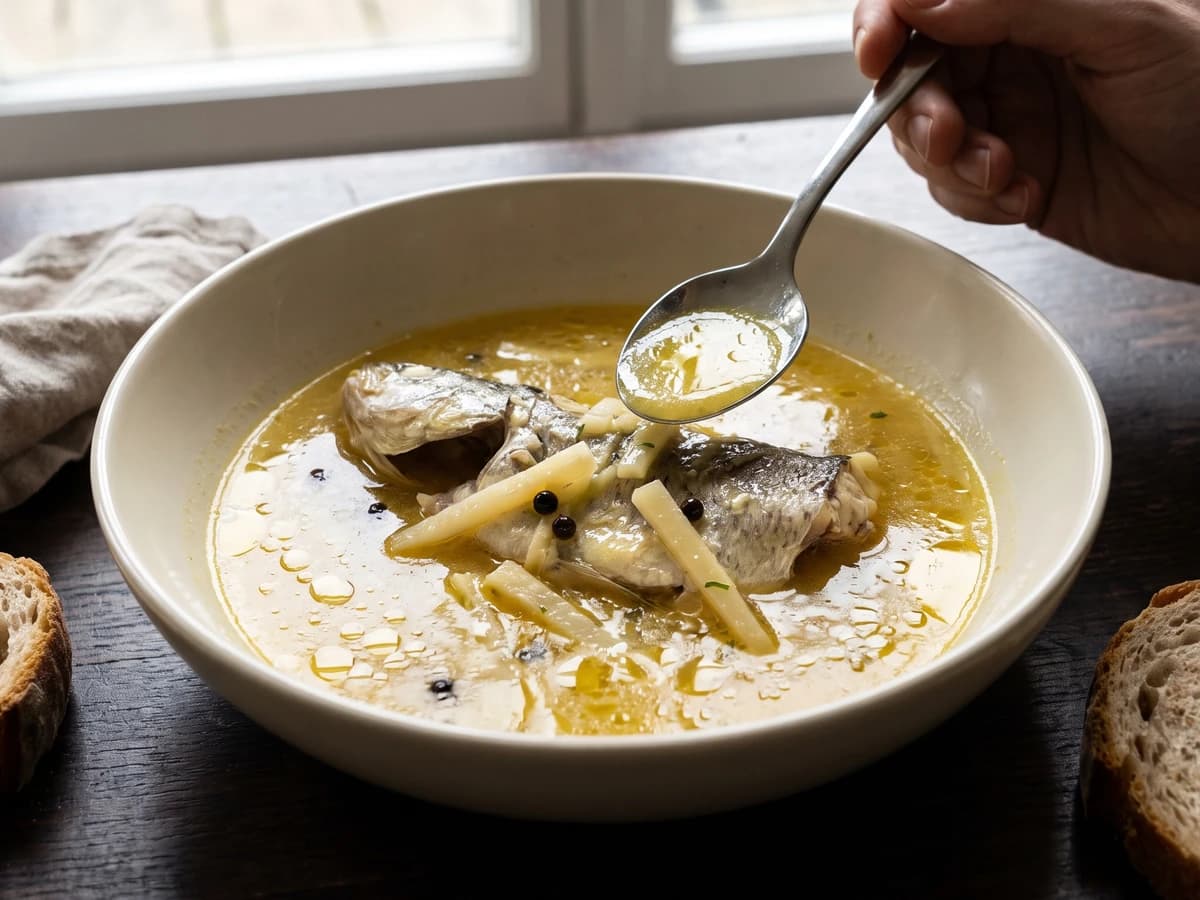
Waterzoi asks fresh, bone-in river fish to thicken its own buttery broth, with parsley root and pepper for company. No flour, no stockpot, just a brisk simmer watched closely.
Chef Juliette
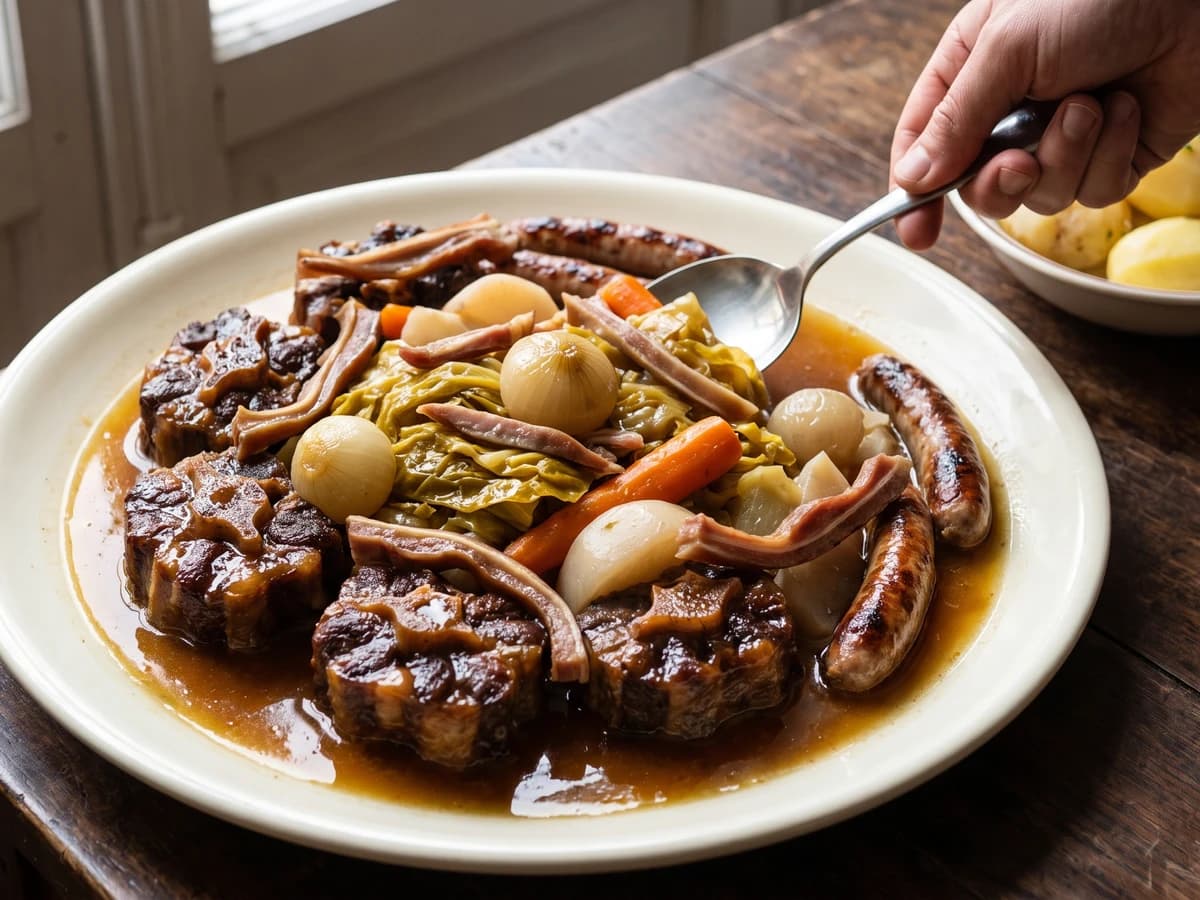
Queue de Bœuf en Hochepot gathers oxtail, pig's trotter and ear, cabbage, roots, and grilled chipolatas around a clear, gelatin-rich broth whose quiet simmer keeps every piece tender and distinct.
Chef Juliette
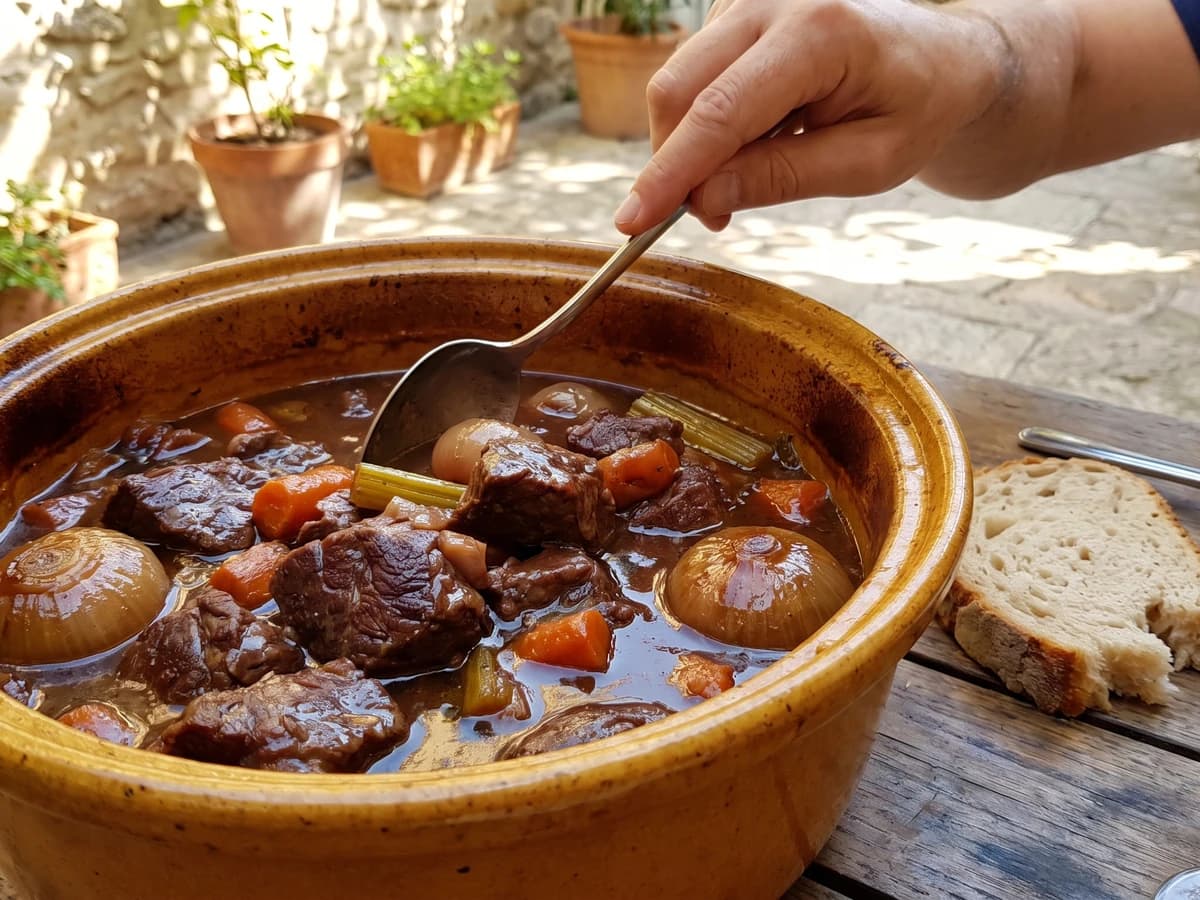
Beef shoulder larded with bacon, sharpened by red wine and vinegar, then sealed with garlic, vegetables, and dry lemon peel until the low oven turns it yielding and the gravy darkly glossy.