Chef Juliette
Bouillabaisse à la Marseillaise
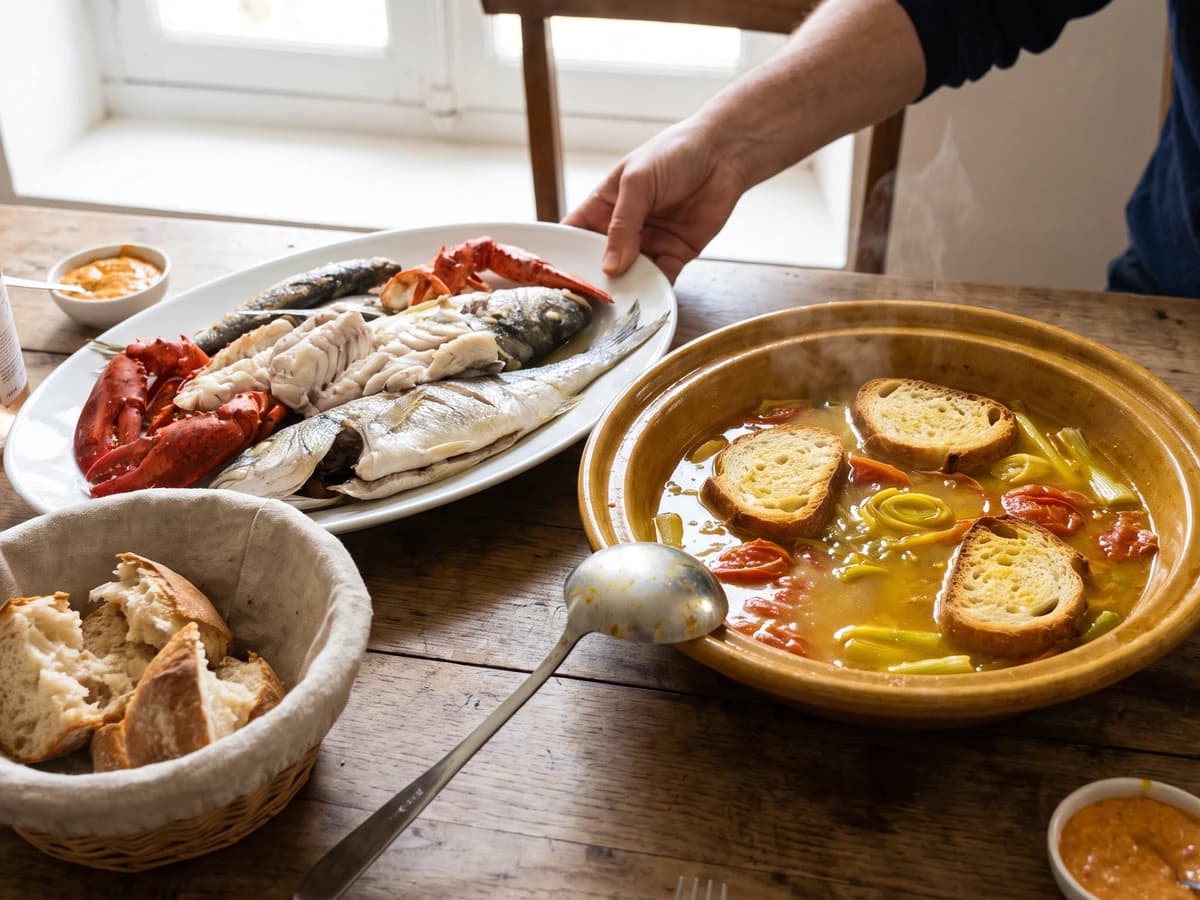
Marseille's great fish stew, saffron-gold and garlic-scented, proves that a hard boil can be the careful choice: it binds olive oil into broth before the whole pot meets bread.
A cooking platform built around craft, culture, and the stories behind what we eat.
Created by Chef Juliette
Based on No. 588, Consommé Montmorency, from Le Guide Culinaire (1907) by Auguste Escoffier
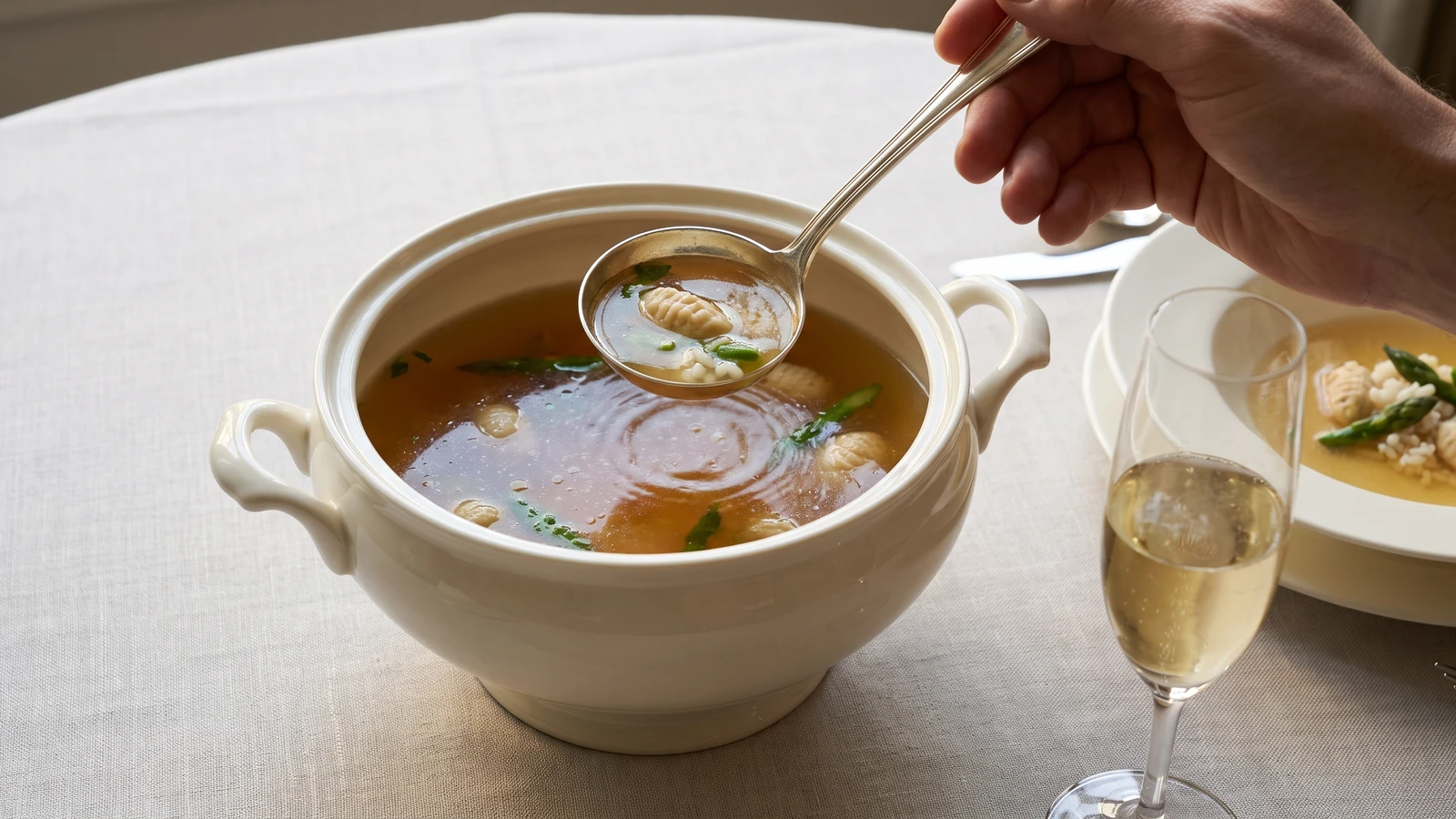
A clear chicken consommé given the faintest body with tapioca, then filled with grooved chicken quenelles, emerald asparagus tips, and rice so separate that each grain catches the light.
Consommé Montmorency (clarified chicken broth lightly bound with tapioca and garnished with chicken quenelles, asparagus, and rice) teaches separation. Every element is cooked alone, drained almost to dryness, and joined only when the soup goes to the table. Let rice starch, asparagus water, or a ragged quenelle stray into the broth and the consommé loses the clarity that makes it itself.
The source formula begins with finished chicken consommé and assumes a stockpot never off the fire, cold chicken forcemeat ready to hand, linen at the straining station, and enough cooks to shape eighteen quenelles for every quart. At home, make or thaw the consommé ahead, use a food processor for the forcemeat, damp muslin for the linen, and a small open-star tip in place of grooved molds. The equipment is brigade scaffolding and may change. The ratio of tapioca to broth, thirty-six quenelles for this two-quart batch, and the separate poaching are the dish, so they stay. One cook, one stove, one evening.
At service, the amber broth should slip from the ladle with the faintest satin body; ivory grooves, green tips, and white grains remain distinct beneath it. The step that matters most is the straining. Let damp muslin and gravity do the work, because pressing the tapioca presses cloudiness into the bowl.
Consommé Montmorency belongs to the Parisian classical dining room, where one clear consommé could become many distinct soups through precisely prepared garnishes. Montmorency, north of Paris, is celebrated in the French larder for its tart cherries, yet this soup contains none, correcting the assumption that every Montmorency title signals fruit. Here the name is fixed by practice: chicken quenelles, green asparagus tips, separate grains of rice, and a tapioca-bound consommé.
Quantity
8 cups (1.9 litres / about 1.9 kg)
well seasoned and completely degreased
Quantity
3 tablespoons (45 ml / 30 g)
to yield at least 6 tablespoons cooked
Quantity
16 cups (3.8 litres / 3.8 kg)
plus more for an ice bath, divided
Quantity
6 ounces (170 g)
trimmed, cubed, and thoroughly chilled
Quantity
1 large (2 tablespoons / 30 g)
thoroughly chilled
Quantity
½ cup (120 ml / 120 g)
thoroughly chilled
Quantity
½ teaspoon (2.5 ml / 3 g)
Quantity
⅛ teaspoon (0.6 ml / 0.25 g)
Quantity
2 tablespoons (30 ml / 24 g)
rinsed, to yield at least 4 tablespoons cooked
Quantity
4 tablespoons (60 ml / 50 g)
trimmed to 1½-inch lengths
Quantity
2 tablespoons (30 ml / 36 g)
divided
Quantity
4 cups (950 ml / about 550 g)
for chilling
| Ingredient | Quantity |
|---|---|
| prepared chicken consomméwell seasoned and completely degreased | 8 cups (1.9 litres / about 1.9 kg) |
| small pearl tapiocato yield at least 6 tablespoons cooked | 3 tablespoons (45 ml / 30 g) |
| waterplus more for an ice bath, divided | 16 cups (3.8 litres / 3.8 kg) |
| boneless, skinless chicken breasttrimmed, cubed, and thoroughly chilled | 6 ounces (170 g) |
| large egg whitethoroughly chilled | 1 large (2 tablespoons / 30 g) |
| heavy creamthoroughly chilled | ½ cup (120 ml / 120 g) |
| fine sea salt for the chicken forcemeat | ½ teaspoon (2.5 ml / 3 g) |
| ground white pepper | ⅛ teaspoon (0.6 ml / 0.25 g) |
| dry long-grain white ricerinsed, to yield at least 4 tablespoons cooked | 2 tablespoons (30 ml / 24 g) |
| small green asparagus tipstrimmed to 1½-inch lengths | 4 tablespoons (60 ml / 50 g) |
| fine sea salt for the cooking waterdivided | 2 tablespoons (30 ml / 36 g) |
| icefor chilling | 4 cups (950 ml / about 550 g) |
Bring 6 cups of the water to a boil in a saucepan. Rain in the small pearl tapioca while stirring, then lower the heat and poach at a gentle simmer for 20 to 30 minutes, stirring often enough to prevent sticking. The pearls are ready when they are completely translucent, with no chalky bead at the centre. Drain them in a fine sieve without rinsing, then measure exactly 6 level tablespoons of cooked tapioca. Discard any surplus.
Reserve 1 cup of the chicken consommé and warm the remaining 7 cups to a bare simmer. Stir in the measured 6 tablespoons of poached tapioca and hold it at that barely moving simmer for 8 minutes, letting the released starch give the broth a very light body. Line a fine sieve with well-rinsed damp muslin and set it over a clean pot. Pour in the consommé and let gravity carry it through, then stir in the reserved cup. Never squeeze or press the cloth. If the flow slows, lift the corners gently; if you have pressed and clouded the broth, let it stand for 5 minutes and ladle the clear upper portion through fresh damp muslin, leaving the sediment behind.
Chill the food processor bowl and blade for 15 minutes. Pulse the cold chicken with the ½ teaspoon of salt until it becomes a smooth, tacky paste, scraping the bowl once or twice. Add the egg white and pulse until fully absorbed. Add the cold cream in four small additions, pulsing briefly after each, then add the white pepper. Stop as soon as the forcemeat is satin-smooth. Warmth breaks this emulsion, so if the paste turns grainy or sheds liquid, stop at once, nest the processor bowl in ice for 10 minutes, and pulse again only two or three times. Ça se rattrape. Poach a teaspoonful in hot water until it reaches 165°F (74°C); it should hold together, taste properly seasoned, and feel tender rather than rubbery.
Fit a piping bag with a ½-inch open-star tip and fill it with the cold chicken forcemeat. On a tray lined with dampened parchment, pipe 36 tapered, grooved quenelles about 1¼ inches long. Use a wet paring knife to cut the paste cleanly at the tip. Chill the shaped quenelles for 10 minutes so the grooves set before poaching.
Heat 4 cups of the water with 2 teaspoons of the cooking salt to 175 to 180°F (79 to 82°C). The surface should barely tremble. Working in three batches, lift the quenelles from the parchment with a wet thin spatula and lower them into the water. Poach for 5 to 7 minutes, turning once, until opaque, lightly springy, and 165°F (74°C) at the centre. Drain them on a lint-free towel. If the water boils and the grooves begin to blur, remove the pan from the heat and add a splash of cold water before continuing with the next batch.
Bring 4 cups of the water and 2 teaspoons of the cooking salt to a lively simmer. Add the rinsed rice and poach it like pasta until tender but unbroken, about 10 to 12 minutes. Drain immediately, rinse briefly under hot water to remove loose starch, and spread the rice over a clean towel to dry. If the grains cling together, rinse them once more under hot water and drain well. Measure exactly 4 level tablespoons of cooked rice for the soup; every grain should remain distinct and separate.
Prepare a bowl of ice and cold water. Bring the remaining 2 cups of water and 2 teaspoons of cooking salt to a boil, add the asparagus tips, and blanch until vivid green and just tender, 60 to 90 seconds for slender tips or up to 2 minutes for thicker ones. Transfer them directly to the ice bath, then drain and pat them thoroughly dry. Measure exactly 4 tablespoons for the tureen.
Reheat the strained consommé gently until its surface quivers, without letting it roll at a boil. Warm a 3-quart soup tureen with hot water, empty it, and dry it well. Arrange all 36 drained quenelles, the 4 tablespoons of asparagus tips, and the 4 tablespoons of separate rice grains in the tureen. Pour the consommé over them and serve at once, dividing the garnishes evenly among the bowls. The broth stays clear because nothing has been allowed to cook in it at the finish. À table!
1 serving (about 300g)
Culinary guides, cultural storytelling, and the editorial depth that makes cooking meaningful.
Discover Culinary ExplorerChef Juliette
Marseille's great fish stew, saffron-gold and garlic-scented, proves that a hard boil can be the careful choice: it binds olive oil into broth before the whole pot meets bread.
Chef Juliette
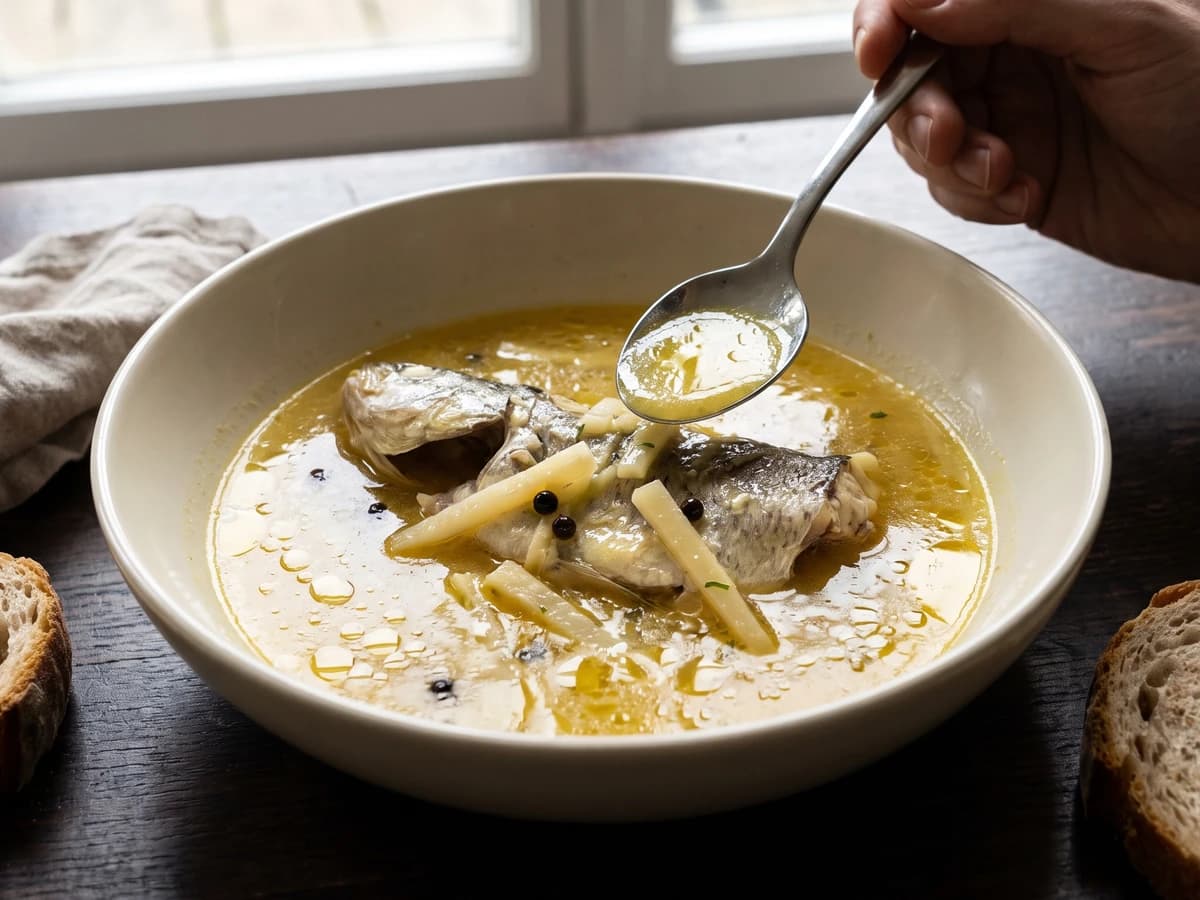
Waterzoi asks fresh, bone-in river fish to thicken its own buttery broth, with parsley root and pepper for company. No flour, no stockpot, just a brisk simmer watched closely.
Chef Juliette
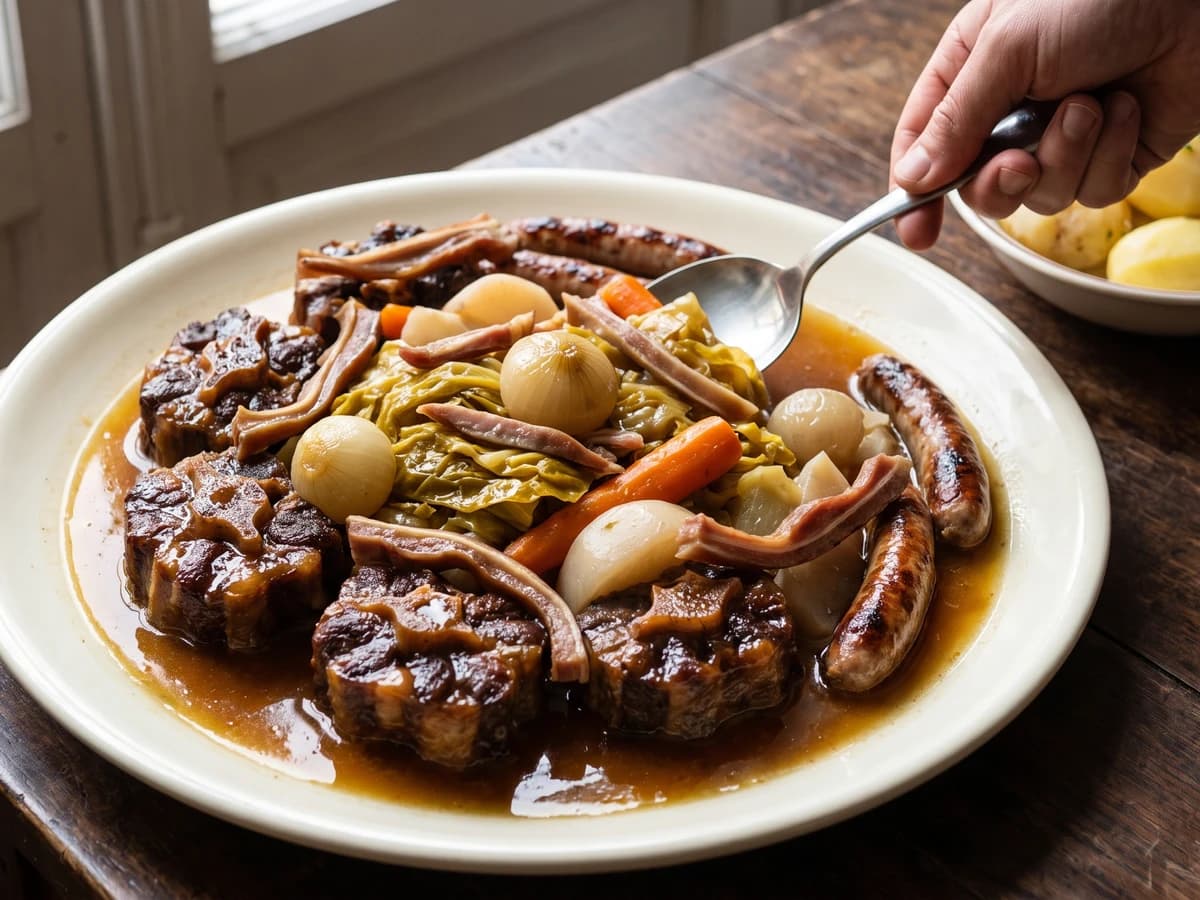
Queue de Bœuf en Hochepot gathers oxtail, pig's trotter and ear, cabbage, roots, and grilled chipolatas around a clear, gelatin-rich broth whose quiet simmer keeps every piece tender and distinct.
Chef Juliette
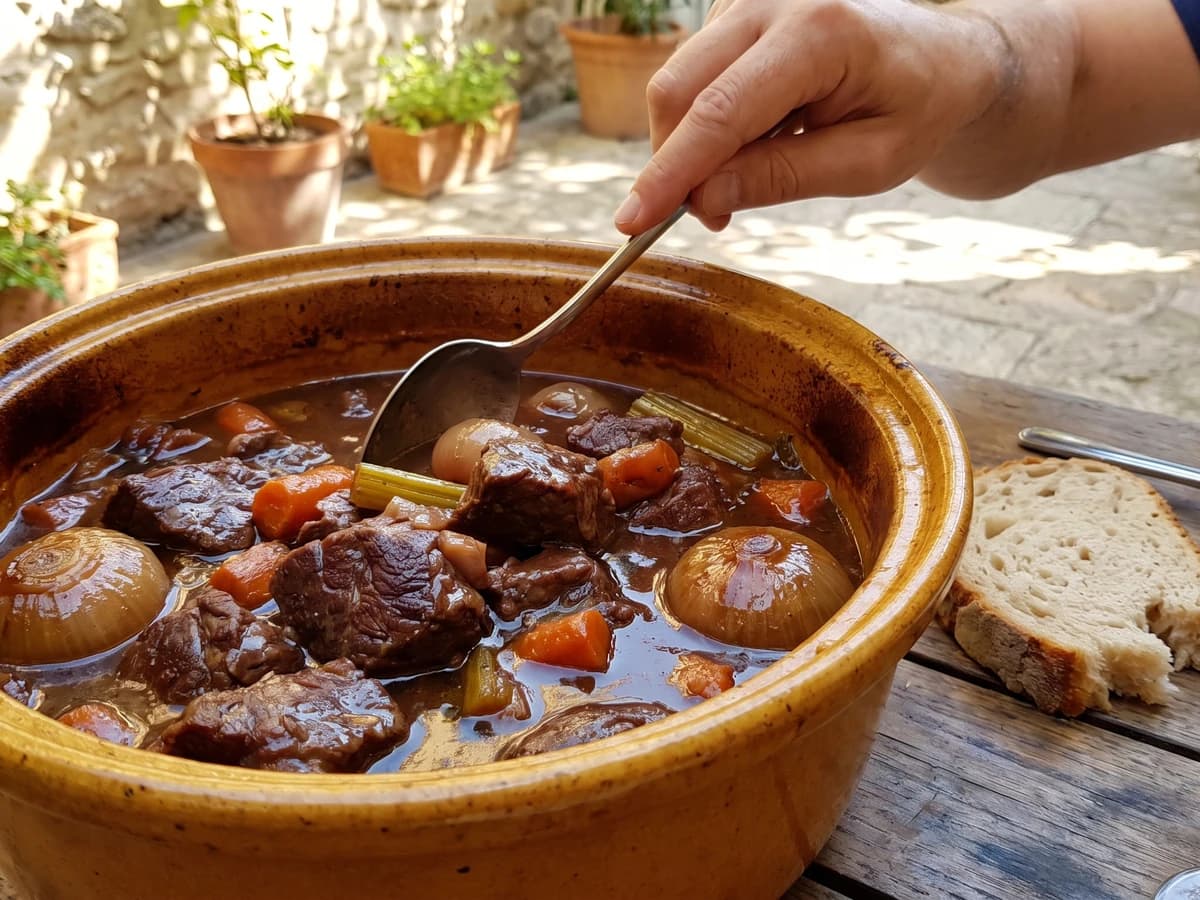
Beef shoulder larded with bacon, sharpened by red wine and vinegar, then sealed with garlic, vegetables, and dry lemon peel until the low oven turns it yielding and the gravy darkly glossy.