Chef Juliette
Bouillabaisse à la Marseillaise
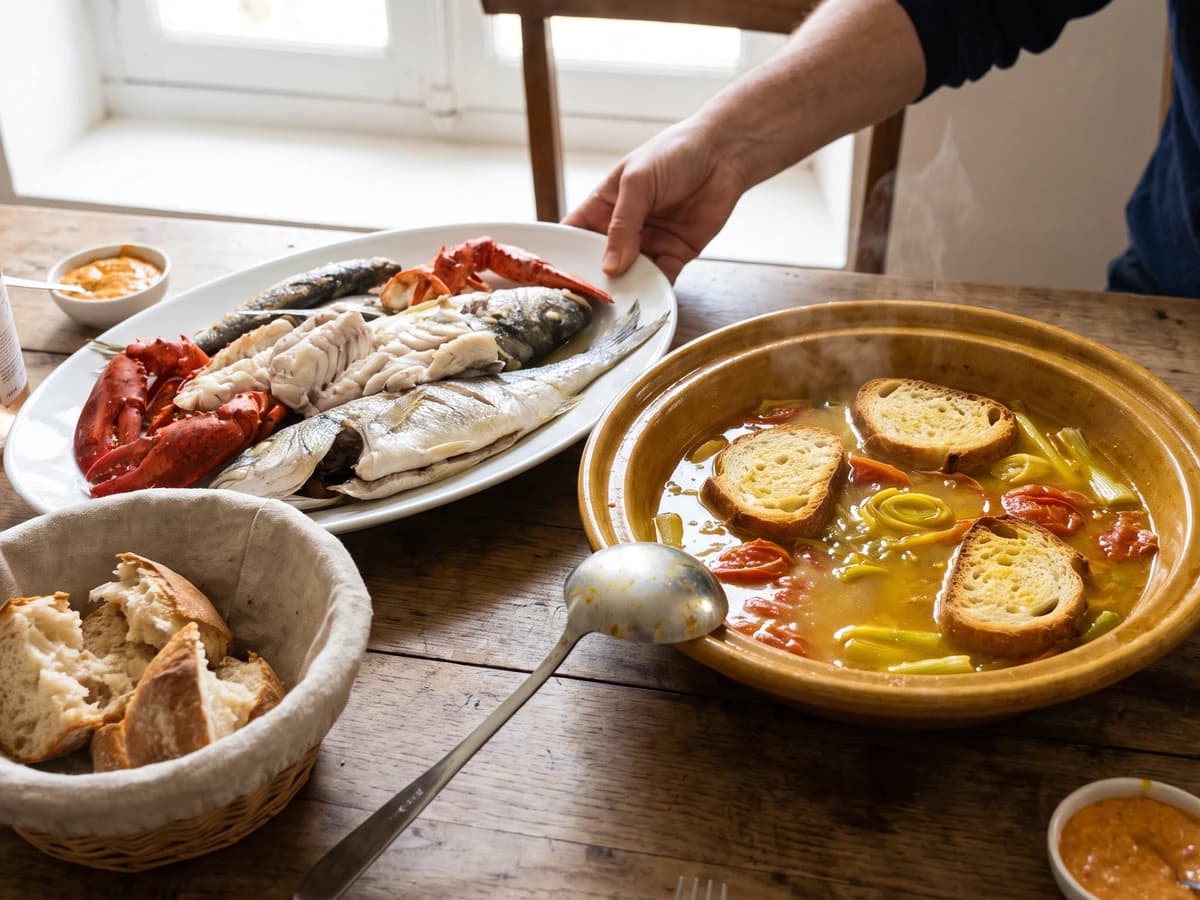
Marseille's great fish stew, saffron-gold and garlic-scented, proves that a hard boil can be the careful choice: it binds olive oil into broth before the whole pot meets bread.
A cooking platform built around craft, culture, and the stories behind what we eat.
Created by Chef Juliette
Based on No. 584, Consommé à la Milanaise, from Le Guide Culinaire (1907) by Auguste Escoffier
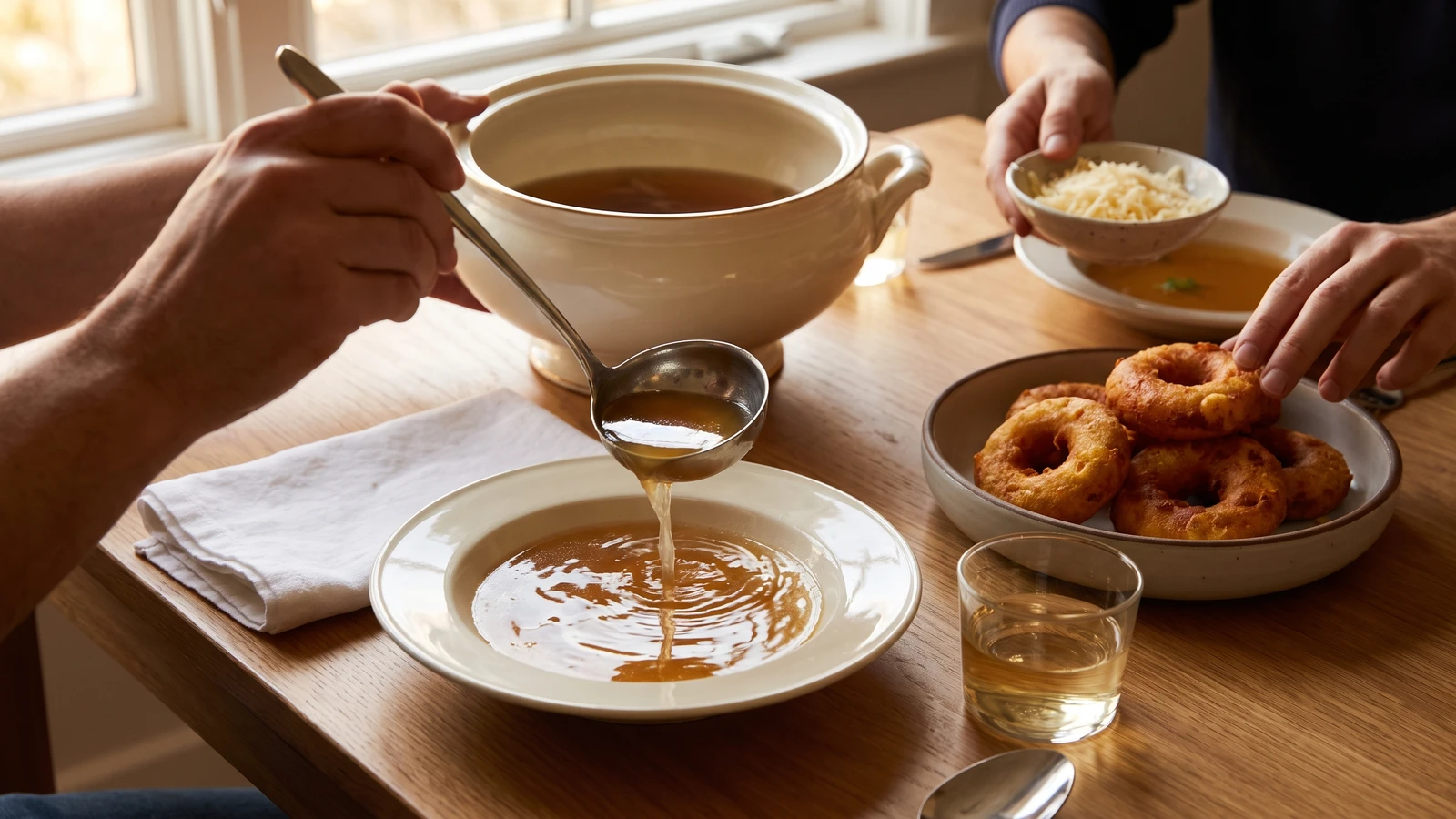
Crystal-clear chicken consommé meets its crisp counterpoint: macaroni bound with dense Béchamel, yolk, and cheese, crumbed into small quoits and fried gold at the last minute, then served apart so every bite keeps its crust.
Consommé à la Milanaise (clarified chicken broth with fried macaroni-and-cheese quoits) teaches a clean opposition: the broth must stay limpid, the garnish crisp. The one true thing to know before touching a pan is that they cannot wait together. Keep them apart until the diner chooses the moment, and both remain themselves.
The old entry assumed a saucier with dense Béchamel ready, a clear chicken stock never off the fire, linen for drying pasta, and a pan of hot fat waiting for service. At home, prepared consommé warms in one saucepan while a small, thermometer-guided pot replaces the frying vat; a lint-free towel replaces the linen, and no salamander belongs in the job. The source already makes a home-sized quart for four, so its proportions remain untouched. The brigade scaffolding goes, but the last-minute frying and separate service stay. One cook, one stove, one evening.
Cool the macaroni mixture until it holds a clean edge before you shape it. That chill, more than any flourish, decides whether the quoits reach the table golden and whole.
Consommé à la Milanaise belongs to the French grand-kitchen table, where the phrase à la Milanaise pointed toward Milan in Lombardy through macaroni and grated cheese rather than reproducing a Milanese household soup. Italian pasta entered the French classical repertory as a garnish, and this formula binds it with Béchamel and cheese, then breads and fries it into quoits beside a clarified chicken consommé. Serving the broth, fried garnish, and grated Gruyère-Parmesan separately is not empty ceremony; it protects the contrast that gives the dish its reason.
Quantity
½ cup (120 ml / 57 g)
moderately thick
Quantity
6 cups (1.4 L / 1.4 kg)
for cooking the macaroni
Quantity
2 teaspoons (10 ml / 12 g)
for the macaroni water
Quantity
½ cup (120 ml / 125 g)
made with real butter and whole milk
Quantity
1
Quantity
¼ cup (60 ml / 28 g)
finely grated for the macaroni mixture
Quantity
1
for the Anglaise
Quantity
1 tablespoon (15 ml / 14 g)
for the Anglaise
Quantity
¼ teaspoon (1.25 ml / 1.5 g)
for the Anglaise
Quantity
1 small pinch
for the Anglaise
Quantity
1 cup (240 ml / 60 g)
Quantity
4 cups (960 ml / 880 g)
Quantity
4 cups (960 ml / 960 g)
Quantity
Scant ¼ cup (55 ml / 21 g)
finely grated for passing at table
Quantity
Scant ¼ cup (55 ml / 21 g)
finely grated for passing at table
| Ingredient | Quantity |
|---|---|
| dry straight tubular macaronimoderately thick | ½ cup (120 ml / 57 g) |
| waterfor cooking the macaroni | 6 cups (1.4 L / 1.4 kg) |
| fine saltfor the macaroni water | 2 teaspoons (10 ml / 12 g) |
| prepared very dense Béchamelmade with real butter and whole milk | ½ cup (120 ml / 125 g) |
| large egg yolk | 1 |
| Gruyèrefinely grated for the macaroni mixture | ¼ cup (60 ml / 28 g) |
| large eggfor the Anglaise | 1 |
| neutral oilfor the Anglaise | 1 tablespoon (15 ml / 14 g) |
| fine saltfor the Anglaise | ¼ teaspoon (1.25 ml / 1.5 g) |
| finely ground white pepperfor the Anglaise | 1 small pinch |
| very fine dry breadcrumbs | 1 cup (240 ml / 60 g) |
| refined neutral frying oil | 4 cups (960 ml / 880 g) |
| prepared clear chicken consommé | 4 cups (960 ml / 960 g) |
| Gruyèrefinely grated for passing at table | Scant ¼ cup (55 ml / 21 g) |
| Parmesanfinely grated for passing at table | Scant ¼ cup (55 ml / 21 g) |
Bring the water and 2 teaspoons of salt to a lively boil. Add the macaroni and cook until tender through but still intact, about 8 to 10 minutes depending on its shape; it must cut cleanly without collapsing. Drain thoroughly, spread it over a clean lint-free towel, and cut the tubes crosswise into rings about ¼ inch (6 mm) wide as soon as they are cool enough to handle. Do not rinse them, because their surface starch helps the dense sauce grip.
Warm the prepared dense Béchamel over the lowest heat until it becomes pliable. Mix the egg yolk with the ¼ cup of Gruyère, then beat in a spoonful of warm Béchamel to temper the yolk. Remove the saucepan from the heat, stir in the yolk mixture, and return it to low heat for 30 to 60 seconds, stirring constantly, until a spoon drawn through the sauce leaves a firm track. Never let it boil. If the yolk begins to grain, lift the pan off the heat at once, whisk hard, and pass the sauce through a fine sieve while it is still warm.
Fold the macaroni rings through the enriched Béchamel until every piece is coated. Spread the mixture about ½ inch (1 cm) thick on a shallow plate or small tray. Let it stand for 10 minutes, cover once it has cooled, then refrigerate for about 30 minutes. It is ready when it feels firm, leaves a clean edge when cut, and no longer clings heavily to your fingers.
Divide the cold mixture into 14 to 16 walnut-sized portions. Roll each briefly between cold palms, then flatten it into a small quoit about 1¼ inches (3 cm) across and ⅜ inch (1 cm) thick, the practical home equivalent of the book's shilling comparison. If the portions slump, stop and chill them for another 15 minutes. Cold is the correction here, not extra breadcrumbs mixed into the filling.
Whisk the whole egg with the tablespoon of neutral oil, ¼ teaspoon salt, and white pepper until completely combined. This is Anglaise, beaten egg with oil and seasoning. Dip each quoit in the Anglaise, let the excess fall away, then coat it on every side with the very fine breadcrumbs, pressing gently so no bare patch remains. Arrange the crumbed quoits in one layer and refrigerate for 15 minutes to set the coating.
Pour the frying oil into a heavy, high-sided saucepan no more than half full and heat it to 350°F (175°C). In a second saucepan, bring the chicken consommé nearly to a boil, cover it, and hold it just below that point. Warm the soup tureen and four bowls with hot water, then dry them thoroughly before service.
Four minutes before service, lower one test quoit into the hot oil with a spider or slotted spoon. If it holds, fry the rest in two quick batches until evenly golden, about 2 minutes per batch, keeping the oil near 350°F (175°C). If the tester opens, lift it out, return the remaining quoits to the cold for 15 minutes, patch any cracks with a little Anglaise and breadcrumbs, and restore the oil temperature. Ça se rattrape. Drain the golden quoits on a rack or absorbent paper and send them to the table at once.
Bring the consommé to a brief full boil, then pour it into the warmed tureen. Mix the remaining Gruyère and Parmesan in equal quantities and place them in a small serving bowl. Carry the broth, the hot fried quoits, and the grated cheese to the table separately, exactly as the dish requires; each diner may add a quoit and a little cheese at the last possible moment. À table!
1 serving (about 350g)
Culinary guides, cultural storytelling, and the editorial depth that makes cooking meaningful.
Discover Culinary ExplorerChef Juliette
Marseille's great fish stew, saffron-gold and garlic-scented, proves that a hard boil can be the careful choice: it binds olive oil into broth before the whole pot meets bread.
Chef Juliette
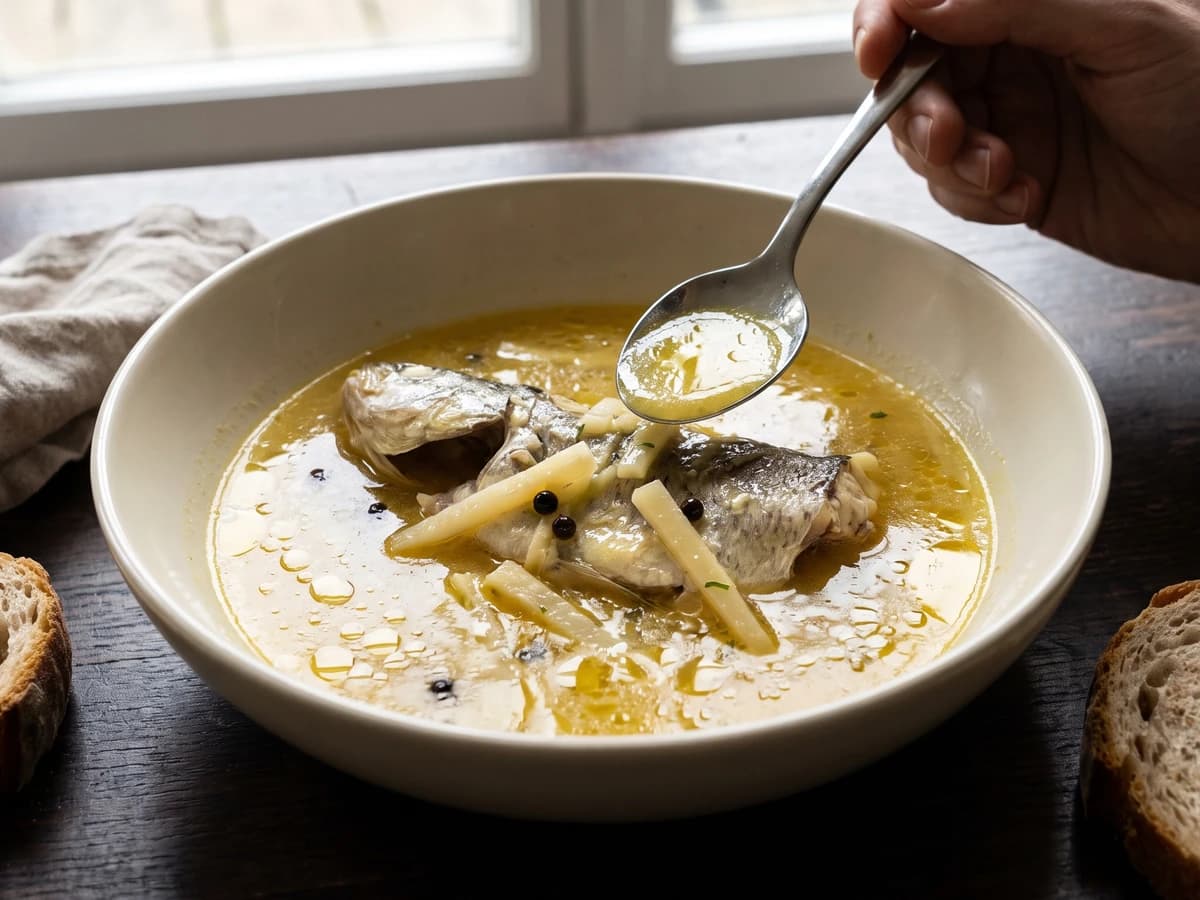
Waterzoi asks fresh, bone-in river fish to thicken its own buttery broth, with parsley root and pepper for company. No flour, no stockpot, just a brisk simmer watched closely.
Chef Juliette
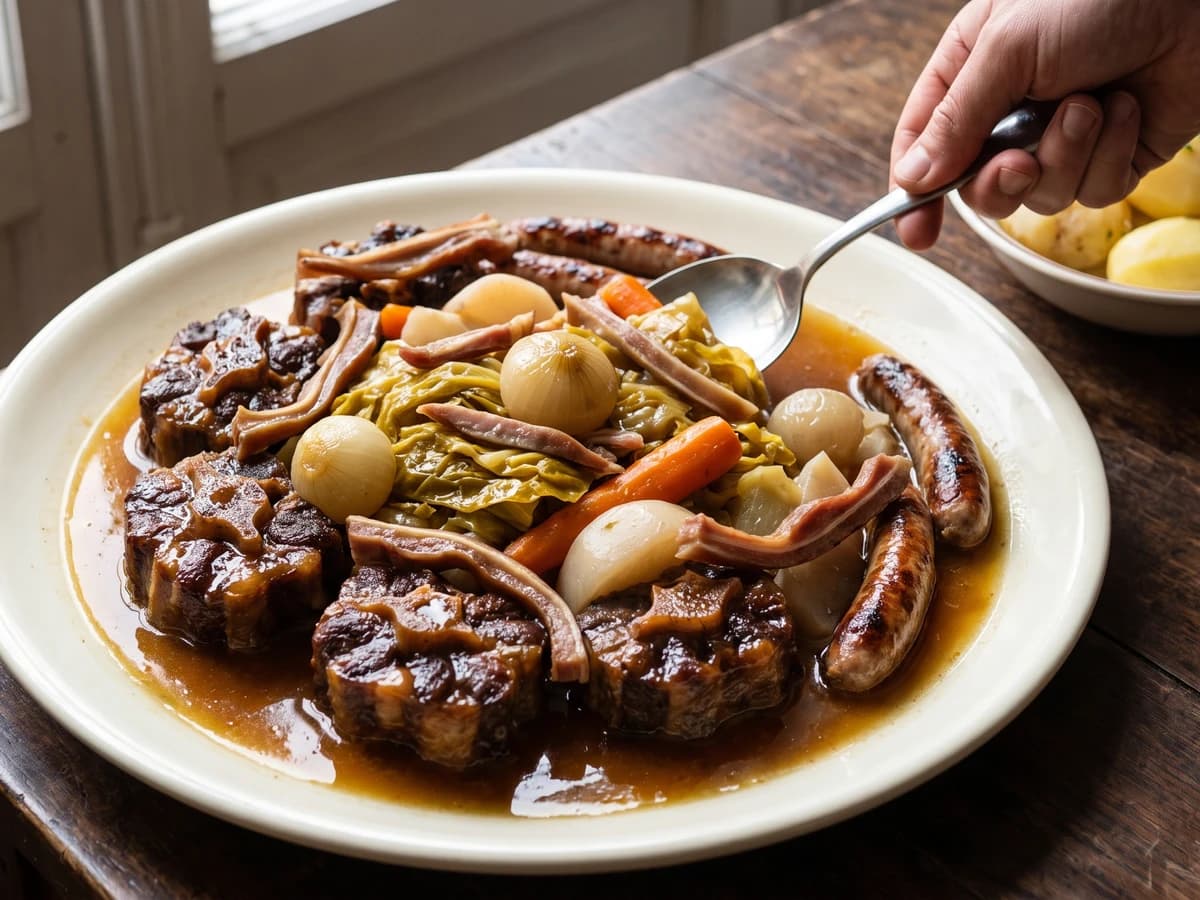
Queue de Bœuf en Hochepot gathers oxtail, pig's trotter and ear, cabbage, roots, and grilled chipolatas around a clear, gelatin-rich broth whose quiet simmer keeps every piece tender and distinct.
Chef Juliette
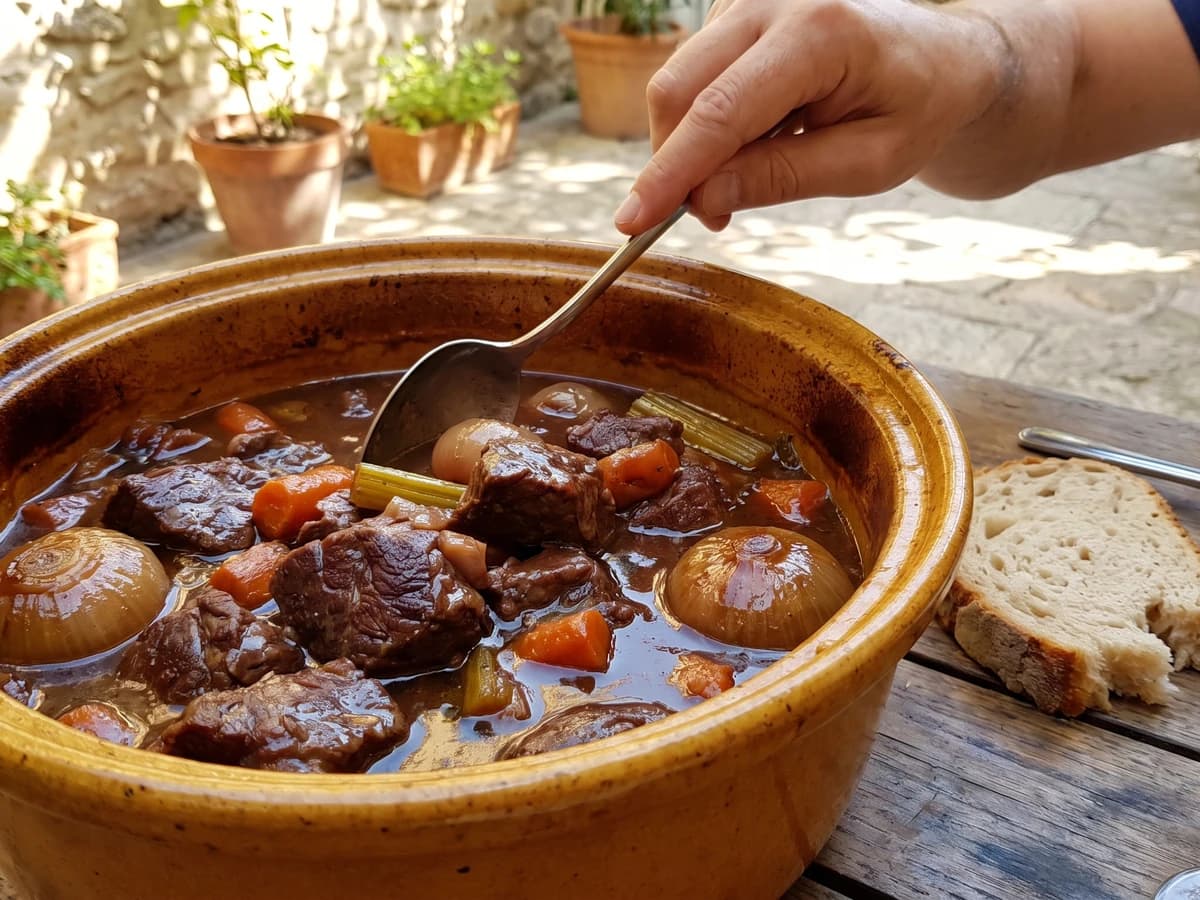
Beef shoulder larded with bacon, sharpened by red wine and vinegar, then sealed with garlic, vegetables, and dry lemon peel until the low oven turns it yielding and the gravy darkly glossy.