Culinary Explorer

A cooking platform built around craft, culture, and the stories behind what we eat.
Discover Culinary Explorer
Consommé Metternich

Consommé Metternich

Created by Chef Juliette

Based on No. 583, Consommé Metternich, from Le Guide Culinaire (1907) by Auguste Escoffier

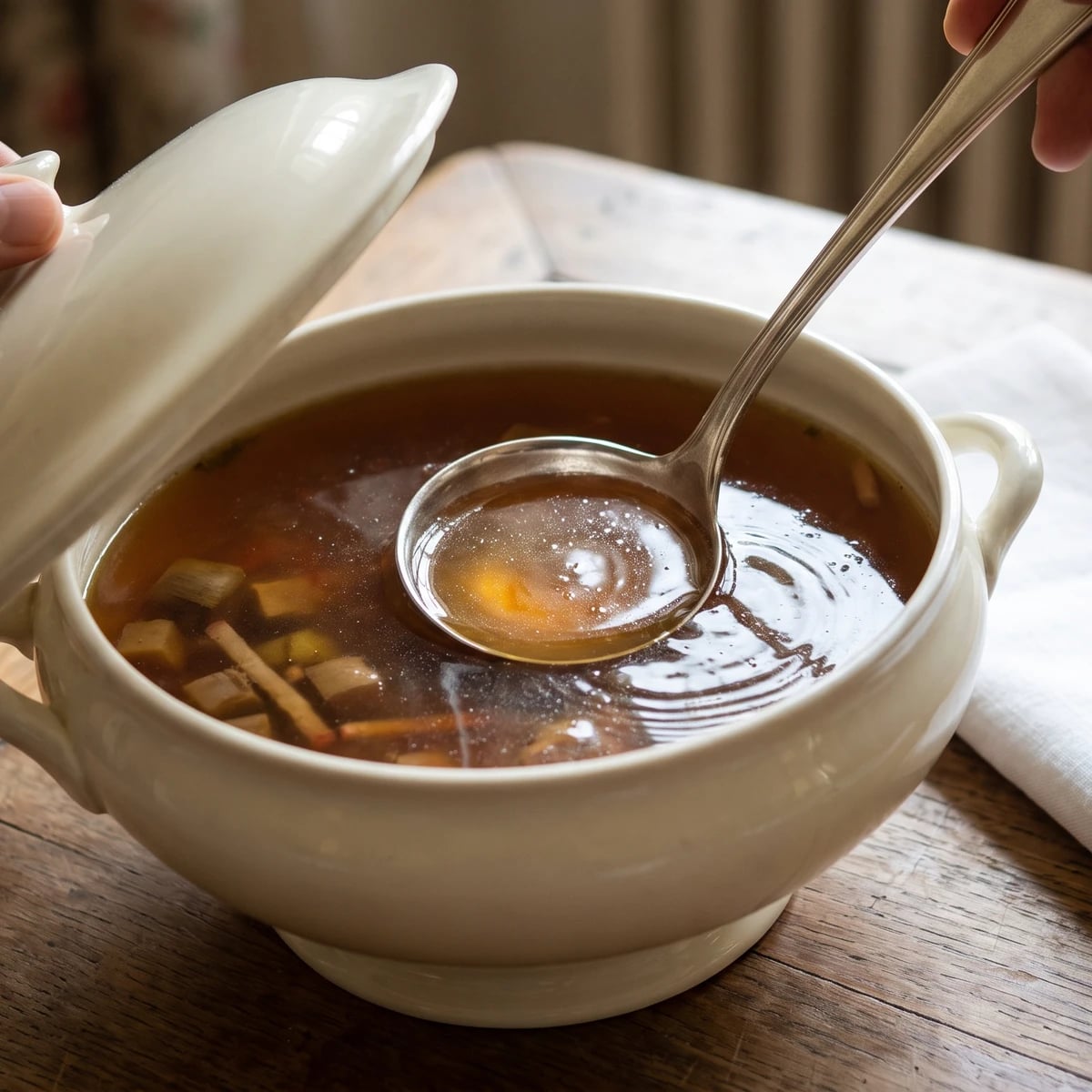
Consommé Metternich turns clarity into ceremony: pheasant-scented game broth around tender artichoke and game-sauce royale, with just enough roast pheasant julienne to announce the bird without clouding the bowl.

Soups & Stews
French
Dinner Party
Special Occasion
Holiday
25 min
Active Time
35 min cook1 hr 30 min total
YieldAbout 2 quarts (8 first-course servings)

Consommé Metternich (clarified game broth with artichoke royale and pheasant) teaches that luxury in a consommé means definition, not abundance. The broth must be brilliantly clear, the royale tender enough to yield beneath the spoon yet firm enough to cut, and the pheasant julienne fine enough to warm in the bowl. Before touching a pan, know the one true thing: boil the broth if you must, never the garnish.

The source assumes a saucier on staff, game stock never off the fire, finished reduced game Espagnole, and rows of dariole-moulds. It also assumes a kitchen with a salamander close at hand, though this formula never uses one, so the home version invents no broiler step. Begin with the finished game consommé prepared with pheasant fumet and the finished reduced game Espagnole, just as the entry does. Make those components ahead and chill or freeze them; that is planning, not compromise. This batch makes about two quarts, doubling the book's one-quart formula and every garnish in the same proportion.

Four small ramekins replace the dariole-moulds, and a covered bain-marie replaces dedicated poaching equipment. The brigade logistics may go; the clear consommé, the reduced sauce, and the gentle poach are the dish and must stay. Watch the water around the royale. It should remain calm, because a boiling bath turns a silken custard into a sponge.

Consommé Metternich belongs to the formal grand-kitchen repertoire of Paris, where clear soups carrying diplomatic and aristocratic names opened important dinners. Its title invokes Prince Metternich, but the preparation is French in grammar: clarified game broth, a precisely cut royale, and a restrained garnish chosen to deepen rather than obscure the consommé. The name does not make the soup Austrian; it reflects the French banquet custom of honoring public figures through the composition and naming of dishes.

The technique, the tradition, and the story behind every dish.

Discover Culinary Explorer

Ingredients

finished game consommé prepared with pheasant fumet

Quantity

2 quarts (1.9 L / about 1.9 kg)

smooth artichoke-heart purée

Quantity

1 cup (240 ml / 225 g)

finished reduced game Espagnole

Quantity

¼ cup (60 ml / 65 g)

large eggs

Quantity

2

large egg yolks

Quantity

2

unsalted butter

Quantity

1 teaspoon (5 ml / 5 g)

softened, for the moulds

roast pheasant breast fillet

Quantity

2 tablespoons (30 ml / 20 g)

cut julienne-fashion into fine match-shaped rods

fine salt and freshly ground white pepper

Quantity

to taste

Equipment Needed

  • Four 3-ounce (90 ml) dariole-moulds or straight-sided ramekins
  • Deep roasting pan for the bain-marie
  • Fine-mesh sieve and damp muslin or unbleached coffee filter
  • 3-quart (2.8 L) saucepan
  • Thin-bladed knife
  • Soup tureen

Instructions

  1. 1

    Ready the components

    Set the finished game consommé prepared with pheasant fumet and the finished reduced game Espagnole within reach. Fumet is the concentrated essence of the bird, and here it gives the clarified broth its unmistakable pheasant character. Heat the oven to 300°F (150°C), butter four 3-ounce (90 ml) dariole-moulds or straight-sided ramekins, and set them in a deep roasting pan.

  2. 2

    Mix the royale

    Stir the artichoke purée and reduced game Espagnole together until completely even. Whisk the whole eggs and yolks only until combined, then fold them into the purée without beating in air. Season cautiously with fine salt and white pepper; both the consommé and Espagnole already carry seasoning. Pass the mixture through a fine sieve, pressing gently, and divide it among the four prepared moulds. Tap each mould once against a folded towel to release hidden air bubbles.

    A royale is a savory custard intended for cutting. Air makes holes, so use a spoon or quiet whisk and never beat the mixture to a foam.
  3. 3

    Poach without boiling

    Pour hot water into the roasting pan until it reaches halfway up the moulds, then cover the pan loosely with foil. Poach in the oven for 25 to 30 minutes, until the edges are set and the centres give a soft, unified tremble when nudged. The water must never bubble. If it begins to simmer, add a little cold water to the bath and lower the oven by 25°F (15°C); ça se rattrape before the custard honeycombs. If an edge has already roughened, trim it after unmoulding and use the smooth centre for the dice.

  4. 4

    Chill and cut

    Lift the moulds from the bain-marie and cool them for 10 minutes, then refrigerate for about 20 minutes so the royale firms without becoming hard. Run a thin knife around each edge and turn the custards onto a board. Cut them into neat ¼-inch (6 mm) dice. Use a clean, damp knife and wipe it between cuts; pressure crushes the royale, while a straight downward cut leaves clean faces.

  5. 5

    Cut the pheasant

    If the pheasant is not already prepared, cut the roast breast julienne-fashion, meaning fine match-shaped rods about 1 inch (2.5 cm) long. Keep the measured two tablespoons modest. This garnish identifies the consommé without crowding it, and the source is exact about that restraint.

  6. 6

    Polish the consommé

    Bring the game consommé prepared with pheasant fumet slowly to a full boil in a clean saucepan. Skim away any surface fat and taste, adjusting the salt only if necessary. If small particles appear, pass the broth through a fine sieve lined with damp muslin or an unbleached coffee filter. Do not whisk or stir vigorously. Clarity is the point.

  7. 7

    Garnish and pour

    Warm a soup tureen with hot water, then empty and dry it thoroughly. Place the diced artichoke royale and the pheasant julienne in the tureen, arranging them gently so the dice remain whole. Pour the boiling consommé over the garnish and carry it straight to the table. The broth warms the royale and pheasant without toughening either. Serve at once. À table!

Chef Tips

  • This entry begins with finished game consommé, pheasant fumet, and reduced game Espagnole because the book treats them as parts of the working canon, not as recipes to rebuild inside every dish. Prepare them separately and keep them measured in the freezer; one cook, one stove, one evening then becomes entirely honest.
  • Frozen or well-drained canned artichoke hearts make a sound purée when fresh artichokes are poor. Process them until smooth, then press them through a sieve and weigh the finished purée. A fibrous purée gives ragged dice.
  • Use breast meat reserved from the pheasant employed for the fumet if possible. Roast it only until just cooked, cool it, and cut across the grain. Dry, overcooked breast will remain dry even under excellent consommé.
  • The reduced game Espagnole must be properly concentrated and cool before it meets the eggs. A warm sauce starts setting the custard in the bowl; a thin sauce weakens both its flavour and its cut.
  • Store the broth, royale, and pheasant separately. Left together, the royale sheds particles and the julienne dulls the consommé. Clarity is maintained right up to the moment of service.

Advance Preparation

  • The game consommé prepared with pheasant fumet and the reduced game Espagnole may be made well ahead, chilled promptly, and frozen in separate measured containers. Thaw them in the refrigerator before use.
  • The royale can be poached, cooled, and refrigerated in its moulds one day ahead. Unmould and cut it while cold, then cover the dice closely so their surfaces do not dry.
  • The pheasant breast may be roasted one day ahead, but cut the julienne shortly before serving. Keep all three elements separate until the consommé is boiling and the tureen is warm.

Frequently Asked Questions

Nutrition Information

1 serving (about 290g)

Calories
105 calories
Total Fat
4 g
Saturated Fat
2 g
Trans Fat
0 g
Unsaturated Fat
2 g
Cholesterol
100 mg
Sodium
1100 mg
Total Carbohydrates
6 g
Dietary Fiber
2 g
Sugars
1 g
Protein
11 g

Note: Chef personas and recipes are created with AI assistance. Cook with care: follow safe food-handling practices, check doneness with a thermometer when needed, and adapt for allergies and your kitchen.

Where cooking meets culture.

Culinary guides, cultural storytelling, and the editorial depth that makes cooking meaningful.

Discover Culinary Explorer