
Chef Juliette
Consommé Alexandra
A clear chicken consommé gains the faintest body from tapioca, then carries fine chicken julienne, long grooved quenelles, and lettuce chiffonade, each garnish distinct beneath the shimmering golden broth.
A cooking platform built around craft, culture, and the stories behind what we eat.
Created by Chef Juliette
Based on No. 579, Consommé Marguerite, from Le Guide Culinaire (1907) by Auguste Escoffier
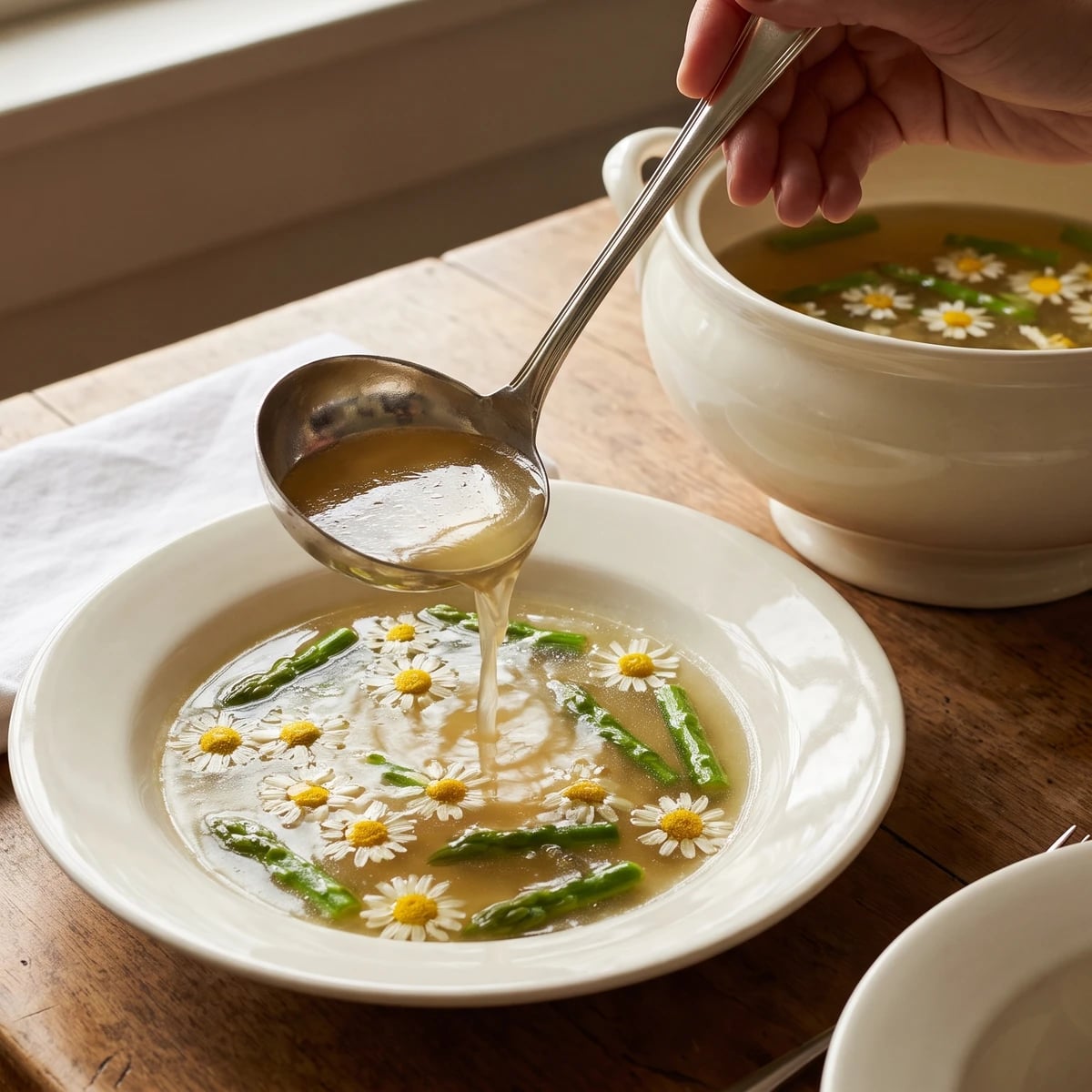
A lesson in precision served by the spoonful: tender chicken-cream marguerites, yellow yolk hearts, and green asparagus suspended in consommé so clear every careful cut remains visible.
Consommé Marguerite (clear chicken consommé with daisy-shaped chicken garnish) teaches that clarity is built twice: first in the broth, then in everything you allow to touch it. The one true thing to know before lifting a pan is that every flower and asparagus piece must be fully cooked, cold, and dry before the final pour. One loose crumb of forcemeat or yolk will turn precision into murk.
The original assumed a saucier on staff, a stock never off the fire, prepared farce mousseline de volaille, and a fancy cutter ready in the pastry drawer. A home kitchen needs prepared, very clear consommé, a one-inch daisy cutter, floured parchment, and a shallow pan held below the simmer. The entry's one-quart service is doubled to the requested two-quart home batch, with its ratios kept exact: four tablespoons of forcemeat for the sausage, two yolks bound by one teaspoon of raw forcemeat, and two tablespoons of asparagus. Constant hot holding is brigade scaffolding and can go; the clear consommé, gentle poach, flower shape, yolk center, and last-minute pour are the dish and must stay. One cook, one stove, one evening.
The safety change is a brief covered steaming after the yolk centers are fitted. Brigade service counted on boiling consommé to set that pinprick of raw chicken immediately, but a home soupière sheds heat too quickly, so the centers are cooked before assembly. Keep the poaching water at a tremble, never a boil; if the sausage begins to feather, lift it out, lower the heat, and return it gently. Ça se rattrape. Above all, dry every finished marguerite before it reaches the tureen. That clean, dry garnish is what protects the consommé.
Consommé Marguerite belongs to the Parisian classical repertory of named clear soups, in which a precisely cut garnish gave a familiar chicken consommé its identity. Marguerite means daisy: the title refers to the poached chicken rounds stamped into petals and dotted with sieved yolk, not to an herb, a woman, or a regional larder. Such garnished consommés traveled from grand dining rooms to bourgeois dinner tables because their careful components could be prepared ahead and assembled cleanly at service.
Quantity
4 tablespoons (60 ml / 60 g), plus 1 teaspoon (5 ml / 5 g)
kept very cold and divided
Quantity
2 tablespoons (30 ml / 16 g)
for lightly dusting the work surface; not all may be needed
Quantity
2 large
hard-cooked and chilled; yolks only
Quantity
6 spears, yielding 2 tablespoons (30 ml / 25 g)
trimmed and cut into 1-inch (2.5 cm) lengths
Quantity
8 cups (1.9 L / 1.9 kg)
fully seasoned
| Ingredient | Quantity |
|---|---|
| farce mousseline de volaille (chicken forcemeat with cream)kept very cold and divided | 4 tablespoons (60 ml / 60 g), plus 1 teaspoon (5 ml / 5 g) |
| all-purpose flourfor lightly dusting the work surface; not all may be needed | 2 tablespoons (30 ml / 16 g) |
| eggshard-cooked and chilled; yolks only | 2 large |
| very thin green asparagus spearstrimmed and cut into 1-inch (2.5 cm) lengths | 6 spears, yielding 2 tablespoons (30 ml / 25 g) |
| very clear chicken consomméfully seasoned | 8 cups (1.9 L / 1.9 kg) |
Lower the eggs into gently boiling water and cook for 10 minutes, then chill them completely in ice water. Blanch the asparagus lengths in fresh boiling water for 45 seconds, just until bright green and barely tender, then chill them at once. Drain and blot every piece dry. Shell the eggs, remove the yolks whole, and reserve the whites for another dish.
Reserve 1 teaspoon (5 ml / 5 g) of the raw farce mousseline in a covered chilled bowl. Dust a sheet of parchment very lightly with flour, place the remaining 4 tablespoons (60 ml / 60 g) of farce upon it, and use a bench scraper and floured fingertips to roll it into an even sausage about 1 inch (2.5 cm) thick. Flour the surface, not the interior; kneading flour into the farce would make it heavy. If the sausage is too soft to lift, chill it for 10 minutes.
Heat a wide pan of water to 175 to 180°F (80 to 82°C), with movement beneath the surface but no hard bubbling. Lower in the sausage on a broad slotted spatula and poach for 10 to 12 minutes, turning it once, until the center reaches 165°F (74°C). Boiling makes the emulsion expand, feather, and split. If the surface begins to fray, lift the sausage out immediately, lower the heat, and return it once the water is calm. Ça se rattrape.
Transfer the poached sausage to ice water for 3 minutes, then blot it thoroughly and refrigerate for 30 minutes. Once firm, cut it across into thin roundels about 1/8 inch (3 mm) thick. Stamp each roundel with a 1-inch (2.5 cm) daisy cutter, keeping the petals distinct. Work while the sausage is cold; if the slices buckle or smear, return them to the refrigerator for 10 minutes before continuing.
Push the cooked yolks through a fine sieve onto a chilled plate. Mix them with the reserved 1 teaspoon (5 ml / 5 g) of raw farce mousseline until the crumbs just cohere, then press a tiny yellow bead into the center of every chicken flower. Keep the petals clean. If the mixture crumbles, smear it once against the side of the bowl with a spoon; do not add water or cream, which would loosen it into the consommé.
Arrange the flowers in one layer on parchment inside a steamer basket or on a heatproof plate set over barely simmering water. Cover and cook for 3 minutes, until the centers are matte, firm, and free of any raw shine. If a center lifts, press it back while still warm and cook that flower for 1 minute more. Transfer the marguerites to a clean plate, chill them uncovered, and blot away every trace of moisture.
Fill the soupière and serving bowls with hot water to warm them, then empty and dry them completely. Arrange the marguerites across the bottom of the soupière and distribute the dry asparagus lengths between them. Handle the flowers by their edges so the yolk centers remain neat.
Pass the chicken consommé through a dampened fine cloth into a spotless saucepan. Bring it to a clear full boil for no more than 30 seconds, skimming away any fat beads or foam without stirring. If sediment rises, let the pan stand for 1 minute, then ladle the clear upper broth through a fresh damp cloth and leave the final cloudy spoonful behind. Pour the boiling consommé slowly down the inside wall of the soupière rather than directly onto the flowers. Serve at once, with several marguerites and a little asparagus in every bowl. À table!
1 serving (about 255g)
Culinary guides, cultural storytelling, and the editorial depth that makes cooking meaningful.
Discover Culinary Explorer
Chef Juliette
A clear chicken consommé gains the faintest body from tapioca, then carries fine chicken julienne, long grooved quenelles, and lettuce chiffonade, each garnish distinct beneath the shimmering golden broth.

Chef Juliette
Crystal-clear chicken consommé poured over jewel-like dice of truffle, tomato, and pea royale, with fine chicken and mushroom: a formal first course made practical for one careful home cook.

Chef Juliette
Consommé Andalouse sets a jewel-clear chicken broth around tomato royale, ham julienne, separate grains of rice, and fragile egg threads, a lesson in precision whose final pour must be swift and gentle.

Chef Juliette
A crystal-clear consommé set with jewel-like vegetable and truffle pearls, tender chicken quenelles, peas, and asparagus royale, where precision in the garnish makes a formal soup feel generous rather than fussy.