Chef Juliette
Bouillabaisse à la Marseillaise
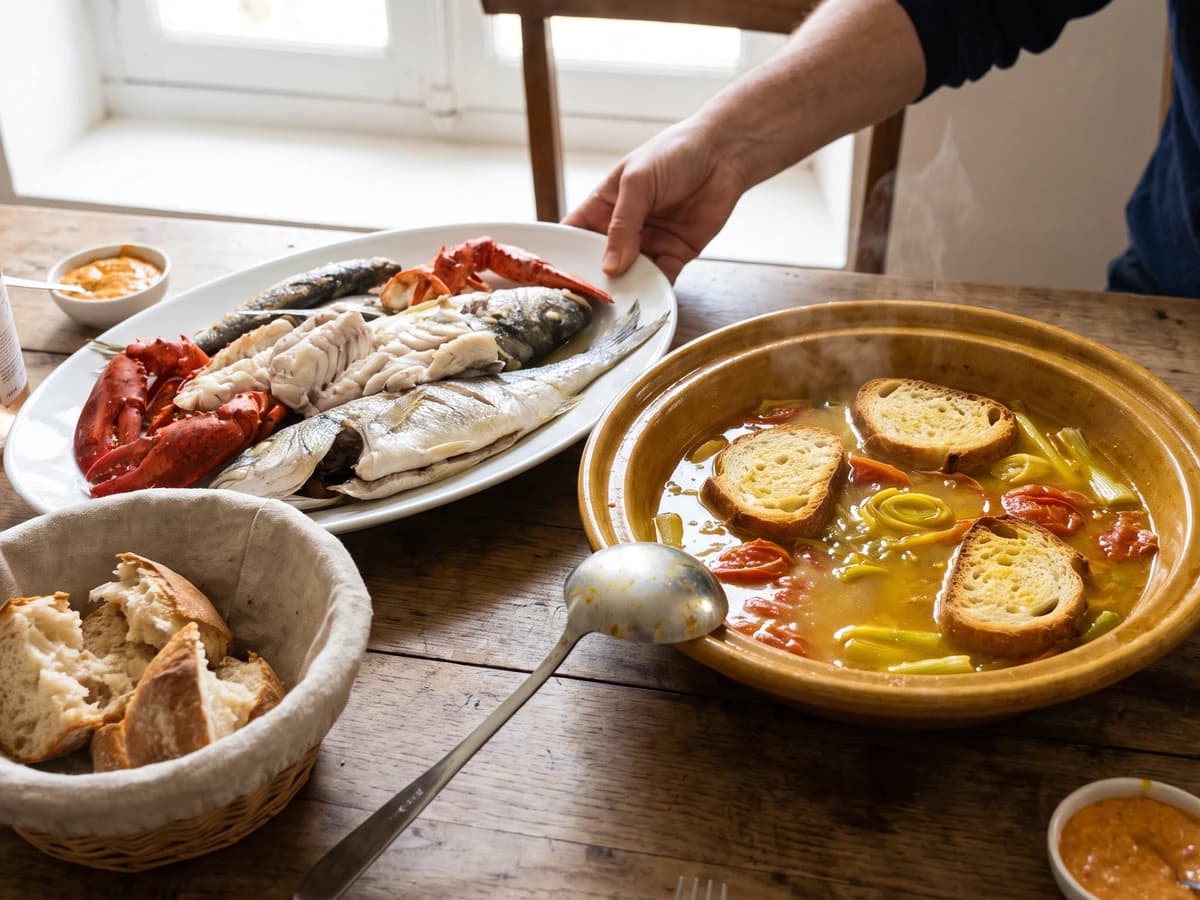
Marseille's great fish stew, saffron-gold and garlic-scented, proves that a hard boil can be the careful choice: it binds olive oil into broth before the whole pot meets bread.
A cooking platform built around craft, culture, and the stories behind what we eat.
Created by Chef Juliette
Based on No. 567, Consommé Florentine, from Le Guide Culinaire (1907) by Auguste Escoffier
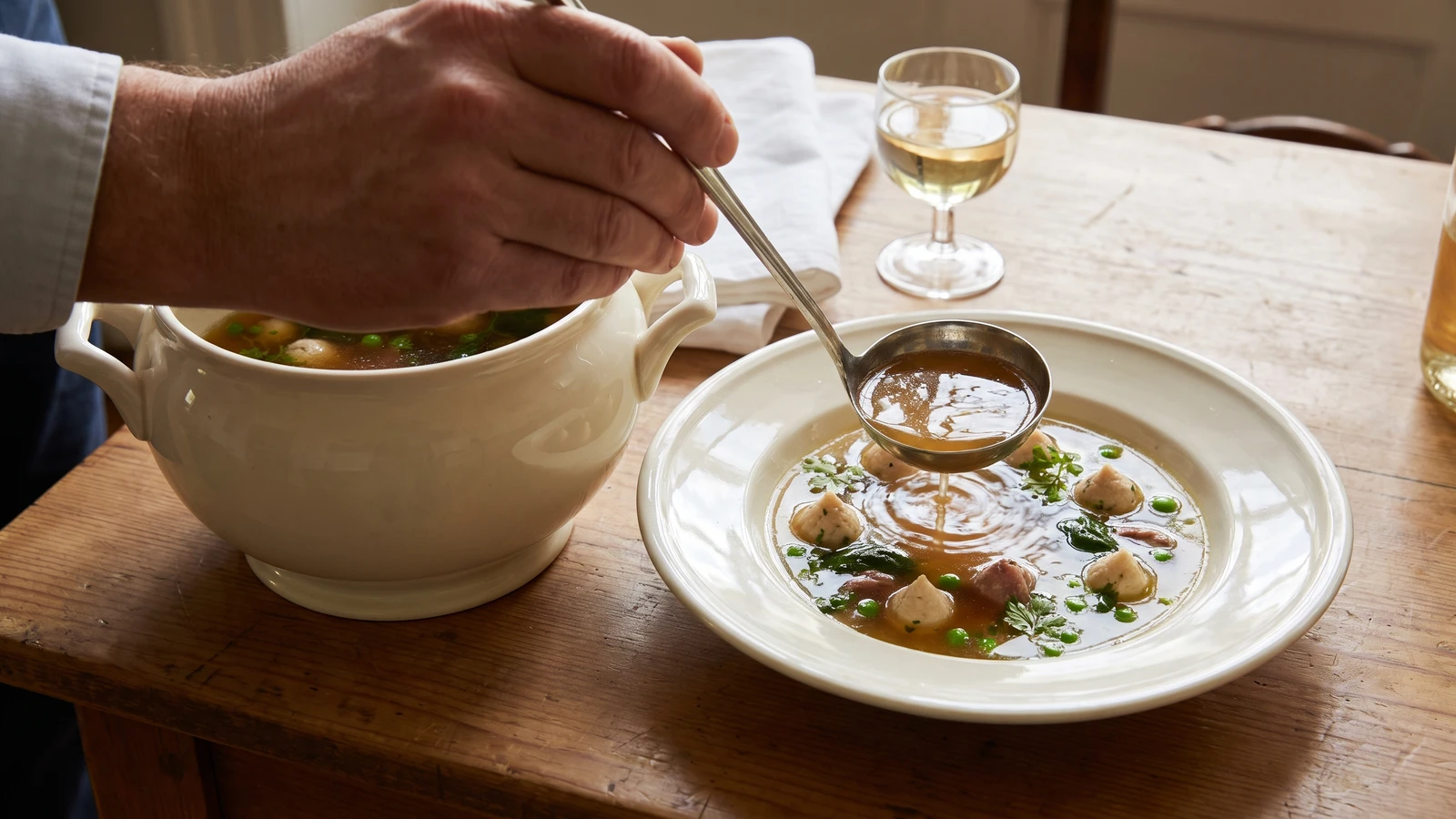
Crystal-clear chicken consommé carries forty-eight tiny quenelles of tongue, chicken, and spinach, the green ones doubled by design, with peas and chervil pluches keeping Florentine true to its name.
Consommé Florentine (clarified chicken broth with spinach-led quenelles) teaches the discipline of clarity. The one true thing to know before touching the pan is that a consommé clears beneath a slow, undisturbed raft, not a furious boil. Once the proteins rise, stop stirring and let them work. The reward is amber broth clear enough to reveal every little quenelle beneath it, with the green spinach ones appearing twice as often as tongue or chicken.
The original kitchen assumed a saucier on staff, chicken stock never off the fire, and enough hands to shape the garnish while someone else guarded the consommé. A salamander has no work here. At home, cold stock, a food processor, damp cheesecloth, two teaspoons, and an attentive cook provide the honest equivalent. The source makes one quart with twenty-four quenelles; this dinner-party tureen doubles it to two quarts, preserving the exact pattern of twelve tongue, twelve chicken, and twenty-four spinach. The peas double with them. One cook, one stove, one evening.
Repeated pounding, dedicated poaching pans, and a row of waiting hands were brigade scaffolding. They can go. Clarifying the broth, keeping the forcemeat cold, reducing the spinach until truly dry, and preserving the 1:1:2 garnish ratio are the dish itself. Watch the raft as it forms and never let the pot roll at a boil. That is the step that decides everything.
Consommé Florentine belongs to the formal dining table of the French grand kitchen, where a clear consommé was distinguished and named by its garnish. Florentine does not mean this is a household soup from Florence; in the French classical vocabulary, à la Florentine signals spinach, and this formula makes the name visible by giving spinach quenelles twice the number of tongue or chicken. Peas and chervil pluches, the tender leaf shreds used to finish soups, carry that green emphasis through to the tureen.
Quantity
12 cups (2.8 L / 2.8 kg)
thoroughly defatted
Quantity
1 pound (450 g)
Quantity
4 large egg whites
Quantity
2 large egg whites
Quantity
1 large carrot (about 3/4 cup / 90 g)
scrubbed and finely diced
Quantity
1 small leek (about 1 cup / 100 g)
washed and finely diced
Quantity
1 stalk (about 1/2 cup / 60 g)
finely diced
Quantity
1 medium tomato (about 3/4 cup / 120 g)
chopped
Quantity
1/2 cup (120 ml / 120 g)
Quantity
8
Quantity
2
Quantity
1
Quantity
1 teaspoon (5 ml / 3 g)
lightly crushed
Quantity
as needed
Quantity
7 ounces (200 g)
diced and very cold
Quantity
1 large egg white
Quantity
2/3 cup (160 ml / 160 g)
Quantity
1 teaspoon (5 ml / 6 g)
Quantity
1/4 teaspoon (1.25 ml / 0.5 g)
Quantity
2 tablespoons (30 ml / 20 g)
very finely chopped
Quantity
2 tablespoons (30 ml / 20 g)
very finely chopped
Quantity
4 ounces (115 g), yielding 1/4 cup (60 ml / 50 g)
cooked, squeezed, puréed, and reduced
Quantity
1 tablespoon (15 ml / 14 g)
softened
Quantity
3 quarts (2.8 L / 2.8 kg)
Quantity
1 tablespoon (15 ml / 18 g)
Quantity
1/4 cup (60 ml / 40 g)
Quantity
2 generous pinches (about 2 tablespoons / 4 g)
| Ingredient | Quantity |
|---|---|
| cold, deeply flavored unsalted chicken stockthoroughly defatted | 12 cups (2.8 L / 2.8 kg) |
| very lean ground chicken | 1 pound (450 g) |
| egg whites for the clarification raft | 4 large egg whites |
| additional egg whites for reclarifying (optional) | 2 large egg whites |
| large carrotscrubbed and finely diced | 1 large carrot (about 3/4 cup / 90 g) |
| small leek, white and pale green parts onlywashed and finely diced | 1 small leek (about 1 cup / 100 g) |
| celery stalkfinely diced | 1 stalk (about 1/2 cup / 60 g) |
| ripe tomatochopped | 1 medium tomato (about 3/4 cup / 120 g) |
| cold water | 1/2 cup (120 ml / 120 g) |
| parsley stems | 8 |
| thyme sprigs | 2 |
| bay leaf | 1 |
| black peppercornslightly crushed | 1 teaspoon (5 ml / 3 g) |
| fine sea salt for the consommé | as needed |
| boneless, skinless chicken breastdiced and very cold | 7 ounces (200 g) |
| egg white for the chicken forcemeat | 1 large egg white |
| very cold heavy cream | 2/3 cup (160 ml / 160 g) |
| fine sea salt for the chicken forcemeat | 1 teaspoon (5 ml / 6 g) |
| ground white pepper | 1/4 teaspoon (1.25 ml / 0.5 g) |
| cooked beef tonguevery finely chopped | 2 tablespoons (30 ml / 20 g) |
| cooked white chicken meatvery finely chopped | 2 tablespoons (30 ml / 20 g) |
| fresh spinachcooked, squeezed, puréed, and reduced | 4 ounces (115 g), yielding 1/4 cup (60 ml / 50 g) |
| unsalted buttersoftened | 1 tablespoon (15 ml / 14 g) |
| water for poaching | 3 quarts (2.8 L / 2.8 kg) |
| fine sea salt for poaching | 1 tablespoon (15 ml / 18 g) |
| very green cooked peas | 1/4 cup (60 ml / 40 g) |
| chervil pluches | 2 generous pinches (about 2 tablespoons / 4 g) |
Put the ground chicken, four egg whites, carrot, leek, celery, tomato, cold water, parsley stems, thyme, bay leaf, and peppercorns in a heavy 8-quart pot. Work them together with a wooden spoon until evenly mixed, then stir in the thoroughly cold chicken stock. Everything must begin cold because gradual heating lets the proteins gather impurities into a strong clarification raft; a warm start sets them too quickly and leaves haze behind.
Set the pot over medium-low heat and stir slowly across the bottom until the mixture approaches a simmer and the proteins begin rising into a thick raft, about 20 minutes. Stop stirring the moment the raft closes over the surface. Cut a 2-inch opening in its centre with the handle of the spoon, then hold the consommé at the barest tremble for 50 to 60 minutes, ladling a little liquid through the opening occasionally to keep the raft moist. Never let it roll at a boil. Ladle the clear liquid gently through the opening and strain it through a fine sieve lined with two layers of damp cheesecloth; do not pour the raft into the sieve or press it. You should have about 8 cups. If there is more, reduce it at a very gentle simmer, then season with salt. If the broth is only flecked, strain it again. If it turned milky because it boiled, ça se rattrape: cool it completely, whisk in the two reserved egg whites, heat slowly until a fresh raft forms, hold it gently for 20 minutes, and strain through clean damp cheesecloth.
Wilt the spinach in a covered pan with only the water clinging to its leaves. Drain it, cool it enough to handle, and squeeze with real conviction until no more water escapes. Purée it finely, then cook the purée in a dry skillet over low heat, stirring, until it forms a dense green paste and leaves no wet trail in the pan. Measure 1/4 cup and cool it completely. Wet spinach loosens the forcemeat and makes the green quenelles fray in the poaching water; reducing it is not decoration, it is structure.
Chill the food processor bowl and blade, then process the cold raw chicken breast with the salt and white pepper until smooth and tacky. Add the egg white and process again. With the machine running in short pulses, add the cold cream gradually, holding back the final 2 tablespoons, until the mixture is glossy, smooth, and soft enough to shape. Press it through a fine-mesh sieve with a flexible spatula, then set it over ice. If it becomes dull, oily, or grainy, it has grown too warm. Stop immediately, chill it for 10 minutes, then pulse in the reserved cream one teaspoon at a time until it comes back together. Keep the forcemeat below 40°F (4°C).
Poach a teaspoon of forcemeat in barely simmering water until cooked through, then cut and taste it. It should be tender, juicy, and evenly fine. Correct the salt now. If it spreads instead of setting, chill the mixture for 20 minutes and test again; warmth is usually the culprit, and flour would only make the quenelles heavy. Weigh the finished forcemeat and divide it into four equal portions. Fold the chopped tongue into one portion, the chopped white chicken into another, and the cold reduced spinach into the remaining two portions combined. This is the ratio that earns the dish its name.
Butter a rimmed tray. Using two teaspoons dipped in cold water, shape the mixtures into small Mecca loaves, miniature peaked ovals of about 2 teaspoons each. Make exactly 12 tongue quenelles, 12 chicken quenelles, and 24 spinach quenelles, setting them in orderly rows on the tray so the count stays honest. Keep the tray cold as you work. If the first quarter produces fewer than 12, the quenelles are too large; pinch them down and reshape before poaching.
Bring the poaching water and salt to 180°F (82°C) in a wide saucepan. The surface should quiver without breaking into a boil. Slide in the quenelles in uncrowded batches, cooking the tongue first, then chicken, then spinach, and poach for 4 to 6 minutes, turning once, until firm, buoyant, and 165°F (74°C) at the centre. Lift them carefully with a slotted spoon and drain on a clean towel. If the first quenelle feathers at its edges, lower the heat and chill the remaining tray for 10 minutes before trying again; a boil batters them, while cold forcemeat holds its shape.
Blanch the peas in a small saucepan of salted boiling water just until tender and brilliantly green, about 1 minute for frozen peas and slightly longer for fresh. Drain at once and cool briefly in cold water to stop the cooking. Warm a 3-quart soupière with hot water, then dry it thoroughly. Frozen peas picked at their peak are the honest choice outside their season; tired fresh peas bring nothing useful to this consommé.
Bring the clarified consommé to one brief, clean boil and remove it from the heat at once. Arrange all 48 warm quenelles in the heated soupière with the peas, keeping the spinach quenelles visibly abundant, then pour the boiling consommé over them. Scatter the chervil pluches across the surface and carry the tureen directly to the table. Clear broth waits for no one. À table!
1 serving (about 295g)
Culinary guides, cultural storytelling, and the editorial depth that makes cooking meaningful.
Discover Culinary ExplorerChef Juliette
Marseille's great fish stew, saffron-gold and garlic-scented, proves that a hard boil can be the careful choice: it binds olive oil into broth before the whole pot meets bread.
Chef Juliette
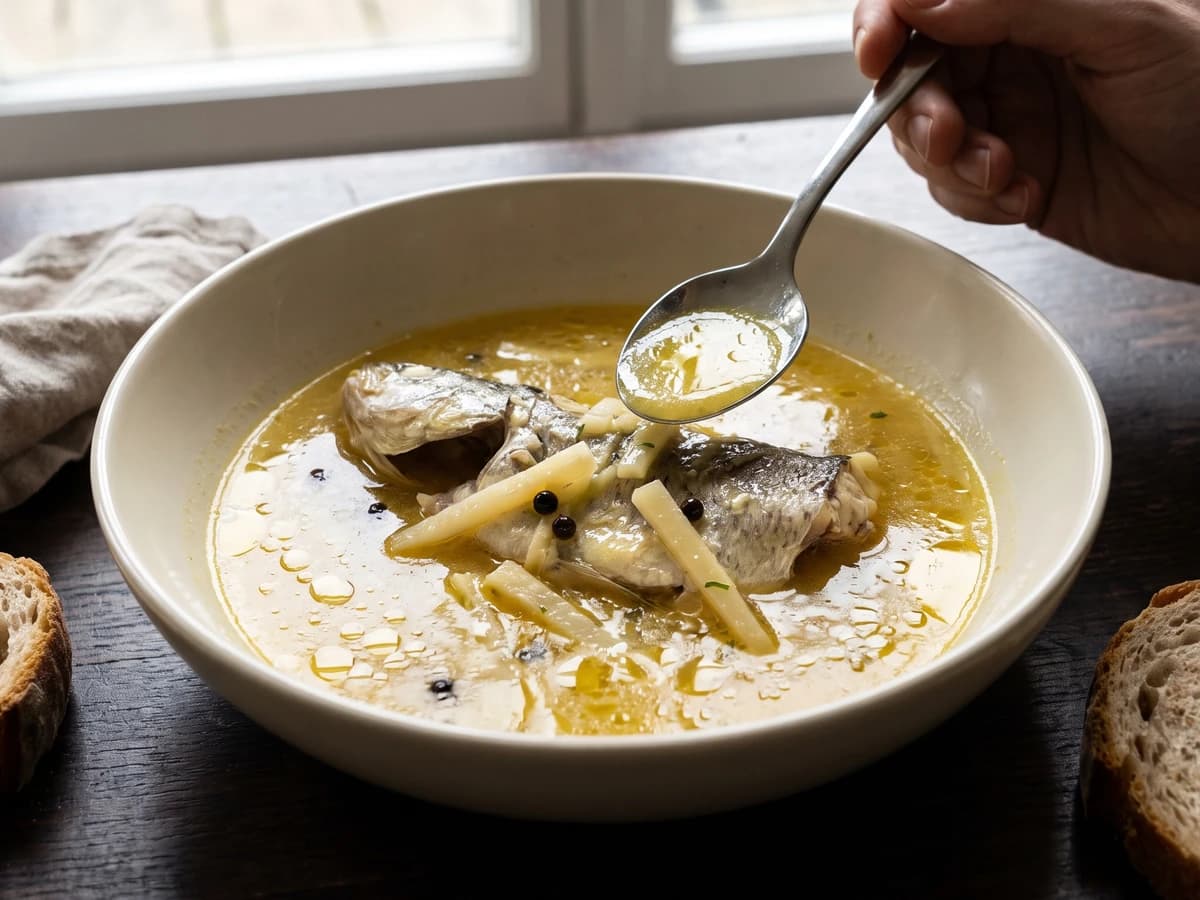
Waterzoi asks fresh, bone-in river fish to thicken its own buttery broth, with parsley root and pepper for company. No flour, no stockpot, just a brisk simmer watched closely.
Chef Juliette
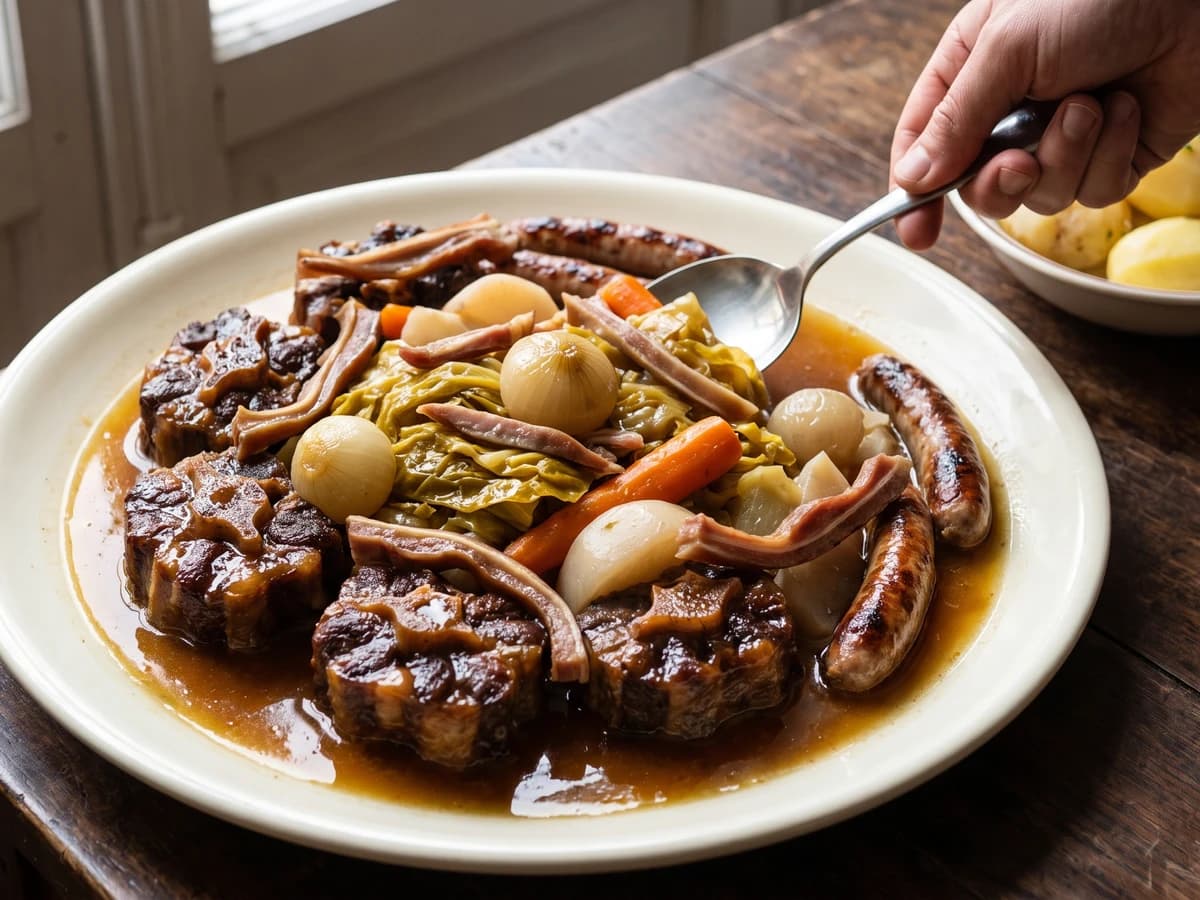
Queue de Bœuf en Hochepot gathers oxtail, pig's trotter and ear, cabbage, roots, and grilled chipolatas around a clear, gelatin-rich broth whose quiet simmer keeps every piece tender and distinct.
Chef Juliette
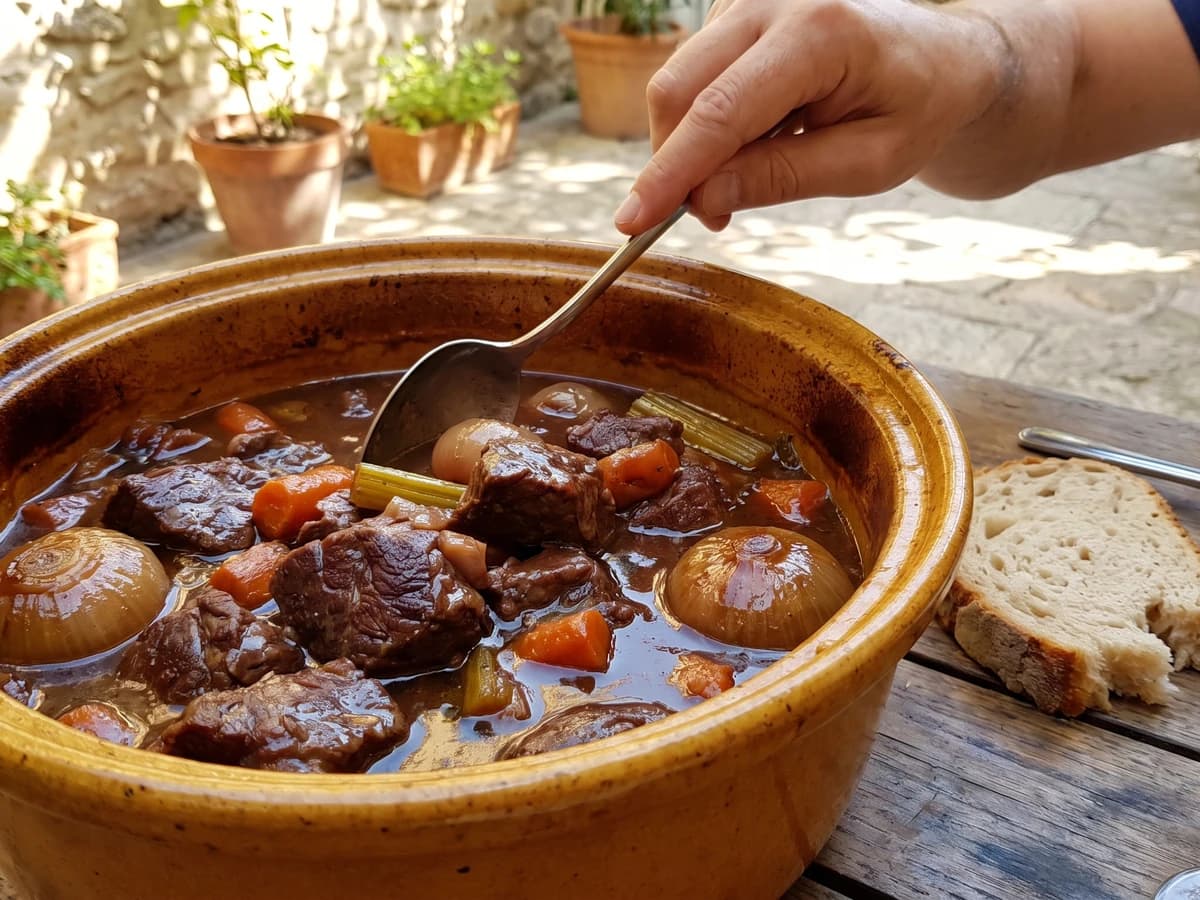
Beef shoulder larded with bacon, sharpened by red wine and vinegar, then sealed with garlic, vegetables, and dry lemon peel until the low oven turns it yielding and the gravy darkly glossy.