Chef Juliette
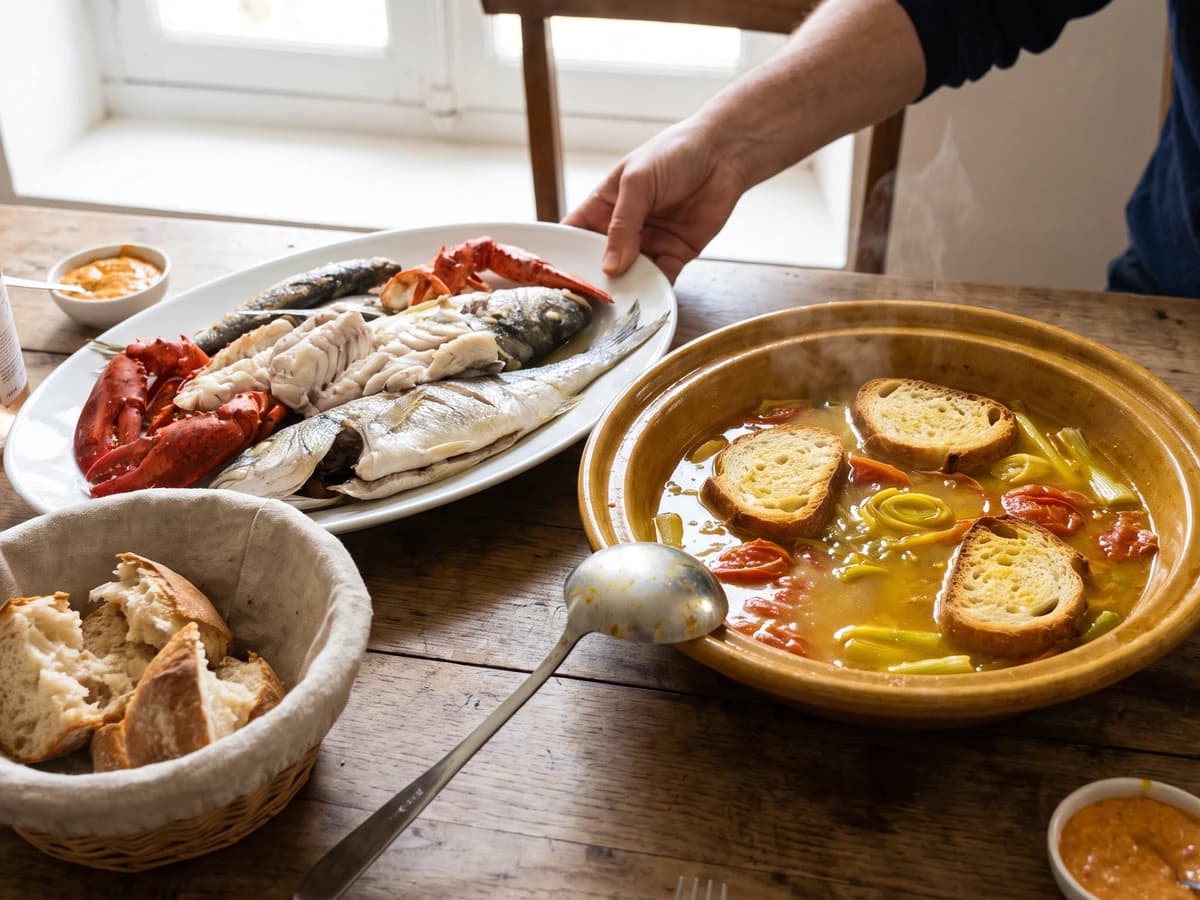
Bouillabaisse à la Marseillaise
Marseille's great fish stew, saffron-gold and garlic-scented, proves that a hard boil can be the careful choice: it binds olive oil into broth before the whole pot meets bread.
A cooking platform built around craft, culture, and the stories behind what we eat.

Created by Chef Juliette
Based on No. 566, Consommé Favorite, from Le Guide Culinaire (1907) by Auguste Escoffier
Consommé Favorite sets jewel-dark violet-potato pellets, artichoke, and mushroom julienne in clear chicken broth, with tapioca dissolved into a barely perceptible silkiness. Precision, not abundance, gives this first course its grace.
Consommé Favorite (clear chicken consommé with tapioca and a composed vegetable garnish) teaches restraint. Its one true principle is this: the tapioca must disappear. It gives the broth a faint silkiness, never visible grains or the weight of a thick soup, while violet potatoes, artichoke bottoms, and mushrooms remain sharply legible in the clear gold consommé.
The original entry assumed a saucier with chicken consommé never off the fire, another pair of hands cutting garnishes, a spoon-cutter for eighteen identical potato pellets per quart, and linen kept solely for straining. Your kitchen needs a finished consommé made ahead, a 13 mm melon baller, and a fine-mesh sieve whose weave is more dependable than household linen. The batch is two quarts, enough for eight first-course servings rather than a service stockpot, and every garnish ratio is doubled exactly from the one-quart formula. Those old arrangements were brigade scaffolding. The clear consommé, three tablespoons of poached strained tapioca per quart, the prescribed garnish, and the last-minute potatoes are the dish itself, so they stay.
Cut the artichoke and mushrooms ahead, but cook the violet-potato pellets only when the bound consommé is ready to serve. Their clean edges and deep color vanish if they wait in hot broth. The step that matters most comes just before that: loosen the tapioca with warm consommé and add it gradually, because a proper liaison gives sheen without announcing itself. One cook, one stove, one evening.
Consommé Favorite belongs to the named consommés of the Paris grand-kitchen canon, where a perfectly clarified broth carried a small, precisely cut garnish rather than an abundance of meat or vegetables. Such soups traveled from the saucier's stock range to formal dining rooms, each title distinguished by its composition; Favorite is marked by violet-potato pellets, julienne of artichoke bottoms and mushrooms, and a restrained tapioca liaison. The tapioca is not meant to make the soup cloudy or heavy, but to lend the clear chicken consommé a barely perceptible body.
Quantity
2 quarts (8 cups / 1.9 liters / about 1.9 kg)
cold and thoroughly skimmed
Quantity
3 tablespoons (45 ml / 35 g), yielding 6 tablespoons (90 ml / about 90 g) once poached and strained
Quantity
3 quarts (12 cups / 2.8 liters / 2.8 kg)
divided
Quantity
1 tablespoon (15 ml / 18 g)
divided
Quantity
6 medium (about 1½ pounds / 680 g)
enough to cut 36 small pellets
Quantity
¼ cup (60 ml / 55 g)
well drained and cut julienne-fashion
Quantity
¼ cup (60 ml / 40 g)
well drained and cut julienne-fashion
Quantity
2 generous pinches (about 2 teaspoons / 10 ml / 1 g)
| Ingredient | Quantity |
|---|---|
| finished clear chicken consommécold and thoroughly skimmed | 2 quarts (8 cups / 1.9 liters / about 1.9 kg) |
| small pearl tapioca | 3 tablespoons (45 ml / 35 g), yielding 6 tablespoons (90 ml / about 90 g) once poached and strained |
| waterdivided | 3 quarts (12 cups / 2.8 liters / 2.8 kg) |
| fine sea saltdivided | 1 tablespoon (15 ml / 18 g) |
| violet-fleshed potatoesenough to cut 36 small pellets | 6 medium (about 1½ pounds / 680 g) |
| cooked artichoke bottomswell drained and cut julienne-fashion | ¼ cup (60 ml / 55 g) |
| cooked button mushroom capswell drained and cut julienne-fashion | ¼ cup (60 ml / 40 g) |
| chervil pluches | 2 generous pinches (about 2 teaspoons / 10 ml / 1 g) |
Inspect the cold chicken consommé before heating it. Lift away every bead of fat from the surface and leave any sediment behind as you measure it into a clean saucepan, reserving about 1 cup for loosening the liaison. The consommé is the finished foundation this entry expects the cook to reach for; reheating and garnishing it belong here, while making and clarifying it remain their own preparation.
Bring 4 cups of the water and 1 teaspoon of the salt to a gentle boil. Rain in the tapioca while stirring, then lower the heat and poach at a quiet simmer, stirring occasionally, until every pearl is transparent, has lost its white core, and begins to collapse, about 20 to 30 minutes. Drain without rinsing and press the hot tapioca through a fine-mesh sieve. Measure exactly 6 tablespoons of the smooth paste. If it cools and becomes too firm to pass, rewarm it with a spoonful of hot water. Ça se rattrape.
Cut the cooked artichoke bottoms and mushroom caps julienne-fashion, into slender matchstick rods about 4 cm long and no thicker than 2 mm. Measure ¼ cup of each after cutting so the source proportions remain exact, then cover them separately. Keep their pale natural color; sautéing or browning would change both the character and clarity of this garnish.
Bring the remaining 8 cups water and 2 teaspoons salt to a lively simmer. Peel the violet potatoes and use a 13 mm melon baller or spoon-cutter to make 36 pellets the size of small hazelnuts, turning the cutter firmly so each pellet is rounded. Rinse them briefly, lower them into the water, and poach without a hard boil until a fine skewer enters with slight resistance, about 7 to 10 minutes. If their edges begin to feather, turn off the heat, add a cup of cold water, and drain them at once without stirring further. Ça se rattrape. Spread the pellets on a clean towel and keep them ready for immediate assembly.
Bring the main saucepan of consommé just to a bare simmer. Whisk about ½ cup of the reserved warm consommé into the strained tapioca until perfectly smooth, then pour this liaison, a light binding, through the clean sieve and into the saucepan while stirring gently. Hold it below a boil for 2 minutes. The broth should remain bright and fluid, with only a soft satin line on the spoon. If translucent knots appear, remove the pan from the heat and strain the consommé once more; if the body feels too heavy, loosen it with the remaining reserved consommé. Never boil it hard, which can dull the broth and roughen the liaison.
Warm a 2½ to 3-quart soupière with hot water, then empty and dry it. Arrange the artichoke and mushroom julienne in the bottom, add the drained violet-potato pellets, and pour the bound chicken consommé over them. Scatter on the chervil pluches, the tender picked leaflets, and serve immediately so every bowl receives four or five potato pellets and a little of each julienne. À table!
1 serving (about 270g)
Culinary guides, cultural storytelling, and the editorial depth that makes cooking meaningful.
Discover Culinary ExplorerChef Juliette
Marseille's great fish stew, saffron-gold and garlic-scented, proves that a hard boil can be the careful choice: it binds olive oil into broth before the whole pot meets bread.
Chef Juliette
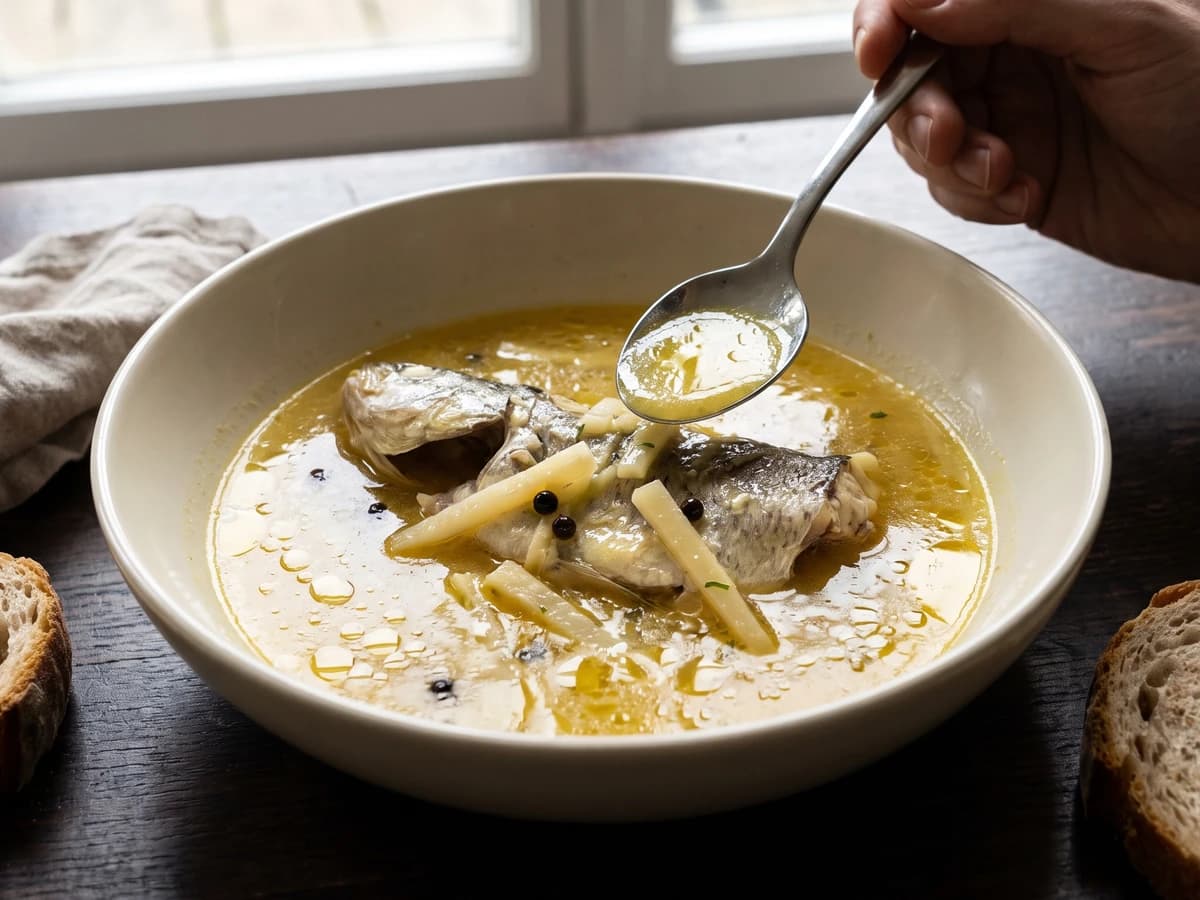
Waterzoi asks fresh, bone-in river fish to thicken its own buttery broth, with parsley root and pepper for company. No flour, no stockpot, just a brisk simmer watched closely.
Chef Juliette
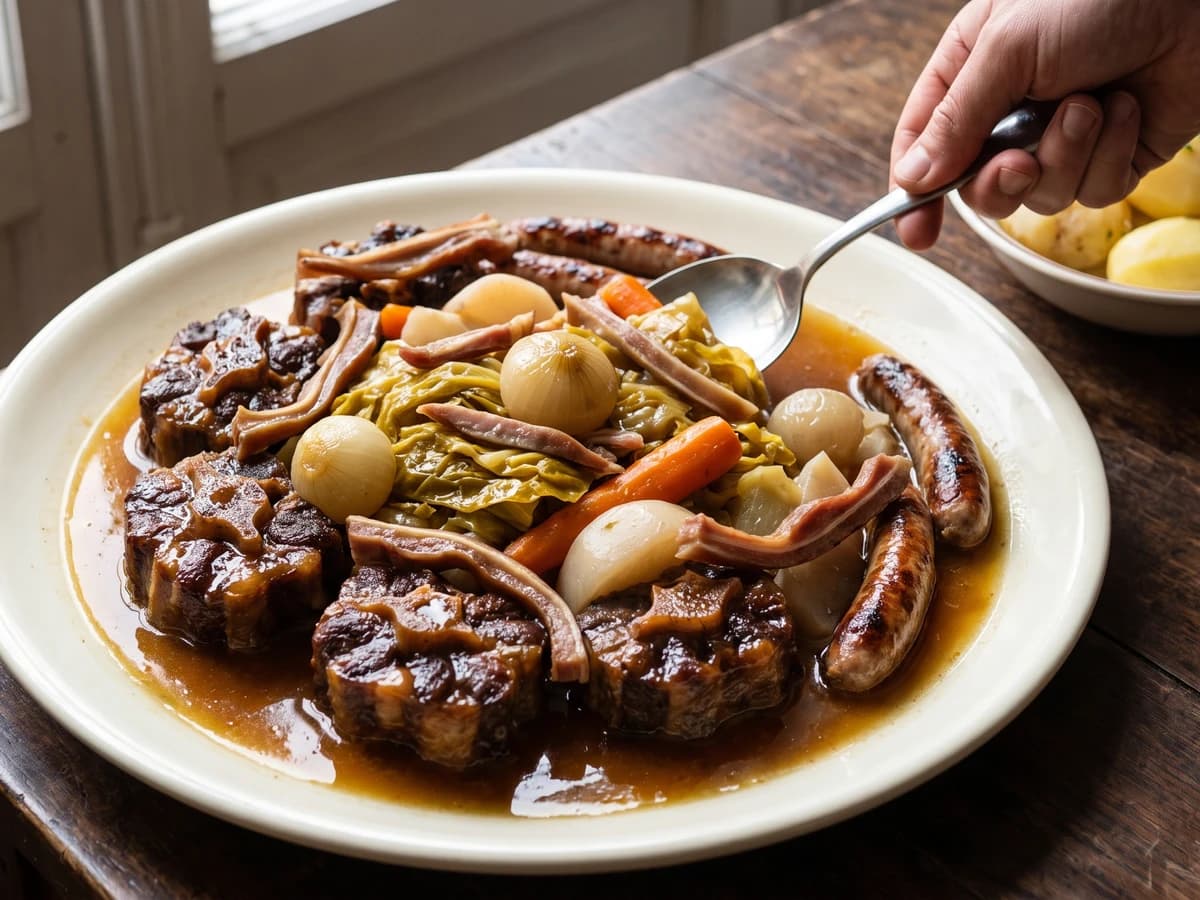
Queue de Bœuf en Hochepot gathers oxtail, pig's trotter and ear, cabbage, roots, and grilled chipolatas around a clear, gelatin-rich broth whose quiet simmer keeps every piece tender and distinct.
Chef Juliette
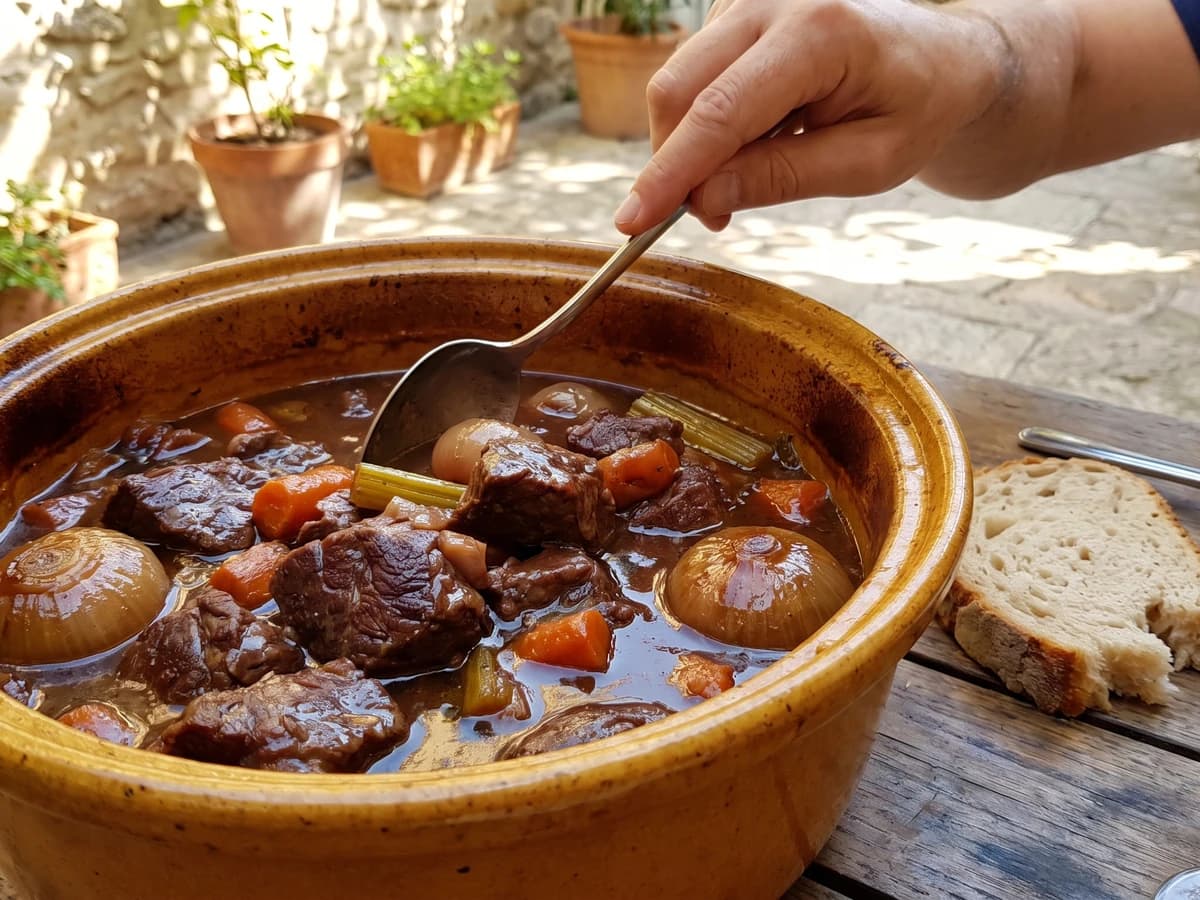
Beef shoulder larded with bacon, sharpened by red wine and vinegar, then sealed with garlic, vegetables, and dry lemon peel until the low oven turns it yielding and the gravy darkly glossy.