Chef Juliette
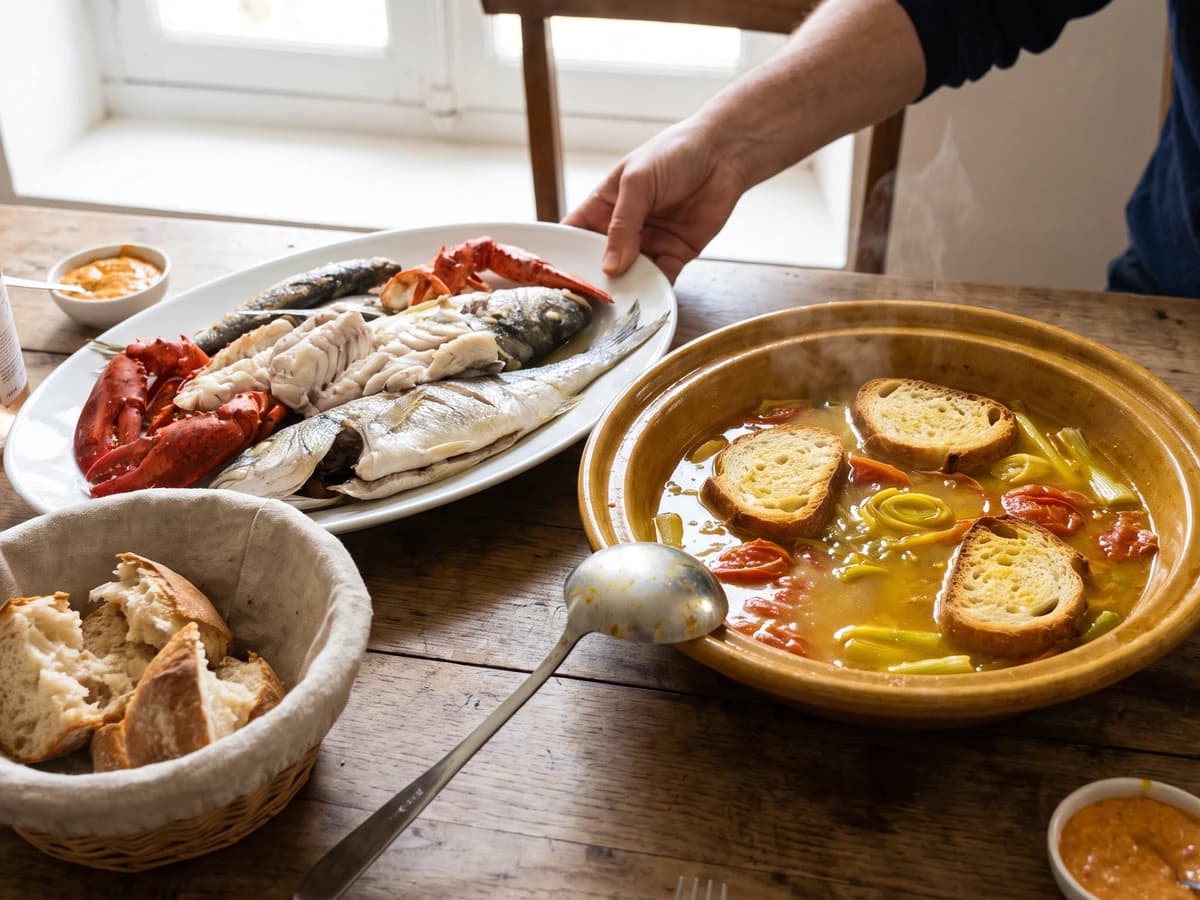
Bouillabaisse à la Marseillaise
Marseille's great fish stew, saffron-gold and garlic-scented, proves that a hard boil can be the careful choice: it binds olive oil into broth before the whole pot meets bread.
A cooking platform built around craft, culture, and the stories behind what we eat.
Created by Chef Juliette
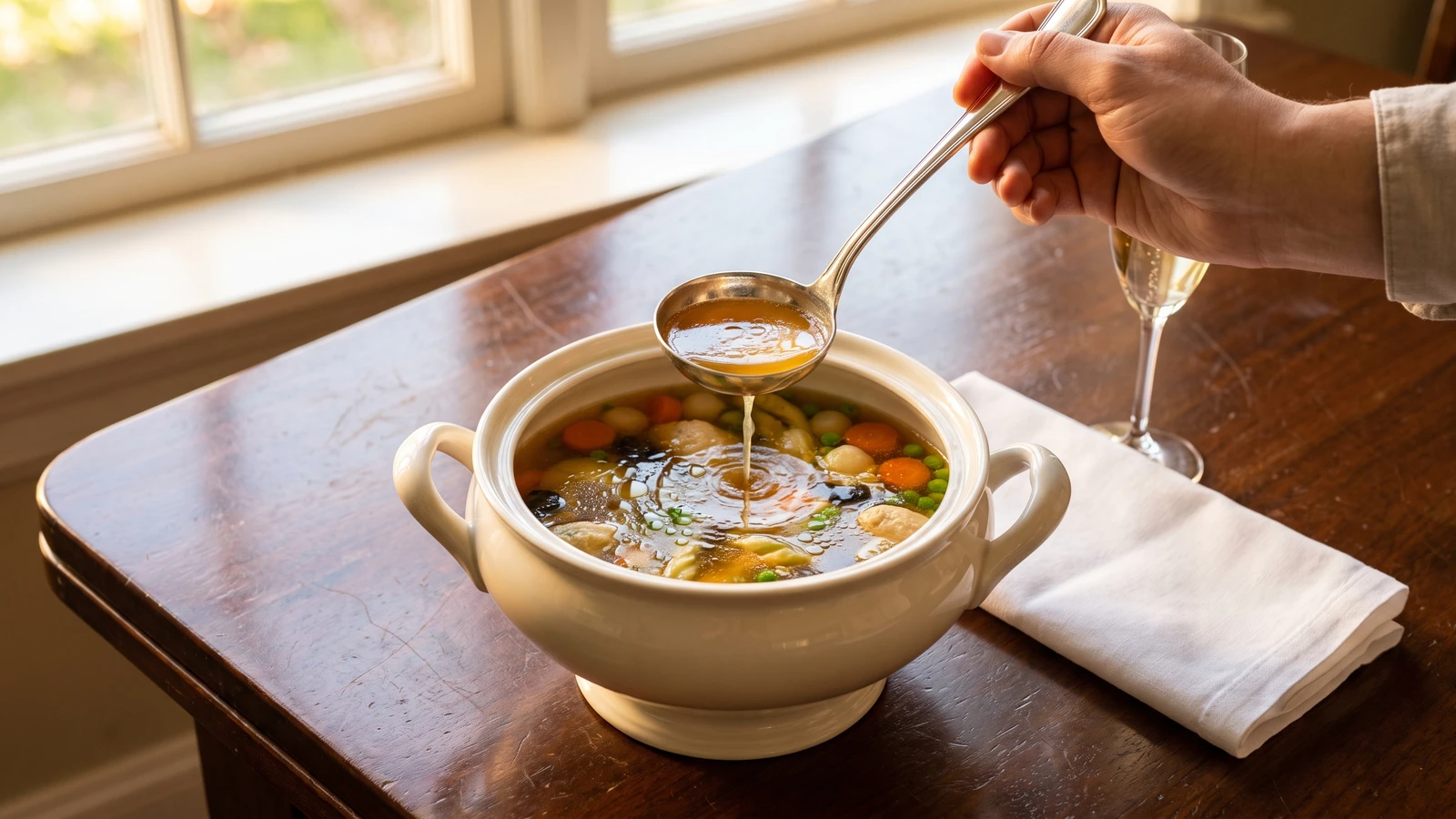
Based on No. 542, Consommé D’Arenberg, from Le Guide Culinaire (1907) by Auguste Escoffier
A crystal-clear consommé set with jewel-like vegetable and truffle pearls, tender chicken quenelles, peas, and asparagus royale, where precision in the garnish makes a formal soup feel generous rather than fussy.
Consommé D’Arenberg (crystal-clear chicken broth with jewelled garnish) teaches a severe and useful principle: everything in the bowl may be elaborate, but nothing is allowed to trouble the broth. The carrot and turnip are cooked in consommé until that liquid becomes glaze, the royale is set separately, the chicken quenelles are poached separately, and the black truffle never sees rough heat. Clarity is not decoration here. It is the structure.
The original assumes a saucier with clarified chicken consommé never off the fire, another pair of hands shaping identical pearls, and Dariole-moulds (small Baba-moulds) waiting on the shelf. At home, use finished consommé prepared ahead, two small ramekins, an 8 mm spoon-cutter, a tiny fluted cutter, and one wide pan. Separate poaching cauldrons and extra hands are brigade scaffolding, so they go; the glazed vegetable pearls, asparagus royale, truffle, peas, and quenelles are the dish, so they stay. One cook, one stove, one evening.
The printed formula fills a one-quart tureen. This version doubles the broth and every garnish in lockstep to make a useful two-quart dinner-party service, changing the quantity without disturbing the proportion or sequence. Before you touch the pan, know the step that decides it: when the carrot and turnip become tender, their consommé must have reduced to a shining glaze, neither a puddle nor caramel.
Consommé D’Arenberg belongs to the Parisian grande cuisine repertoire, where a clarified broth became a composed first course through its precisely prepared garnish rather than through heaviness. Its name follows the classical practice of honoring aristocratic houses, here the House of Arenberg, while royale, truffle, quenelles, and uniformly cut vegetables display the organization of the grand kitchen. Clarity alone does not define this consommé; the asparagus royale and pearls are its identity, not decoration that may be omitted.
Quantity
9 cups (2.13 L / approximately 2.13 kg)
chilled, completely defatted, and unsalted or only lightly salted; divided
Quantity
1 medium (about 3 oz / 85 g), yielding 2 tablespoons (30 ml / 20 g) of pearls
peeled and cut into 8 mm pearls
Quantity
1 (about 4 oz / 115 g), yielding 2 tablespoons (30 ml / 25 g) of pearls
peeled and cut into 8 mm pearls
Quantity
1 (about 1½ oz / 42 g), yielding 2 tablespoons (30 ml / 20 g) of pearls
brushed clean and cut into 8 mm pearls
Quantity
2 packed cups (475 ml / 170 g)
tough bases trimmed
Quantity
1 teaspoon (5 ml / 5 g)
softened
Quantity
1
Quantity
1
Quantity
½ cup (120 ml / 120 g)
divided equally between the royale and forcemeat
Quantity
⅓ cup (80 ml / 55 g)
diced and thoroughly chilled
Quantity
½ (1 tablespoon / 15 ml / 15 g)
Quantity
Up to 1 tablespoon (15 ml / 18 g)
divided according to the seasoning of the consommé
Quantity
⅛ teaspoon (0.6 ml / 0.3 g)
divided
Quantity
2 tablespoons (30 ml / 30 g)
fresh or frozen
| Ingredient | Quantity |
|---|---|
| finished clear chicken consomméchilled, completely defatted, and unsalted or only lightly salted; divided | 9 cups (2.13 L / approximately 2.13 kg) |
| carrotpeeled and cut into 8 mm pearls | 1 medium (about 3 oz / 85 g), yielding 2 tablespoons (30 ml / 20 g) of pearls |
| small white turnippeeled and cut into 8 mm pearls | 1 (about 4 oz / 115 g), yielding 2 tablespoons (30 ml / 25 g) of pearls |
| very black fresh winter trufflebrushed clean and cut into 8 mm pearls | 1 (about 1½ oz / 42 g), yielding 2 tablespoons (30 ml / 20 g) of pearls |
| asparagus headstough bases trimmed | 2 packed cups (475 ml / 170 g) |
| unsalted buttersoftened | 1 teaspoon (5 ml / 5 g) |
| large egg | 1 |
| large egg yolk | 1 |
| cold heavy creamdivided equally between the royale and forcemeat | ½ cup (120 ml / 120 g) |
| skinless chicken breastdiced and thoroughly chilled | ⅓ cup (80 ml / 55 g) |
| large egg white | ½ (1 tablespoon / 15 ml / 15 g) |
| fine sea saltdivided according to the seasoning of the consommé | Up to 1 tablespoon (15 ml / 18 g) |
| ground white pepperdivided | ⅛ teaspoon (0.6 ml / 0.3 g) |
| very green peasfresh or frozen | 2 tablespoons (30 ml / 30 g) |
Use an 8 mm melon baller or Parisienne scoop to cut 2 tablespoons each of carrot and turnip pearls. Turn the vegetables steadily against the cutter so the pearls remain round and equal; uniformity is functional because pieces of different sizes will not become tender together. Keep the carrot and turnip separate, and save the perforated trimmings for a puréed soup.
Pour 1 cup of the consommé into a wide 20 cm saucepan and bring it to a lively simmer. Add the carrot pearls, wait 2 minutes, then add the turnip pearls and continue cooking uncovered until both are tender and the consommé has reduced completely to a clear, syrupy glaze, about 8 to 12 minutes. Roll the pan frequently rather than stirring hard. If the vegetables become tender while liquid remains, lift them out, reduce the consommé alone, then return them; if the glaze tightens or catches, add a spoonful of reserved consommé and release it gently. Ça se rattrape. Transfer the shining pearls and every trace of glaze to a small dish.
Cut 2 tablespoons of truffle pearls with the same 8 mm cutter, preserving the source recipe's matching geometry. Do not cook them. Cover closely and keep cool while the other garnishes are prepared; their perfume will open when the hot consommé reaches the tureen. Save the trimmings for eggs, a sauce, or truffle butter.
Heat the oven to 300°F (150°C). Blanch the asparagus heads in generously salted boiling water until completely tender, 3 to 4 minutes, then cool them under cold water and drain very well. Purée them with ¼ cup of the cream, pass the purée through a fine sieve, and measure ½ cup (120 ml / about 115 g). Whisk this with the whole egg, yolk, ¼ teaspoon salt, and a small pinch of white pepper, keeping air out of the mixture. Butter two Dariole-moulds or ramekins, divide in the royale, and set them in a baking dish. Add hot water to reach halfway up the moulds and bake until the edges are set but the centers retain a slight tremble, 20 to 25 minutes. If the edges begin to puff, lift the dish out, add a little cold water to the water bath, and lower the oven to 275°F (135°C); the royale can still finish smooth. Cool the moulds before unmoulding.
Chill the bowl and blade of a mini food processor. Process the cold chicken with ¼ teaspoon salt and another small pinch of white pepper until sticky and very fine. Reserve 1 teaspoon of the egg white, add the rest, and process only until absorbed. With the blade moving, add the remaining ¼ cup cold cream in a thin stream, stopping as soon as the forcemeat is smooth. Press it through a fine sieve and chill it for 15 minutes. Keep everything cold: if the mixture turns loose or oily, stop, set the bowl over ice until firm, then mix briefly. Ça se rattrape.
Bring a shallow pan of salted water to 175°F to 180°F (80°C to 82°C), a gentle tremble with no hard bubbling. Poach a ½-teaspoon test quenelle for 3 minutes. It should hold its shape, feel tender, and be fully opaque inside; if it spreads, beat the reserved teaspoon of egg white into the forcemeat and chill it for another 10 minutes. With two wet demitasse spoons or a wet ½-teaspoon measure, shape 24 small quenelles like large pearls. Poach them in batches without crowding for about 3 minutes, until their centers reach 165°F (74°C), then lift them onto a clean towel to drain.
Loosen each cooled royale with a thin knife and turn it out. If one clings, dip the base of its mould in warm water for 5 seconds and try again. Slice the royales about ¼ inch (6 mm) thick, then stamp the slices with a small indented or fluted cutter, preserving the source's fancy-cut finish without hunting for obsolete equipment. Blanch the peas in boiling salted water just until bright green, about 30 seconds for frozen peas or 1 minute for fresh, then drain.
Warm the remaining 8 cups of consommé slowly to a bare simmer. Taste and add only as much salt as it needs; reduction has already concentrated the vegetable glaze. If small particles disturb its clarity, pass the consommé through a damp coffee filter or double layer of fine muslin without pressing. Warm the soup tureen with hot water, empty and dry it, then arrange the glazed carrot and turnip pearls, uncooked truffle pearls, asparagus royale, chicken quenelles, and green peas inside. Pour over the hot consommé and carry it directly to the table. À table!
1 serving (about 240g)
Culinary guides, cultural storytelling, and the editorial depth that makes cooking meaningful.
Discover Culinary ExplorerChef Juliette
Marseille's great fish stew, saffron-gold and garlic-scented, proves that a hard boil can be the careful choice: it binds olive oil into broth before the whole pot meets bread.
Chef Juliette
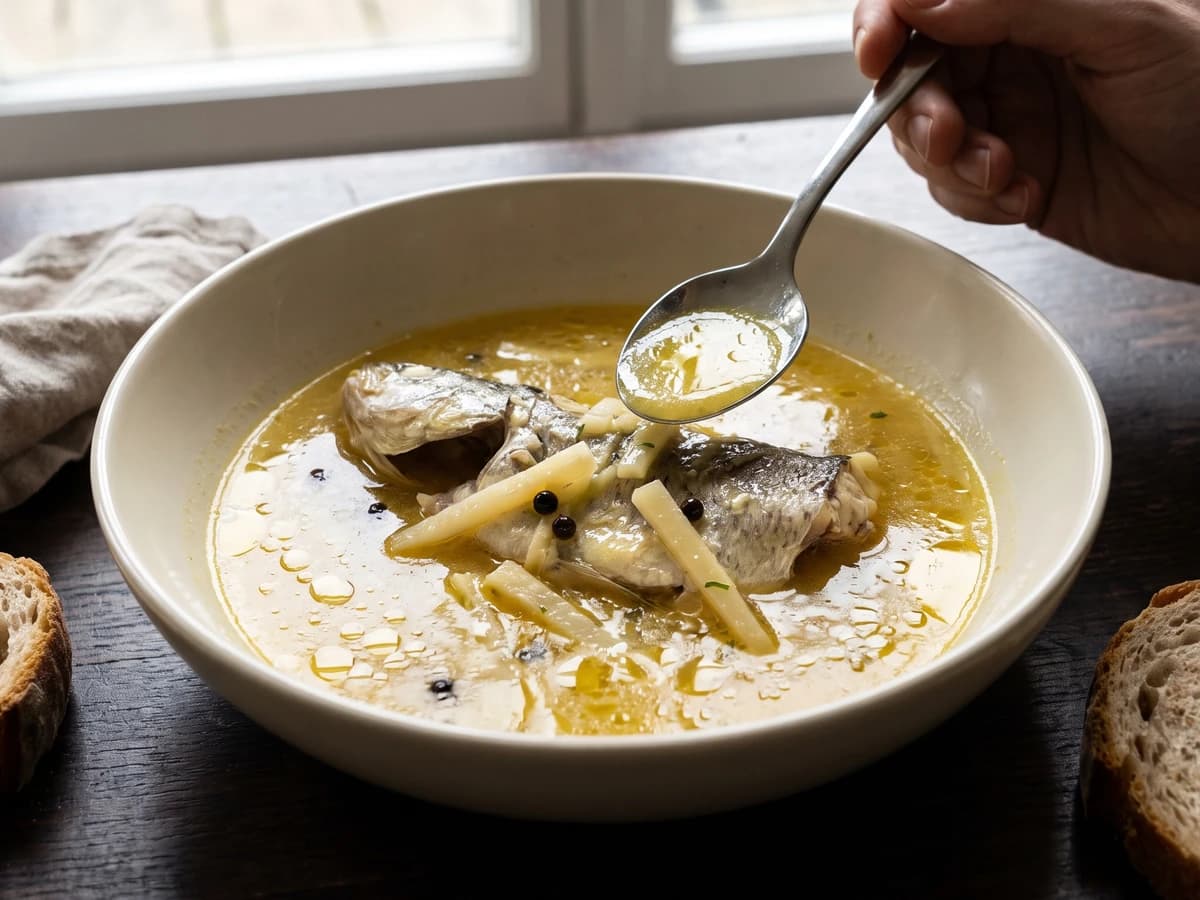
Waterzoi asks fresh, bone-in river fish to thicken its own buttery broth, with parsley root and pepper for company. No flour, no stockpot, just a brisk simmer watched closely.
Chef Juliette
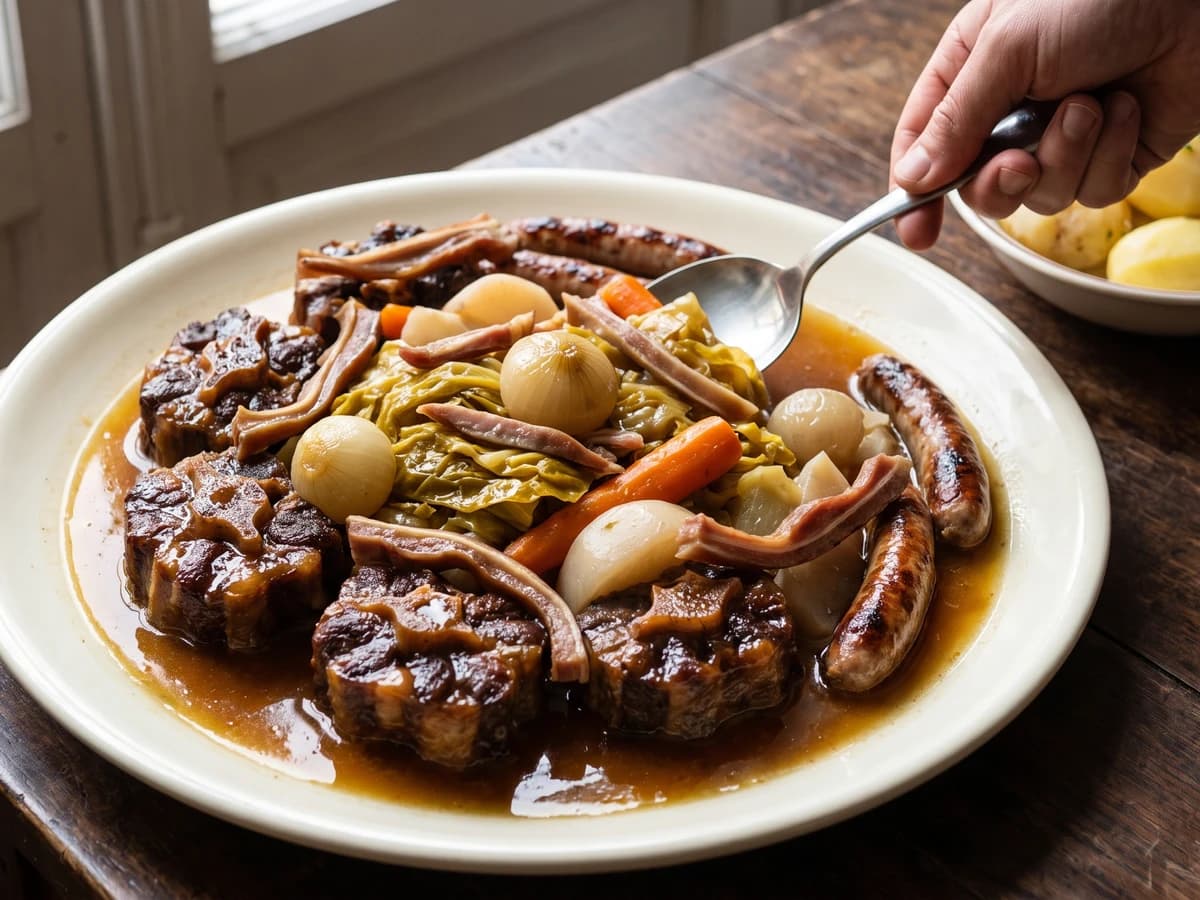
Queue de Bœuf en Hochepot gathers oxtail, pig's trotter and ear, cabbage, roots, and grilled chipolatas around a clear, gelatin-rich broth whose quiet simmer keeps every piece tender and distinct.
Chef Juliette
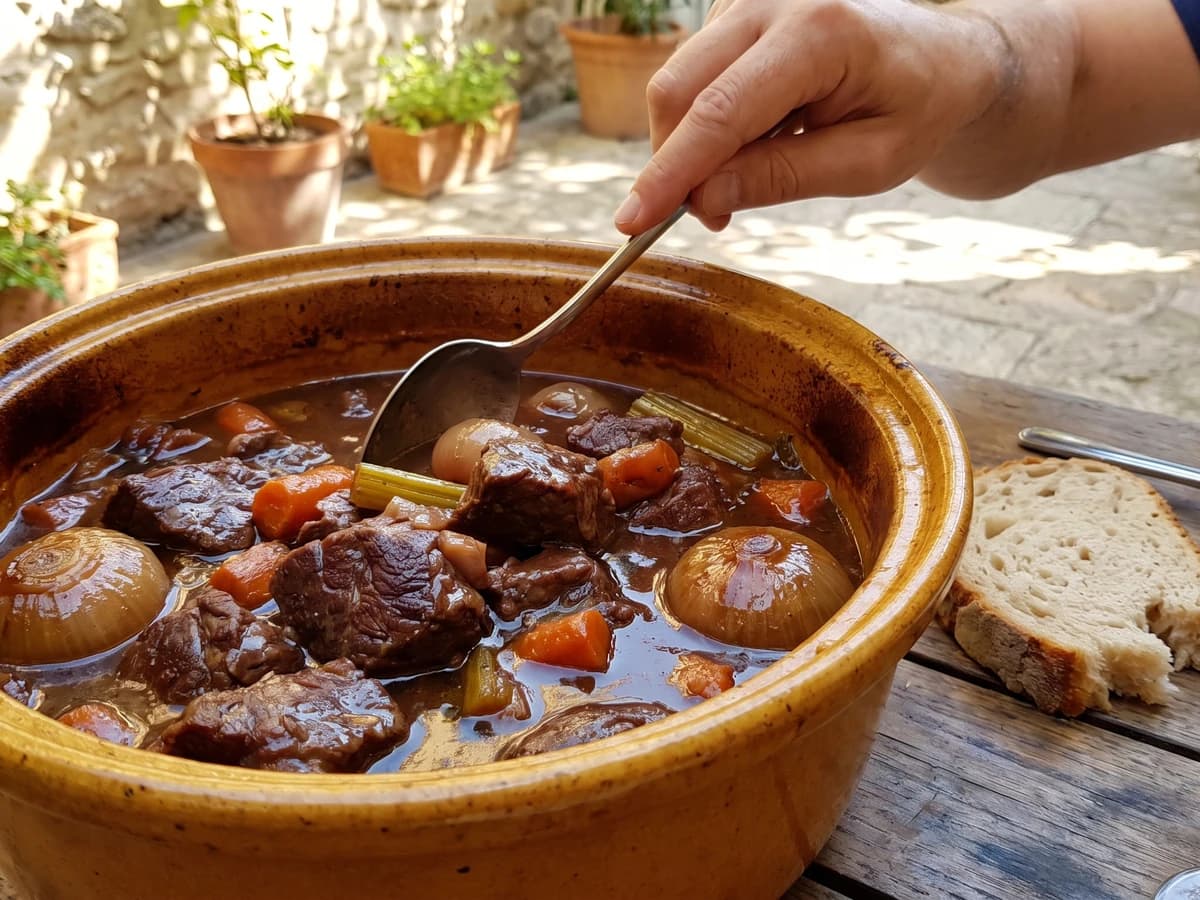
Beef shoulder larded with bacon, sharpened by red wine and vinegar, then sealed with garlic, vegetables, and dry lemon peel until the low oven turns it yielding and the gravy darkly glossy.