Chef Juliette
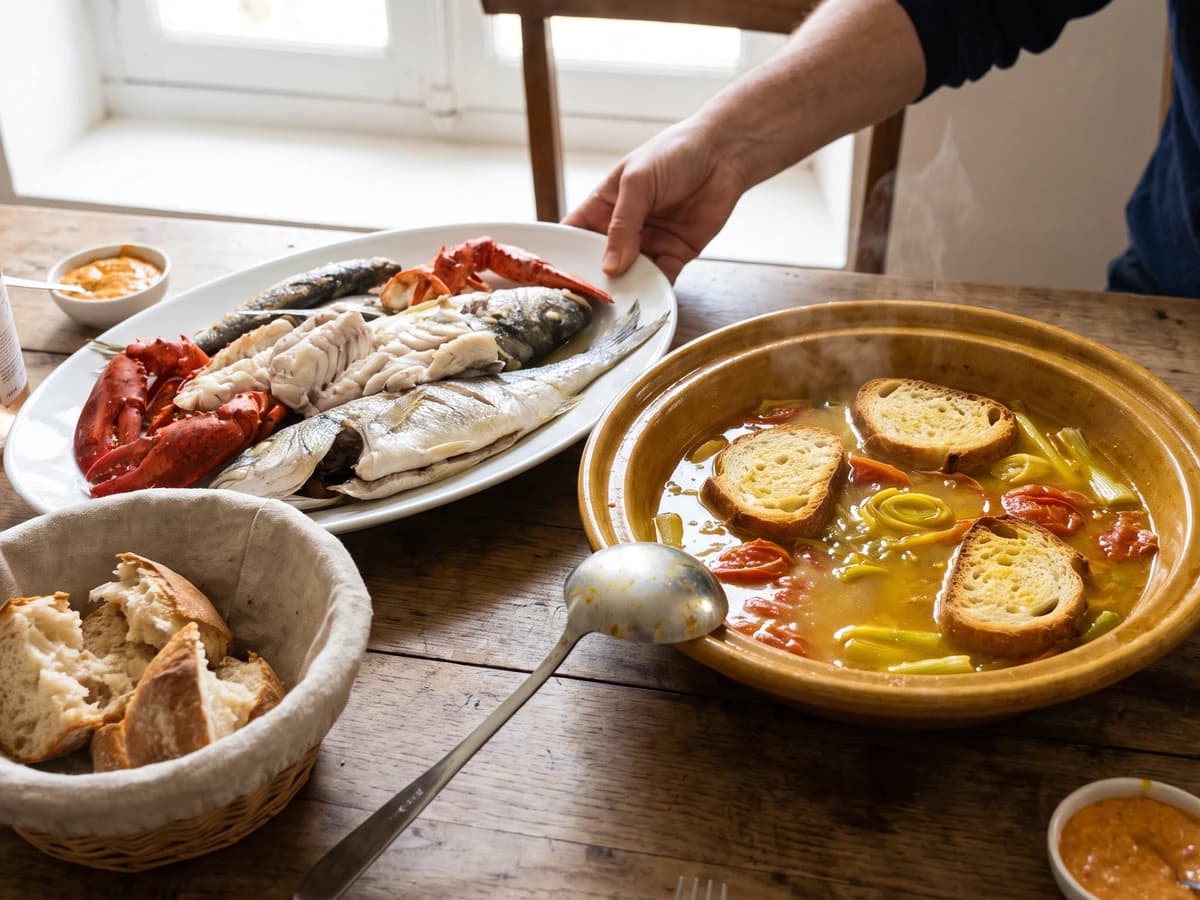
Bouillabaisse à la Marseillaise
Marseille's great fish stew, saffron-gold and garlic-scented, proves that a hard boil can be the careful choice: it binds olive oil into broth before the whole pot meets bread.
A cooking platform built around craft, culture, and the stories behind what we eat.
Created by Chef Juliette
Based on No. 540, Consommé Ambassadrice, from Le Guide Culinaire (1907) by Auguste Escoffier
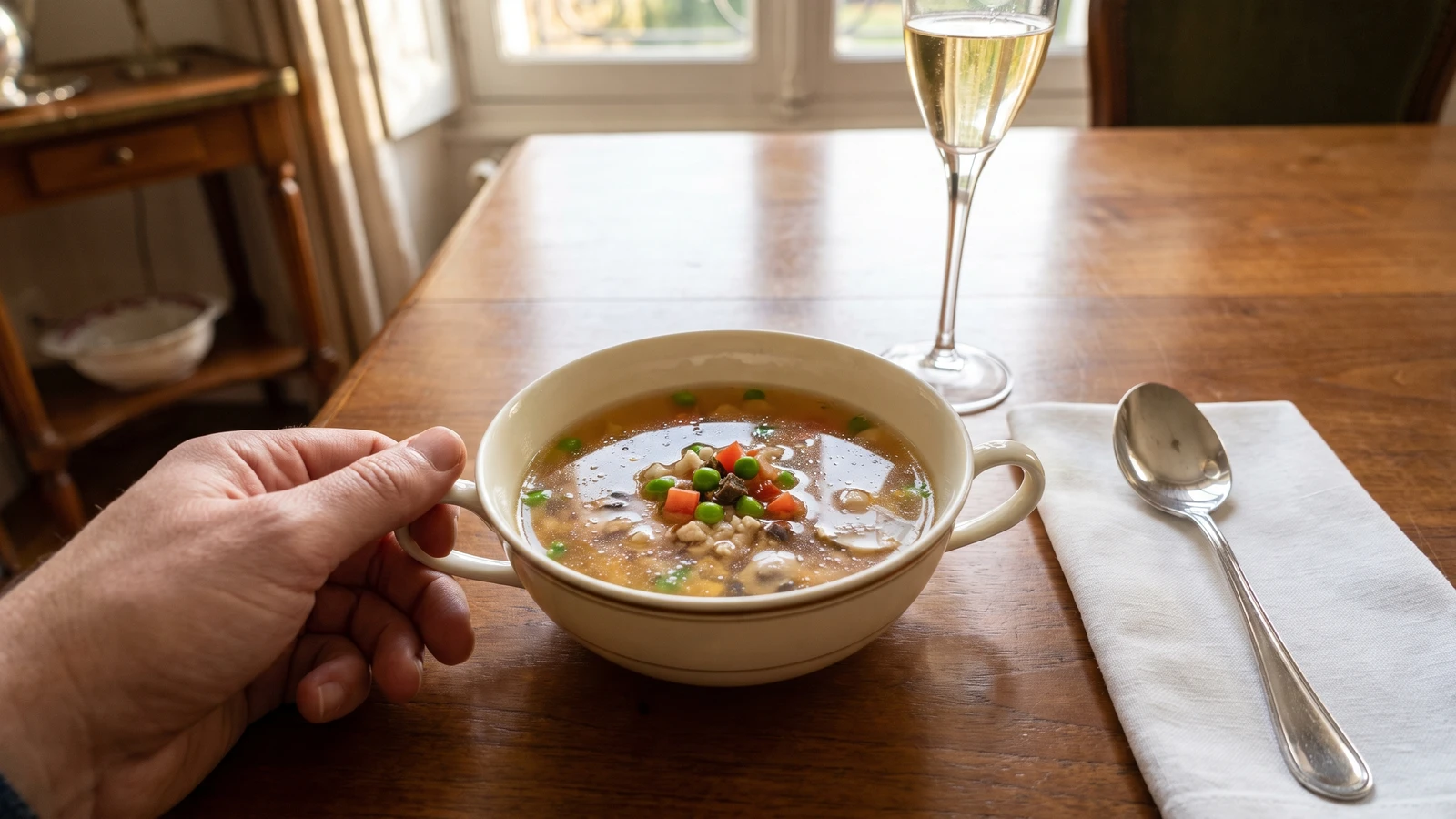
Crystal-clear chicken consommé poured over jewel-like dice of truffle, tomato, and pea royale, with fine chicken and mushroom: a formal first course made practical for one careful home cook.
Consommé Ambassadrice (ambassador's consommé) teaches the discipline of contrast. The broth must remain perfectly lucid while three tender royales bring truffle-dark, tomato-red, and pea-green color to every spoonful. The one true thing to know is this: a royale must be barely set, then completely cold before you cut it. Warm custard tears; chilled custard gives clean little jewels.
The original entry assumed a saucier with finished chicken consommé never far from the fire, three cold royales waiting in Dariole-moulds, and enough hands to prepare the chicken and mushrooms separately. Here, three straight-sided ramekins replace those small Baba-shaped moulds, and a gentle oven bain-marie replaces the constantly watched poaching station. The printed quart is doubled for eight first-course servings, while its equal measures of chicken and mushroom and its final pouring sequence remain intact. No salamander enters this dish because nothing should brown. The staff choreography was scaffolding; the cold royales and clear consommé are the dish. One cook, one stove, one evening.
At service, the boiling consommé wakes the chilled garnish without roughening it, and the bowl arrives clear, hot, and quietly magnificent. Keep the bain-marie below a simmer and pull each royale the moment its center has set. That is the step that decides everything.
Consommé Ambassadrice belongs to the formal Parisian table, where named consommés were distinguished by the precise garnishes placed within an already flawless broth. Its truffle, tomato, and pea royales show how grand kitchens used color and texture while guarding the consommé's absolute clarity. Ambassadrice is a classical service name rather than a regional soup, and the preparation passed naturally into private dinner parties because its garnishes could be made cold before the broth was poured at the last instant.
Quantity
8 cups (1.9 L / about 1.9 kg)
Quantity
1 teaspoon (5 ml / 5 g)
softened, for the ramekins
Quantity
3
Quantity
3
Quantity
3 tablespoons (45 ml / 45 g)
Quantity
1/4 cup (60 ml / 60 g)
Quantity
1/4 cup (60 ml / 65 g)
cooled
Quantity
1/4 cup (60 ml / 65 g)
cooled
Quantity
1 teaspoon (5 ml / 6 g)
divided
Quantity
1/8 teaspoon (0.6 ml / 0.3 g)
Quantity
2 cups (475 ml / 475 g)
for poaching
Quantity
1 small fillet, about 1 1/2 ounces (45 g)
Quantity
3 mushrooms, about 1 1/2 ounces (40 g)
trimmed
| Ingredient | Quantity |
|---|---|
| finished, well-seasoned chicken consommé | 8 cups (1.9 L / about 1.9 kg) |
| unsalted buttersoftened, for the ramekins | 1 teaspoon (5 ml / 5 g) |
| large eggs | 3 |
| large egg yolks | 3 |
| heavy cream | 3 tablespoons (45 ml / 45 g) |
| smooth black truffle purée | 1/4 cup (60 ml / 60 g) |
| thick strained tomato puréecooled | 1/4 cup (60 ml / 65 g) |
| smooth cooked pea puréecooled | 1/4 cup (60 ml / 65 g) |
| fine saltdivided | 1 teaspoon (5 ml / 6 g) |
| finely ground white pepper | 1/8 teaspoon (0.6 ml / 0.3 g) |
| waterfor poaching | 2 cups (475 ml / 475 g) |
| boneless chicken breast fillet or tenderloin | 1 small fillet, about 1 1/2 ounces (45 g) |
| small button mushroomstrimmed | 3 mushrooms, about 1 1/2 ounces (40 g) |
Heat the oven to 300°F (150°C). Butter three straight-sided 6 fluid ounce (180 ml) ramekins very lightly, leaving no thick streaks to mark the custards. Set them in a roasting pan and bring a kettle of water just to the boil. This bain-marie, a hot-water bath, gives the royales the slow, even heat they need to set without becoming porous.
Set out three bowls. In each bowl whisk together 1 egg, 1 yolk, and 1 tablespoon of cream without raising a foam. Whisk the truffle purée into the first, the tomato purée into the second, and the pea purée into the third. Season each sparingly with a pinch of salt and white pepper, remembering that the finished consommé already carries seasoning. Pass each mixture separately through a fine sieve into its prepared ramekin, then tap the ramekins gently against the counter to release hidden air bubbles. Keep the colors separate and wipe the sieve between them.
Cover the ramekins loosely with foil. Pour hot water into the roasting pan until it reaches halfway up their sides, then transfer the pan to the oven. Poach for 25 to 35 minutes, checking each royale separately after 25 minutes. It is ready when the edges are set, the center trembles as one soft piece, and an instant-read thermometer reaches 160°F (71°C). The bath must never bubble. If it begins to simmer or the custards start puffing at the edges, lift the pan out, replace some hot water with cool water, and lower the oven slightly. Ça se rattrape, provided you intervene before the centers curdle.
Lift the ramekins from the bath and remove the foil. Let them cool for no more than 45 minutes, then cover and refrigerate for at least 2 hours. Do not try to hurry the cutting while they are warm. Chilling firms the egg and purée just enough to make clean dice while preserving the soft texture that distinguishes a royale from an ordinary baked custard.
Bring the water and 3/4 teaspoon of the salt to a bare simmer in a small saucepan. Add the mushrooms and poach until tender but still neat, about 3 minutes, then lift them out. Lower in the chicken fillet and poach without boiling until its center reaches 165°F (74°C), about 6 to 9 minutes depending on thickness. Cool both briefly. Mince them separately and measure exactly 2 tablespoons (30 ml) of cooked chicken and 2 tablespoons (30 ml) of cooked mushroom. Their equal volume preserves the source formula; reserve any excess for another meal.
Run a thin knife around each chilled royale. If one clings, stand its base in warm water for 5 seconds, dry it, and try again. Turn each onto a clean board and cut it into regular 1/4 inch (6 mm) dice with a sharp knife, wiping the blade between colors. If an edge drags, dip the knife in hot water and dry it before the next cut. Keep the three colors in separate chilled dishes until service.
Warm the serving tureen with very hot water, then empty and dry it. Bring the chicken consommé to a clean, full boil in a saucepan, skimming away any surface fat or foam without stirring the broth. Taste it now; a consommé served over cold garnish must be fully seasoned. If fine particles appear, pass it through a sieve lined with a clean damp cloth, return it to the pan, and bring it back to the boil.
Place the diced truffle, tomato, and pea royales in the hot tureen with the measured chicken fillet and freshly cooked mushrooms. Pour the boiling consommé directly over the cold garnishes and stir once, very gently, so the colors mingle without breaking. Ladle immediately into warmed consommé cups or shallow soup bowls. Clear amber broth, tender colored dice, nothing extraneous. À table!
1 serving (about 285g)
Culinary guides, cultural storytelling, and the editorial depth that makes cooking meaningful.
Discover Culinary ExplorerChef Juliette
Marseille's great fish stew, saffron-gold and garlic-scented, proves that a hard boil can be the careful choice: it binds olive oil into broth before the whole pot meets bread.
Chef Juliette
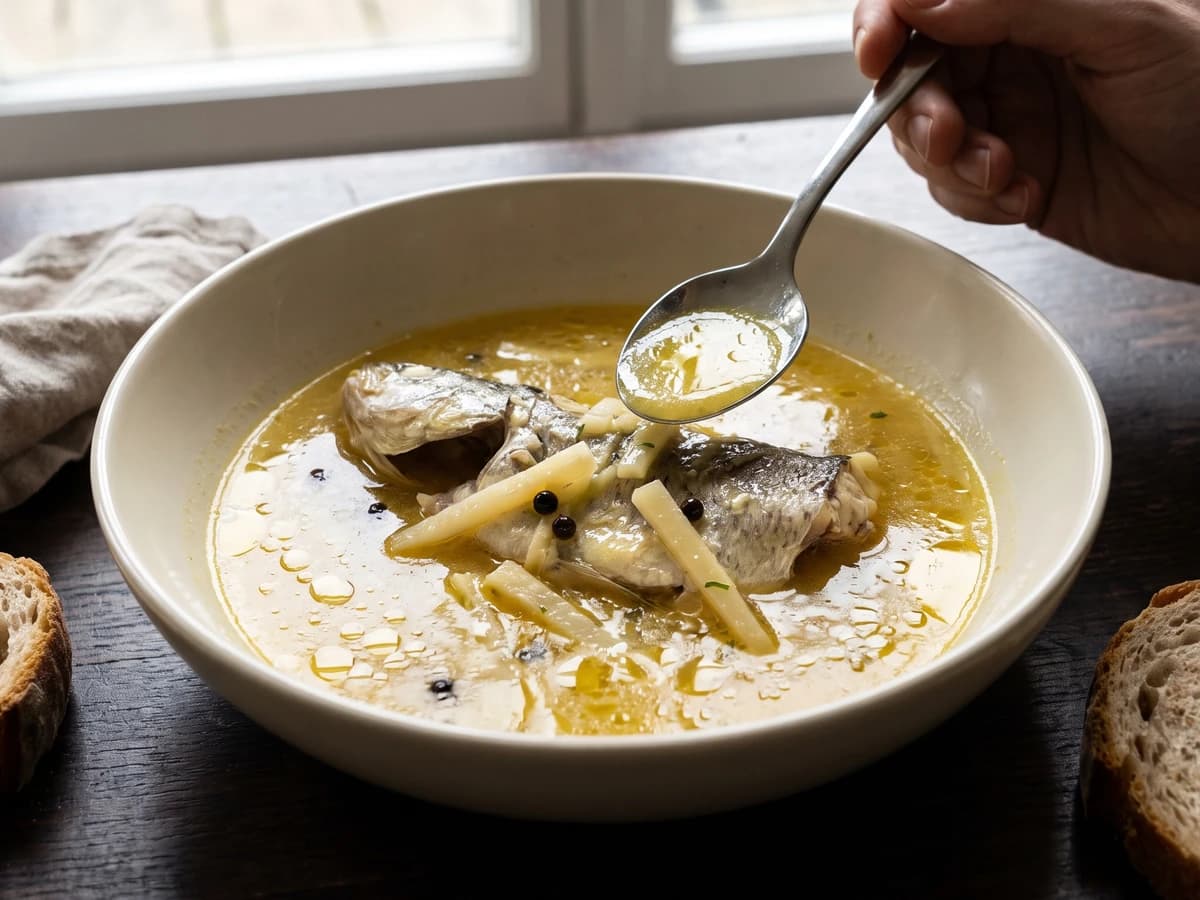
Waterzoi asks fresh, bone-in river fish to thicken its own buttery broth, with parsley root and pepper for company. No flour, no stockpot, just a brisk simmer watched closely.
Chef Juliette
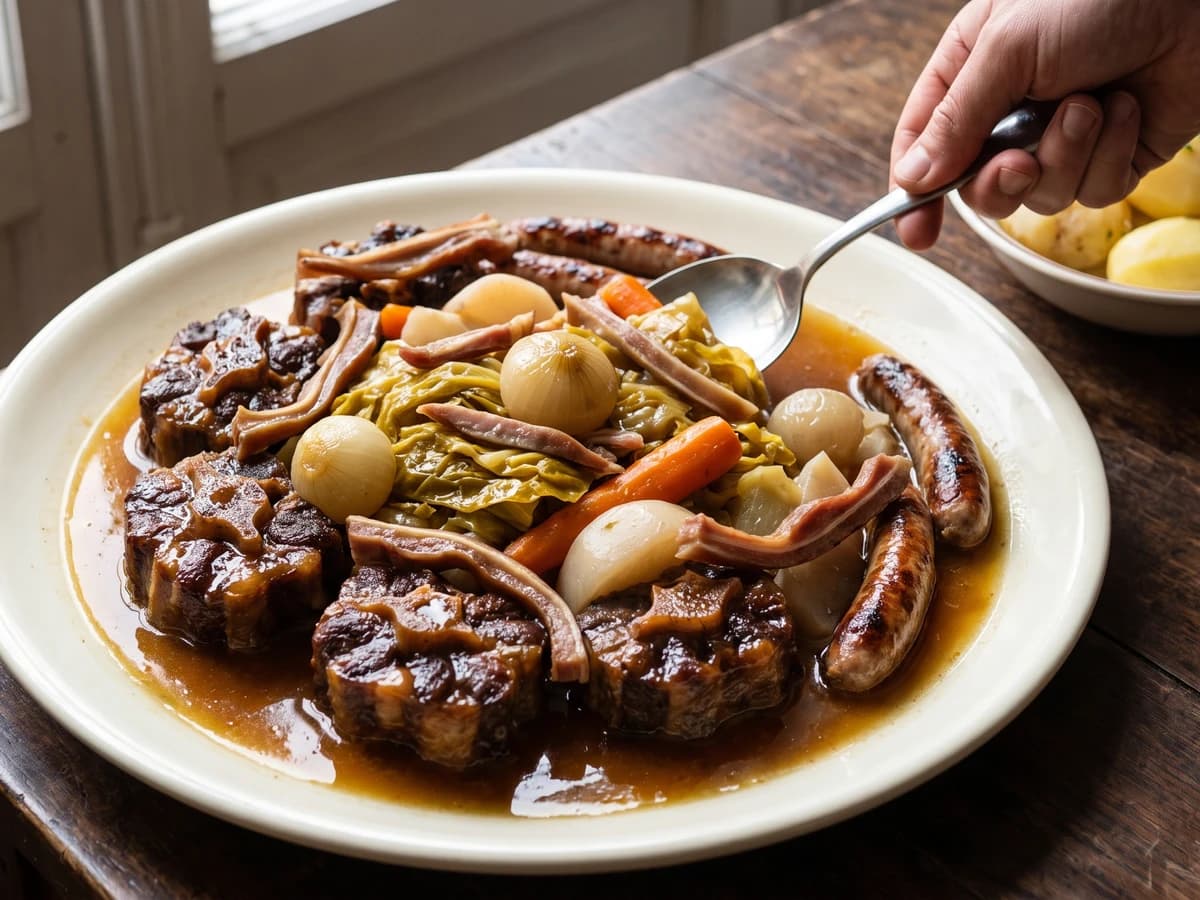
Queue de Bœuf en Hochepot gathers oxtail, pig's trotter and ear, cabbage, roots, and grilled chipolatas around a clear, gelatin-rich broth whose quiet simmer keeps every piece tender and distinct.
Chef Juliette
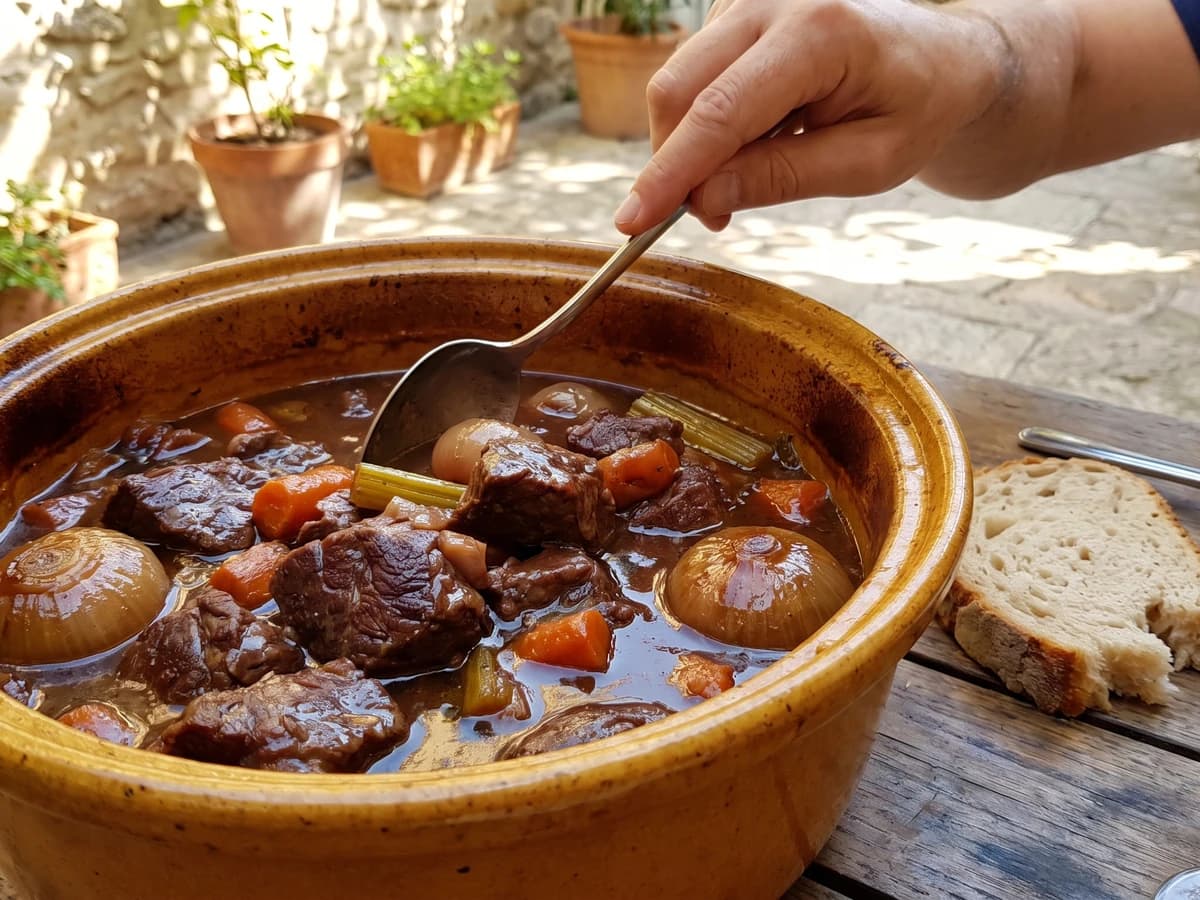
Beef shoulder larded with bacon, sharpened by red wine and vinegar, then sealed with garlic, vegetables, and dry lemon peel until the low oven turns it yielding and the gravy darkly glossy.