Chef Juliette
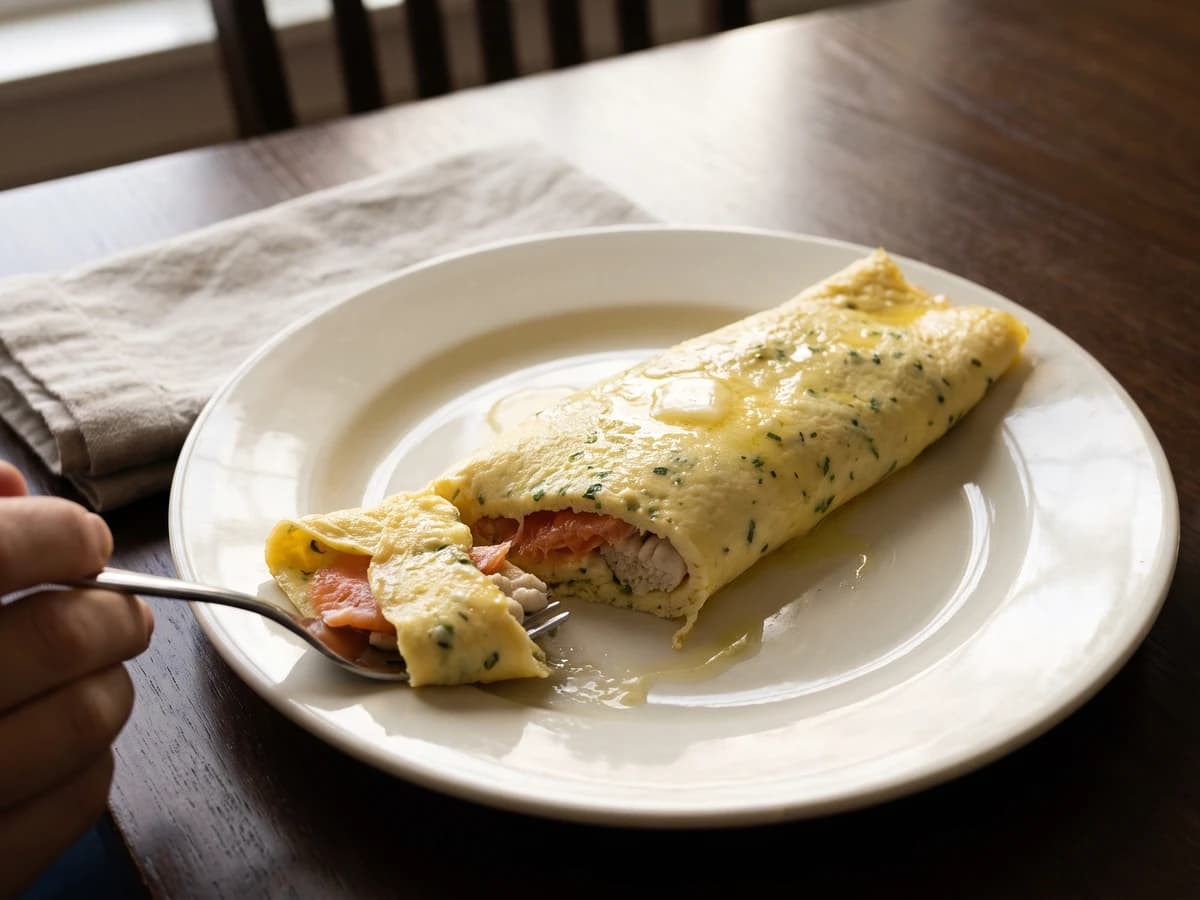
Omelette à l’Écossaise
A creamy omelette aux fines herbes closes around smoked-salmon-wrapped herring milts, gently poached in butter. Have the filling ready, then roll the eggs while they still shine.
A cooking platform built around craft, culture, and the stories behind what we eat.
Created by Chef Juliette
Based on No. 538, Cold Eggs, Rubens, from Le Guide Culinaire (1907) by Auguste Escoffier
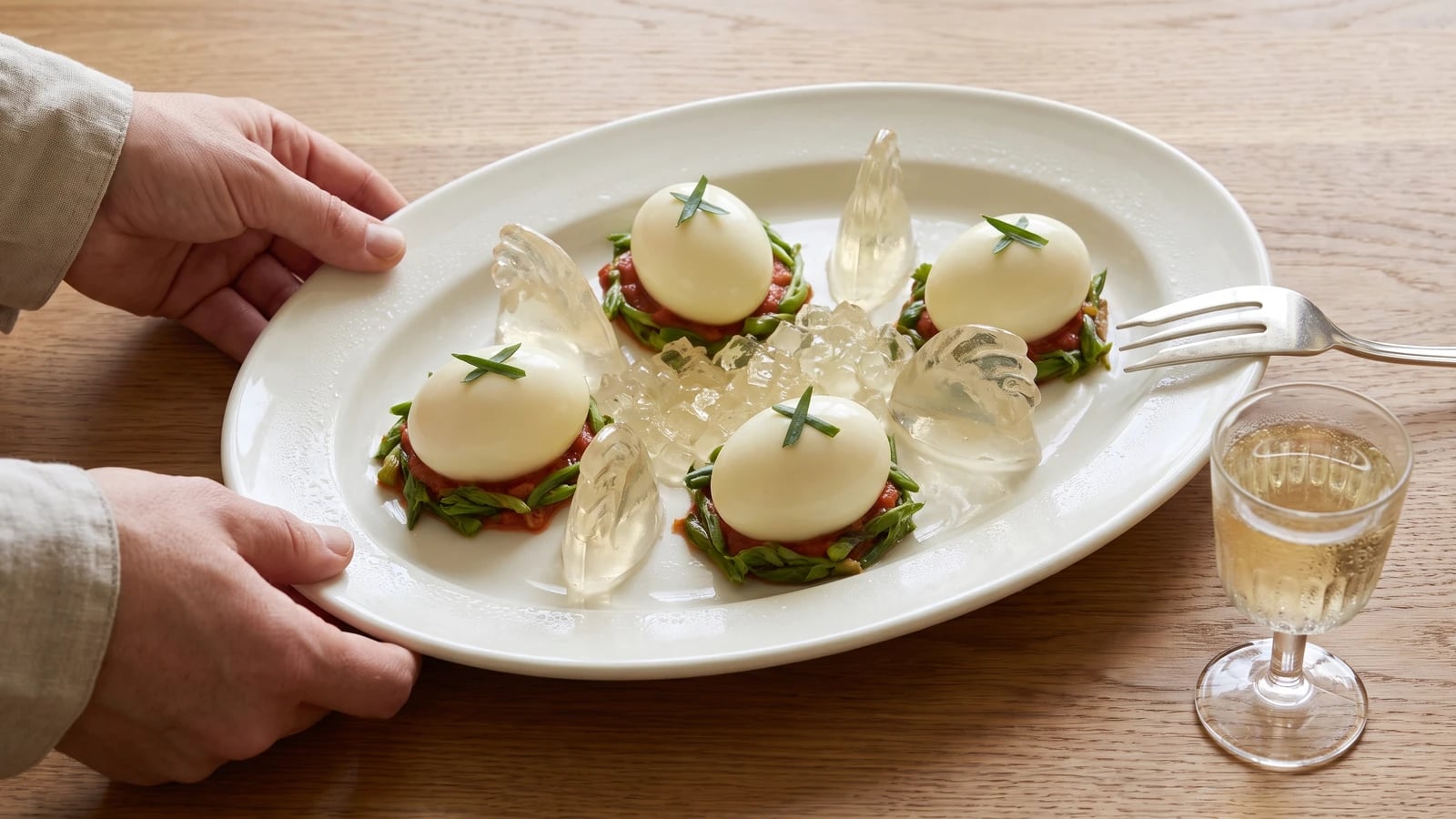
Cold poached eggs under ivory tarragon chaud-froid, perched on tart tomato-bound hop shoots and circled with clear aspic cockscombs: a grand cold entrée translated faithfully for four.
Œufs froids Rubens (cold eggs Rubens) teaches the first law of cold saucing: every element must be fully chilled and absolutely dry before it is coated. A warm egg thins the sauce, a wet egg sends it sliding onto the tray, and neither fault is a tragedy if you catch it. Cold gives the structure; dryness gives the grip.
The original entry assumed a saucier with sauce chaud-froid blanche (white chaud-froid sauce) ready, stock never off the fire, clear jelly waiting at the garde-manger, and a drawer containing the proper metal moulds and cockscomb cutter. A salamander has no work in this cold entrée. At home, one measured pan of light stock becomes the sauce, the binding jelly, the glaze, and the decoration; a shallow tray and a paper template replace the specialist cutter. Those tools and brigade quantities are scaffolding, so they can go. The poached eggs, real hop shoots, tomato-bound mouldings, chaud-froid, tarragon, and clear aspic are the dish, so they stay. One cook, one stove, one evening.
Finished properly, the platter is generous and almost jewel-like: ivory eggs flecked with tarragon, green hop shoots held by red tomato, and clear aspic catching the light between them. Before you coat a single egg, chill it and dry it until the towel comes away clean. That is the step that decides the whole arrangement.
Œufs froids Rubens belongs to the Parisian grand-kitchen repertoire of composed cold entrées, where the garde-manger arranged poached eggs, chaud-froid, vegetable mouldings, and aspic for the formal table. Rubens is a named garnish rather than a regional egg preparation, and the cockscombs are clear jelly cut into silhouette, not poultry offal. Moving the dish from a grand buffet to a home table changes its scale and tools, but not its defining order: mould, coat, glaze, and arrange.
Quantity
3¼ cups (780 ml / 780 g)
divided
Quantity
1 tablespoon plus 2 teaspoons (25 ml / 15 g)
Quantity
1½ teaspoons (7.5 ml / 9 g)
divided
Quantity
1½ cups (350 ml / 300 g)
crushed
Quantity
4 loosely packed cups (950 ml / 200 g)
washed and trimmed
Quantity
1 tablespoon (15 ml / 4 g)
finely chopped
Quantity
1 tablespoon (15 ml / 3 g)
finely chopped
Quantity
¼ teaspoon (1.25 ml / 0.6 g)
Quantity
1 teaspoon (5 ml / 4 g)
for the moulds
Quantity
4
Quantity
2 tablespoons (30 ml / 30 g)
Quantity
1½ tablespoons (22.5 ml / 21 g)
Quantity
2 tablespoons (30 ml / 16 g)
Quantity
½ cup (120 ml / 120 g)
Quantity
1/16 teaspoon (0.3 ml / 0.15 g)
Quantity
12 small leaves
cut into neat pieces
| Ingredient | Quantity |
|---|---|
| clear, unsalted light chicken stockdivided | 3¼ cups (780 ml / 780 g) |
| unflavoured powdered gelatin | 1 tablespoon plus 2 teaspoons (25 ml / 15 g) |
| fine sea saltdivided | 1½ teaspoons (7.5 ml / 9 g) |
| drained canned whole peeled tomatoescrushed | 1½ cups (350 ml / 300 g) |
| tender young hop shootswashed and trimmed | 4 loosely packed cups (950 ml / 200 g) |
| flat-leaf parsleyfinely chopped | 1 tablespoon (15 ml / 4 g) |
| chervilfinely chopped | 1 tablespoon (15 ml / 3 g) |
| freshly ground black pepper | ¼ teaspoon (1.25 ml / 0.6 g) |
| neutral oilfor the moulds | 1 teaspoon (5 ml / 4 g) |
| very fresh large eggs | 4 |
| distilled white vinegar | 2 tablespoons (30 ml / 30 g) |
| unsalted butter | 1½ tablespoons (22.5 ml / 21 g) |
| plain flour | 2 tablespoons (30 ml / 16 g) |
| heavy cream | ½ cup (120 ml / 120 g) |
| ground white pepper | 1/16 teaspoon (0.3 ml / 0.15 g) |
| fresh tarragon leavescut into neat pieces | 12 small leaves |
Reserve ¾ cup (180 ml) of the stock for the chaud-froid. Put ½ cup (120 ml) of the remaining stock in a bowl, sprinkle the gelatin evenly over it, and leave it for 5 minutes to bloom. Warm the final 2 cups (480 ml) of stock just below a simmer with a small pinch of salt, then remove it from the heat and stir in the bloomed gelatin until completely dissolved. Do not boil gelatin or its setting power weakens. Skim away any foam and pass the liquid through a damp fine cloth if it looks cloudy. Pour 1¼ cups (300 ml) into a shallow 8-inch (20 cm) tray, making a layer about ¼ inch (6 mm) deep, and chill until firm. Reserve the remaining aspic for the moulds, sauce, and glaze; if it sets, melt it gently over warm water.
Put the crushed tomatoes in a small saucepan with a pinch of salt. Cook them plainly over medium-low heat for 15 to 20 minutes, stirring often, until the watery juices have evaporated and the tomatoes taste rounded rather than raw. Pass them through a fine sieve and return the purée to the pan if it is looser than thick cream. You need about ½ cup (120 ml / 125 g). Chill it completely. No onion, garlic, or extra herbs belong here; the source asks for tomato, and tomato is what it should taste of.
Cook the hop shoots in generously salted simmering water until tender but still intact, usually 3 to 5 minutes depending on their thickness. Taste one at the stem before draining; young shoots should be pleasantly vegetal, not fibrous. Cool them at once in iced water, drain, and press them very dry between clean towels. Season with the black pepper and enough of the remaining salt to wake them up, then fold in the parsley, chervil, cold tomato purée, and 3 tablespoons (45 ml) of liquid aspic. Add the final tablespoon (15 ml) only if the mixture will not hold when pressed. Brush four shallow tartlet moulds with the neutral oil, divide the mixture among them, and press firmly so no hollow pockets remain. Chill for at least 2 hours.
Bring a wide pan of water and the vinegar to a bare tremble, 180 to 185°F (82 to 85°C). Crack each egg into a cup, slip it close to the surface, and poach for 3½ to 4 minutes, until the white is fully set and the yolk remains soft. Work in two batches if the pan is crowded. Lift each egg into iced water, then trim away ragged white with a small knife. Keep the eggs submerged in fresh cold water until needed. Very fresh eggs hold a neat oval; if a white spreads in the pan, gather it gently around the yolk with the slotted spoon rather than stirring the water.
Melt the butter in a small saucepan, add the flour, and stir over low heat for 2 minutes without allowing the roux to colour. Gradually whisk in the reserved ¾ cup (180 ml) stock, then simmer gently for 5 minutes until smooth and able to nap the back of a spoon. Add the cream and white pepper, simmer for another 3 to 4 minutes, and season carefully with salt. Strain into a bowl and stir as it cools. When the sauce reaches 86 to 90°F (30 to 32°C), whisk in 5 tablespoons (75 ml) of liquid aspic. The chaud-froid must be cool enough to cling yet fluid enough to pour. If it runs from the spoon like milk, set the bowl over ice and stir until it thickens; if it sets in lumps, warm it gently over water and strain it again. Ça se rattrape.
Drain the cold poached eggs, blot them thoroughly, and leave them on a clean towel for 5 minutes so the surface loses every trace of water. Set them on a rack over a tray and spoon the chaud-froid over each one from the crown, letting it fall into an even ivory coat. Chill for 10 minutes, then cover any thin or bare patches with a second spoonful. While the coating is still slightly tacky, arrange three small pieces of tarragon leaf on each egg. A wet egg rejects the sauce and a warm one melts it; cold and dry is the whole principle.
Melt 6 tablespoons (90 ml) of the reserved aspic and cool it until it feels cold but remains fluid and slightly syrupy. Spoon a very thin coat over each decorated egg, enough to seal the tarragon and give the surface a clear gloss. Chill until set, about 20 minutes. If the aspic begins setting before it reaches the eggs, warm it by a degree or two over water; if it is warm enough to soften the chaud-froid, wait and stir. Patience, not force.
Loosen each hop-shoot moulding with the tip of a small knife, warm the outside of the mould for a few seconds under a hot towel, and invert it onto a chilled oval platter. Set the mouldings in a circle and place one glazed egg on each. Cut four cockscomb silhouettes from the firm tray of aspic with a small paper template and a sharp paring knife, then stand one between each egg. Chop the remaining aspic into small, irregular crystals and mound them in the centre. Keep the platter cold until serving. À table!
1 serving (about 380g)
Culinary guides, cultural storytelling, and the editorial depth that makes cooking meaningful.
Discover Culinary ExplorerChef Juliette
A creamy omelette aux fines herbes closes around smoked-salmon-wrapped herring milts, gently poached in butter. Have the filling ready, then roll the eggs while they still shine.
Chef Juliette
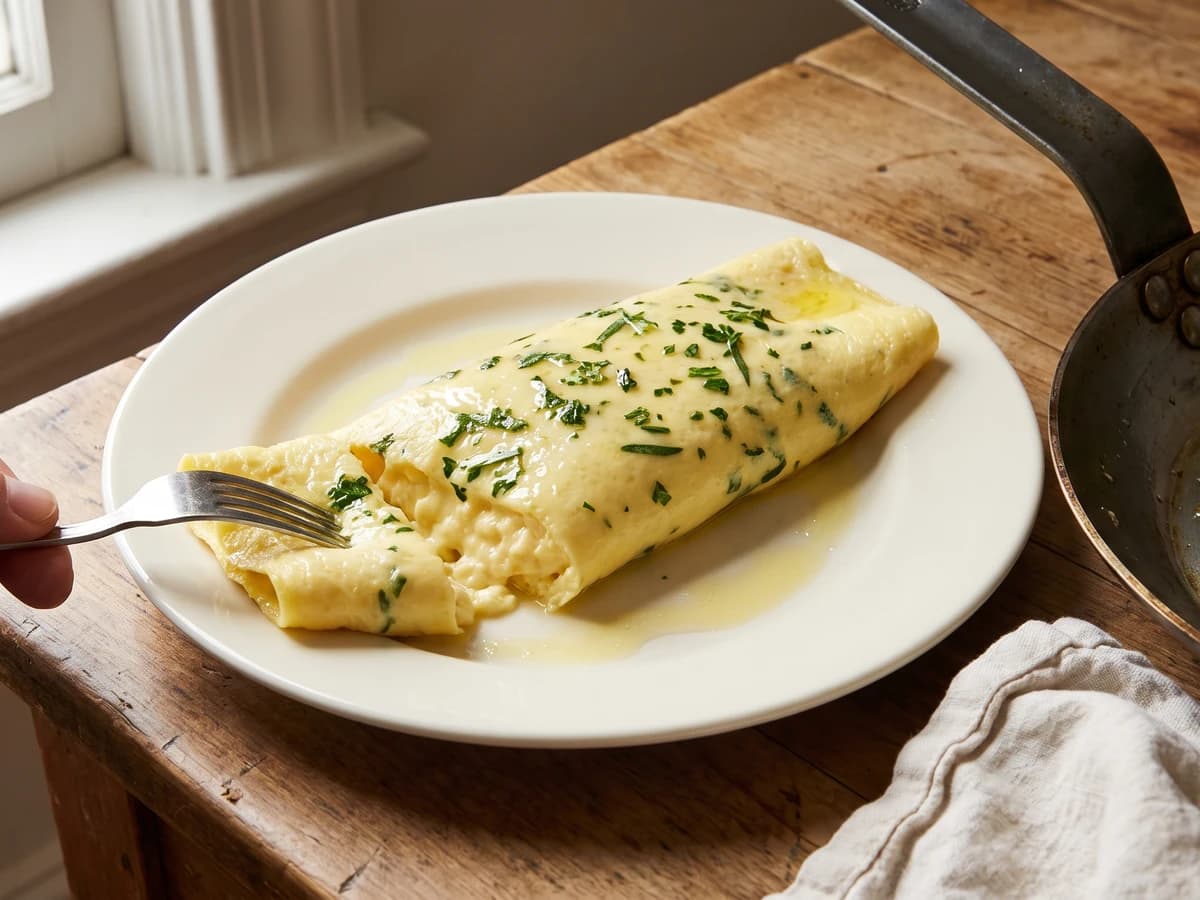
Four tender herbs, hot butter, and two eggs per pan: this rolled omelette teaches the quick hand and good judgment that keep the outside pale and the center creamy.
Chef Juliette
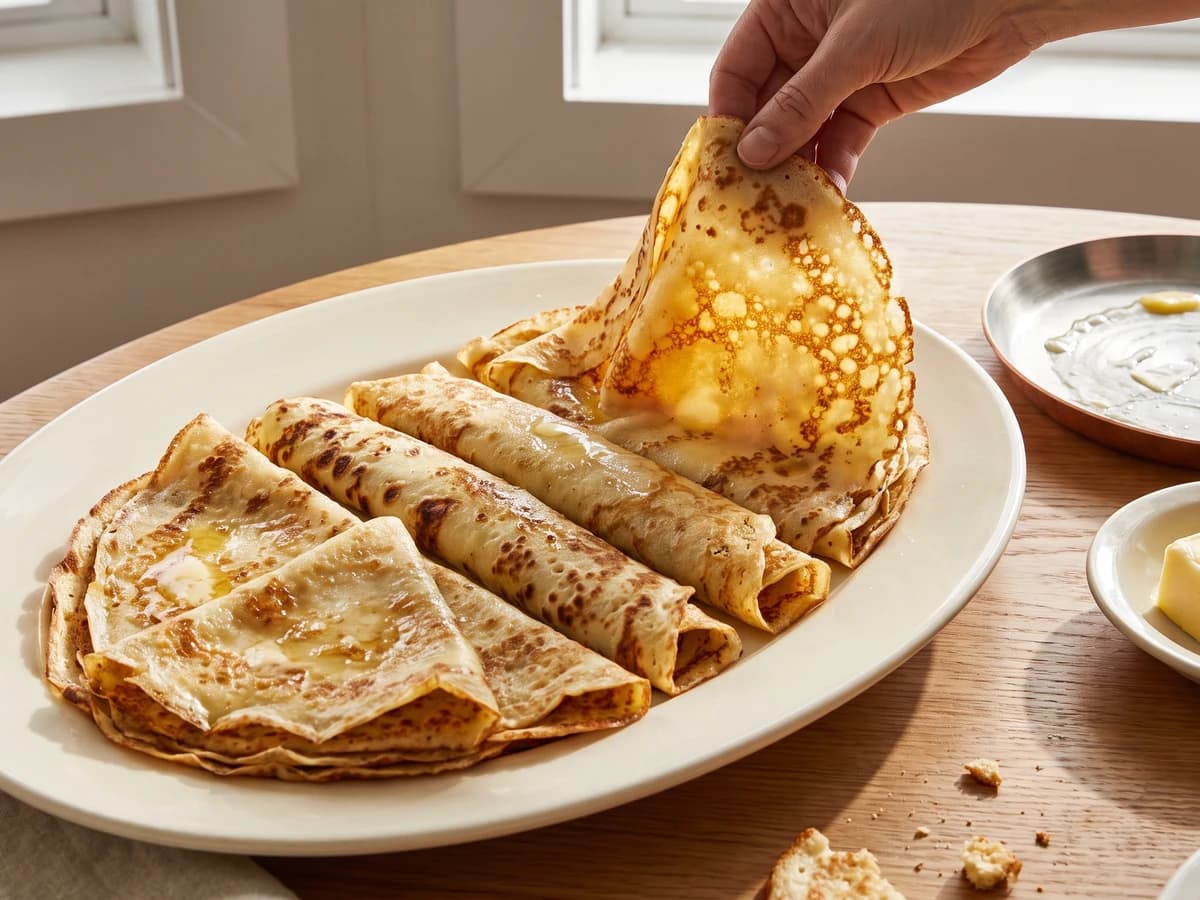
Four batters, one lesson: let the flour drink deeply before cooking, then spread the batter thinly in butter for crêpes and pannequets that bend without becoming tough.
Chef Juliette
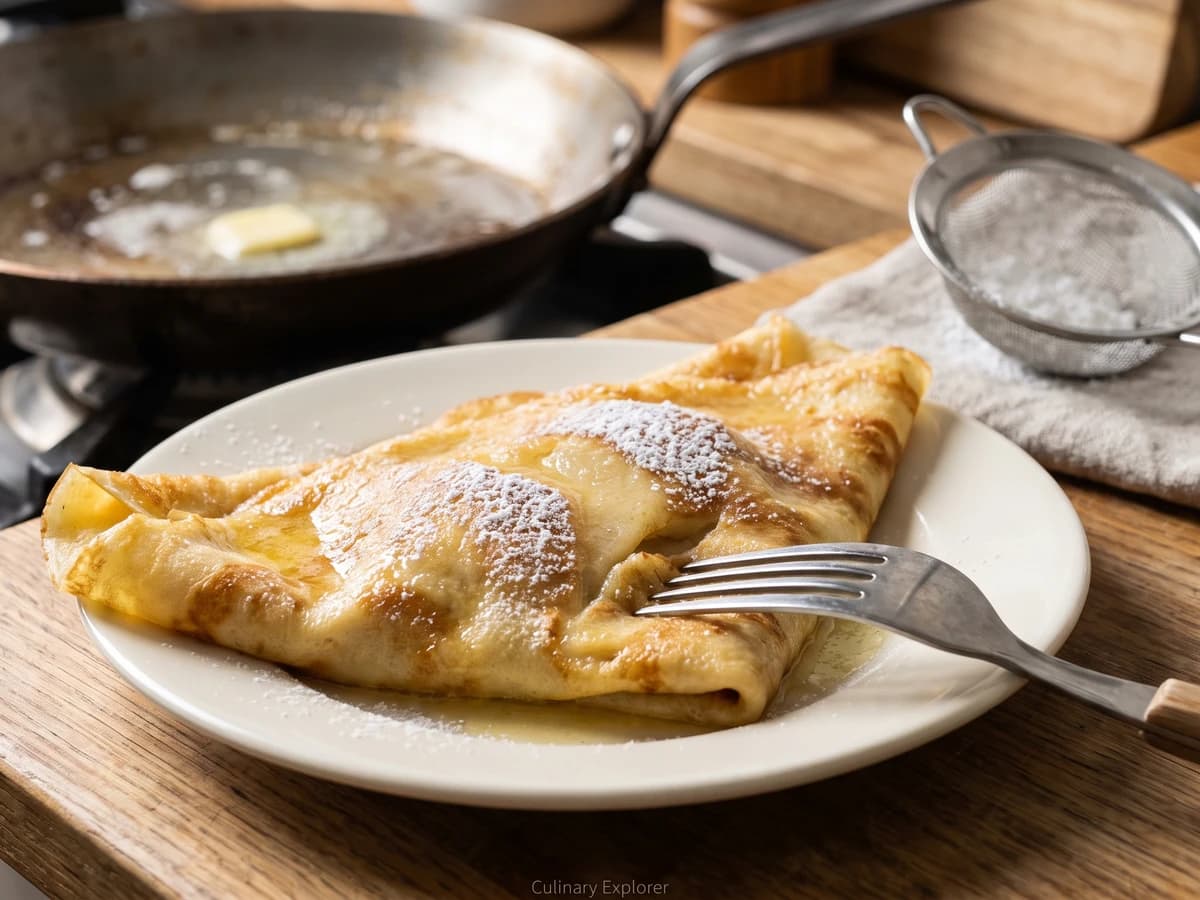
Crêpes au Couvent trap ripe Williams pear dice between two thin pours of sweet batter, then turn in one clean toss and reach the table butter-gold, powdered, and burning hot.