Chef Juliette
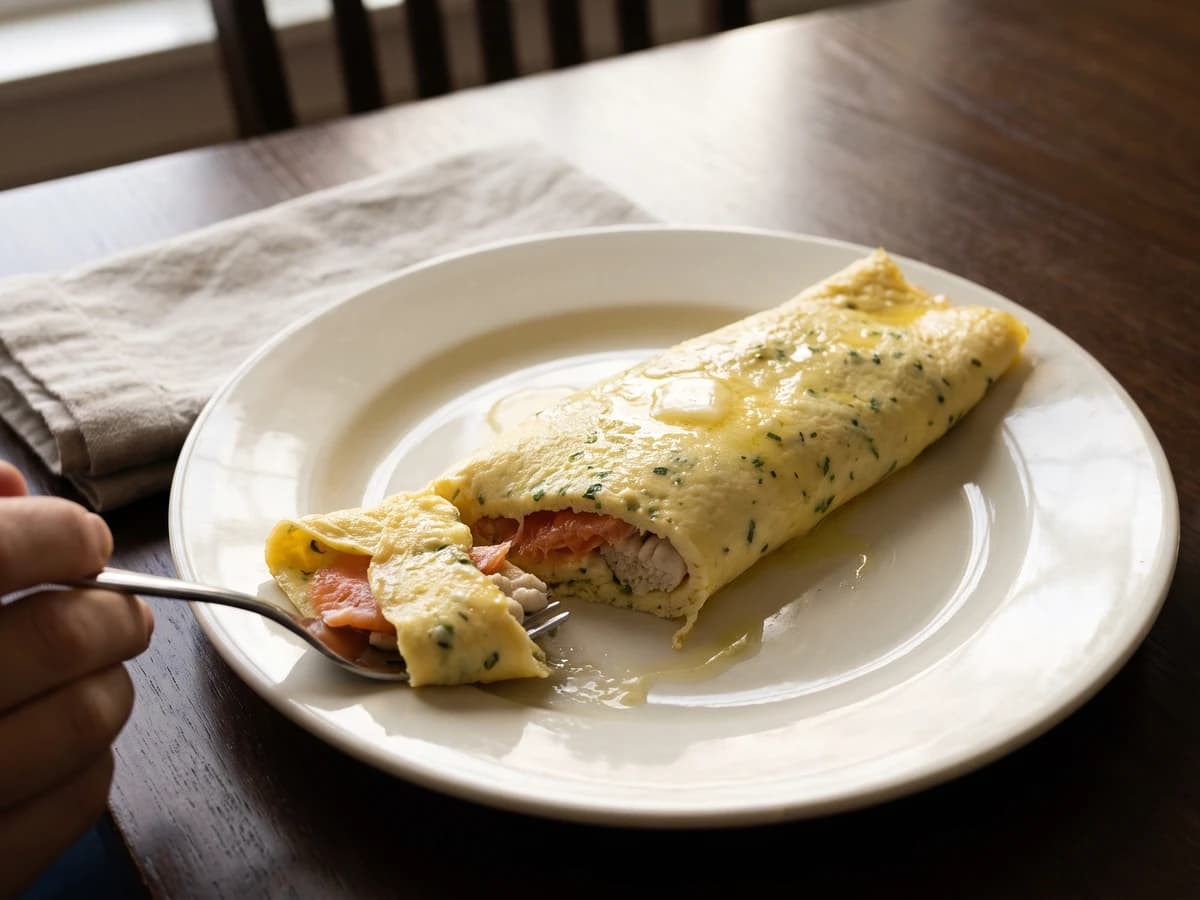
Omelette à l’Écossaise
A creamy omelette aux fines herbes closes around smoked-salmon-wrapped herring milts, gently poached in butter. Have the filling ready, then roll the eggs while they still shine.
A cooking platform built around craft, culture, and the stories behind what we eat.
Created by Chef Juliette
Based on No. 533, Cold Eggs, Frou-frou, from Le Guide Culinaire (1907) by Auguste Escoffier
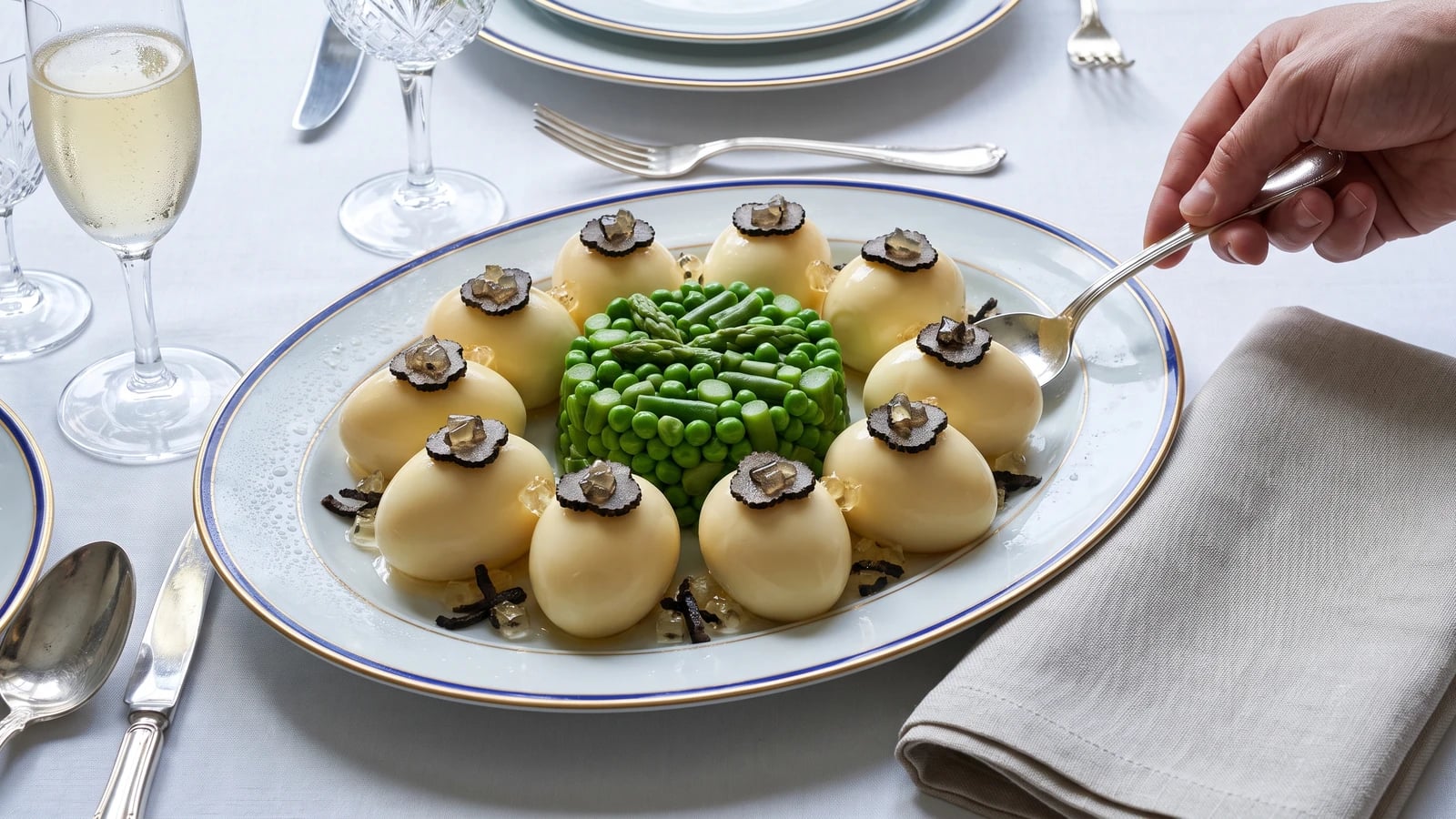
Small poached eggs wear a yolk-enriched chaud-froid, black truffle and clear aspic, then circle a chilled mould of peas, beans and asparagus: the grand cold table, translated faithfully for four.
Œufs froids Frou-frou (cold eggs dressed in yolk-rich chaud-froid) teaches the discipline of temperature. Chaud-froid is a sauce applied warm and served cold, and the one true thing to know before touching a pan is this: the eggs must be cold and absolutely dry, while the sauce and aspic must be cool enough to cling but still fluid. Decoration cannot rescue a coating that slides away.
The original assumed a saucier, a pale stock never off the fire, clear jelly ready in the garde-manger, equal little eggs chosen from a brigade-sized supply, and an ice bed for setting them. The home equivalent is a well-skimmed chicken stock reinforced with measured gelatin, a refrigerator, and a wire rack over a tray. Only the scale and equipment change: eight small eggs and one vegetable mould serve four. Clarifying a stockpot and tending an ice bed are brigade scaffolding; the one-third measure of sieved yolk, the black truffle, the clear glaze, and the moulded salad are the dish and must stay.
Frou-frou should arrive cool and gleaming, its ivory-gold eggs marked by black truffle rings and gathered around a bright green centre. It looks elaborate because the work is layered, not because any single task is beyond you. One cook, one stove, one evening, with the refrigerator doing the waiting. The decisive step is judging the chaud-froid on a chilled spoon before it touches the first egg.
Œufs froids Frou-frou belongs to the Parisian grand-kitchen cold table, where the garde-manger turned poached eggs, aspic and truffle into named compositions for suppers and buffets. The name is a wink: frou-frou evokes the rustle and ornamental fuss of fine dress, echoed here by indented truffle rings and jewel-cut jelly. From grand dining rooms the dish passed naturally into bourgeois dinner-party cooking, since every component can be prepared ahead and revealed cold at serving.
Quantity
3 cups (720 ml / 720 g)
cold and well skimmed
Quantity
1 tablespoon plus 1 teaspoon (20 ml / 12 g)
Quantity
as needed
Quantity
8
preferably pasteurized
Quantity
2 tablespoons (30 ml / 30 g)
Quantity
4
Quantity
2 tablespoons (30 ml / 28 g)
Quantity
3 tablespoons (45 ml / 24 g)
Quantity
1/2 cup (120 ml / 120 g)
Quantity
as needed
Quantity
1 small truffle (about 1 oz / 25 g)
fresh or good preserved, drained
Quantity
3/4 cup (180 ml / 100 g)
fresh or frozen
Quantity
3/4 cup (180 ml / 90 g)
cut into small dice or lozenges
Quantity
3/4 cup (180 ml / 100 g)
Quantity
1 large yolk
Quantity
1 teaspoon (5 ml / 5 g)
Quantity
1 teaspoon (5 ml / 5 g)
Quantity
1/4 cup (60 ml / 55 g)
Quantity
1 teaspoon (5 ml / 5 g)
| Ingredient | Quantity |
|---|---|
| pale low-sodium chicken stockcold and well skimmed | 3 cups (720 ml / 720 g) |
| powdered gelatin | 1 tablespoon plus 1 teaspoon (20 ml / 12 g) |
| fine salt | as needed |
| very fresh small chicken eggs of equal sizepreferably pasteurized | 8 |
| white wine vinegar for poaching | 2 tablespoons (30 ml / 30 g) |
| large eggs for the hard-cooked yolk purée | 4 |
| unsalted butter | 2 tablespoons (30 ml / 28 g) |
| all-purpose flour | 3 tablespoons (45 ml / 24 g) |
| heavy cream | 1/2 cup (120 ml / 120 g) |
| ground white pepper | as needed |
| very black whole trufflefresh or good preserved, drained | 1 small truffle (about 1 oz / 25 g) |
| shelled peasfresh or frozen | 3/4 cup (180 ml / 100 g) |
| haricots vertscut into small dice or lozenges | 3/4 cup (180 ml / 90 g) |
| asparagus tips | 3/4 cup (180 ml / 100 g) |
| pasteurized egg yolk for mayonnaise | 1 large yolk |
| Dijon mustard | 1 teaspoon (5 ml / 5 g) |
| white wine vinegar for mayonnaise | 1 teaspoon (5 ml / 5 g) |
| neutral oil for mayonnaise | 1/4 cup (60 ml / 55 g) |
| neutral oil for the mould | 1 teaspoon (5 ml / 5 g) |
Pass the chicken stock through a dampened coffee filter or several layers of damp cheesecloth if it carries any cloudy sediment. Reserve 3/4 cup (180 ml) of the stock for the chaud-froid. Sprinkle the gelatin over 1/2 cup (120 ml) of the remaining cold stock and leave it for 5 minutes, until every grain has swollen. Warm the rest of the stock just below a simmer, remove it from the heat, and stir in the bloomed gelatin until completely dissolved. Season lightly with salt, remembering that cold dulls seasoning. Pour 1 1/4 cups (300 ml) into a shallow pan for the chopped jelly and dice; put the remaining 1 cup (240 ml) in a heatproof container for the sauce, salad and glaze. Chill both until firm, about 4 hours.
Bring a wide saucepan holding 2 inches of water to the barest simmer and add the poaching vinegar. Crack each small egg into its own cup. Slip in four at a time and poach without boiling for 2 1/2 to 3 minutes, until the whites are set around still-tender yolks. Lift them into ice water with a slotted spoon, then trim ragged white fringes with small scissors so all eight eggs form neat, equal ovals. Transfer them to fresh cold water, cover, and refrigerate. Hard-cook the other four eggs for 10 minutes, chill and peel them, then remove the yolks. Press the yolks through a fine sieve and measure a lightly packed 1/3 cup (80 ml / about 70 g).
Bring a saucepan of well-salted water to a lively boil. Blanch the haricots verts until tender but still shapely, about 3 minutes, then lift them into ice water. Cook the asparagus tips for about 2 minutes and the peas for 1 minute, chilling each as soon as it is ready. Drain everything thoroughly and spread the vegetables on a clean towel. Water left clinging to them weakens the mayonnaise and prevents a clean set, so let them become properly dry before mixing.
Whisk the pasteurized yolk with the Dijon mustard, mayonnaise vinegar and a pinch of salt. Add the neutral oil first drop by drop, then in a fine thread, whisking until the mayonnaise stands in soft peaks. If it splits, place 1 teaspoon of cold water in a clean bowl and whisk the broken mayonnaise into it a teaspoon at a time until smooth again. Measure 1/4 cup (60 ml / 60 g) of mayonnaise. Gently melt 1/4 cup (60 ml) of the aspic and cool it until fluid but no longer warm, then whisk it gradually into the measured mayonnaise. Fold this binder through the dry vegetables. Brush a 3-cup (700 ml) smooth mould very lightly with oil, pack in the salad without crushing the asparagus tips, cover, and chill for at least 4 hours.
Melt the butter gently without coloring it, add the flour, and stir for 2 minutes to make a roux blanc, a white roux cooked without browning. Whisk in the reserved 3/4 cup (180 ml) chicken stock a little at a time, then add the cream. Simmer gently for 8 to 10 minutes, stirring, until the raw flour taste is gone. Pass the sauce through a fine sieve, return it to the pan, and reduce it to exactly 3/4 cup (180 ml). Melt 1/4 cup (60 ml) aspic and stir it in, giving you 1 cup (240 ml) white chaud-froid sauce. Cool it until barely lukewarm, then whisk in the measured 1/3 cup sieved yolk, preserving the source formula's one-third proportion. Season with salt and white pepper. Test it on a chilled spoon: it should cloak the metal smoothly. If it runs, stir the bowl over ice; if it drags into ridges, loosen it with melted aspic one teaspoon at a time. Ça se rattrape.
Drain the poached eggs and dry them very carefully on a smooth towel. Set them on a wire rack over a chilled tray, rounded side up. Spoon the yolk chaud-froid over each egg in one generous, even coat, making certain no white shows through, then refrigerate for 10 minutes. Slice the truffle paper-thin. Cut eight rings with two round piping tips, one nested inside the other, then make six shallow notches around each outer edge with a sharp paring knife to reproduce the original indented ring without a specialized cutter. Place one ring on each egg while the coating remains faintly tacky. Chop the truffle trimmings finely and press a narrow ribbon around the base of every egg.
Melt the remaining aspic reserved for glazing and let it cool until it is clear, fluid and beginning to gain body. Spoon or brush a thin coat over each decorated egg, covering both the chaud-froid and truffle. If the yellow coating begins to soften, the aspic is too warm. Stop, return the eggs to the refrigerator until firm, and cool the aspic before continuing. Chill the glazed eggs until completely set.
Cut half the aspic from the shallow pan into clear 1/4-inch dice and chop the other half more finely. Dip the vegetable mould in warm water for 3 to 5 seconds, dry its outside, and invert it onto the centre of a chilled platter. If it clings, wrap the mould briefly in a warm towel rather than soaking it and melting the binder. Place a line of chopped aspic around the mould's base. Encircle it with the eight eggs, resting them on the chopped jelly, then finish the outside of the platter with a border of clear aspic dice. Keep the platter cold until serving. À table!
1 serving (about 400g)
Culinary guides, cultural storytelling, and the editorial depth that makes cooking meaningful.
Discover Culinary ExplorerChef Juliette
A creamy omelette aux fines herbes closes around smoked-salmon-wrapped herring milts, gently poached in butter. Have the filling ready, then roll the eggs while they still shine.
Chef Juliette
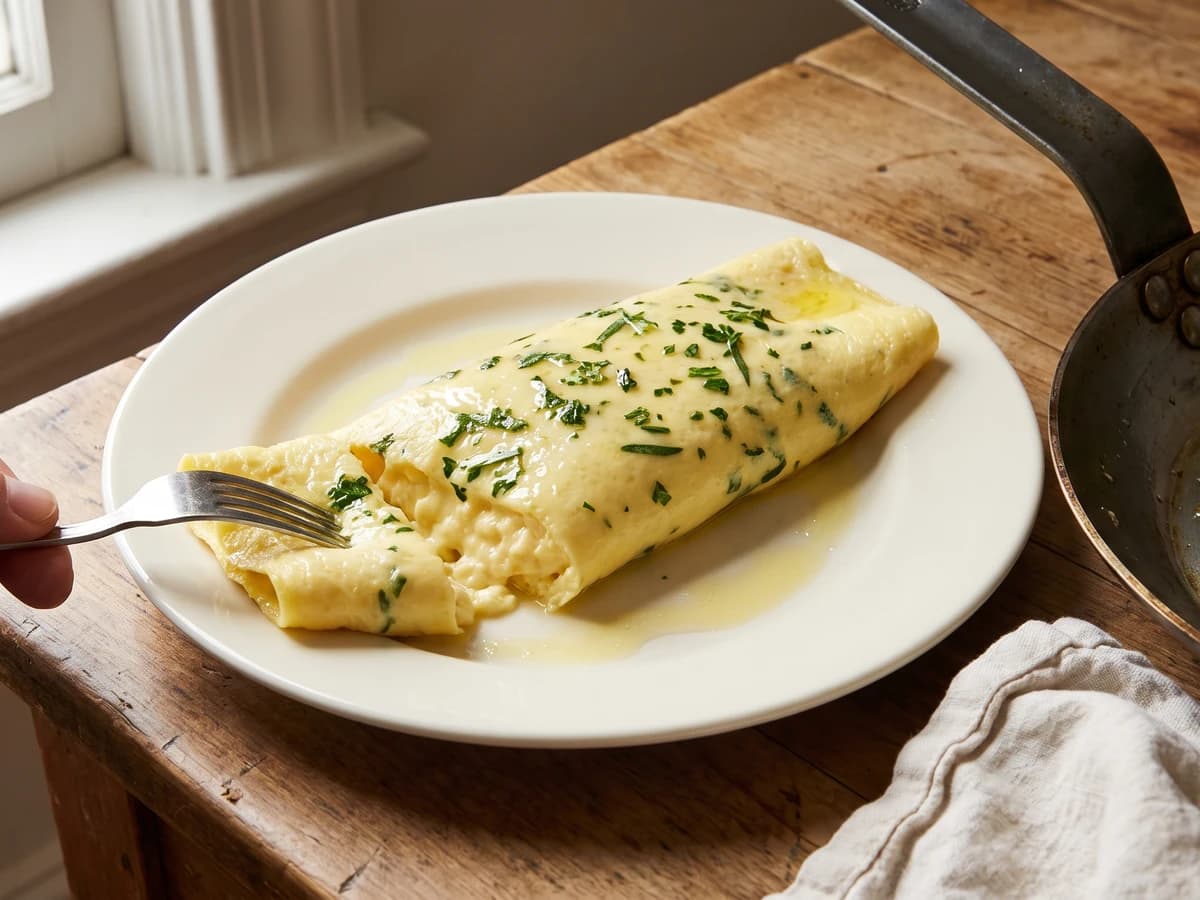
Four tender herbs, hot butter, and two eggs per pan: this rolled omelette teaches the quick hand and good judgment that keep the outside pale and the center creamy.
Chef Juliette
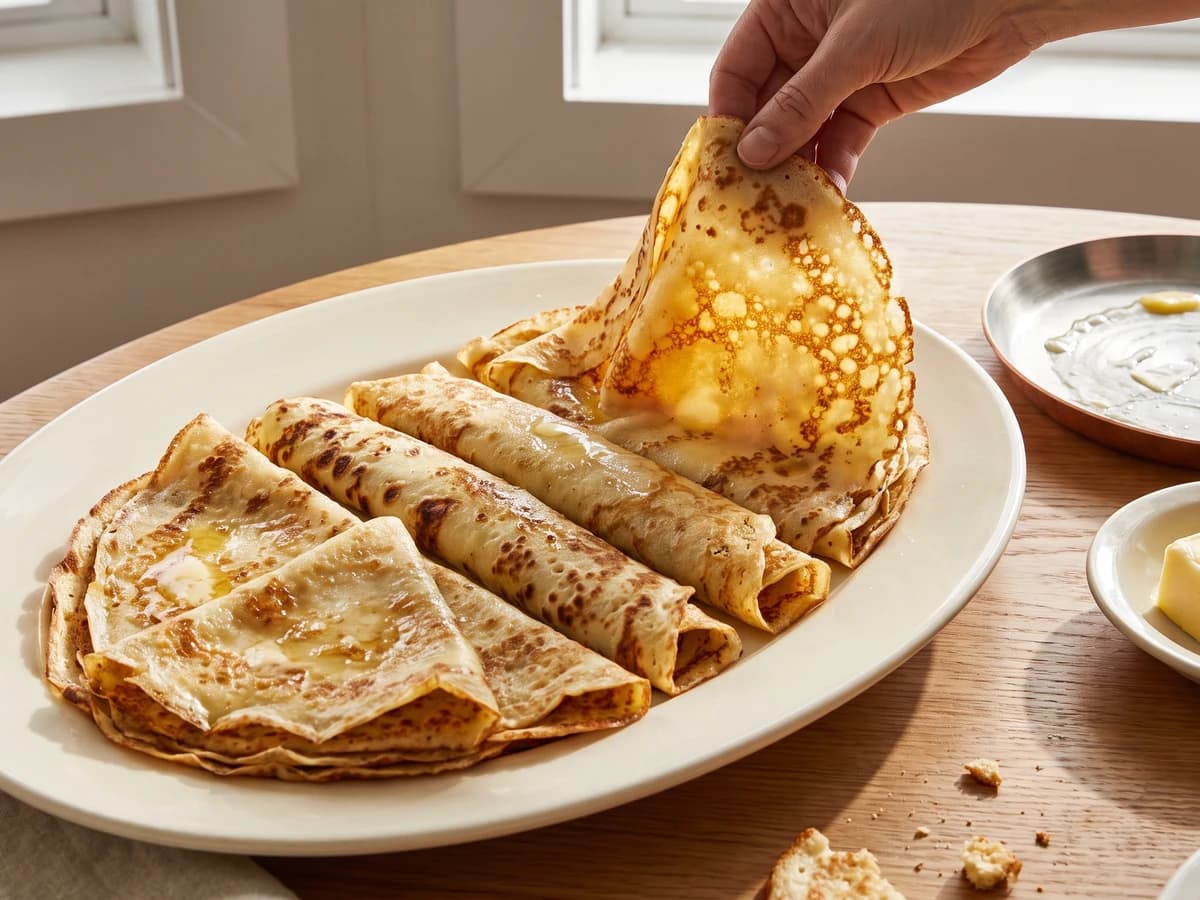
Four batters, one lesson: let the flour drink deeply before cooking, then spread the batter thinly in butter for crêpes and pannequets that bend without becoming tough.
Chef Juliette
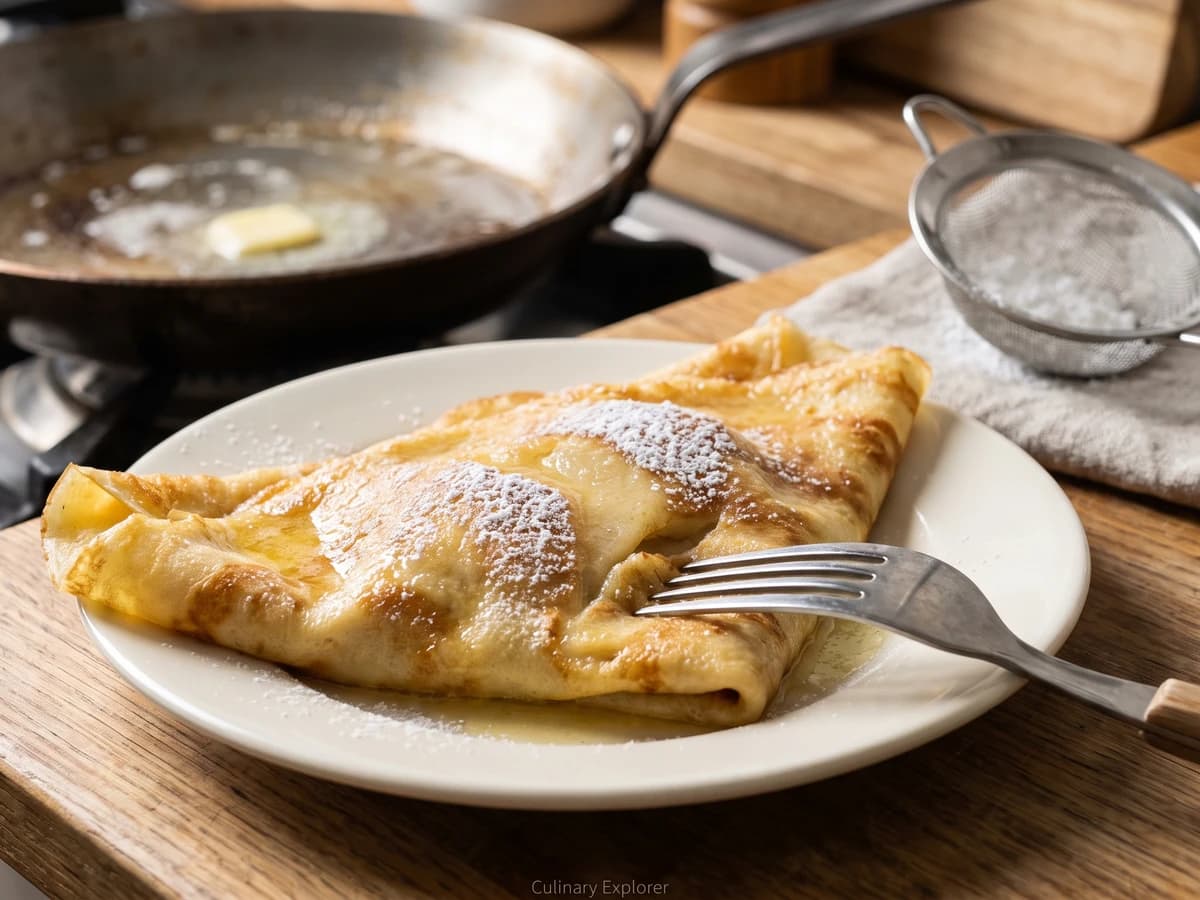
Crêpes au Couvent trap ripe Williams pear dice between two thin pours of sweet batter, then turn in one clean toss and reach the table butter-gold, powdered, and burning hot.