Chef Juliette
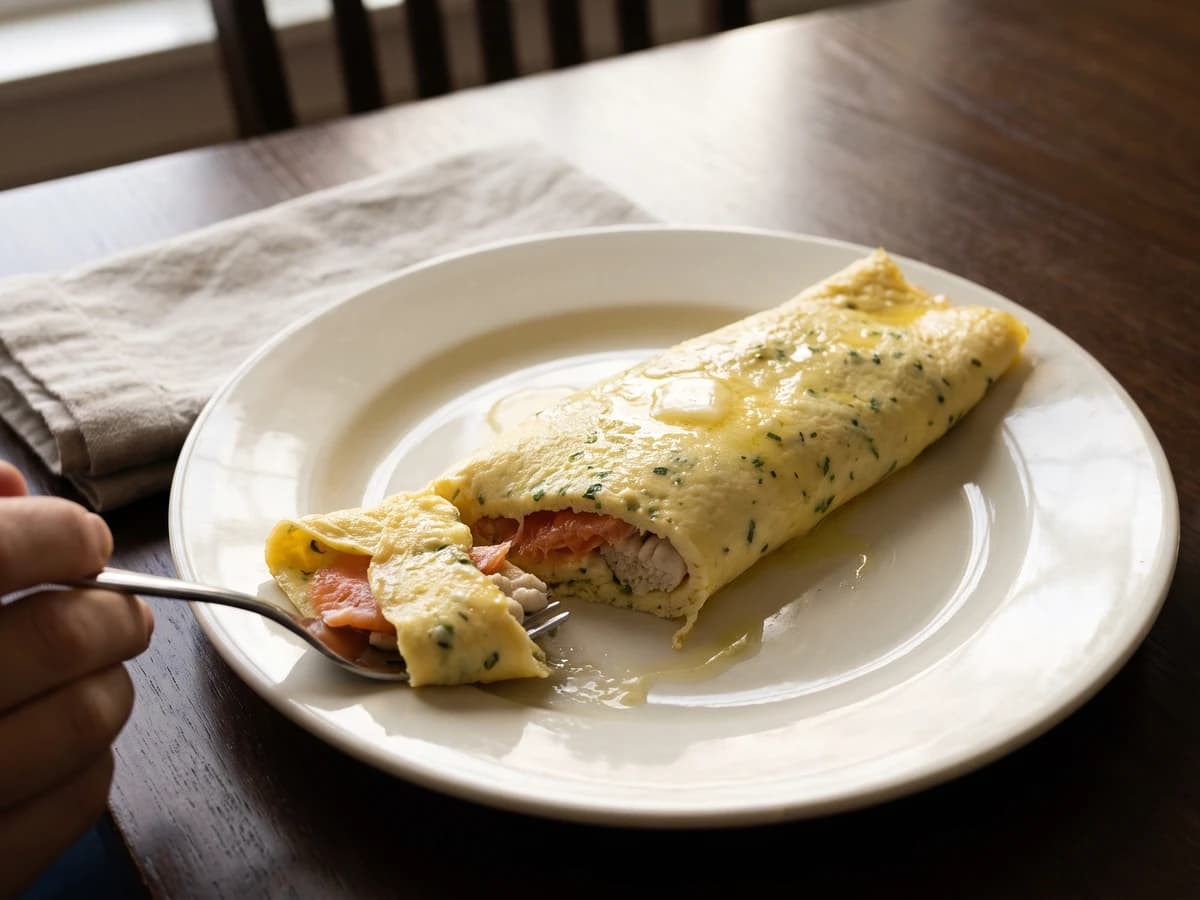
Omelette à l’Écossaise
A creamy omelette aux fines herbes closes around smoked-salmon-wrapped herring milts, gently poached in butter. Have the filling ready, then roll the eggs while they still shine.
A cooking platform built around craft, culture, and the stories behind what we eat.
Created by Chef Juliette
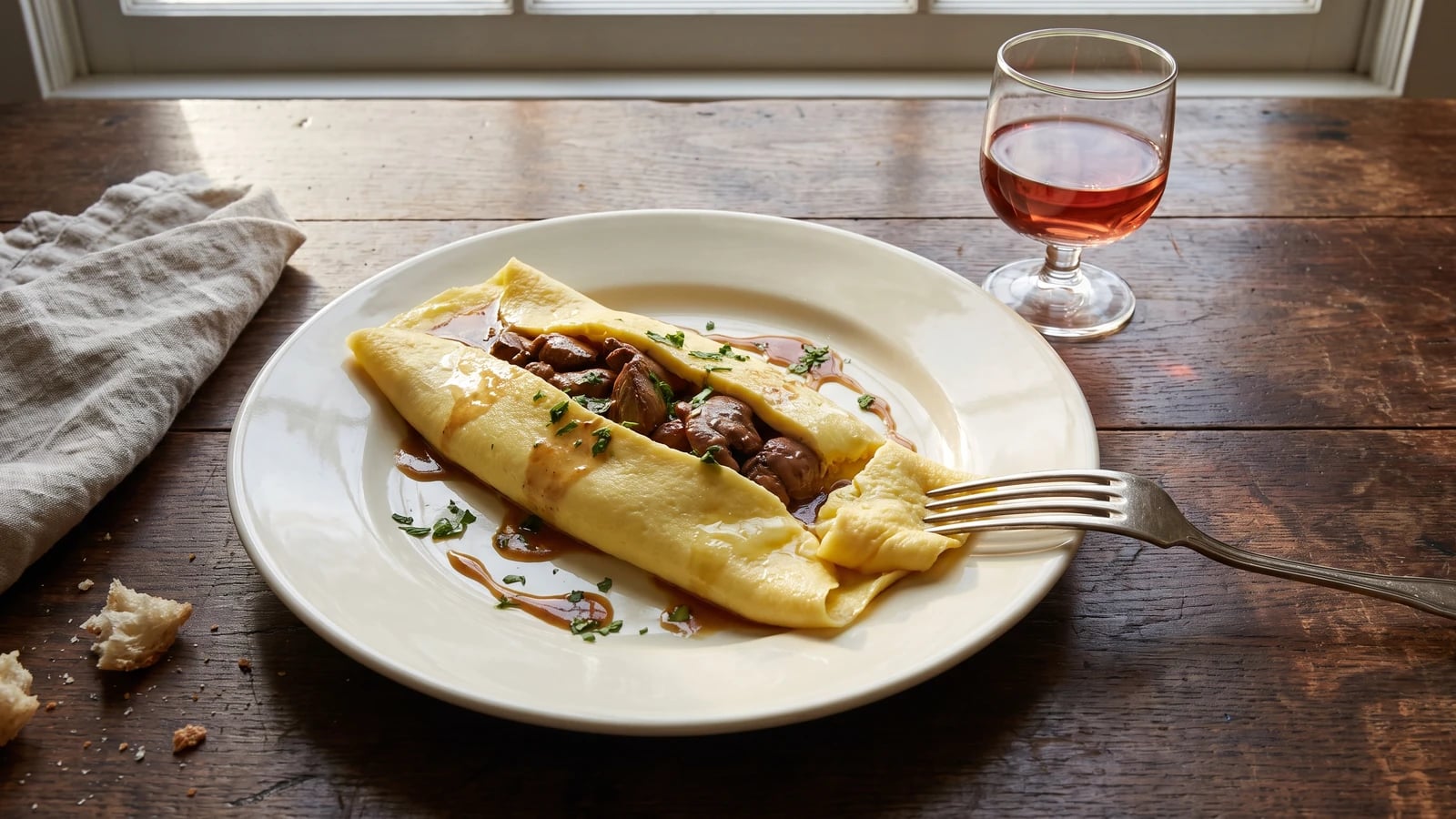
Based on No. 504, Omelet with Chicken’s Liver, from Le Guide Culinaire (1907) by Auguste Escoffier
Tender French omelets folded around chicken livers sautéed in butter and bound with half-glaze, then split and filled once more: a compact lesson in timing, fond, and generous classical garnish.
Omelette aux foies de volaille (omelet with chicken livers) teaches the first law of a filled omelet: the filling waits for the eggs, never the eggs for the filling. Chicken livers must be browned, bound with half-glaze, portioned, and kept warm before the first egg meets the pan. Then the omelet stays tender while the garnish remains glossy and distinct.
The original formula assumed a saucier nearby and brown stock never off the fire, so half-glaze could be ladled out without ceremony. Your honest equivalent is a small measure of properly prepared demi-glace, already finished and warmed in a saucepan. Making that entire sauce system during omelet service was brigade scaffolding, and it can go. What stays is the dish itself: two tablespoonfuls of liver folded inside each omelet, one spooned into the opening, and a fine thread of half-glaze around the plate. Four individual three-egg omelets preserve those proportions for one cook, one stove, one evening.
The finished omelette should be butter-gold and tender, with chestnut-brown liver appearing through the slit and dark sauce gleaming around it. The one step that decides everything is your mise en place: filling ready, plates warm, and eggs beaten only when the pan is waiting.
Omelette aux foies de volaille belongs to Parisian cuisine bourgeoise and the classical omelet repertoire, where a plain envelope of eggs became a complete supper through a carefully prepared garnish. Poultry livers, saved whenever a bird entered the household kitchen, traveled naturally into grand service because their mineral richness answered both butter and demi-glace. The opening along the crown is not plating theater: it announces the garnish twice, folded inside for substance and spooned visibly into the split, exactly as the classical formula directs.
Quantity
12
Quantity
¾ cup (180 ml / 120 g)
trimmed and cut into ¼-inch (6 mm) dice
Quantity
½ cup (120 ml / 125 g)
divided and warmed
Quantity
6 tablespoons (90 ml / 85 g)
divided
Quantity
¾ teaspoon (4 ml / 4.5 g)
divided
Quantity
¼ teaspoon (1 ml / 0.6 g)
divided
Quantity
2 tablespoons (30 ml / 8 g)
finely chopped
| Ingredient | Quantity |
|---|---|
| large eggs | 12 |
| chicken liverstrimmed and cut into ¼-inch (6 mm) dice | ¾ cup (180 ml / 120 g) |
| prepared half-glaze (demi-glace)divided and warmed | ½ cup (120 ml / 125 g) |
| unsalted butterdivided | 6 tablespoons (90 ml / 85 g) |
| fine saltdivided | ¾ teaspoon (4 ml / 4.5 g) |
| freshly ground black pepperdivided | ¼ teaspoon (1 ml / 0.6 g) |
| flat-leaf parsleyfinely chopped | 2 tablespoons (30 ml / 8 g) |
Warm four plates with hot water, then dry them thoroughly. Put the half-glaze in a small saucepan and bring it to a bare simmer; reserve ¼ cup (60 ml / about 62 g) for finishing the plates and keep the remainder beside the liver pan. Divide the eggs among four bowls, three eggs per bowl, but don't beat them yet. Set out the butter, seasonings, parsley, and a tablespoon measure. Once the eggs begin cooking, nothing else should need your attention.
Melt 2 tablespoons (30 ml / 28 g) butter in a wide skillet over medium-high heat. When the foam subsides, season the diced livers with ¼ teaspoon (1 ml / 1.5 g) salt and half the pepper, then add them in one uncrowded layer. Sauté, cooking quickly while tossing, until the edges are well browned and the small pieces reach 165°F (74°C), about 2 to 3 minutes. If the livers release liquid and begin to stew, lift them out immediately, boil the liquid away, and return them for thirty seconds. Ça se rattrape.
Lower the heat and add the unreserved ¼ cup (60 ml / about 62 g) half-glaze to the livers. Toss for 30 to 60 seconds, just until the sauce clings and coheres the dice into a glossy garnish without hiding their shape. If the glaze runs across the pan, simmer it a little longer; if it turns pasty, loosen it with a few drops of hot water. Portion two-thirds of the mixture for filling the omelets and one-third for their openings, keeping both warm over the gentlest heat.
Beat the first bowl of three eggs with ⅛ teaspoon salt and a small pinch of the remaining pepper, stopping as soon as the whites and yolks are fully joined. Don't beat in air and don't season all four portions at once; salt left standing in beaten egg thins it, while separate bowls keep every omelet consistent.
Heat an 8-inch (20 cm) omelet pan over medium-high heat and add 1 tablespoon (15 ml / 14 g) butter. Swirl as it foams, then pour in the eggs. Stir briskly with a fork or flexible spatula while shaking the pan until small, moist curds form, then spread them into an even layer. While the surface remains softly wet but no loose egg runs, place exactly 2 tablespoons of the warm liver mixture across the center. Fold the near third over the filling, then roll the omelet toward the far rim and turn it seam-side down onto a warm plate. If the egg catches before you can fold it, take the pan off the heat and loosen the edge gently. A tender omelet with a wrinkle is still a good omelet.
With the tip of a small knife, make a shallow opening lengthwise along the crown without cutting through the bottom. Ease the opening apart and spoon in exactly 1 tablespoon of the reserved liver garnish. Sprinkle lightly with parsley, then surround the omelet with 1 tablespoon of the reserved warm half-glaze, poured in a narrow thread rather than a puddle.
Wipe the pan clean, then repeat with the remaining egg portions, using 1 tablespoon butter, 2 tablespoons liver filling, 1 tablespoon liver garnish, and 1 tablespoon finishing half-glaze for each omelet. Work steadily so the first waits no longer than five minutes, or send each plate directly to the table as it is finished. Omelets don't improve under a cover or in an oven. À table!
1 serving (about 215g)
Culinary guides, cultural storytelling, and the editorial depth that makes cooking meaningful.
Discover Culinary ExplorerChef Juliette
A creamy omelette aux fines herbes closes around smoked-salmon-wrapped herring milts, gently poached in butter. Have the filling ready, then roll the eggs while they still shine.
Chef Juliette
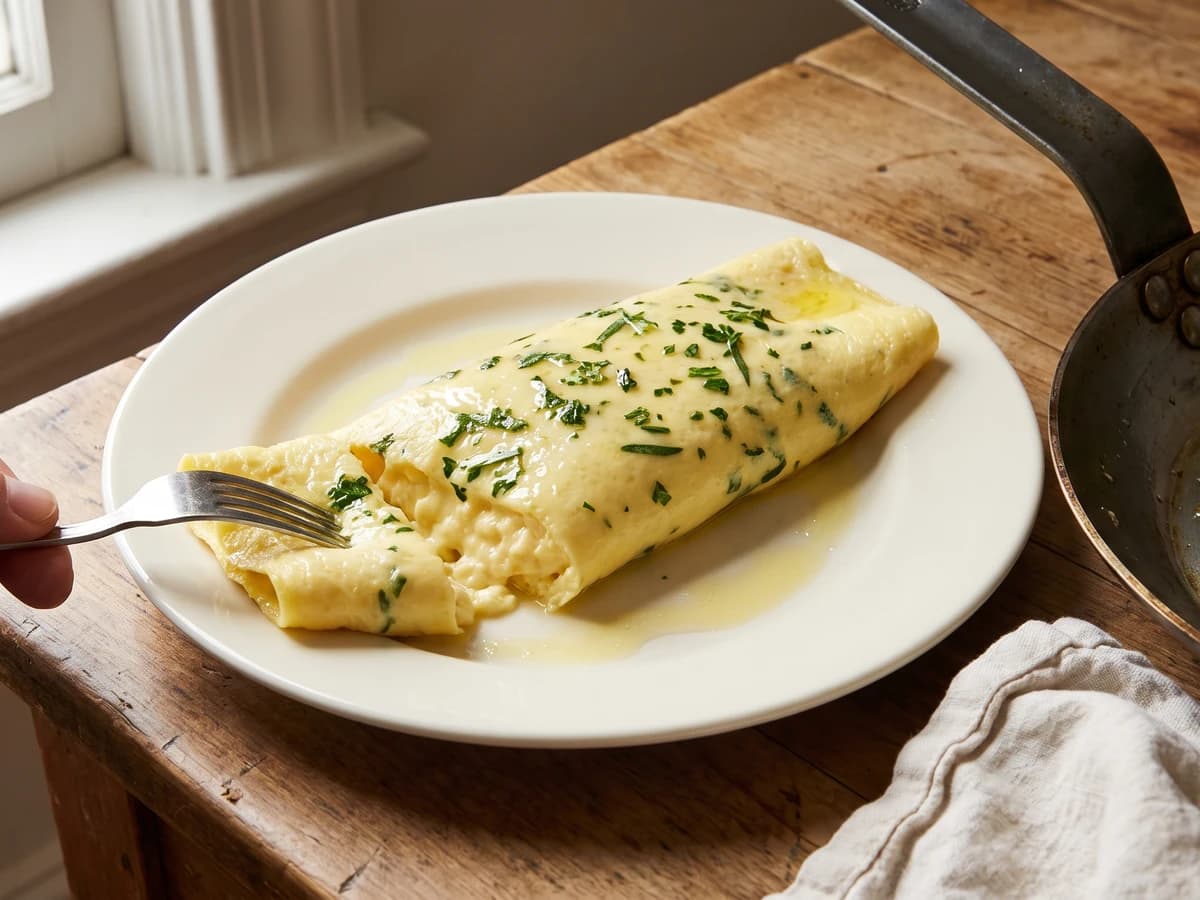
Four tender herbs, hot butter, and two eggs per pan: this rolled omelette teaches the quick hand and good judgment that keep the outside pale and the center creamy.
Chef Juliette
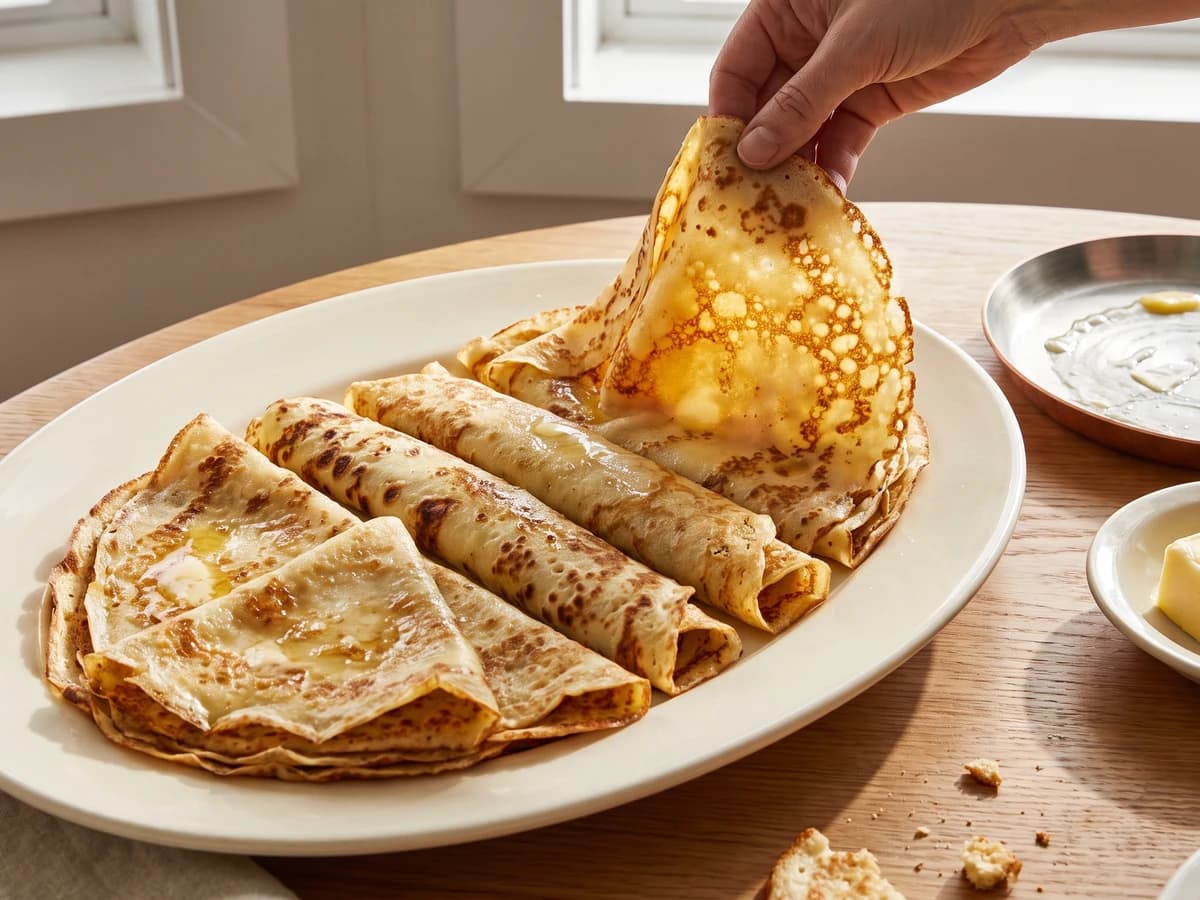
Four batters, one lesson: let the flour drink deeply before cooking, then spread the batter thinly in butter for crêpes and pannequets that bend without becoming tough.
Chef Juliette
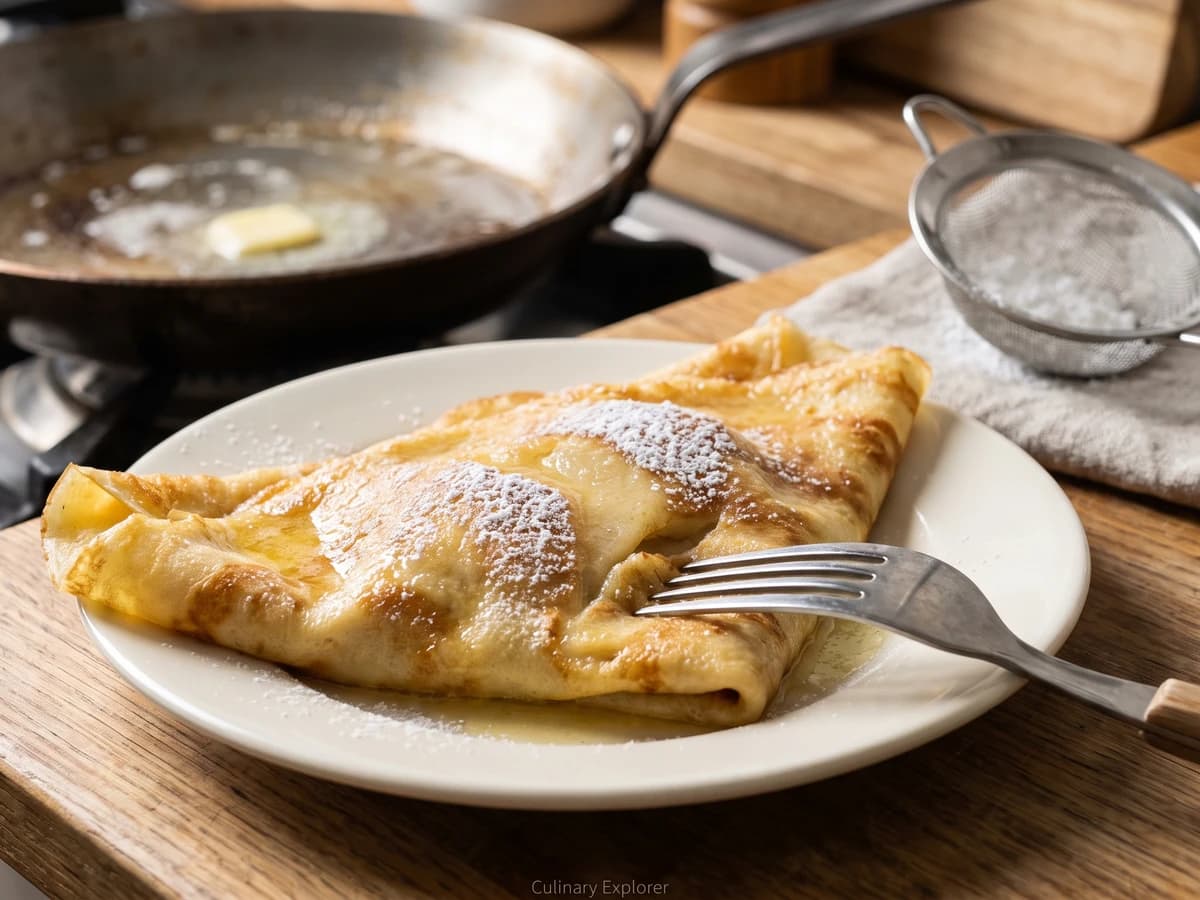
Crêpes au Couvent trap ripe Williams pear dice between two thin pours of sweet batter, then turn in one clean toss and reach the table butter-gold, powdered, and burning hot.