Chef Juliette
Omelette à l’Écossaise
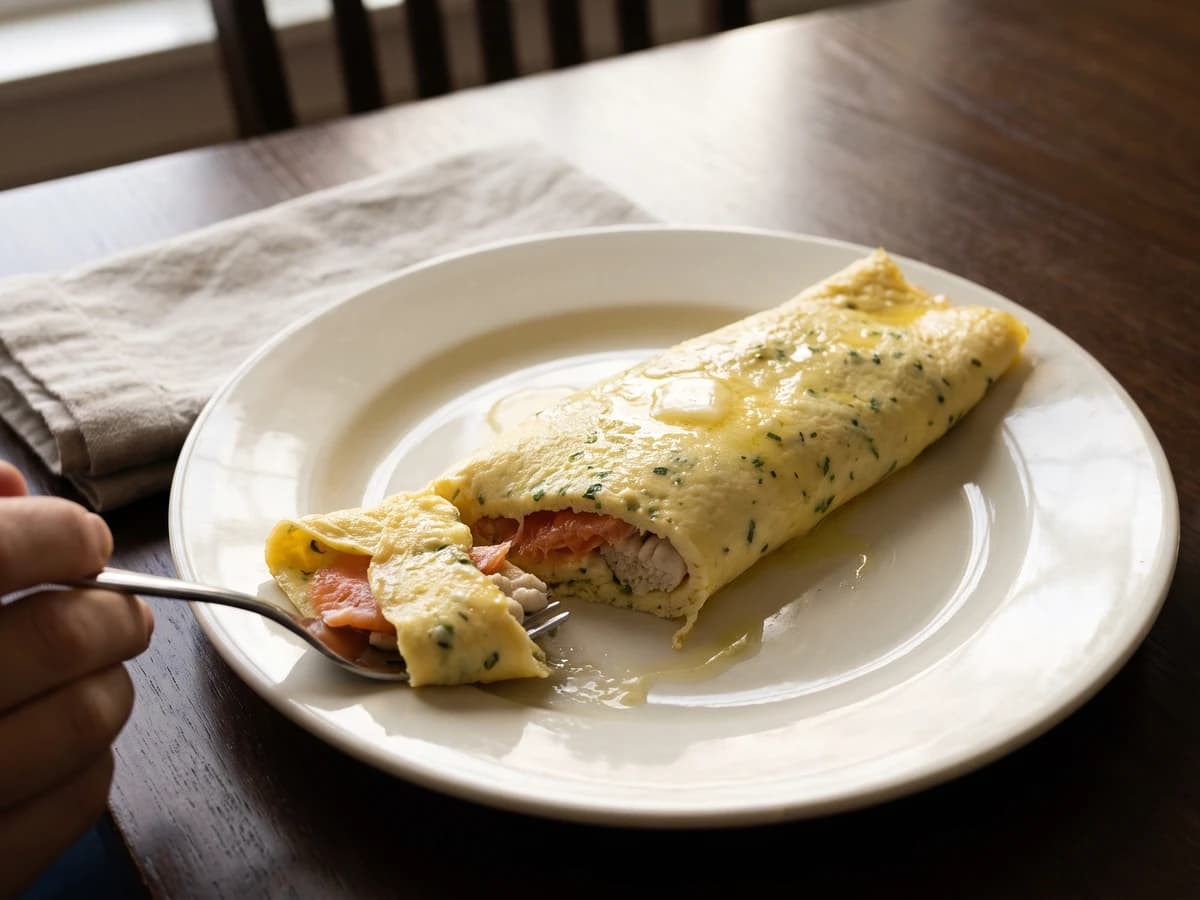
A creamy omelette aux fines herbes closes around smoked-salmon-wrapped herring milts, gently poached in butter. Have the filling ready, then roll the eggs while they still shine.
A cooking platform built around craft, culture, and the stories behind what we eat.
Created by Chef Juliette
Based on No. 497, Omelet à la Choisy, from Le Guide Culinaire (1907) by Auguste Escoffier
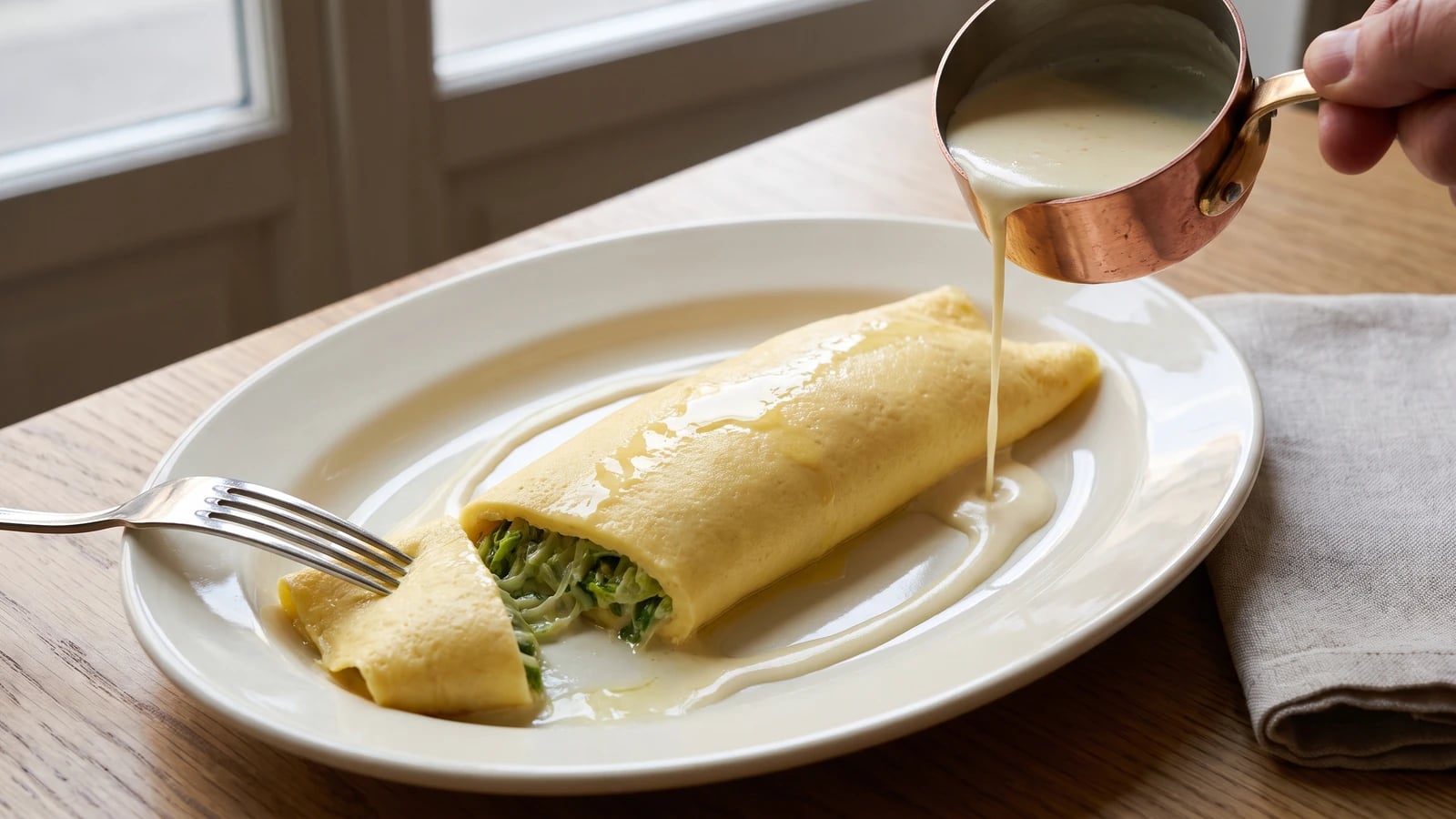
Omelette à la Choisy folds a pale, trembling French omelette around braised lettuce cut chaff-fine and bound with cream sauce, then circles it with one ivory thread. The filling waits for the eggs, never the reverse.
Omelette à la Choisy (a rolled omelette with cream-bound braised lettuce) teaches the timing that governs every French omelette: the filling must be warm and ready before the eggs touch the pan. The centre should still tremble when you roll, so there is no useful pause once cooking begins.
The source formula assumed a pot of braised lettuce waiting, a saucier holding cream sauce, and light stock never off the fire. At home, one lidded pan, one small saucepan, and an omelette pan do the work. We make four individual omelettes and keep the prescribed two tablespoonfuls of filling in each. What changed is the batch size and the holding, not the sequence: braise, Cisel, bind, roll, sauce. One cook, one stove, one evening.
The Cisel, the book's chaff-fine crosswise cut, stays because long strands of lettuce would pull against the tender eggs. Properly done, the filling is soft and savoury, the sauce lies in a narrow ivory thread, and the omelette wears only the faintest butter-gold sheen. Pull each omelette while its surface still shines and its centre trembles, then roll at once.
The designation à la Choisy points to Choisy-le-Roi, south of Paris, but its culinary home is the Parisian classical repertory, where place names often identify a prescribed garnish rather than a local household dish. In that vocabulary, Choisy became closely associated with lettuce treated as a cooked vegetable, braised, finely cut, and finished with cream. The surprise for many cooks is that the lettuce is neither crisp nor raw; it becomes tender enough to disappear into the omelette while keeping its quiet vegetal character.
Quantity
1 medium head (about 6 oz / 170 g)
halved through the core and carefully washed
Quantity
½ cup (120 ml / 120 g)
Quantity
1 tablespoon (15 ml / 14 g)
for braising the lettuce
Quantity
1 tablespoon (15 ml / 14 g)
for the cream sauce
Quantity
1 tablespoon (15 ml / 8 g)
Quantity
½ cup (120 ml / 123 g)
Quantity
½ cup (120 ml / 120 g)
Quantity
12
Quantity
4 tablespoons (60 ml / 56 g)
divided for cooking four omelettes
Quantity
2 teaspoons (10 ml / 12 g)
divided
Quantity
¼ teaspoon (1.25 ml / 0.5 g)
divided
| Ingredient | Quantity |
|---|---|
| butter lettucehalved through the core and carefully washed | 1 medium head (about 6 oz / 170 g) |
| light unsalted chicken stock | ½ cup (120 ml / 120 g) |
| unsalted butterfor braising the lettuce | 1 tablespoon (15 ml / 14 g) |
| unsalted butterfor the cream sauce | 1 tablespoon (15 ml / 14 g) |
| plain flour | 1 tablespoon (15 ml / 8 g) |
| whole milk | ½ cup (120 ml / 123 g) |
| heavy cream | ½ cup (120 ml / 120 g) |
| large eggs | 12 |
| unsalted butterdivided for cooking four omelettes | 4 tablespoons (60 ml / 56 g) |
| fine sea saltdivided | 2 teaspoons (10 ml / 12 g) |
| finely ground white pepperdivided | ¼ teaspoon (1.25 ml / 0.5 g) |
Bring a wide pot of water to a full boil and season it with about half the measured salt. Lower in the lettuce halves and blanch for 90 seconds, turning once, until the leaves collapse but remain green. Transfer them immediately to cold water, then drain and press gently between clean towels. Blanching makes the leaves supple enough to braise evenly; squeezing now prevents their water from diluting the stock.
Melt 1 tablespoon (15 ml / 14 g) butter in the lidded sauté pan over medium heat. Add the lettuce cut-side down, pour in the stock, and season with a small pinch each of salt and white pepper. Cover and hold at a bare simmer for 12 to 15 minutes, turning once, until the thickest leaves yield completely under a knife. Uncover for the final few minutes so most of the stock reduces. Lift out the lettuce and let it drain; it should be tender and moist, never awash in liquid.
Melt 1 tablespoon (15 ml / 14 g) butter in the small saucepan over medium-low heat. Stir in the flour and cook this pale roux for 1 minute without allowing it to colour. Add the milk a little at a time, whisking each addition smooth before the next, then simmer gently for 3 minutes. Whisk in the cream and continue at a quiet simmer until the sauce reduces to about ⅔ cup (160 ml) and naps the back of a spoon in a thin, even coat. Season with salt and white pepper. If it forms lumps, take it off the heat and whisk firmly; if any remain, pass it through a fine sieve. Ça se rattrape.
Remove the lettuce cores. Stack and roll the braised leaves, then Cisel them by cutting crosswise into very fine, short shreds, no wider than ⅛ inch (3 mm). Return the lettuce to the clean sauté pan over medium heat and stir for 30 to 60 seconds, just until no loose water remains. Fold in 2 tablespoons (30 ml) of the cream sauce, using only enough to cohere the shreds. The filling should hold softly on a spoon without becoming pasty. Divide it into four portions of 2 tablespoons (30 ml) each and keep them warm.
Warm four plates. Keep the remaining cream sauce barely warm, thinning it with a teaspoon of milk if it has tightened beyond a pourable ribbon. Beat 3 eggs at a time with a pinch of salt and white pepper, mixing only until the whites and yolks unite. Don't beat in a froth; an omelette wants a close, tender texture, not bubbles. Have one portion of lettuce beside the stove before each batch of eggs meets the pan.
Heat the omelette pan over medium to medium-high heat. Add 1 tablespoon (15 ml / 14 g) butter and swirl until it foams without browning. Pour in one batch of eggs, then stir briskly with a flexible spatula while shaking the pan for 5 to 10 seconds. Smooth the eggs into an even layer. As soon as the underside is set but the surface remains glossy and the centre trembles, lay one 2-tablespoon portion of lettuce just off centre. Fold the near edge over the filling, tilt the pan, and roll the omelette onto a warm plate with its seam underneath. If the eggs catch before they roll, lift the pan from the heat and loosen the edge gently; a torn seam goes underneath and the sauce will finish the plate. Repeat with the remaining eggs, butter, and filling.
Spoon about 2 tablespoons (30 ml) of warm cream sauce in a narrow thread around each omelette, leaving the smooth roll visible rather than covering it. The book asks for a thread, not a moat. Serve immediately, while the centre remains softly set. À table!
1 serving (about 260g)
Culinary guides, cultural storytelling, and the editorial depth that makes cooking meaningful.
Discover Culinary ExplorerChef Juliette
A creamy omelette aux fines herbes closes around smoked-salmon-wrapped herring milts, gently poached in butter. Have the filling ready, then roll the eggs while they still shine.
Chef Juliette
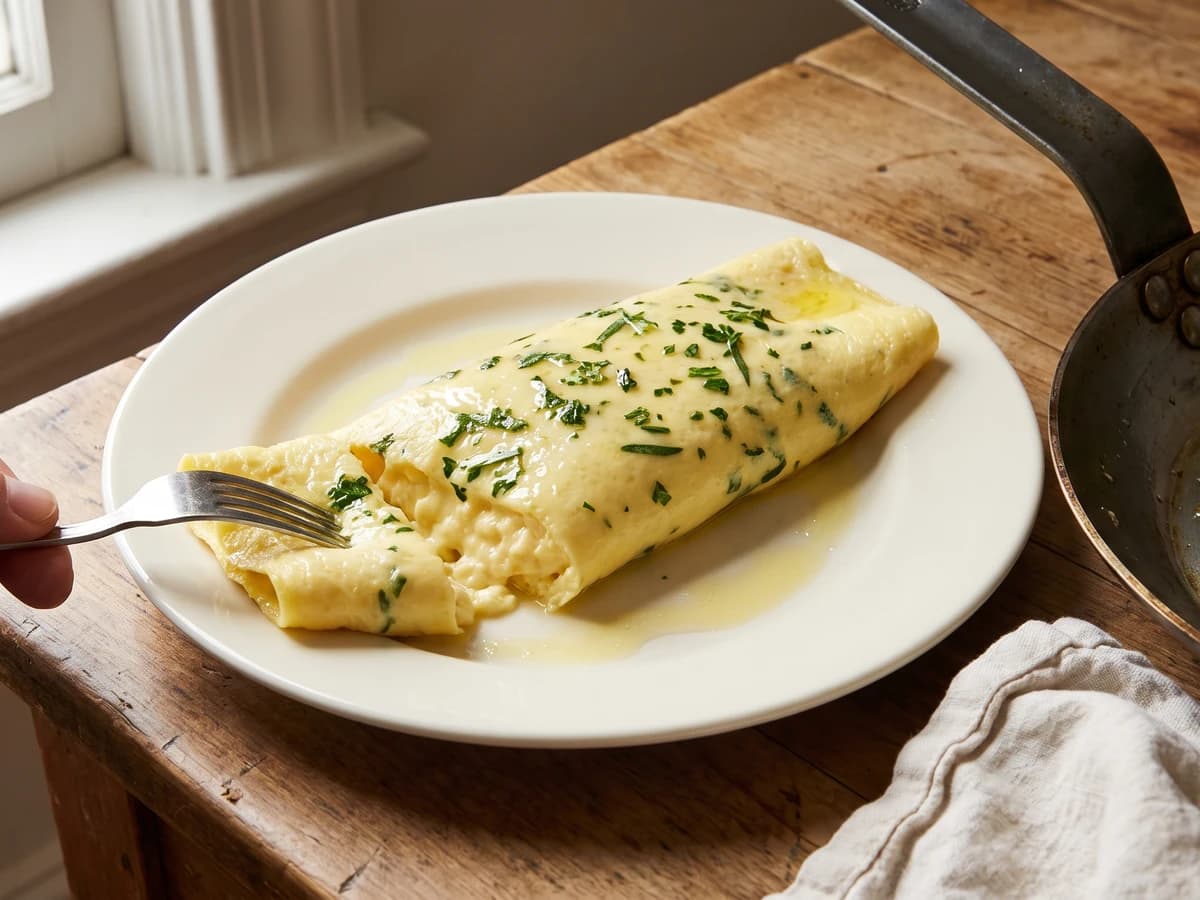
Four tender herbs, hot butter, and two eggs per pan: this rolled omelette teaches the quick hand and good judgment that keep the outside pale and the center creamy.
Chef Juliette
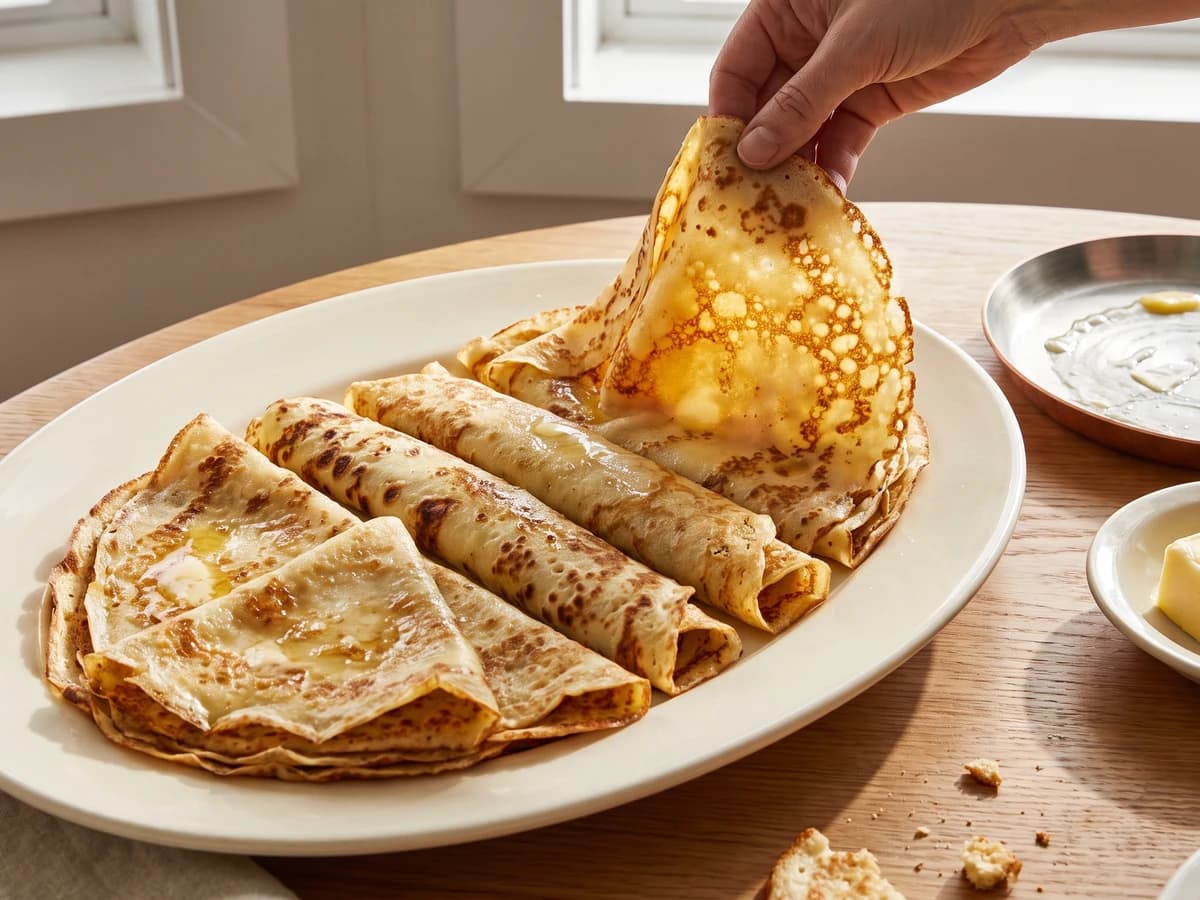
Four batters, one lesson: let the flour drink deeply before cooking, then spread the batter thinly in butter for crêpes and pannequets that bend without becoming tough.
Chef Juliette
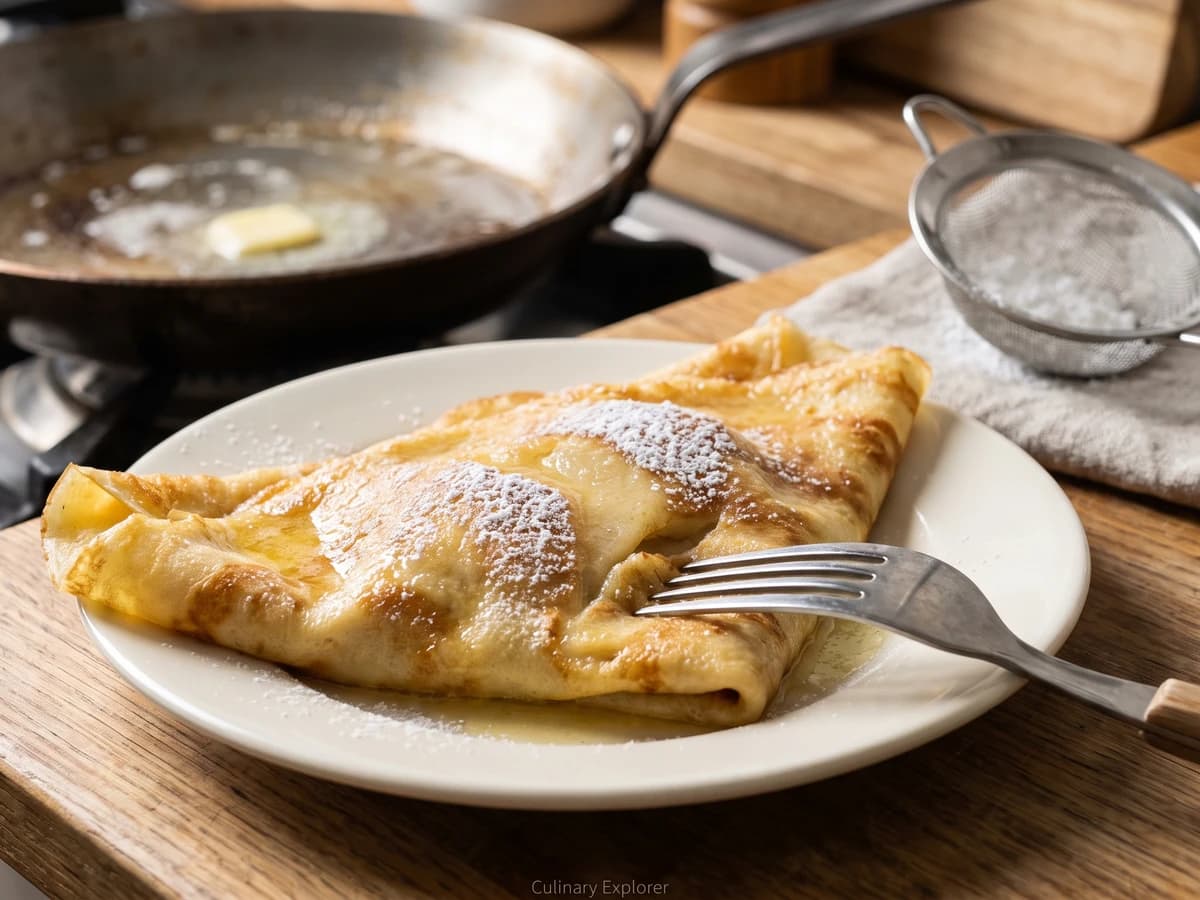
Crêpes au Couvent trap ripe Williams pear dice between two thin pours of sweet batter, then turn in one clean toss and reach the table butter-gold, powdered, and burning hot.