Chef Juliette
Omelette à l’Écossaise
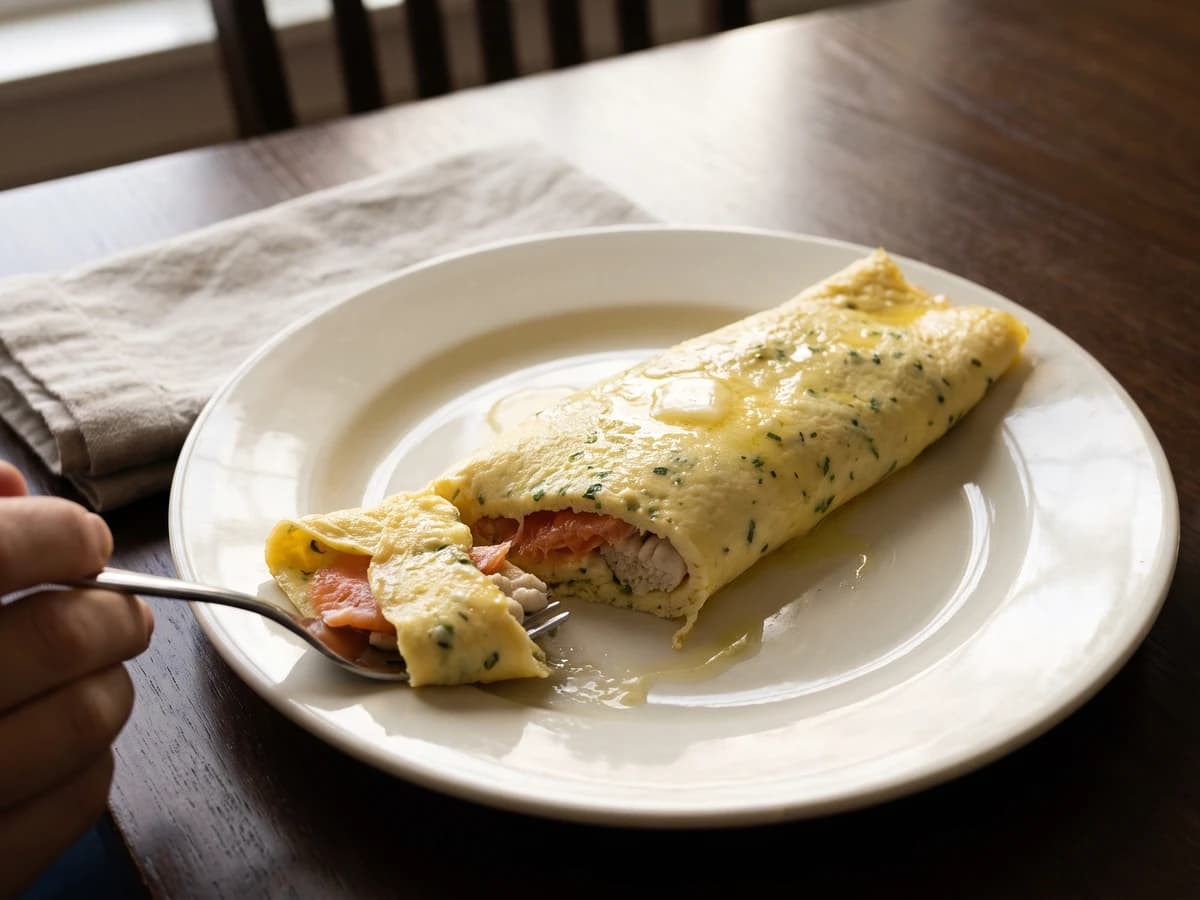
A creamy omelette aux fines herbes closes around smoked-salmon-wrapped herring milts, gently poached in butter. Have the filling ready, then roll the eggs while they still shine.
A cooking platform built around craft, culture, and the stories behind what we eat.
Created by Chef Juliette
Based on No. 425, Poached Eggs Masséna, from Le Guide Culinaire (1907) by Auguste Escoffier
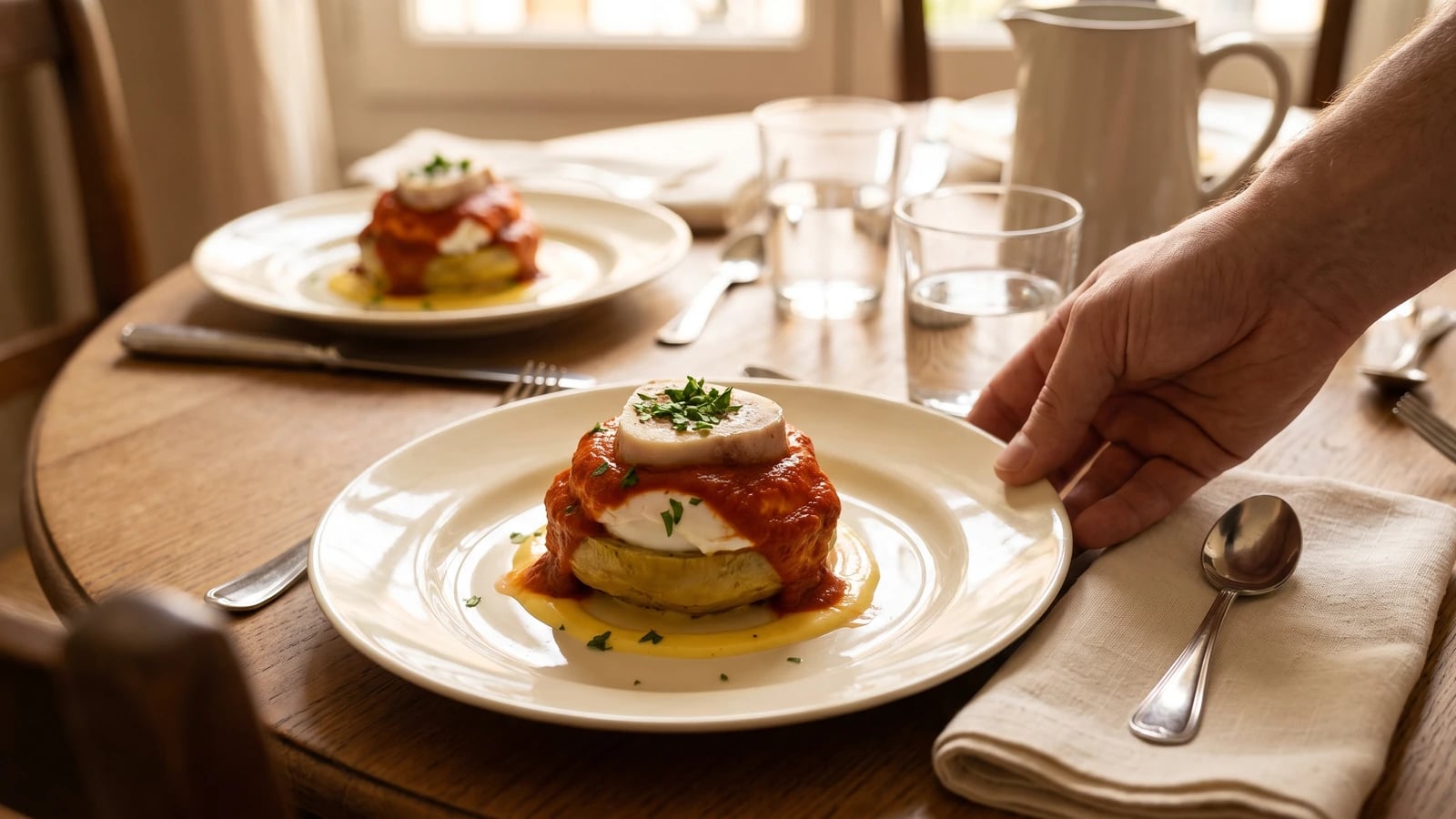
Œufs pochés Masséna teaches warm assembly: buttery artichoke, steady Béarnaise, a tomato-masked poached egg, and melting marrow brought together so every layer arrives hot and distinct.
Œufs pochés Masséna (poached eggs Masséna) teaches warm assembly. The one true thing to know before touching a pan is this: the Béarnaise must stay warm enough to flow but never hot enough to split, while the artichoke, tomato-coated egg, and marrow arrive ready around it. This is not a race. It is choreography.
The old entry assumed a saucier at hand, a stockpot never off the fire behind the sauces, cooked artichoke bottoms ready by the dozen, neatly trimmed eggs, and marrow already freed from the bone. At home, begin with the two finished sauces, use four prepared artichoke bottoms, and work from one broad poaching pan. The brigade portions and extra hands are scaffolding, so they go. The tablespoon of Béarnaise inside each artichoke, the tomato masking the egg, and the poached marrow crown are the dish, so they stay. No salamander is needed because the source does not call for a gratinée finish.
Scaled to four, it is generous enough for a special first course and entirely possible for one cook, one stove, one evening. Set every component in its place before the eggs enter the water. The decisive step is holding the Béarnaise gently while the eggs and marrow come to it.
Œufs pochés Masséna belongs to the Parisian grand-kitchen repertory of composed egg dishes, where named garnishes transform a poached egg into a formal first course. The title is honorific rather than regional; despite its echo of Nice, the garnish is not a Niçois household preparation. The dish traveled through formal dining rooms and cookery manuals because its structure is memorable: a vegetable base, two contrasting sauces, a tender egg, and a rich marrow crown assembled at the last moment.
Quantity
4 (about 8 oz / 225 g)
drained and patted dry
Quantity
2 tablespoons (30 ml / 28 g)
Quantity
¼ cup (60 ml / 60 g)
Quantity
4
Quantity
1
for poaching insurance
Quantity
½ cup (120 ml / 125 g)
Quantity
3 tablespoons (45 ml / 40 g)
cut into four ⅜-inch (1 cm) rounds
Quantity
1 tablespoon (15 ml / 4 g)
finely chopped
Quantity
3 quarts (2.8 L / 2.8 kg)
divided
Quantity
1½ teaspoons (7.5 ml / 9 g)
divided
| Ingredient | Quantity |
|---|---|
| medium cooked artichoke bottomsdrained and patted dry | 4 (about 8 oz / 225 g) |
| unsalted butter | 2 tablespoons (30 ml / 28 g) |
| finished Béarnaise sauce | ¼ cup (60 ml / 60 g) |
| large eggs | 4 |
| large egg (optional)for poaching insurance | 1 |
| finished smooth classical tomato sauce | ½ cup (120 ml / 125 g) |
| chilled beef bone marrowcut into four ⅜-inch (1 cm) rounds | 3 tablespoons (45 ml / 40 g) |
| flat-leaf parsleyfinely chopped | 1 tablespoon (15 ml / 4 g) |
| cold waterdivided | 3 quarts (2.8 L / 2.8 kg) |
| fine sea saltdivided | 1½ teaspoons (7.5 ml / 9 g) |
Cover the marrow rounds with cold water and refrigerate them for 30 minutes, changing the water once; this draws away blood without warming the delicate fat. Drain and keep them very cold. Examine the artichoke bottoms. If a cavity is too shallow to hold its spoonful of Béarnaise, scrape away a teaspoon or two from the center with a small spoon, stopping well before you pierce the base. Arrange the sauces, eggs, parsley, and four warm plates before cooking begins.
Warm the tomato sauce over low heat until it reaches nappant consistency, thick enough to coat the back of a spoon without sitting like paste. If it is too tight, loosen it with hot water a teaspoon at a time; if it runs straight off the spoon, simmer it briefly. Hold the Béarnaise in a heatproof bowl over a bain-marie, a warm-water bath kept around 122 to 131°F (50 to 55°C), with the bowl clear of the water. If the Béarnaise splits and butter beads around the edge, put 1 teaspoon (5 ml) cool water in a clean bowl, whisk in one spoonful of broken sauce until smooth, then add the rest gradually. Ça se rattrape.
Melt the butter in a lidded skillet over medium-low heat. Set the artichoke bottoms in flat-side down, season them with a small pinch of the salt, and spoon butter over their rims. Cover and heat for 5 to 7 minutes, basting once, until hot through and butter-gold at the edges. They are already cooked, so the aim is to warm and season them, not brown them into toughness. If they release water, uncover the pan and let the moisture cook away before basting again.
Fill a wide saucepan with about 3 inches (8 cm) of the remaining water, add most of the remaining salt, and bring it just below a simmer, around 180 to 190°F (82 to 88°C). Crack each egg into a fine-mesh strainer for a few seconds to shed the loose white, then transfer it to a small cup. Slip the eggs into the water one at a time, leaving space between them, and poach for about 3 minutes, until the whites are set and the yolks still yield beneath them. If a white spreads, fold it gently around its yolk with a spoon during the first 20 seconds. If a yolk breaks, lift that egg out and use the spare. Drain the eggs on a folded lint-free towel and trim any ragged tails.
Skim any stray egg white from the water and return it to a bare tremble. Lower the cold marrow rounds on a slotted spoon and poach them for 1 to 2 minutes, just until the edges turn opaque and the centers soften while keeping their shape. Never let the water boil, or the marrow melts into it. If a slice begins to slump, lift it immediately; the heat of the egg and sauces will finish softening it. Drain the rounds carefully on a warm plate.
Place one buttered artichoke bottom on each warm plate and fill every cavity with exactly 1 tablespoon (15 ml) of Béarnaise. Working with one egg at a time, spoon 2 tablespoons (30 ml) of tomato sauce into a warm shallow bowl, set the egg into it, and spoon the sauce over until the egg is completely masked. Lift the coated egg with a broad spoon and settle it onto the artichoke. If the sauce slides away, return the egg to its towel, reduce the sauce for a minute, and coat it again. Crown each egg with a poached marrow round and a pinch of chopped parsley. Serve at once, while the sauces gleam and the yolks remain fluid. À table!
1 serving (about 170g)
Culinary guides, cultural storytelling, and the editorial depth that makes cooking meaningful.
Discover Culinary ExplorerChef Juliette
A creamy omelette aux fines herbes closes around smoked-salmon-wrapped herring milts, gently poached in butter. Have the filling ready, then roll the eggs while they still shine.
Chef Juliette
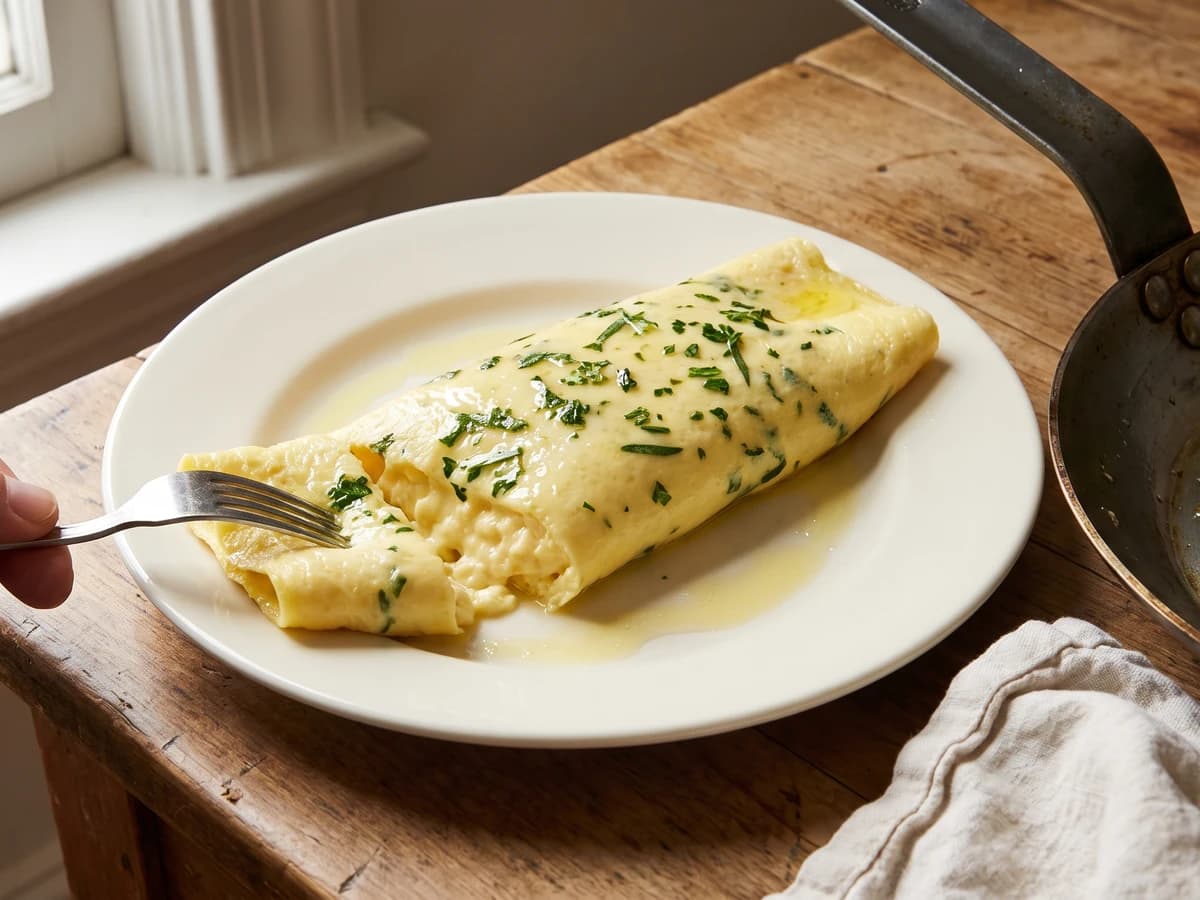
Four tender herbs, hot butter, and two eggs per pan: this rolled omelette teaches the quick hand and good judgment that keep the outside pale and the center creamy.
Chef Juliette
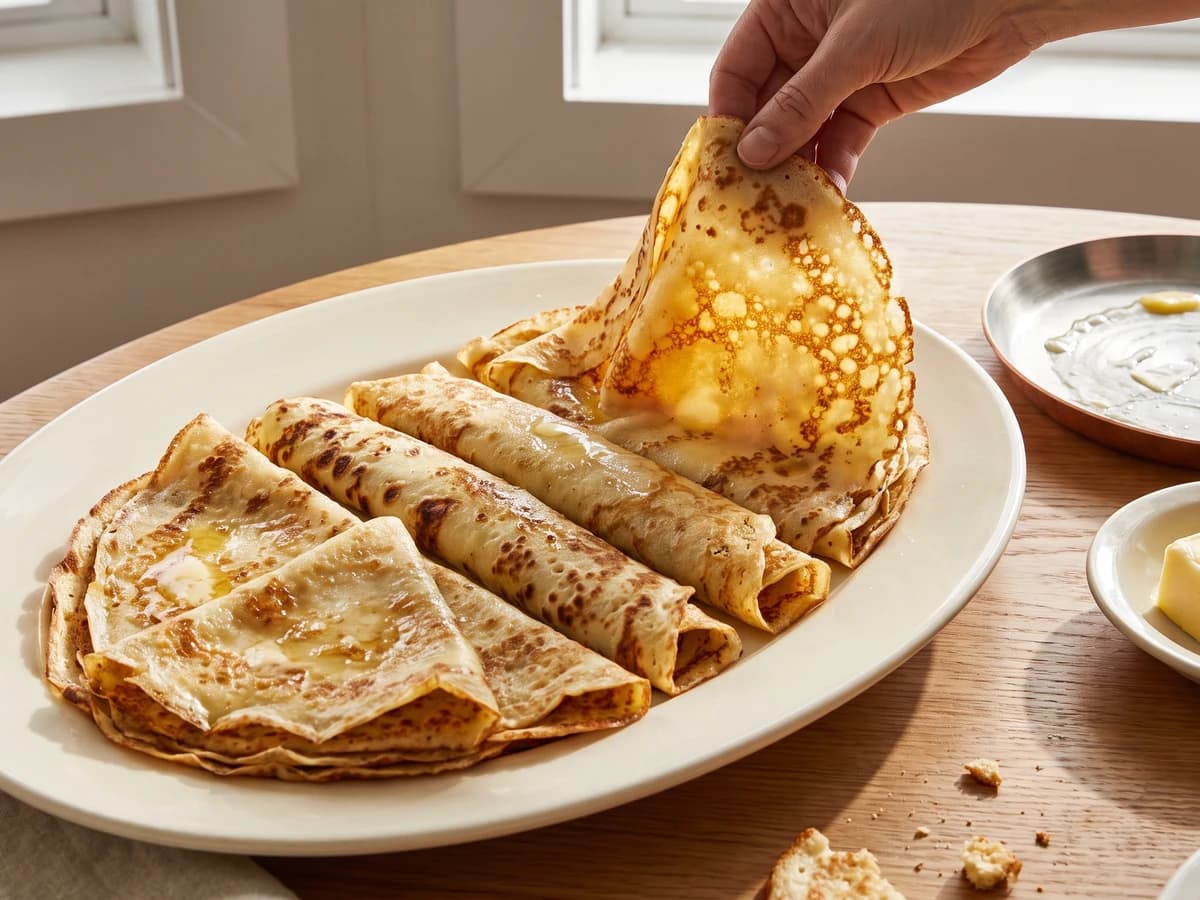
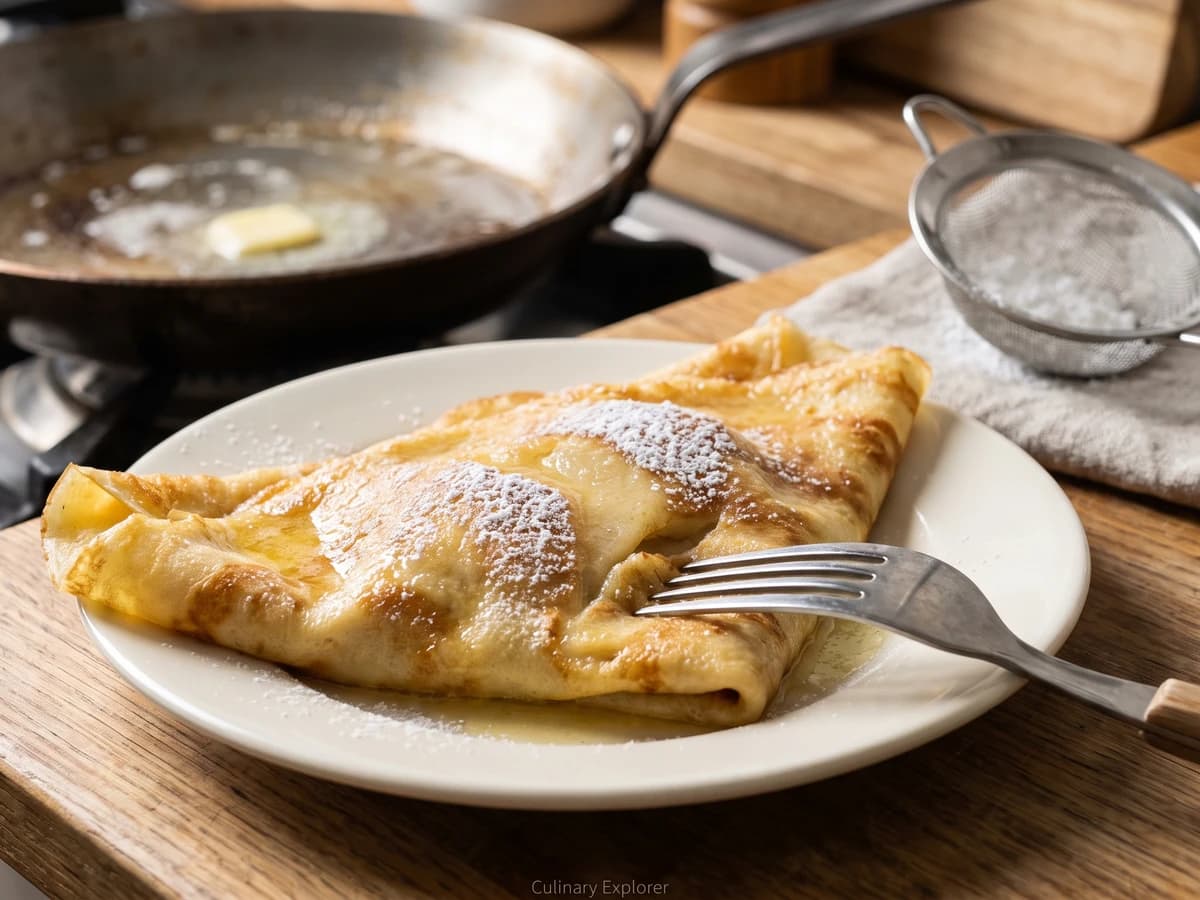
Four batters, one lesson: let the flour drink deeply before cooking, then spread the batter thinly in butter for crêpes and pannequets that bend without becoming tough.
Chef Juliette
Crêpes au Couvent trap ripe Williams pear dice between two thin pours of sweet batter, then turn in one clean toss and reach the table butter-gold, powdered, and burning hot.