Chef Juliette
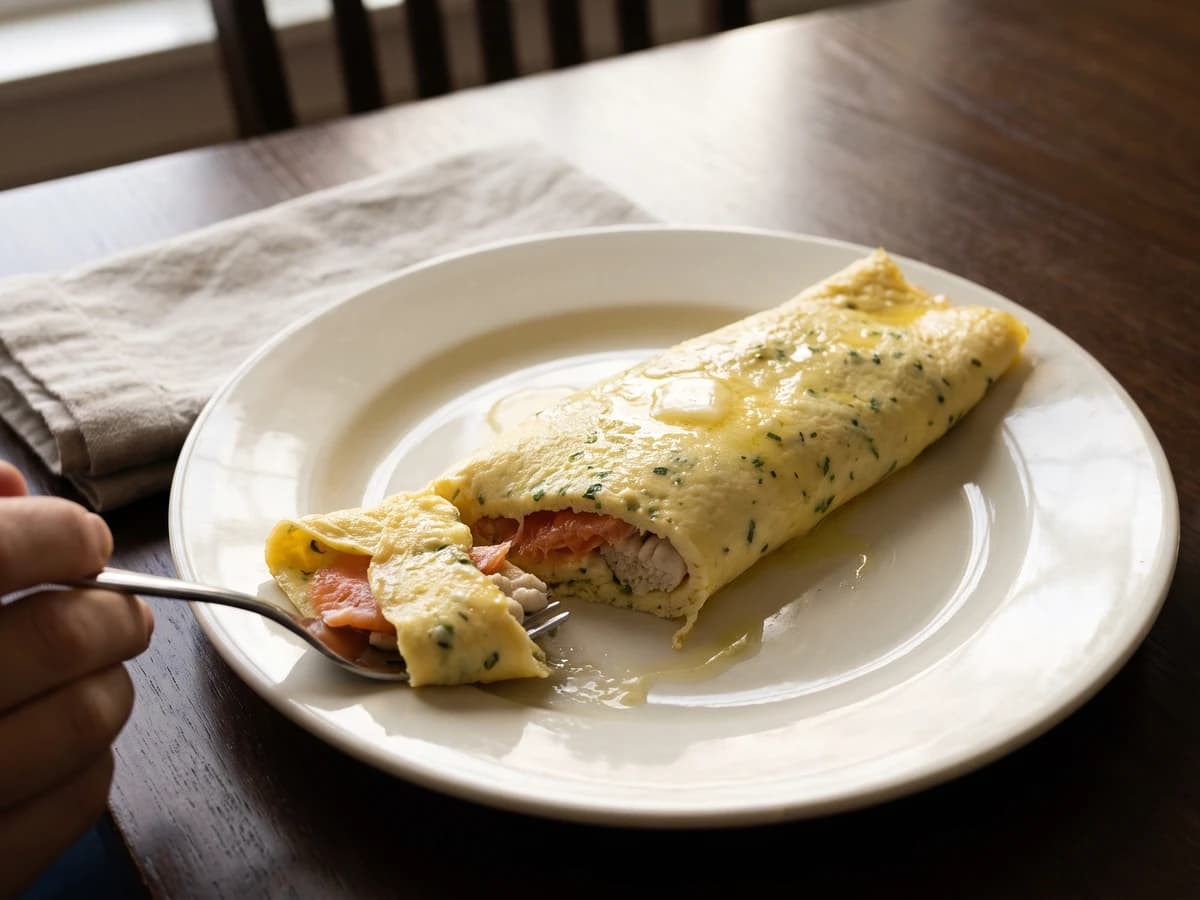
Omelette à l’Écossaise
A creamy omelette aux fines herbes closes around smoked-salmon-wrapped herring milts, gently poached in butter. Have the filling ready, then roll the eggs while they still shine.
A cooking platform built around craft, culture, and the stories behind what we eat.
Created by Chef Juliette
Based on No. 418, Poached Eggs Boïeldieu, from Le Guide Culinaire (1907) by Auguste Escoffier
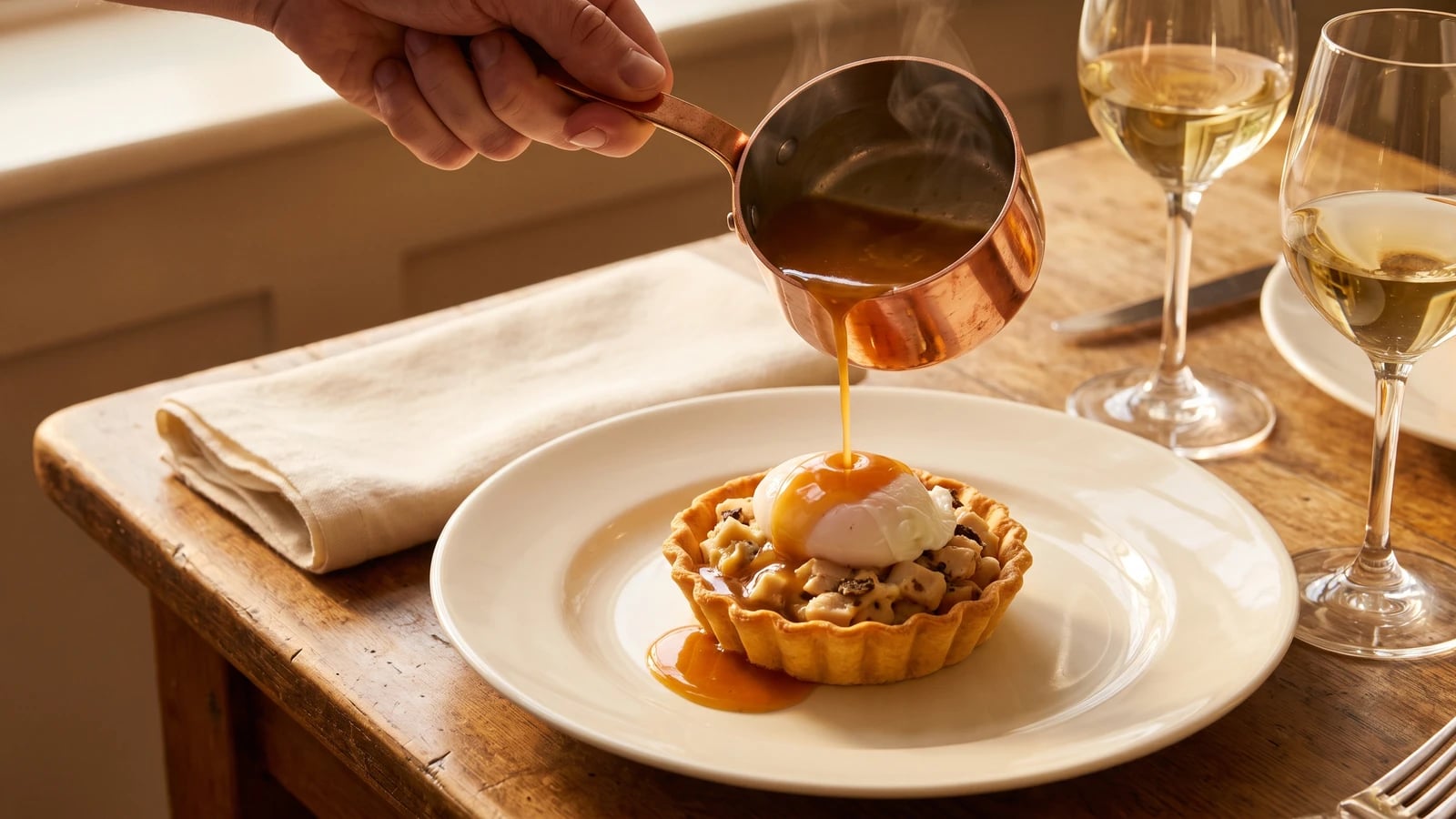
Tender poached eggs crown crisp tartlets packed with chicken, foie gras, and truffle salpicon, while two expressions of poultry stock, ivory velouté and glossy gravy, make a composed dish possible at home.
Œufs pochés Boïeldieu (Boïeldieu poached eggs) teaches the discipline of a composed dish: crisp tartlet, creamy salpicon, tender egg, and glossy gravy, each ready at the same moment. The one true thing to know before touching a pan is that temperature governs everything. The tartlet and filling can wait briefly, the gravy can be held gently, but the egg does not wait.
The original recipe assumed tartlet cases standing ready, a saucier holding poultry velouté and reduced poultry gravy, and stock never off the fire. A salamander belonged to that kitchen, but it has no work here because this dish is coated, not gratinéed. At home, one batch of good stock is divided: a blond roux turns one part into velouté, while browned chicken fond and reduction turn the other into gravy. Four tartlet tins replace a brigade tray. One cook, one stove, one evening.
Separate sauce stations and a rack of pre-poached eggs were brigade scaffolding, so they can go. The crisp tartlet, the salpicon of evenly diced chicken, foie gras, and truffle bound with velouté, and the distinct reduced gravy are the dish itself, so they stay. Have the tartlets filled and the gravy ready before you lower the eggs into the water. That is the step that matters most.
Œufs pochés Boïeldieu belongs to the Parisian classical table, where named egg preparations appeared as composed entrées before the main course, not chiefly at breakfast. Its title honors the composer François-Adrien Boieldieu, while its garnish speaks that table's generous vocabulary: poultry, foie gras, truffle, and two carefully differentiated poultry sauces. Salpicon names the method, evenly diced ingredients cohered with sauce, rather than one fixed mixture.
Quantity
1 cup (240 ml / 125 g), plus more for rolling
Quantity
8 tablespoons (120 ml / 113 g)
divided into 5 tablespoons for the pastry, 1 for browning, 1 for the velouté, and 1 kept cold for finishing
Quantity
1
Quantity
1 to 1½ tablespoons (15 to 22 ml / 15 to 22 g)
Quantity
1 teaspoon (5 ml / 6 g)
divided
Quantity
4 cups (960 ml / 960 g)
divided
Quantity
4 sections (8 oz / 225 g)
Quantity
2 tablespoons (30 ml / 25 g)
finely diced
Quantity
⅓ cup (80 ml / 45 g)
finely diced
Quantity
1 teaspoon (5 ml / 3 g) arrowroot plus 1 tablespoon (15 ml / 15 g) cold water
stirred into a smooth slurry
Quantity
1 small portion (3 oz / 85 g)
Quantity
1 tablespoon (15 ml / 8 g)
Quantity
¼ cup (60 ml / 55 g)
chilled and cut into ¼-inch dice
Quantity
2 tablespoons (30 ml / 15 g)
cut into ¼-inch dice, with any jar liquid reserved
Quantity
4
Quantity
2 tablespoons (30 ml / 30 g)
Quantity
8 cups (1.9 L / 1.9 kg)
Quantity
⅛ teaspoon (0.6 ml / 0.3 g)
| Ingredient | Quantity |
|---|---|
| all-purpose flour | 1 cup (240 ml / 125 g), plus more for rolling |
| unsalted butterdivided into 5 tablespoons for the pastry, 1 for browning, 1 for the velouté, and 1 kept cold for finishing | 8 tablespoons (120 ml / 113 g) |
| large egg yolk | 1 |
| ice water | 1 to 1½ tablespoons (15 to 22 ml / 15 to 22 g) |
| fine saltdivided | 1 teaspoon (5 ml / 6 g) |
| unsalted, gelatin-rich chicken stockdivided | 4 cups (960 ml / 960 g) |
| chicken wing sections | 4 sections (8 oz / 225 g) |
| shallotfinely diced | 2 tablespoons (30 ml / 25 g) |
| carrotfinely diced | ⅓ cup (80 ml / 45 g) |
| arrowroot and cold waterstirred into a smooth slurry | 1 teaspoon (5 ml / 3 g) arrowroot plus 1 tablespoon (15 ml / 15 g) cold water |
| boneless, skinless chicken breast | 1 small portion (3 oz / 85 g) |
| all-purpose flour for the poultry velouté | 1 tablespoon (15 ml / 8 g) |
| cooked foie graschilled and cut into ¼-inch dice | ¼ cup (60 ml / 55 g) |
| fresh or preserved black trufflecut into ¼-inch dice, with any jar liquid reserved | 2 tablespoons (30 ml / 15 g) |
| large, very fresh eggs | 4 |
| white wine vinegar | 2 tablespoons (30 ml / 30 g) |
| water for poaching | 8 cups (1.9 L / 1.9 kg) |
| ground white pepper | ⅛ teaspoon (0.6 ml / 0.3 g) |
Mix the 1 cup flour with ¼ teaspoon of the salt. Rub in 5 tablespoons of cold butter until the mixture resembles coarse crumbs with a few small flakes of butter still visible. Stir in the egg yolk and 1 tablespoon of ice water, adding the remaining water by drops only if the dough will not hold when pressed. If it crumbles, add water by the teaspoon; if it feels greasy, chill it immediately. Ça se rattrape. Shape into a disc without kneading, cover, and chill for 25 minutes.
Heat the oven to 375°F (190°C). Roll the dough about ⅛ inch thick and line four 4-inch (10 cm) shallow tartlet tins. Patch any cracks with a scrap of dough pressed firmly into place. Prick the bases, chill for 10 minutes, then line with parchment and pastry weights. Bake for 12 minutes, remove the weights, and bake for another 6 to 8 minutes, until the shells are crisp and evenly butter-gold. Unmold them while barely warm and set them on a baking sheet.
Melt 1 tablespoon of butter in a small heavy saucepan over medium heat. Brown the chicken wings deeply on every side, then add the shallot and carrot and cook until their edges bronze. Pour in 3 cups of the chicken stock, scraping the fond from the pan floor, and simmer uncovered until reduced to about ¾ cup, 35 to 45 minutes. Strain into a clean saucepan without pressing hard on the solids. Bring the gravy to a gentle simmer and whisk in the arrowroot slurry a little at a time, stopping as soon as it naps the back of a spoon. Finish by monter au beurre, whisking the final cold tablespoon of butter into the gravy off the heat. If it becomes gluey, loosen it with stock or water; if the butter beads on the surface, whisk in a teaspoon of cold water away from the heat. Hold it warm without boiling.
Bring the remaining 1 cup of chicken stock to the barest simmer in a small saucepan and season lightly. Add the chicken breast, cover, and cook gently for 8 to 10 minutes, turning once, until its centre reaches 160°F (71°C). Rest it for 5 minutes so it finishes cooking, then cut it into neat ¼-inch dice. Strain the poaching stock and measure ¾ cup, adding a little water if needed.
Melt 1 tablespoon of butter in a saucepan, stir in the tablespoon of flour, and cook this blond roux for 2 minutes without letting it colour. Gradually whisk in the hot reserved poaching stock, then simmer for 3 to 4 minutes, until the poultry velouté is smooth and coats a spoon. If it lumps, pass it through a fine sieve and return it to gentle heat. Fold ½ cup of the velouté around the diced chicken and truffle, adding up to 1 teaspoon of reserved truffle liquid if using preserved truffle. Remove the pan from the heat and fold in the cold foie gras last. The salpicon should be cohered, not swimming; loosen it with more velouté if dry, but never boil it after the foie gras enters or the dice will melt away.
Lower the oven to 300°F (150°C) and warm the empty tartlet shells for 4 minutes. Divide the warm salpicon among them, keeping the filling level enough to support an egg. Return them to the switched-off oven for no more than 5 minutes. From this point, sequence decides the dish: the filled tartlets and poultry gravy must be ready before the eggs touch the water.
Bring the 8 cups of water and vinegar to a bare tremble in a wide saucepan. Crack each egg into its own small cup, then slip the eggs into the water one at a time, leaving space between them. Poach for 3 to 3½ minutes, nudging loose white around each yolk, until the whites are set and the centres remain soft. If the water boils, pull the pan off the heat at once; a hard boil toughens the white and tears it into ribbons. Lift the eggs with a slotted spoon, trim only the ragged threads, and drain them thoroughly on a clean towel.
Set one drained poached egg on each filled tartlet and season it lightly with salt and white pepper. Rewarm the poultry gravy just until fluid, never boiling, then spoon it generously over each egg while leaving the crisp tartlet rim visible. Serve immediately. The egg does not wait. À table!
1 serving (about 250g)
Culinary guides, cultural storytelling, and the editorial depth that makes cooking meaningful.
Discover Culinary ExplorerChef Juliette
A creamy omelette aux fines herbes closes around smoked-salmon-wrapped herring milts, gently poached in butter. Have the filling ready, then roll the eggs while they still shine.
Chef Juliette
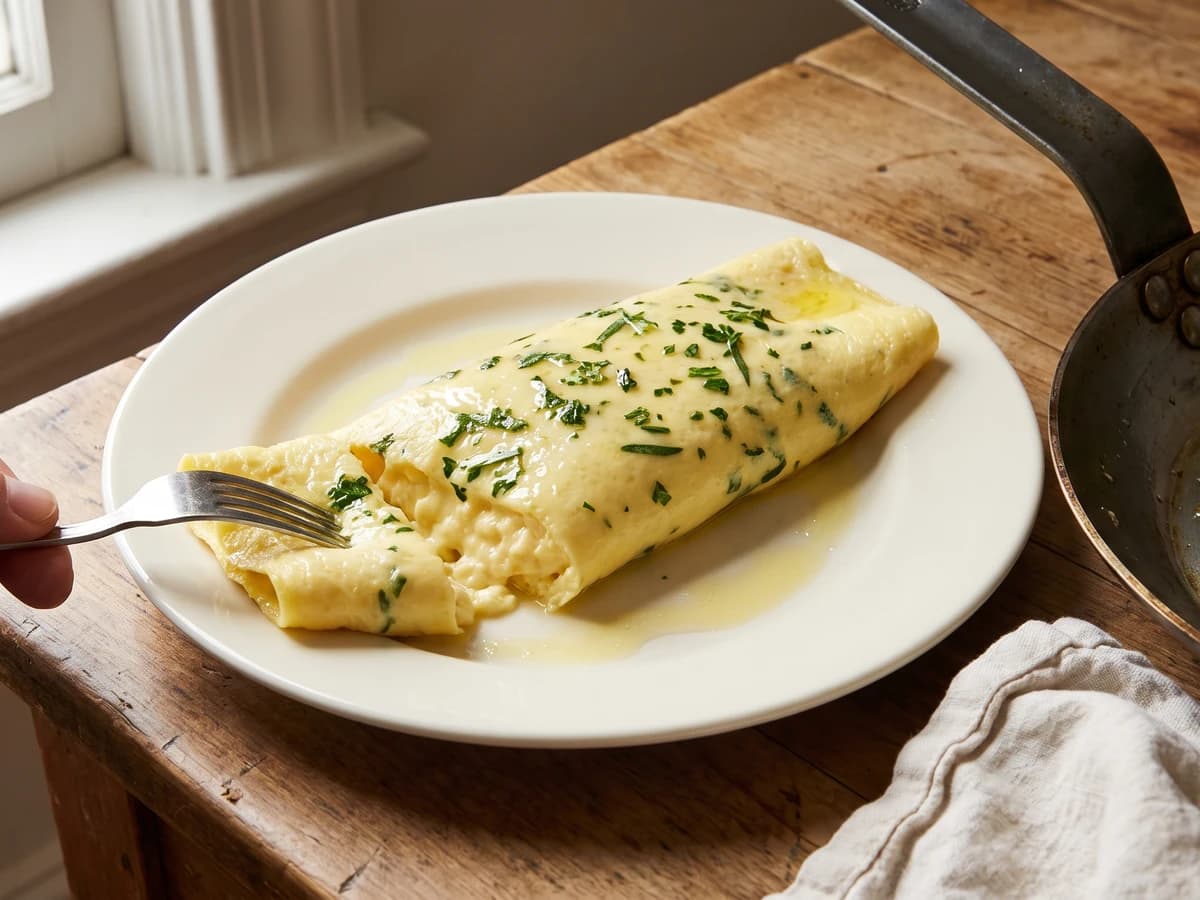
Four tender herbs, hot butter, and two eggs per pan: this rolled omelette teaches the quick hand and good judgment that keep the outside pale and the center creamy.
Chef Juliette
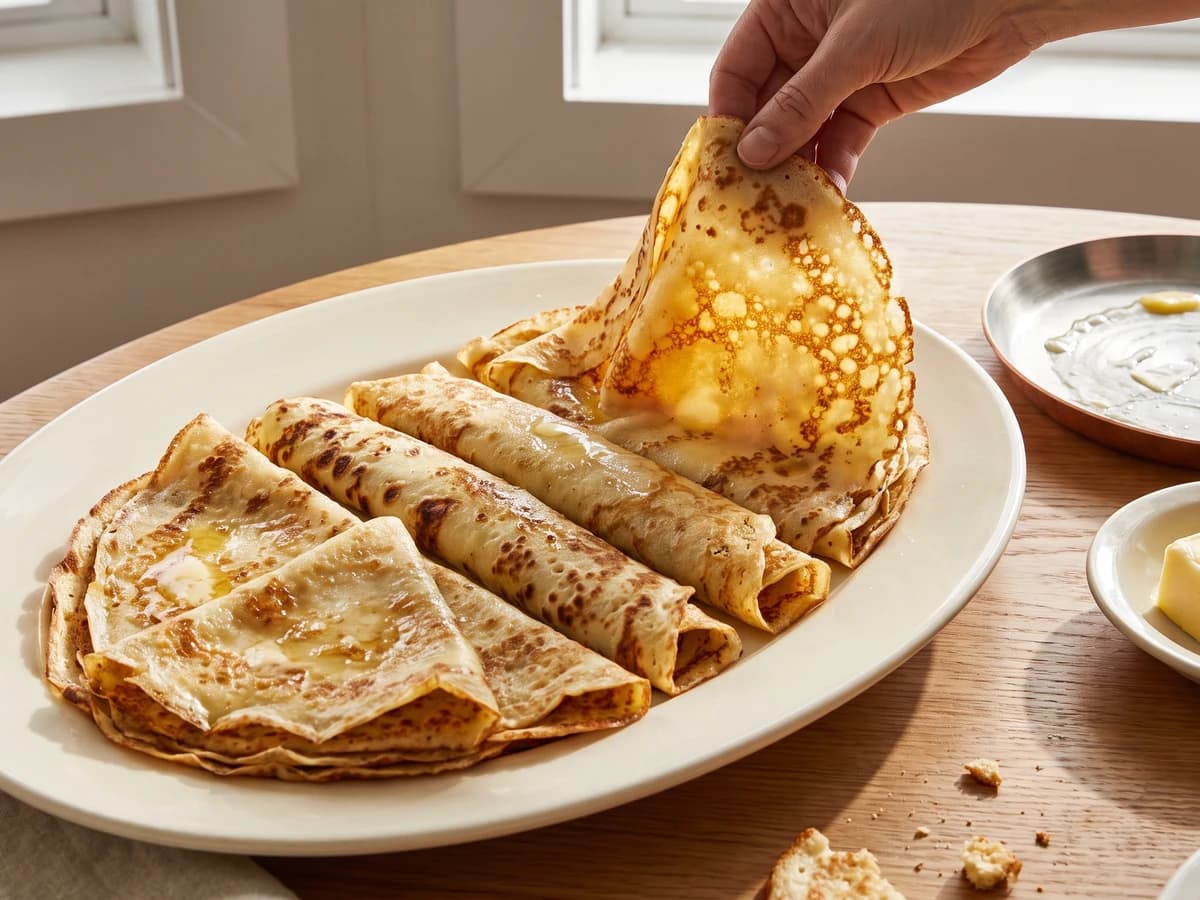
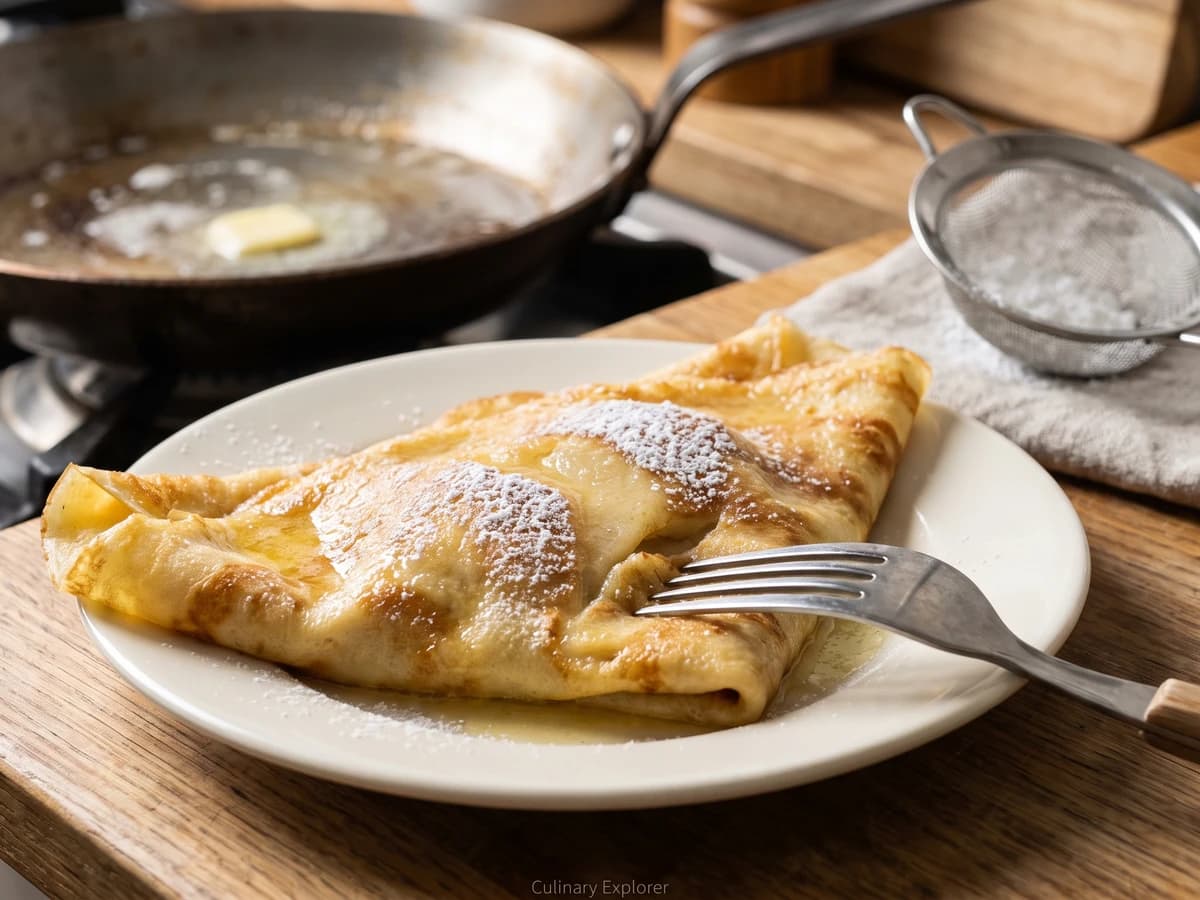
Four batters, one lesson: let the flour drink deeply before cooking, then spread the batter thinly in butter for crêpes and pannequets that bend without becoming tough.
Chef Juliette
Crêpes au Couvent trap ripe Williams pear dice between two thin pours of sweet batter, then turn in one clean toss and reach the table butter-gold, powdered, and burning hot.