Chef Juliette
Bouillabaisse à la Marseillaise
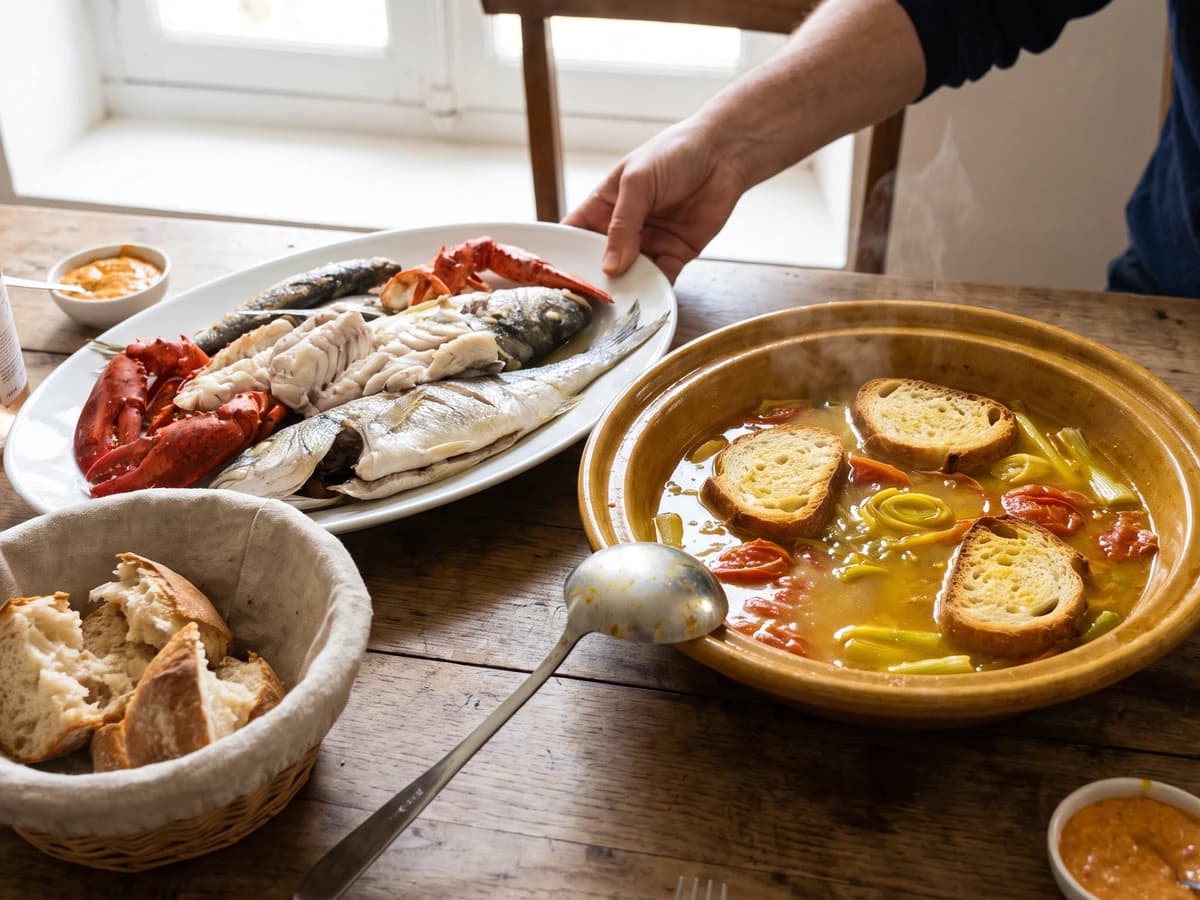
Marseille's great fish stew, saffron-gold and garlic-scented, proves that a hard boil can be the careful choice: it binds olive oil into broth before the whole pot meets bread.
A cooking platform built around craft, culture, and the stories behind what we eat.
Created by Chef Juliette
Based on No. 3, Chicken Consommé, from Le Guide Culinaire (1907) by Auguste Escoffier
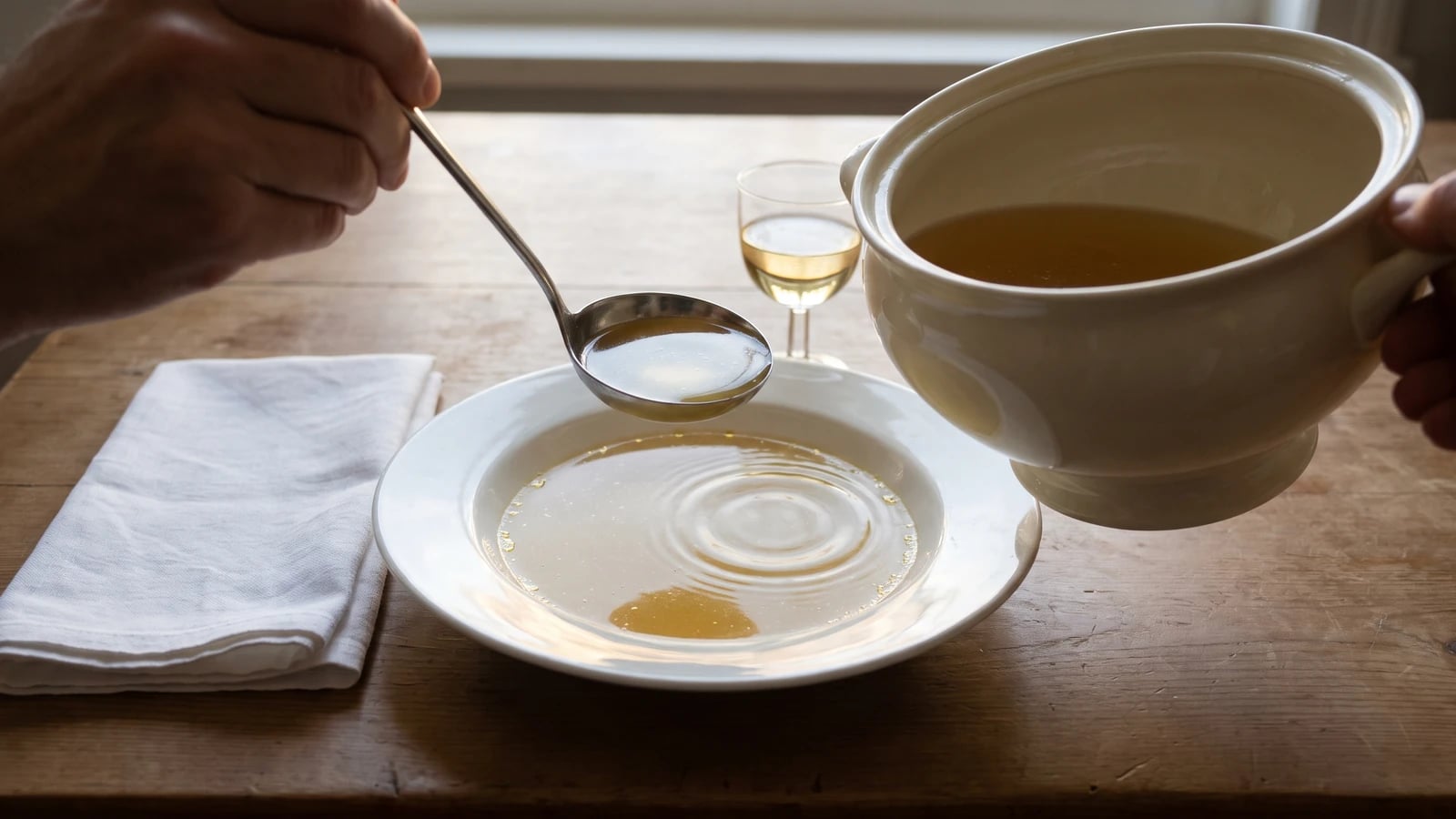
A clear soup that teaches restraint: old hen, roast carcasses, and patient clarification producing a light amber consommé whose depth is tasted, never advertised by darkness.
Consommé blanc de volaille (clear white chicken consommé) teaches one true thing: clarity comes from a cold clarification and stillness once the raft rises, not from straining a cloudy broth into submission. The stock may simmer for hours, but the decisive moment lasts seconds. Stop stirring when the proteins gather at the surface, keep the heat at a tremble, and the consommé clears beneath them.
The original formula assumed a saucier beside the pot, ordinary white stock never off the fire, and enough roast fowl carcasses to clarify a brigade quantity. Here, one lightly colored old hen and a reduced measure of lean beef make the parent stock, while two trimmed roast carcasses strengthen the clarification. I have reduced the volume to about two quarts, not changed the sequence or the balance. Repeated stockpot handling was brigade scaffolding, so careful skimming and a rapid ice-bath chill replace it. The colored hen, lean roast carcasses, cold raft, and bare simmer are the dish itself, and all remain. One cook, one stove, one evening.
The finished consommé should be light amber yellow, limpid enough to show the bottom of a white cup, and rich without a bead of grease on its surface. Dark brown is not deeper flavor here; it means the poultry was colored too far. Begin with everything cold, and when the raft rises, stop stirring. That stillness decides the soup.
Consommé blanc de volaille belongs to the classical Parisian service table, where a clear soup opened a formal meal and displayed the kitchen's command of stock, fat, and fire. It grew from the household practice of clarifying broth, then grand kitchens gave it a double construction: an old hen lightly colored for the stock and lean roast fowl carcasses added during clarification. In this vocabulary, blanc does not mean colorless; it distinguishes the pale stock family from brown consommé, and its proper color remains a warm, light amber yellow.
Quantity
1, weighing 4 to 5 pounds (1.8 to 2.3 kg)
quartered with excess fat removed
Quantity
2, about 2 pounds (900 g)
excess skin and fat removed and butcher-cut into 2-inch pieces
Quantity
1½ pounds (680 g)
cut into 2-inch pieces
Quantity
4½ quarts (4.25 liters / 4.25 kg)
Quantity
1 (¾ cup / 120 g)
roughly chopped
Quantity
1 (1½ cups / 200 g)
quartered
Quantity
1 (1¼ cups / 150 g)
white and pale green parts thoroughly washed and sliced
Quantity
2 (1 cup / 100 g)
roughly chopped
Quantity
1
4 parsley stems, 2 thyme sprigs, and 1 bay leaf
Quantity
2
Quantity
12 ounces (340 g)
finely minced
Quantity
1 (½ cup / 75 g)
finely minced
Quantity
½ leek (½ cup / 60 g)
white part finely minced
Quantity
1 stalk (½ cup / 50 g)
finely minced
Quantity
3 large (⅓ cup / 90 g)
Quantity
1 cup (240 ml / 240 g)
Quantity
2 large (¼ cup / 60 g)
Quantity
½ cup (120 ml / 120 g)
Quantity
2 teaspoons (10 ml / 12 g)
divided
| Ingredient | Quantity |
|---|---|
| old hen or stewing chickenquartered with excess fat removed | 1, weighing 4 to 5 pounds (1.8 to 2.3 kg) |
| lean raw chicken carcassesexcess skin and fat removed and butcher-cut into 2-inch pieces | 2, about 2 pounds (900 g) |
| lean beef shincut into 2-inch pieces | 1½ pounds (680 g) |
| cold water for the stock | 4½ quarts (4.25 liters / 4.25 kg) |
| large carrot for the stockroughly chopped | 1 (¾ cup / 120 g) |
| medium yellow onionquartered | 1 (1½ cups / 200 g) |
| large leek for the stockwhite and pale green parts thoroughly washed and sliced | 1 (1¼ cups / 150 g) |
| celery stalks for the stockroughly chopped | 2 (1 cup / 100 g) |
| bouquet garni4 parsley stems, 2 thyme sprigs, and 1 bay leaf | 1 |
| whole cloves | 2 |
| very lean beef top roundfinely minced | 12 ounces (340 g) |
| small carrot for the clarificationfinely minced | 1 (½ cup / 75 g) |
| leek for the clarificationwhite part finely minced | ½ leek (½ cup / 60 g) |
| celery for the clarificationfinely minced | 1 stalk (½ cup / 50 g) |
| egg whites | 3 large (⅓ cup / 90 g) |
| cold water for the clarification | 1 cup (240 ml / 240 g) |
| egg whites for reclarifying (optional) | 2 large (¼ cup / 60 g) |
| cold water for reclarifying (optional) | ½ cup (120 ml / 120 g) |
| fine saltdivided | 2 teaspoons (10 ml / 12 g) |
Heat the oven to 400°F (200°C). Arrange the hen pieces and trimmed carcasses in a single layer in a roasting pan without oil. Roast until the exposed surfaces are pale gold, turning once, 25 to 35 minutes; remove individual pieces as they reach the right color. You are waking the poultry's aroma, not building the dark crust of a brown stock. Set the carcasses aside to cool, then refrigerate them for the clarification.
Put the lightly colored hen, beef shin, and 4½ quarts cold water into a 10 to 12-quart stockpot. Bring the liquid slowly toward a simmer over about 40 minutes, skimming the grey foam as it gathers; rushing this stage churns those proteins back into the stock. Once the foaming subsides, add the roughly chopped carrot, onion, leek, celery, bouquet garni, cloves, and 1 teaspoon of the salt. Hold at the barest tremble for 3 to 3½ hours, uncovered, skimming fat occasionally. Never let it roll. The reduced quantity of beef gives the parent white stock its classical body, while the old hen remains the leading flavor.
Lift out the large solids with a skimmer, then ladle the stock through a damp fine-mesh sieve into a clean bowl. Do not press the meat or vegetables; pressing extracts cloudy particles and tired flavors. Set the bowl into a larger bowl of ice water and stir the stock gently until cool, then refrigerate until thoroughly cold, about 45 minutes in a shallow container. Remove every firm patch of fat from the surface. The stock need not be perfectly clear yet, but it must be cold and well degreased before clarification.
Clean the stockpot. In it, loosen the finely minced beef with the minced carrot, leek, celery, 3 egg whites, and 1 cup cold water. Add the chilled roast carcass pieces and mix until the whites coat everything. Pour in the cold stock and stir thoroughly, reaching across the pot floor so no meat remains packed in a corner. Cold ingredients give the egg whites time to capture fat and fine particles as they coagulate; starting warm closes that door too soon.
Set the pot over medium-low heat and stir slowly from the bottom with a flat wooden spoon as the mixture warms. When pale curds begin gathering and the solids rise into a continuous cap, stop stirring completely. Open a 2-inch chimney near one side of the raft with the spoon handle, then keep the liquid beneath at a bare tremble for 50 to 60 minutes, ladling a little clear broth through the chimney and over the raft several times. Bubbles should appear only at the opening, never across the whole surface. If the pot boils and tears the raft apart, remove it from the heat and let it settle for 10 minutes. Ladle and filter it as directed below; if the broth remains hazy, cool it completely, whisk in the optional 2 whites with the optional ½ cup cold water, and repeat the slow heating without additional meat or carcasses. Ça se rattrape, though the second clarification will soften the flavor slightly.
Line a fine sieve with damp muslin or four layers of rinsed cheesecloth and set it over a clean bowl. Push a ladle through the chimney and draw the consommé from beneath the raft, passing it through the cloth a ladleful at a time. Leave the final cloudy spoonfuls in the pot. Never tip the whole raft into the sieve and never press it; gravity gives you a limpid consommé, while pressure sends grease and fine protein straight through.
Measure the filtered consommé. If you have more than 2 quarts, return it to a spotless pot and reduce it gently, without a rolling boil, until you reach about that volume. Draw a clean piece of absorbent kitchen paper lightly across the surface to collect any remaining beads of fat. Add the remaining salt little by little, tasting after each addition; clarification removes seasoning as well as impurities. The finished liquid should be light amber yellow, not brown, with enough body to linger on the lips but no greasy film.
Warm a soupière or individual soup cups with hot water, then dry them. Bring the consommé just to a quiet simmer and pour it immediately, leaving behind any sediment at the bottom of the pot. Serve it clear, without a reflex scattering of herbs, so its warm color and chicken aroma remain legible. À table!
1 serving (about 240g)
Culinary guides, cultural storytelling, and the editorial depth that makes cooking meaningful.
Discover Culinary ExplorerChef Juliette
Marseille's great fish stew, saffron-gold and garlic-scented, proves that a hard boil can be the careful choice: it binds olive oil into broth before the whole pot meets bread.
Chef Juliette
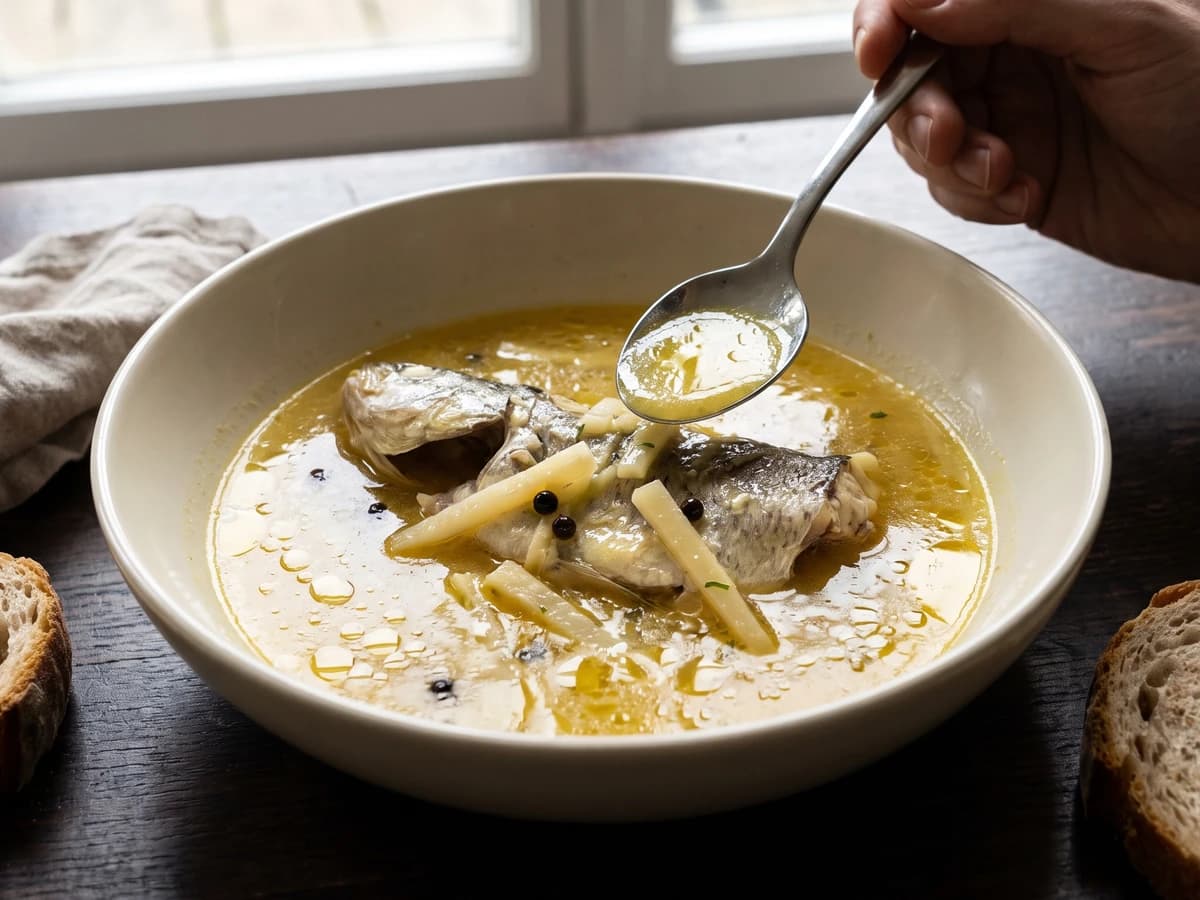
Waterzoi asks fresh, bone-in river fish to thicken its own buttery broth, with parsley root and pepper for company. No flour, no stockpot, just a brisk simmer watched closely.
Chef Juliette
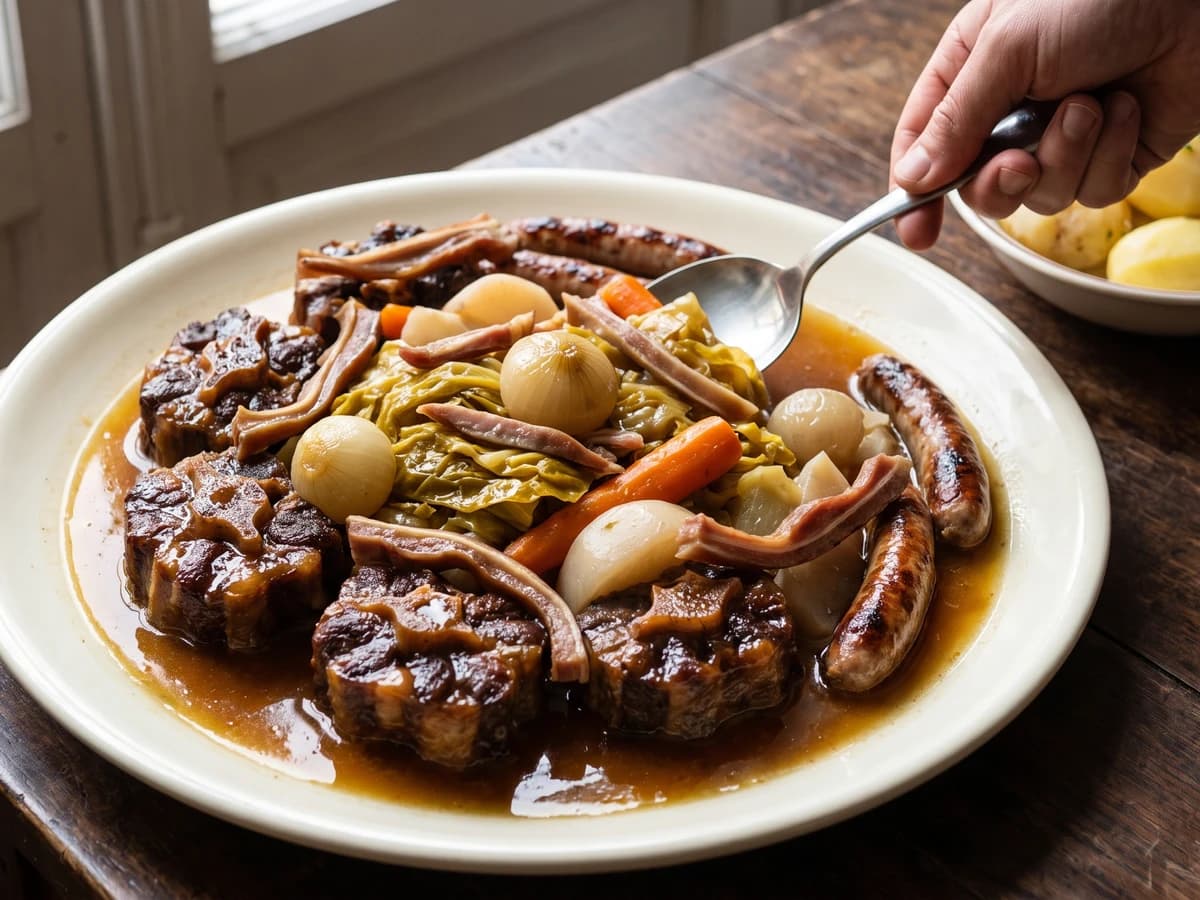
Queue de Bœuf en Hochepot gathers oxtail, pig's trotter and ear, cabbage, roots, and grilled chipolatas around a clear, gelatin-rich broth whose quiet simmer keeps every piece tender and distinct.
Chef Juliette
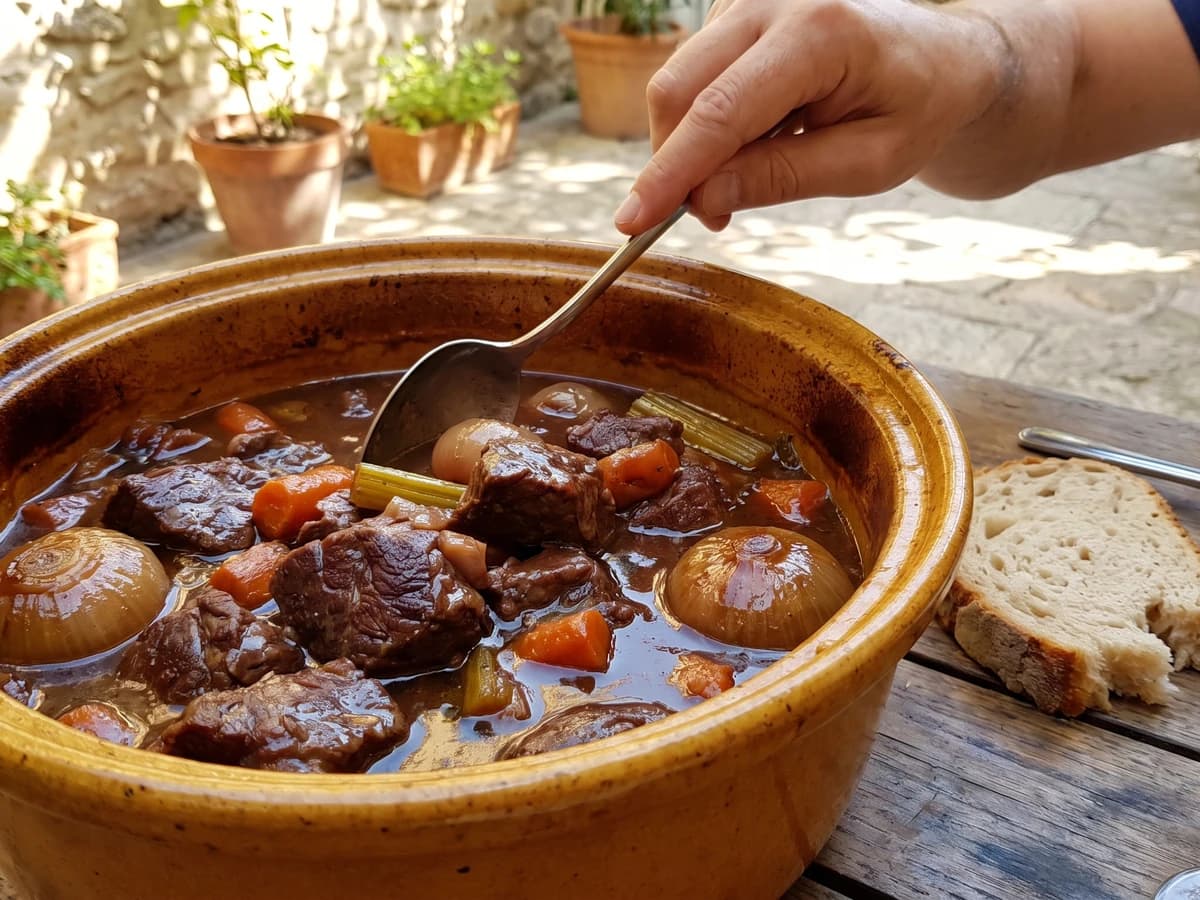
Beef shoulder larded with bacon, sharpened by red wine and vinegar, then sealed with garlic, vegetables, and dry lemon peel until the low oven turns it yielding and the gravy darkly glossy.