Chef Juliette
Ordinary or White Consommé
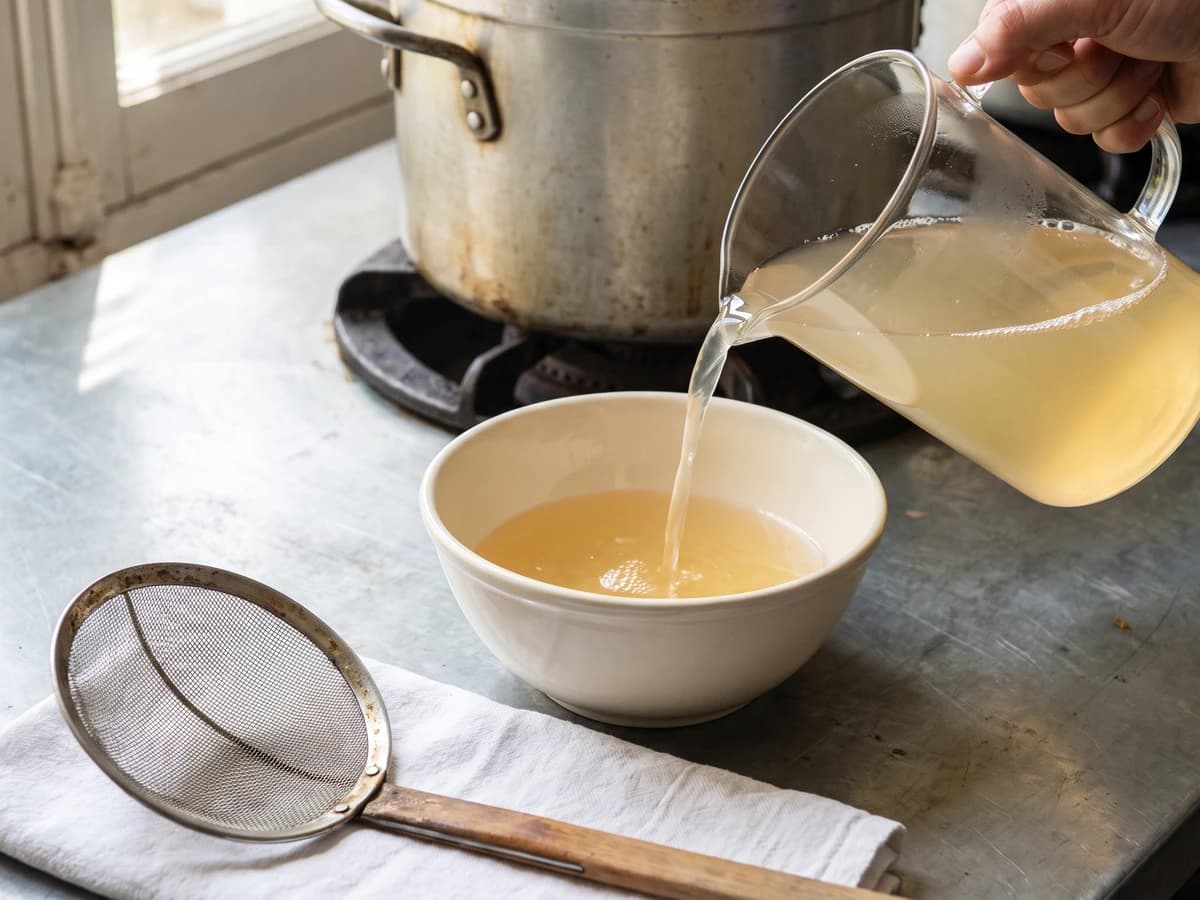
Beef shin, lean beef, and fowl begin in cold water and rise slowly toward a tremble. Skim before the boil, and you learn the quiet discipline that gives every clear French broth its backbone.
A cooking platform built around craft, culture, and the stories behind what we eat.
Created by Chef Juliette
Based on No. 28, Béchamel Sauce, from Le Guide Culinaire (1907) by Auguste Escoffier
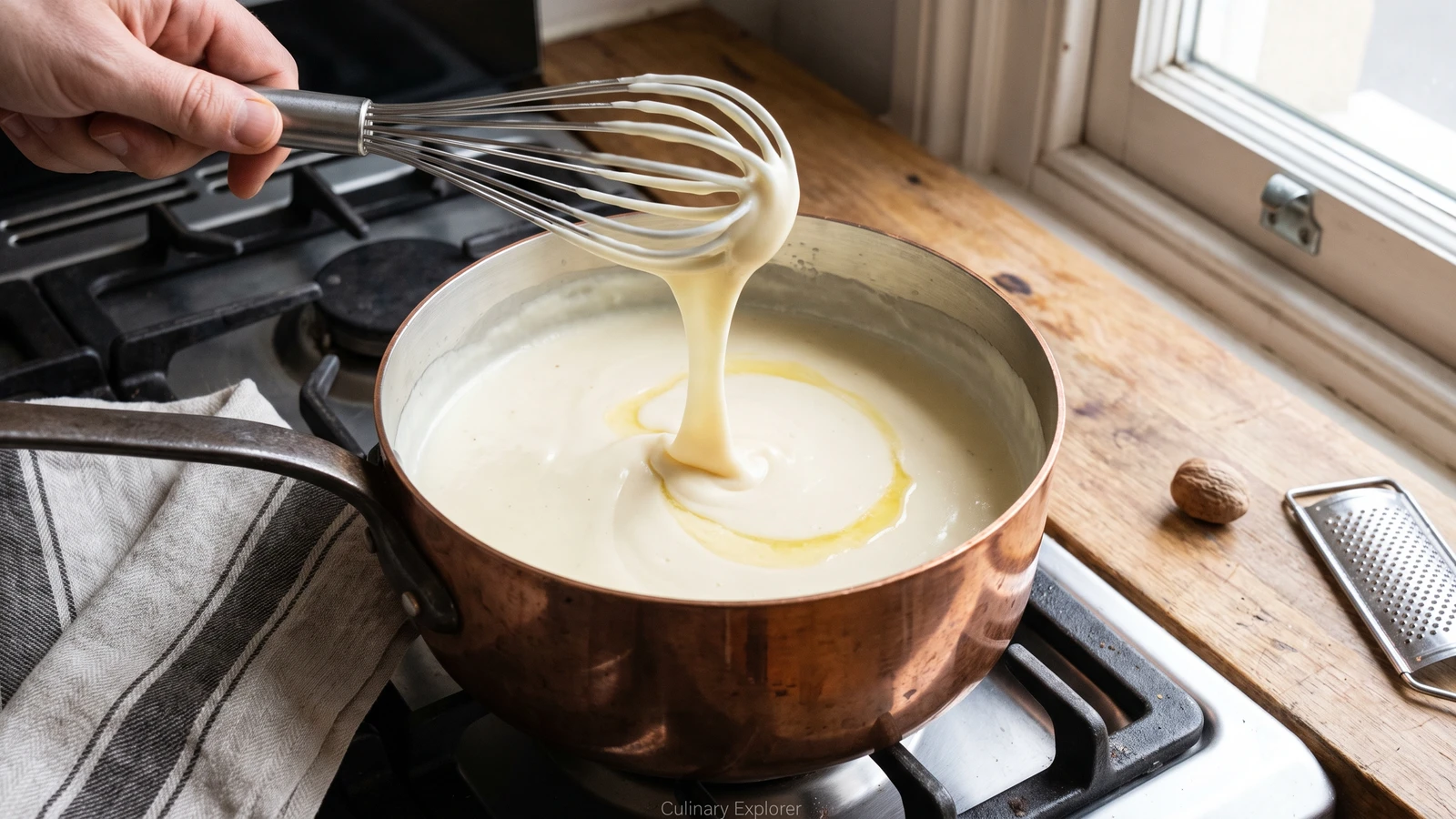
Sauce Béchamel (white sauce) teaches the roux: boiling milk, nearly cool white roux, and a hard whisk make an ivory ribbon no lump can survive.
Sauce Béchamel (white sauce) teaches the first law of roux-thickened sauces: separate the temperatures. Boiling milk must meet an almost-cool white roux while the whisk moves hard and reaches every corner. Get that one contrast right and the sauce turns smooth before it has time to form a lump. C'est la même grammaire across the whole family.
The four-quart formula assumed a saucier tending several pans and a tammy waiting beside the stove. Here the quantities are halved for about two quarts, enough for a generous gratin or several smaller dishes, and a fine-mesh sieve replaces the tammy. Scale and old equipment are brigade scaffolding. The pale roux, uncoloured veal and onion, boiling milk, and slow hour of cooking are the dish, so they remain intact. One cook, one stove, one evening.
Finished Béchamel should be ivory rather than beige, glossy rather than gluey, with enough body to cover a spoon in a smooth, opaque ribbon. If lumps appear when milk meets roux, stop pouring and whisk before doing anything else. Ça se rattrape. Before you touch the pan, allow enough time for the roux to become barely warm; that pause decides the sauce.
Béchamel found its canonical home in the grand kitchens of Paris, where it became a foundational white sauce used to bind, cloak, and enrich other preparations. Grand-kitchen formulas often simmered the milk and roux with lean veal and aromatics, as this one does, while Lenten tables omitted the meat. The familiar mixture of milk, butter, and flour is therefore only the pared form that traveled most easily into home gratins, croquettes, and baked dishes.
Quantity
9 cups (2.13 L / 2.19 kg)
Quantity
½ cup (120 ml / 113.5 g)
for the white roux
Quantity
15 tablespoons (225 ml / 113.5 g)
Quantity
¼ pound (4 ounces / 113 g)
cut into small cubes
Quantity
2 tablespoons (30 ml / 28 g)
divided between cooking the veal and protecting the finished sauce
Quantity
½, about ⅓ cup (80 ml / 50 g)
finely minced
Quantity
1½ teaspoons (7.5 ml / 9.5 g)
Quantity
1 small pinch, about 1/16 teaspoon (0.3 ml / 0.15 g)
Quantity
1 small pinch, about 1/16 teaspoon (0.3 ml / 0.1 g)
Quantity
½ small sprig
| Ingredient | Quantity |
|---|---|
| whole milk | 9 cups (2.13 L / 2.19 kg) |
| unsalted butterfor the white roux | ½ cup (120 ml / 113.5 g) |
| plain flour | 15 tablespoons (225 ml / 113.5 g) |
| lean vealcut into small cubes | ¼ pound (4 ounces / 113 g) |
| unsalted butterdivided between cooking the veal and protecting the finished sauce | 2 tablespoons (30 ml / 28 g) |
| small onionfinely minced | ½, about ⅓ cup (80 ml / 50 g) |
| fine salt | 1½ teaspoons (7.5 ml / 9.5 g) |
| mignonnette (coarsely crushed peppercorns) | 1 small pinch, about 1/16 teaspoon (0.3 ml / 0.15 g) |
| freshly grated nutmeg | 1 small pinch, about 1/16 teaspoon (0.3 ml / 0.1 g) |
| fresh thyme | ½ small sprig |
Melt the ½ cup butter in a heavy 5-quart saucepan over low heat. Add the flour and stir continuously with a wooden spoon for 3 to 4 minutes, until the paste loosens slightly and loses its raw flour smell while remaining completely ivory. Remove the pan from the heat and let the roux cool for 15 to 20 minutes, until it feels barely warm. Colour cannot be whisked away later; if the roux browns, begin again with fresh butter and flour.
Melt 1 tablespoon of the remaining butter in a skillet over medium-low heat. Raidir, stiffen without browning, the veal and minced onion for 5 to 6 minutes, stirring often, until the veal is opaque and firm at the edges and the onion has softened. Neither should take colour. If the butter begins to brown, pull the pan from the heat at once and lower the burner before continuing.
Pour the milk into a separate heavy saucepan and bring it to a full boil over medium heat, stirring across the bottom frequently so the milk cannot scorch. Watch closely as it approaches the boil; milk rises with great confidence and no sense of the size of your stove. Remove it from the heat the moment it swells.
Set the nearly cool roux pan on a folded cloth so it cannot slide. Pour in the boiling milk in a steady stream while whisking hard, reaching around the wall and into every corner of the pan. Once all the milk is incorporated, return the pan to medium heat and whisk until the sauce reaches its first boil. If lumps appear, stop pouring and whisk them smooth before adding more milk. If a few survive, pass the sauce through the fine-mesh sieve into a clean pan now, then continue. Ça se rattrape.
Add the veal, onion, and their butter to the Béchamel, followed by the salt, mignonnette, nutmeg, and thyme. Bring the sauce just back to the boil, then lower the heat until only a few lazy bubbles break the surface. Cook for about 1 hour from the initial boil, stirring every 5 minutes and scraping the bottom and corners. This lowest-burner simmer is the home equivalent of cooking at the side of the fire. If the sauce catches, do not scrape the browned layer into it; immediately pour the unstuck sauce into a clean pan and continue over gentler heat.
Remove the thyme and pass the Béchamel through a fine-mesh sieve into a heatproof bowl, pressing the sauce through gently without crushing the veal and onion. It is ready when it coats the back of a spoon in a smooth ivory layer and a finger drawn through it leaves a clean path. If it is too loose, simmer it a few minutes longer; if it has tightened too far, whisk in hot milk a spoonful at a time. For holding or cooling, melt the final tablespoon of butter and spoon it over the surface in a thin film so no skin forms. We don't apologize for butter.
1 serving (about 64g)
Culinary guides, cultural storytelling, and the editorial depth that makes cooking meaningful.
Discover Culinary ExplorerChef Juliette
Beef shin, lean beef, and fowl begin in cold water and rise slowly toward a tremble. Skim before the boil, and you learn the quiet discipline that gives every clear French broth its backbone.
Chef Juliette
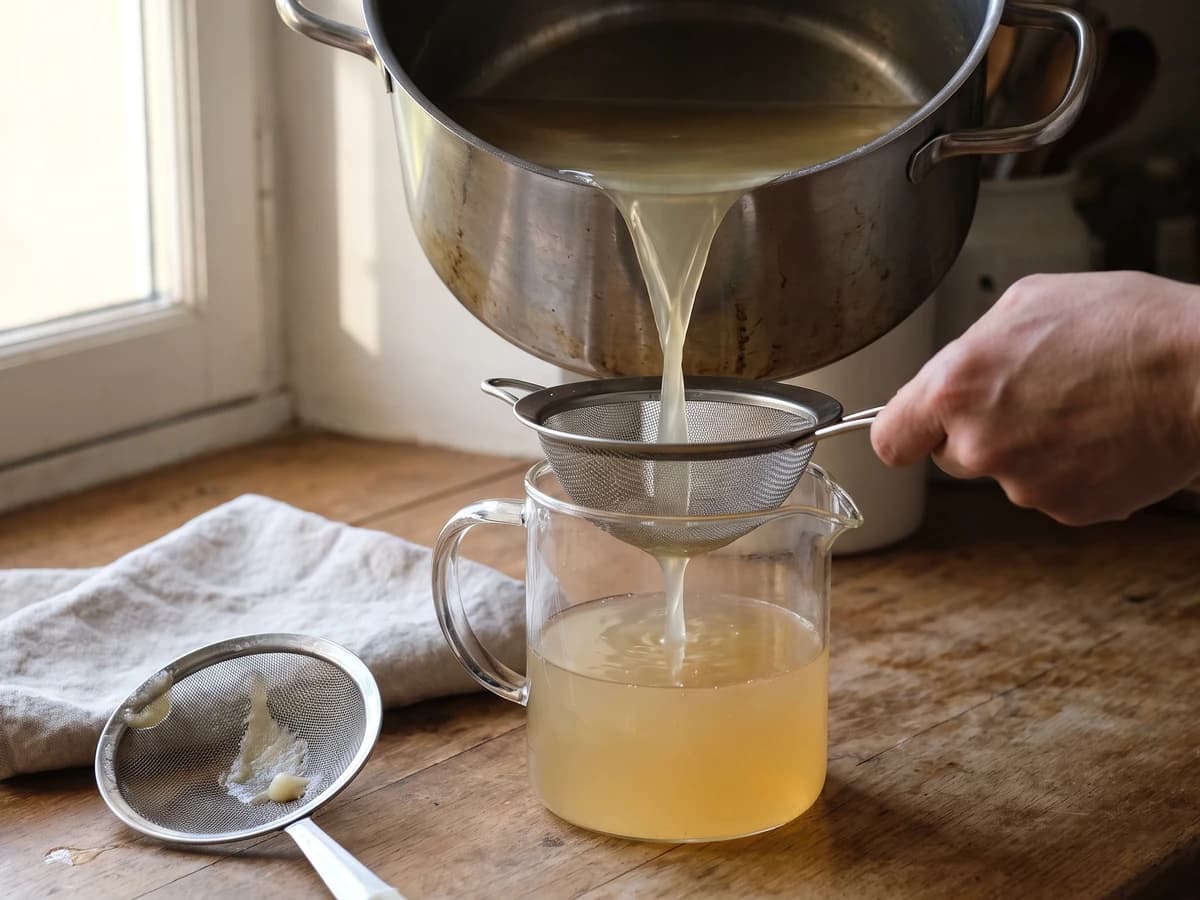
Break the veal bones small, then give them eight hours at a bare tremble. This pale, gelatinous fond becomes the quiet foundation beneath velouté, blanquette, and every sauce that must stay light.
Chef Juliette
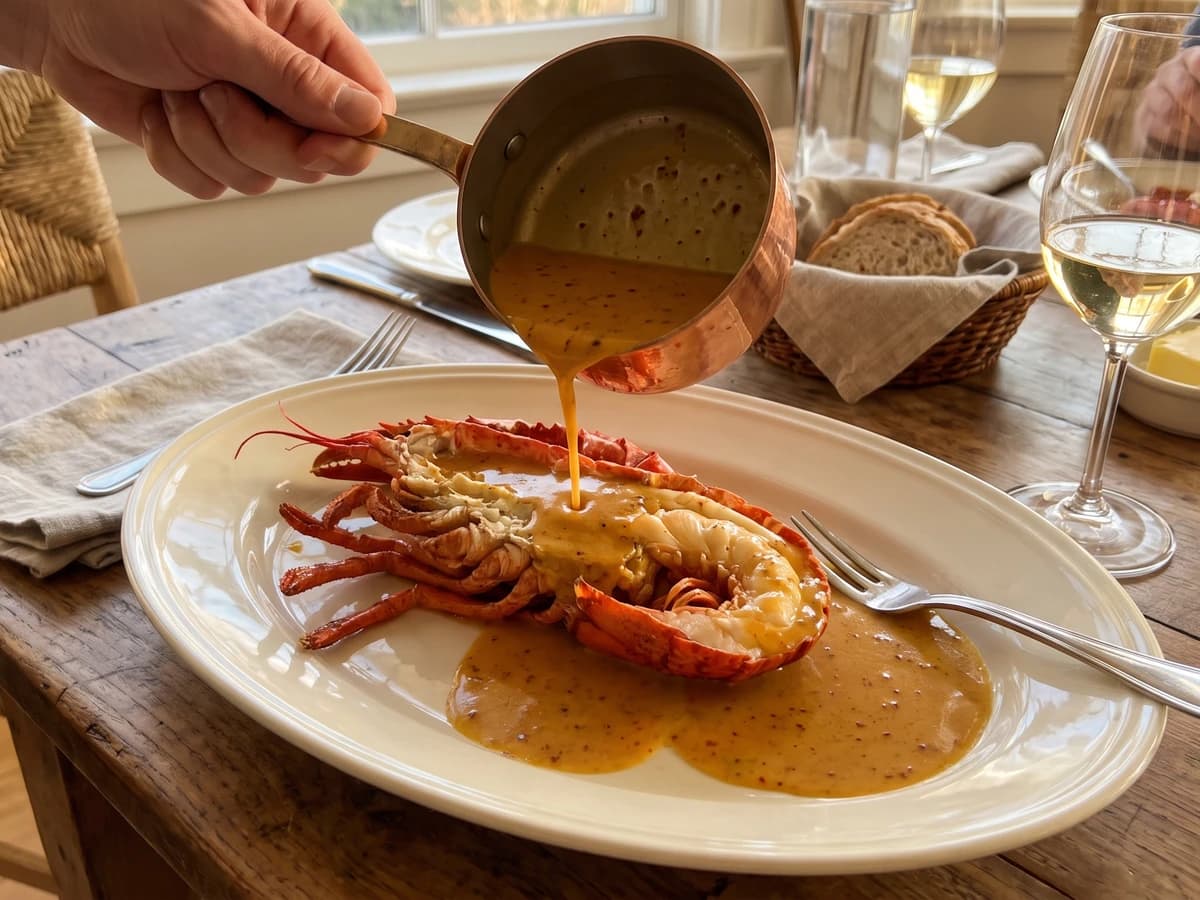
Sauce Orientale concentrates lobster-rich American Sauce with curry, then folds in cream away from the fire: a glossy, gently spiced derivative made for lobster, crayfish, and firm fish.
Chef Juliette
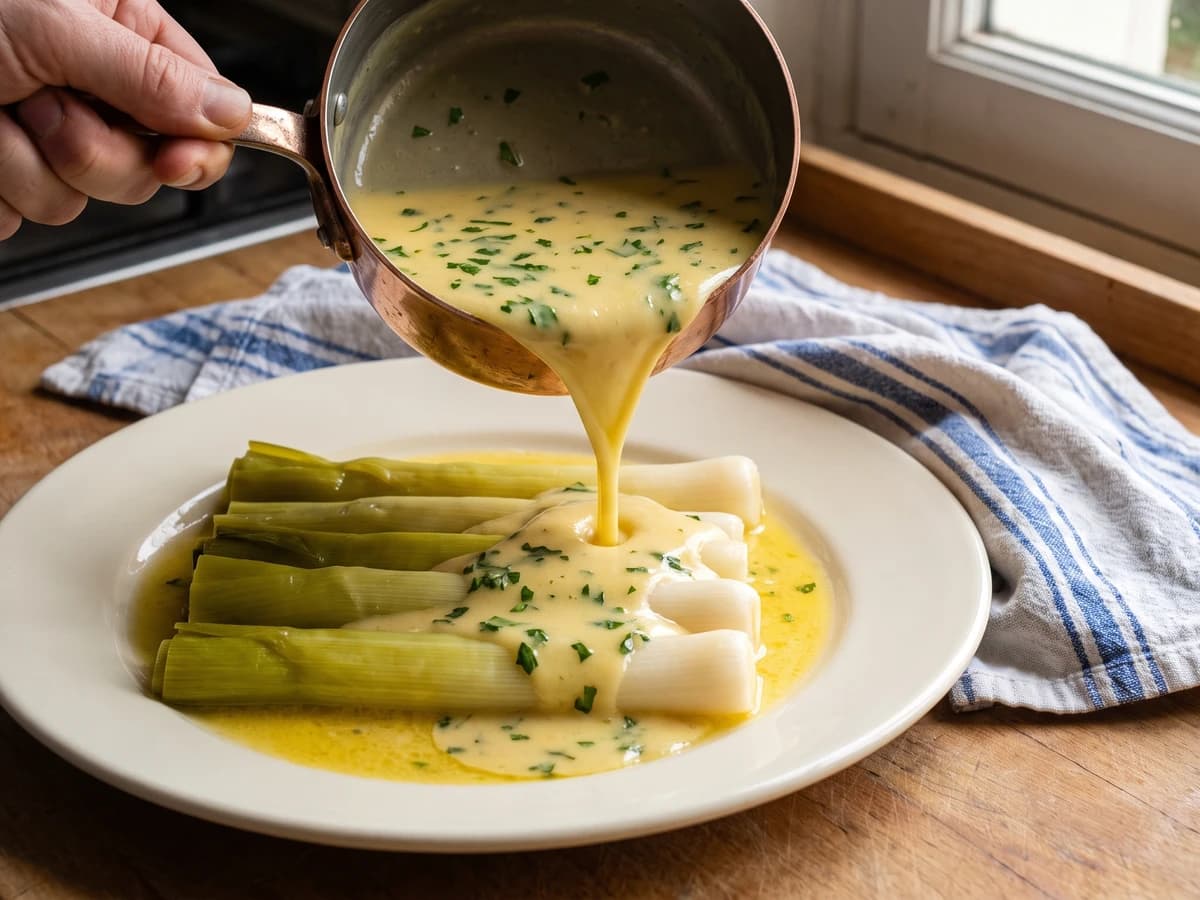
An old lesson in sauce families: Sauce Allemande takes mushroom liquor, then butter, lemon, and parsley, becoming a glossy Poulette for sheep's trotters, leeks, cauliflower, and anything needing gentle richness with a bright edge.