
Chef Juliette
John Dory (St. Pierre)
John Dory has the delicacy of sole and the firmness of turbot. A light flouring, a quick butter sauté, and nut-brown beurre noisette show exactly why looks never mattered.
A cooking platform built around craft, culture, and the stories behind what we eat.
Created by Chef Juliette
Based on No. 265, Frying Medium For Fish, from Le Guide Culinaire (1907) by Auguste Escoffier
Bain de friture teaches the rule governing fried fish: match the oil's heat to the fish's size, and milk plus flour forms a crisp, protective coat.
Bain de friture pour poisson (frying medium for fish) teaches one true thing: the oil's temperature must suit the fish's thickness, so the coating browns at the same moment the flesh finishes cooking. Too cool and the flour drinks oil. Too hot and the coat darkens while the centre remains raw. For these fillets, 180°C is the meeting point.
The original method assumed a large working fryer, repeated batches, and frying fat filtered and used until its strength was exhausted. A home kitchen has neither that turnover nor a brigade watching the vat, so fresh refined oil, a heavy pot, and a clip-on thermometer are the honest equivalents. Pushing dark oil to exhaustion was useful economy at scale; at home it becomes bitter and smoky. That scaffolding can go. The salted-milk steep, the light flouring, and the temperature control are the dish and must stay. One cook, one stove, one evening.
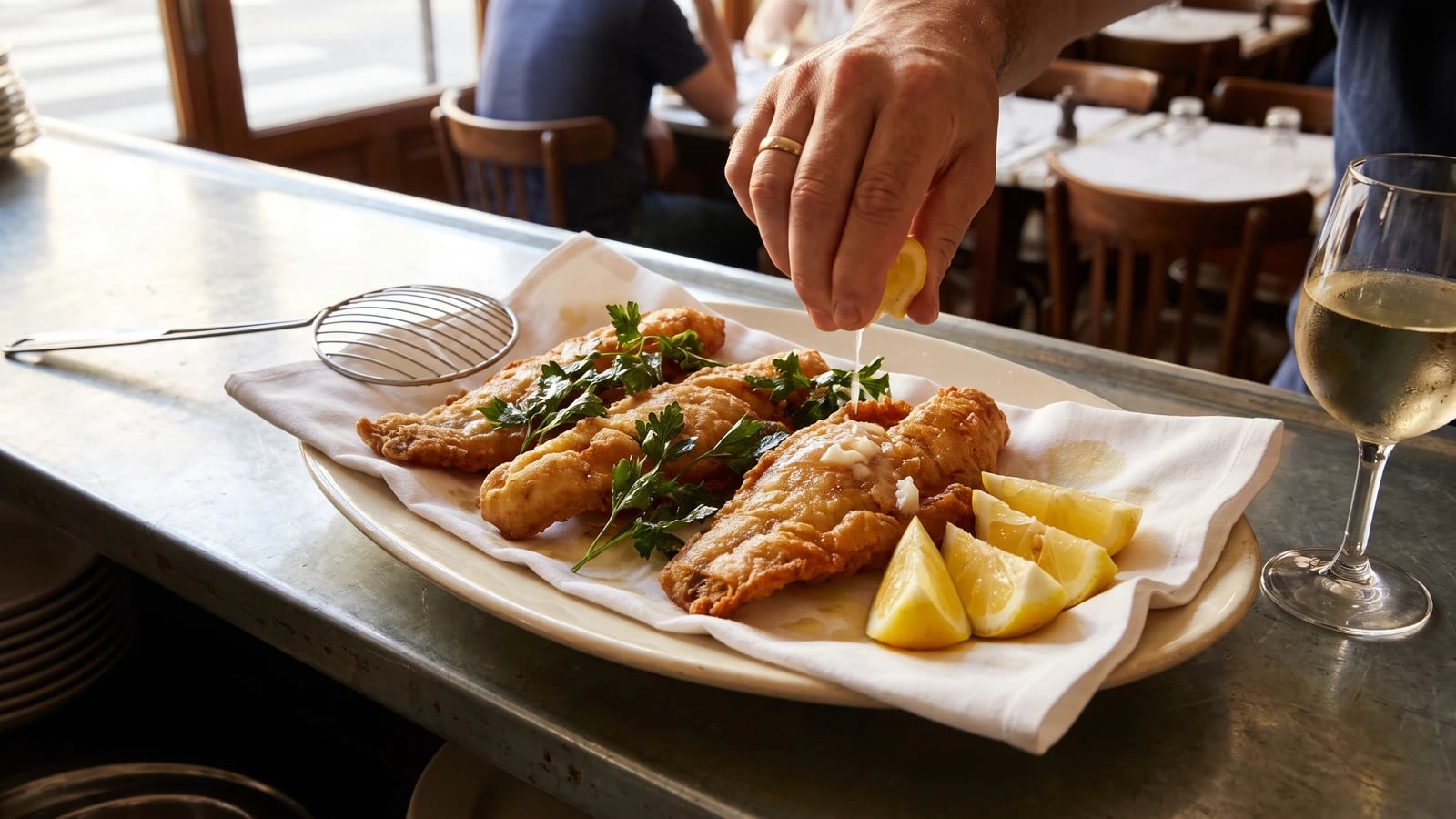
When it lands on the platter, the crust should be thin and crisp rather than armoured, with moist flakes beneath and only the faintest sheen of oil. Flour immediately before frying and wait for the oil to recover between batches. That pause decides the whole result.
Along the Rhône and Saône around Lyon, friture of small freshwater fish belongs to riverside tables, while the guinguettes of the Marne around Paris made the same quick frying a social meal. Classical kitchens turned those local practices into a general rule for fish cookery: friture named both the fat bath and the food emerging from it. The exception for Mediterranean nonats and whitebait preserves a practical distinction, since fish this tiny need only flour, while larger pieces benefit from salted milk before dredging.
Quantity
4 fillets, 1½ pounds total (680 g)
cut evenly, about ¾ inch (2 cm) thick
Quantity
1½ cups (360 ml / 370 g)
Quantity
2 teaspoons (10 ml / 12 g)
divided
Quantity
1½ cups (360 ml / 180 g)
Quantity
6 cups (1.4 L / 1.3 kg)
Quantity
12 sprigs (about 20 g)
washed and dried completely
Quantity
2 (about 220 g)
channelled and cut into sections
| Ingredient | Quantity |
|---|---|
| skinless firm white-fish fillets, such as cod, haddock, or pollockcut evenly, about ¾ inch (2 cm) thick | 4 fillets, 1½ pounds total (680 g) |
| cold whole milk | 1½ cups (360 ml / 370 g) |
| fine sea saltdivided | 2 teaspoons (10 ml / 12 g) |
| plain flour | 1½ cups (360 ml / 180 g) |
| refined peanut or sunflower oil | 6 cups (1.4 L / 1.3 kg) |
| flat-leaf parsley sprigswashed and dried completely | 12 sprigs (about 20 g) |
| medium lemonschannelled and cut into sections | 2 (about 220 g) |
Pour the oil into a heavy, deep pot, leaving the vessel no more than half full. Clip on the thermometer and heat the bain de friture steadily to 180°C (355°F). This temperature suits fillets about ¾ inch (2 cm) thick: thinner fish can take 185°C (365°F), while thicker pieces need 170 to 175°C (340 to 350°F) so their centres cook before the coating darkens. Never leave heating oil unattended.
Dissolve 1 teaspoon of the salt in the cold milk. Lay the fish in a shallow dish, pour over the salted milk, and refrigerate for 15 minutes, turning once. The milk leaves a fine film that catches the flour and softens any sharp marine aroma without masking the fish. Lift out each fillet and let the excess milk run away; discard the used milk.
Spread the flour in a wide dish. Dredge each damp fillet just before it enters the oil, pressing very lightly so the flour adheres, then shake off every loose veil. You want a thin coat, not a paste. If the flour gums into thick wet patches, brush them away and dredge that area again lightly. Ça se rattrape.
Lower two fillets into the bain de friture, moving them away from you to prevent splashing. Fry without crowding, turning once, until the crust is evenly golden and the flesh is opaque and flakes under gentle pressure, about 3 to 5 minutes depending on thickness. The centre should reach 63°C (145°F). Let the oil return to 180°C before frying the next batch.
Lift each fillet with a spider and let it drain over the pot for several seconds. Set it on a wire rack over absorbent paper, touch the underside briefly to the paper, and season lightly with some of the remaining salt. Never stack the pieces. Trapped moisture softens the coating you have just worked to make crisp.
Make certain the parsley is completely dry, because water and hot oil quarrel violently. Lower the sprigs into the bain de friture with the spider and fry for 5 to 10 seconds, just until crisp and deep green. Drain them on paper and salt with the final pinch. If the parsley is even slightly damp, dry it again before it approaches the pot.
Arrange the fish on a folded white serviette or fresh absorbent paper set over a warm platter. Add the fried parsley sprays and channelled lemon sections, keeping the lemon beside the crust until each person squeezes it. Serve at once, while the flour still murmurs under the fork. À table!
1 serving (about 205g)
Culinary guides, cultural storytelling, and the editorial depth that makes cooking meaningful.
Discover Culinary ExplorerChef Juliette
John Dory has the delicacy of sole and the firmness of turbot. A light flouring, a quick butter sauté, and nut-brown beurre noisette show exactly why looks never mattered.

Chef Juliette
Fresh haddock proves its delicacy in the meunière pan: a fine flour crust, moist pearly flakes, and beurre noisette sharpened with lemon and parsley, ready from one skillet in half an hour.

Chef Juliette
Éperlans à l’Anglaise turns small fish into a lesson in disciplined coating: boned smelts under a close, crisp crumb, pan-fried in clarified butter and finished with bright, half-melted maître d’hôtel butter.

Chef Juliette
Tiny smelts, shallot, mushrooms, white wine, gratin sauce, and fine bread raspings meet a fierce oven, where the fish must turn tender in the same breath the buttered crust bronzes.