
Chef Juliette
John Dory (St. Pierre)
John Dory has the delicacy of sole and the firmness of turbot. A light flouring, a quick butter sauté, and nut-brown beurre noisette show exactly why looks never mattered.
A cooking platform built around craft, culture, and the stories behind what we eat.
Created by Chef Juliette
Based on No. 260, Fish Grills, from Le Guide Culinaire (1907) by Auguste Escoffier
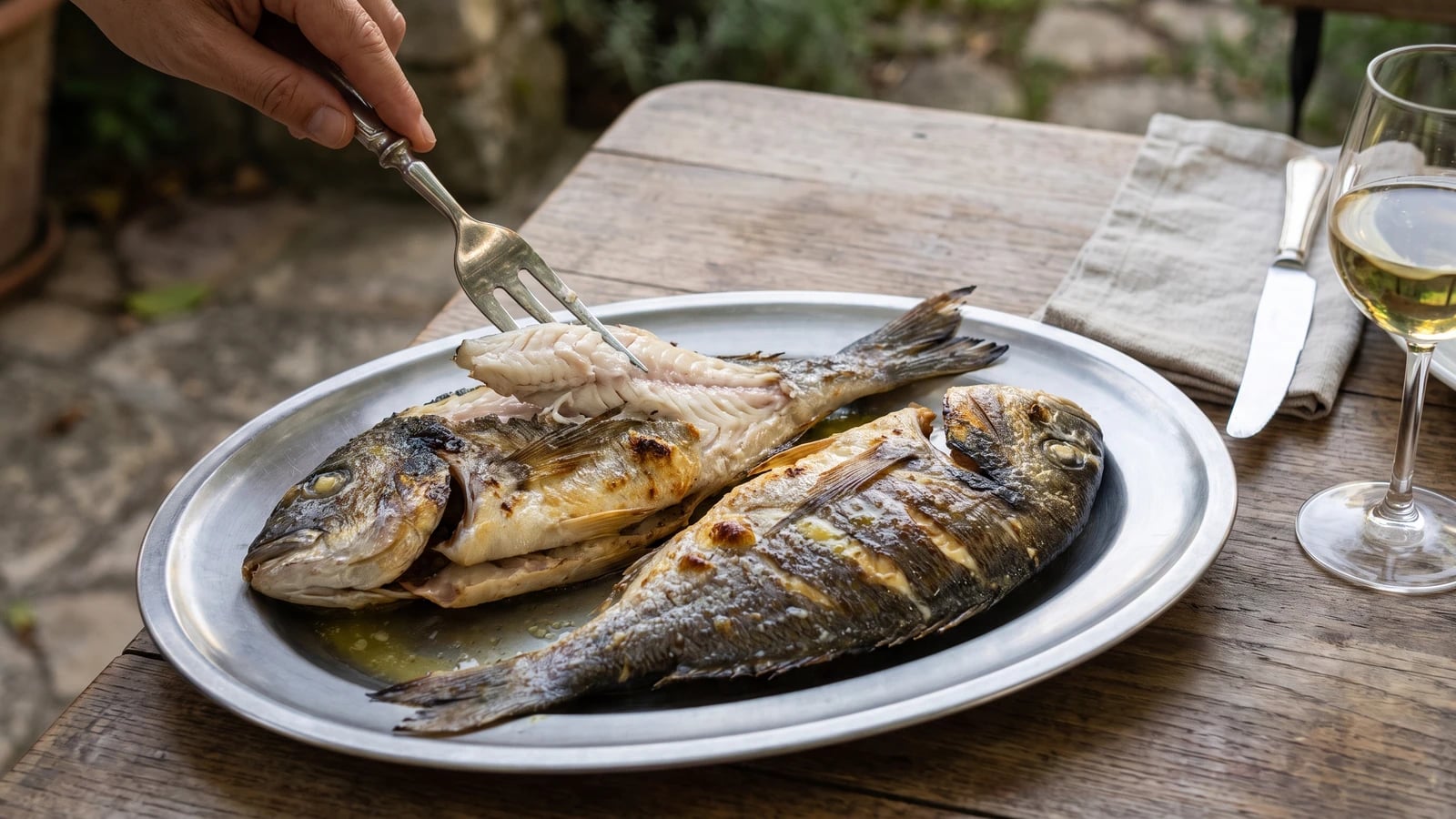
Poissons grillés teaches the discipline of moderate fire: whole sea bream, lightly floured and generously buttered, cooks to a golden shell while the flesh stays moist and releases cleanly from the bone.
Poissons grillés (grilled fish) teaches the discipline of moderate fire. Fierce heat blackens flour and butter before the thick flesh releases from the bone; timid heat leaves the crust pale and the skin stuck. Hold the fire between those failures, and a whole lean fish comes off bronze, moist, and clean at the backbone. The floured shell is not decoration. It is protection against drying.
The old formula assumed a grill cook stationed at an open charcoal fire, a service-sized gridiron, and a free hand to sprinkle butter as the fish cooked. It needed no saucier, no stockpot kept simmering, and no salamander, because none belongs to this preparation. At home, a two-zone gas or charcoal grill, two whole sea bream, and a small pot of clarified butter do the same work. The scale and control of the fire changed; the intent did not.
The attendant and oversized gridiron were brigade scaffolding, so they go. The moderate fire, flour before butter for a lean fish, repeated basting, and final bone test are the dish, so they stay. Keep the cooler zone ready if the crust colors too quickly, but set the fire properly before the fish meets it. That is the step that decides the evening.
Poissons grillés belong to France's coastal and river tables rather than to one region: herring and mackerel suit the Channel and Atlantic ports, red mullet the Mediterranean coast, and trout the inland streams. The classical canon carried that everyday gridiron practice into grand kitchens, preserving a practical distinction between fish rich enough to baste itself and lean fish that need a floured, buttered shell. The enduring test needs no thermometer: a whole fish is ready when its bones release easily from the flesh.
Quantity
2, each 1¼ to 1½ pounds (570 to 680 g)
scaled, gutted, and fins trimmed
Quantity
1½ teaspoons (7.5 ml / 9 g)
Quantity
½ cup (120 ml / 60 g)
for dredging
Quantity
½ cup (120 ml / 110 g)
warmed until fluid and divided
| Ingredient | Quantity |
|---|---|
| whole sea breamscaled, gutted, and fins trimmed | 2, each 1¼ to 1½ pounds (570 to 680 g) |
| fine sea salt | 1½ teaspoons (7.5 ml / 9 g) |
| all-purpose flourfor dredging | ½ cup (120 ml / 60 g) |
| clarified butterwarmed until fluid and divided | ½ cup (120 ml / 110 g) |
Prepare a two-zone grill, with one side holding a steady moderate heat of about 355 to 375°F (180 to 190°C) at grate level and the other side cooler. On charcoal, spread an even single layer of glowing coals over two-thirds of the grill and leave the remaining third nearly empty; on gas, set one burner to medium and an adjacent burner to low. Scrape the grate thoroughly clean. A fierce fire scorches the coating before a whole fish cooks beside the bone, while the cooler zone gives you somewhere safe to finish it.
Pat the fish completely dry inside and out, paying particular attention to the skin around the belly opening. Moisture turns the flour to paste and encourages sticking. Season both cavities and both sides evenly with the salt, then move directly to the flour so the salt has no time to draw fresh moisture to the surface.
Spread the flour in a shallow tray. Roll each fish through it, coating the skin thinly from head to tail, then shake away every loose clump. Pour half the clarified butter into a separate shallow dish and brush it generously over the floured fish, always flour first and butter second. The flour forms the golden shield; a thick, wet layer becomes dough and burns. Discard the butter and flour that touched the raw fish, keeping the remaining clarified butter clean for basting.
Lay the fish across the moderate zone, leaving room between them. If using a fish basket, close it without squeezing the bodies; without one, leave the fish directly on the grate and have two broad spatulas ready. Grill the first side for 7 to 9 minutes without nudging it. Spoon a thin stream of clean clarified butter over the exposed side two or three times as it cooks. If the coating blackens or the butter flares, slide the fish immediately to the cooler zone and reduce the burner or close the vents slightly. Ça se rattrape. Let the fire settle before returning the fish to moderate heat.
Turn each fish in one confident movement, using the basket or supporting the head and tail with two spatulas. If the skin resists, wait another minute; a properly browned surface releases more willingly than a pale one. Baste again and grill the second side for 6 to 8 minutes. The fish is ready when the crust is butter-gold, the thickest flesh is opaque and moist, and a dorsal fin with its little attached bones pulls free without tearing. An instant-read thermometer placed in the thickest part beside, but not against, the backbone should register at least 145°F (63°C). If the crust is ready before the center, move the fish to the cooler zone, close the lid, and finish there for 2 to 4 minutes.
Transfer the fish whole to a warm platter and let them settle for 3 minutes. Serve by lifting away the upper fillets, drawing out the backbone in one piece, and then freeing the lower fillets. When the cooking is right, the bones come away cleanly and the flesh remains pearly beneath its crisp, floured shell. Bring the platter straight to the table. À table!
1 serving (about 150g)
Culinary guides, cultural storytelling, and the editorial depth that makes cooking meaningful.
Discover Culinary ExplorerChef Juliette
John Dory has the delicacy of sole and the firmness of turbot. A light flouring, a quick butter sauté, and nut-brown beurre noisette show exactly why looks never mattered.

Chef Juliette
Fresh haddock proves its delicacy in the meunière pan: a fine flour crust, moist pearly flakes, and beurre noisette sharpened with lemon and parsley, ready from one skillet in half an hour.

Chef Juliette
Éperlans à l’Anglaise turns small fish into a lesson in disciplined coating: boned smelts under a close, crisp crumb, pan-fried in clarified butter and finished with bright, half-melted maître d’hôtel butter.

Chef Juliette
Tiny smelts, shallot, mushrooms, white wine, gratin sauce, and fine bread raspings meet a fierce oven, where the fish must turn tender in the same breath the buttered crust bronzes.