
Chef Juliette
John Dory (St. Pierre)
John Dory has the delicacy of sole and the firmness of turbot. A light flouring, a quick butter sauté, and nut-brown beurre noisette show exactly why looks never mattered.
A cooking platform built around craft, culture, and the stories behind what we eat.
Created by Chef Juliette
Based on No. 254, Oven Roasts, from Le Guide Culinaire (1907) by Auguste Escoffier
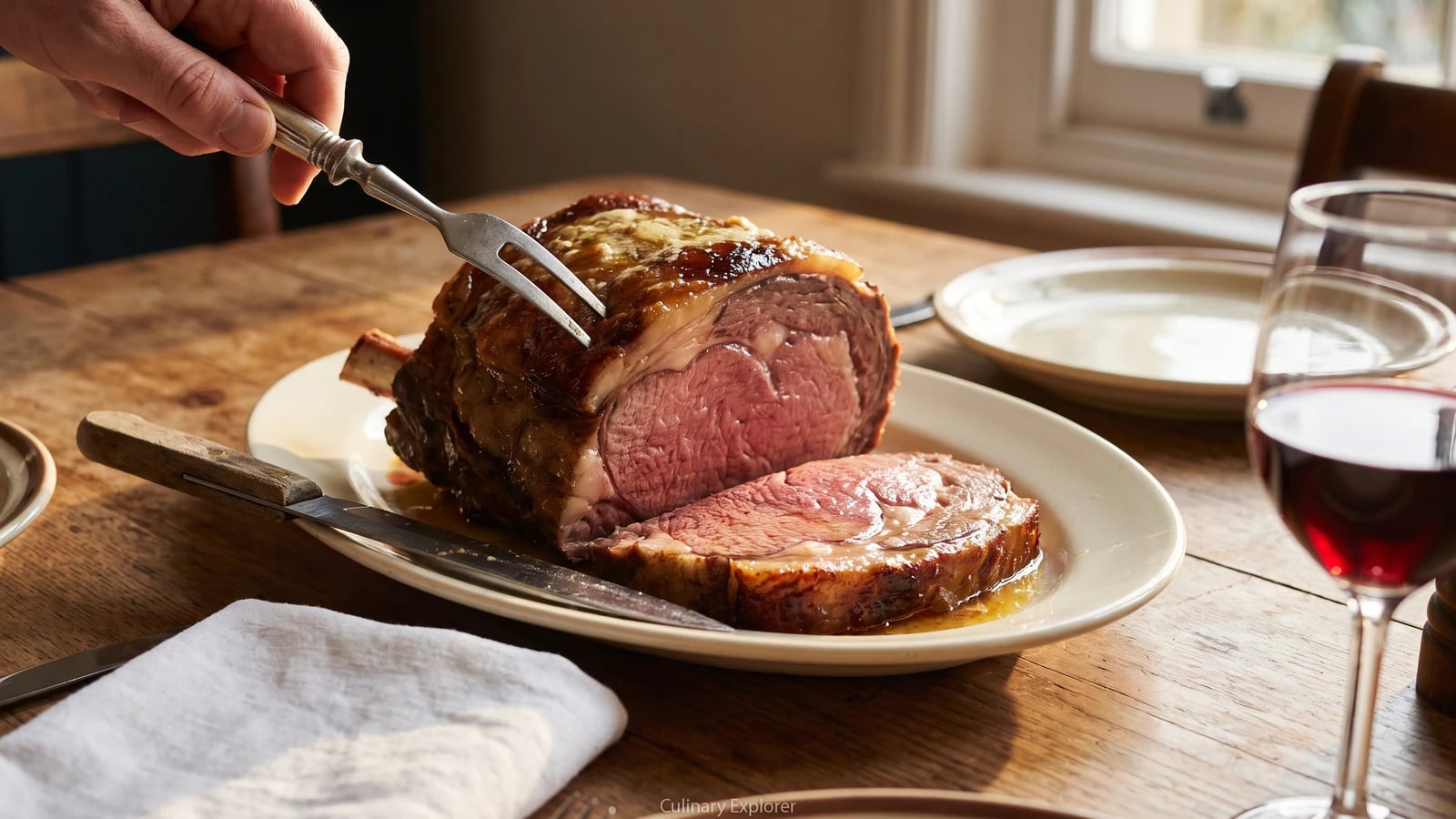
The master lesson in roasting: keep beef high above its drippings, add no liquid, and baste with fat alone until the crust bronzes and the center stays rosy.
Rôti de bœuf au four (oven-roasted beef) teaches one true thing: roasting requires dry heat around the meat. Raise the beef above its drippings and add no liquid. Water, stock, wine, or gravy produces vapor, softens the crust, and begins to stew what should be roasting.
The original entry assumes no saucier, no perpetual stockpot, and no salamander. Its brigade luxury is a proper meatstand, with a spit balanced over the pan offered as the practical substitute. At home, a sturdy wire rack inside a shallow roasting pan does the same work. The formal meatstand is scaffolding and can go; the air gap must stay. Here the open-ended brigade instruction becomes one 3-pound rib roast for four people. What changed is the equipment and portion, never the intent. One cook, one stove, one evening.
When it is right, the fat cap is deep bronze, the cut face is rosy, and clear juices bead beneath the knife. Before you touch the pan, secure the rack and leave the pan dry. That separation is the step that decides the roast.
Rôti au four belongs to the French bourgeois Sunday and holiday table rather than to one particular region. The method carries the grammar of rôtissage à la broche, spit-roasting, in which meat cooked before radiant heat while its fat drained safely below; when the oven took over the turning, classical cooks preserved that separation with a meatstand. Stock beneath the beef is not a richer version of the same dish, since its vapor changes roasting toward braising.
Quantity
1 roast, about 3 pounds (1.4 kg)
tied, with an even fat cap
Quantity
2 teaspoons (10 ml / 12 g)
Quantity
1 teaspoon (5 ml / 2 g)
Quantity
3 tablespoons (45 ml / 40 g)
melted
| Ingredient | Quantity |
|---|---|
| bone-in beef rib roasttied, with an even fat cap | 1 roast, about 3 pounds (1.4 kg) |
| fine sea salt | 2 teaspoons (10 ml / 12 g) |
| freshly ground black pepper | 1 teaspoon (5 ml / 2 g) |
| clarified buttermelted | 3 tablespoons (45 ml / 40 g) |
Take the beef from the cold 45 minutes before roasting. Check that the ties hold it in a compact, even shape, then blot every surface thoroughly dry. Season with the salt and pepper, pressing them into the fat and meat. You are taking the hard chill from the surface, not trying to warm the center. If moisture beads again before the beef enters the oven, blot it once more; a wet surface delays browning.
Heat a conventional oven to 450°F (230°C), or a fan oven to 410°F (210°C), with a shelf in the lower-middle position. Fit a sturdy rack at least 1 inch (2.5 cm) high inside a shallow metal roasting pan. Set the beef fat-side up and bone-side down, making certain no part of the meat touches the pan or its future drippings. Brush the surface with 1 tablespoon of the clarified butter. Pour nothing beneath it. The empty space is not an omission; it is the method.
Roast at the high temperature for 15 minutes without opening the door. This first heat begins the Maillard browning that gives the beef its burnished crust. If the pan smokes sharply, ça se rattrape: transfer the rack and beef to a clean, dry roasting pan and lower the oven early. Never pour water into hot fat, since it spits dangerously and creates the very vapor the method excludes.
Lower the conventional oven to 350°F (175°C), or the fan oven to 320°F (160°C). Every 15 to 20 minutes, open the door briefly and spoon clear rendered fat from beneath the rack over the beef, supplementing it with the remaining clarified butter as needed. Baste with fat alone, never stock, wine, water, or gravy. If the drippings darken past chestnut and smell acrid, stop using them and continue with clean clarified butter. The roast is entirely recoverable before bitter fat reaches its crust.
Begin checking after 40 minutes at the lower temperature. Insert an instant-read thermometer sideways into the thickest central muscle, avoiding bone and pockets of fat. Remove the roast at 125 to 129°F (52 to 54°C) for a rosy medium-rare finish, or 136 to 140°F (58 to 60°C) for medium. A 3-pound roast usually needs 50 to 65 minutes after the initial high heat, but the thermometer decides, not the clock. The center will rise another 5 to 9°F (3 to 5°C) while resting.
Leave the beef on its rack for 20 to 25 minutes, loosely covered with foil only if the kitchen is cold. Do not wrap it tightly, or the crust softens. Cut away the ribs in one piece, then slice the meat across the grain about ½ inch (1 cm) thick. If the first slice reveals a center rarer than your table wants, ça se rattrape: return the unsliced roast to the 350°F (175°C) oven in 5-minute intervals. Spoon a little clear roasting fat over the carved slices and serve at once. À table!
1 serving (about 235g)
Culinary guides, cultural storytelling, and the editorial depth that makes cooking meaningful.
Discover Culinary ExplorerChef Juliette
John Dory has the delicacy of sole and the firmness of turbot. A light flouring, a quick butter sauté, and nut-brown beurre noisette show exactly why looks never mattered.

Chef Juliette
Fresh haddock proves its delicacy in the meunière pan: a fine flour crust, moist pearly flakes, and beurre noisette sharpened with lemon and parsley, ready from one skillet in half an hour.

Chef Juliette
Éperlans à l’Anglaise turns small fish into a lesson in disciplined coating: boned smelts under a close, crisp crumb, pan-fried in clarified butter and finished with bright, half-melted maître d’hôtel butter.

Chef Juliette
Tiny smelts, shallot, mushrooms, white wine, gratin sauce, and fine bread raspings meet a fierce oven, where the fish must turn tender in the same breath the buttered crust bronzes.