
Chef Juliette
John Dory (St. Pierre)
John Dory has the delicacy of sole and the firmness of turbot. A light flouring, a quick butter sauté, and nut-brown beurre noisette show exactly why looks never mattered.
A cooking platform built around craft, culture, and the stories behind what we eat.
Created by Chef Juliette
Based on No. 253, Spitted Roasts, from Le Guide Culinaire (1907) by Auguste Escoffier
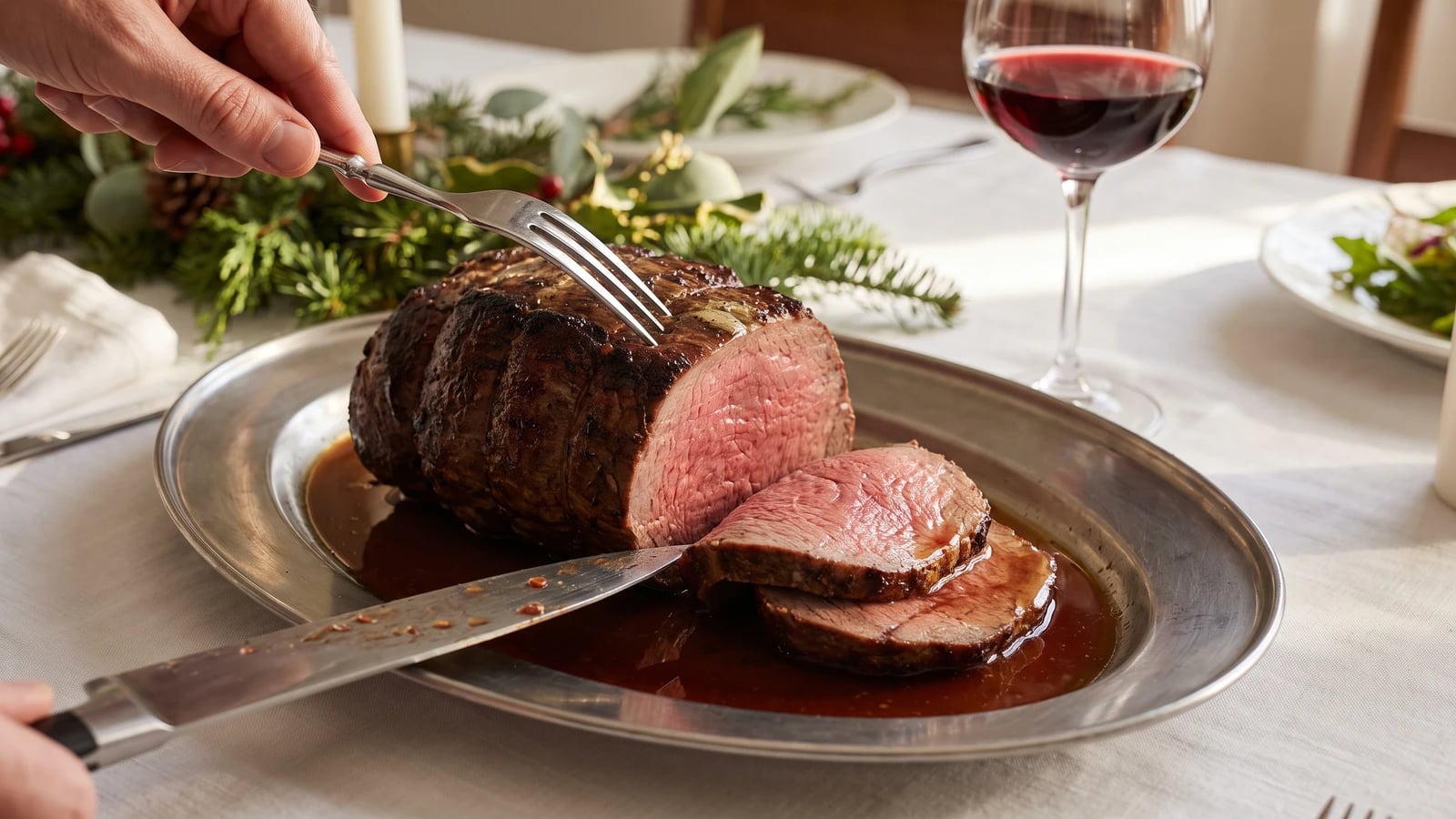
A roast governed by fire, not the clock: beef or lamb turns before fierce, nearly flameless heat until the crust bronzes, the center stays rosy, and the resting juices gather beneath the knife.
Rôtis à la broche (spit-roasted meats) teach one true thing: roasting is the management of radiant heat. For juicy red meat, the fire must be fierce and penetrating but nearly flameless, while the roast stays balanced and turning so every surface meets that heat in turn. Time offers a useful boundary, never a verdict. The crust, the resistance of the meat, and the temperature at its center tell you when it is done.
The original method assumed an open hearth, a true turning spit, and a practiced rôtisseur who judged coals and distance by eye. It assumed no saucier, no stockpot never off the fire, and no salamander; those are brigade scaffolds for other preparations. At home, an oven or grill rotisserie supplies the rotation, while a V-rack and disciplined quarter-turns are the honest equivalent when no spit is available. The motor is scaffolding and may go. Rotation cannot. A compact 2¼-pound roast brings the formula down to four servings, and clarified butter replaces the easy, continuous basting of an open hearth. One cook, one stove, one evening.
Shape and balance the meat before it approaches the heat. If the roast swings, lurches, or carries one heavy side, it will color unevenly and strain the motor; stop, retie it, and thread it through its true center. That careful setting is the step that decides the roast.
Rôtis à la broche have no single regional home; their professional home was the Parisian rôtisserie and the rôtisseur’s station, while household hearths throughout France turned beef, lamb, poultry, and game for family tables. The practice traveled in both directions between specialist roasting kitchens and domestic hearths, but its rules remained those of fire rather than luxury. The classical distinction is precise: red butcher’s meat wants penetrating heat with almost no flame, white meat wants steadier heat so it cooks through while coloring, and small game traditionally meets a livelier wood fire.
Quantity
1 roast, 2¼ lb (1.02 kg)
tied into an even cylinder
Quantity
2 teaspoons (10 ml / 12 g)
Quantity
1 teaspoon (5 ml / 2 g)
Quantity
4 tablespoons (60 ml / 57 g)
1 tablespoon kept cold; 3 tablespoons clarified
Quantity
½ cup (120 ml / 120 g), plus more as needed
| Ingredient | Quantity |
|---|---|
| compact center-cut boneless beef sirloin roast or rolled boneless leg of lambtied into an even cylinder | 1 roast, 2¼ lb (1.02 kg) |
| fine sea salt | 2 teaspoons (10 ml / 12 g) |
| freshly ground black pepper | 1 teaspoon (5 ml / 2 g) |
| unsalted butter1 tablespoon kept cold; 3 tablespoons clarified | 4 tablespoons (60 ml / 57 g) |
| water | ½ cup (120 ml / 120 g), plus more as needed |
Pat the meat completely dry. Fold any tapering end beneath itself, then tie the roast crosswise with butcher’s twine at 1-inch (2.5 cm) intervals until it forms a compact, even cylinder. The source calls this properly setting the meat, and it matters because a thick end and a thin end cannot finish together. Unless the roast was salted in advance, season it evenly with the salt and black pepper.
Keep 1 tablespoon (15 ml / 14 g) of the butter cold for the jus. Melt the remaining butter gently until its milk solids sink and white foam gathers on top. Skim the foam, then pour the clear golden beurre clarifié (clarified butter) into a small bowl, leaving the pale solids behind. Whole butter burns before this fierce fire; removing its milk solids lets the butter baste and bronze the meat without turning bitter.
For an oven rotisserie, preheat the oven to 475°F (245°C) and fit a shallow drip pan beneath the spit. For a covered charcoal rotisserie, arrange a dense bed of fully glowing coals behind or beside the roast, about 6 to 8 inches (15 to 20 cm) away, with no flames licking the meat. If you have no spit, set a V-rack in a shallow roasting pan and heat the oven to the same temperature; you will turn the roast by hand. Pour the water into the drip pan just before cooking so the falling juices brown without burning.
Thread the spit through the geometric center of the roast and tighten the forks securely. Turn it once by hand before starting the motor. If a heavy side drops, the spit bows, or the motor labors, stop and reposition the meat now. Ça se rattrape: slide the forks free, retie the roast more evenly, and thread it again through the true center. For the V-rack method, settle the roast with its broadest side facing upward and keep sturdy tongs beside the oven.
Brush the meat lightly with beurre clarifié and begin turning it before the fierce, nearly flameless heat. Baste every 10 minutes. With a V-rack, rotate the roast one quarter-turn every 8 minutes so all four faces meet the heat. Begin checking the center after 25 minutes, inserting an instant-read thermometer from the side and clear of the spit. A 2¼-pound (1.02 kg) beef roast generally needs 35 to 45 minutes and should leave the heat at 125°F (52°C) for medium-rare; lamb generally needs 40 to 50 minutes and should leave at 130°F (54°C). The exterior should be taut and deeply Maillard-bronze. If it darkens too quickly, lower the oven to 425°F (220°C) or move the coals farther away. If the center nears its target while the crust remains pale, stop basting and give each exposed face 30 to 60 seconds beneath the broiler, watching continuously.
Transfer the roast to a warm board and cover it loosely with foil for 20 minutes. The center will rise another 5 to 10°F (3 to 6°C), while the juices settle back through the meat. Do not wrap it tightly, or trapped moisture will soften the crust you worked to build. Pour every juice that gathers on the board into the drip pan.
Set the drip pan over medium heat if it is safe for the stovetop, or scrape its contents into a small saucepan. Add the resting juices and scrape up every bronze speck of fond. Boil until the liquid reduces to about ⅓ cup (80 ml) and tastes distinctly of the roast, then skim away only the excess fat. Remove the pan from the heat and monter au beurre (whisk in cold butter off the heat) with the reserved tablespoon until the jus de rôti is glossy. If it looks greasy or separates, whisk in 1 teaspoon (5 ml / 5 g) cold water. It will come back together.
Remove every length of twine. Slice the roast across the grain into pieces about ¼ inch (6 mm) thick, keeping the slices together so they stay warm. Spoon the jus around the meat rather than over its crust, and serve the remaining jus at the table. À table!
1 serving (about 205g)
Culinary guides, cultural storytelling, and the editorial depth that makes cooking meaningful.
Discover Culinary ExplorerChef Juliette
John Dory has the delicacy of sole and the firmness of turbot. A light flouring, a quick butter sauté, and nut-brown beurre noisette show exactly why looks never mattered.

Chef Juliette
Fresh haddock proves its delicacy in the meunière pan: a fine flour crust, moist pearly flakes, and beurre noisette sharpened with lemon and parsley, ready from one skillet in half an hour.

Chef Juliette
Éperlans à l’Anglaise turns small fish into a lesson in disciplined coating: boned smelts under a close, crisp crumb, pan-fried in clarified butter and finished with bright, half-melted maître d’hôtel butter.

Chef Juliette
Tiny smelts, shallot, mushrooms, white wine, gratin sauce, and fine bread raspings meet a fierce oven, where the fish must turn tender in the same breath the buttered crust bronzes.