
Chef Juliette
John Dory (St. Pierre)
John Dory has the delicacy of sole and the firmness of turbot. A light flouring, a quick butter sauté, and nut-brown beurre noisette show exactly why looks never mattered.
A cooking platform built around craft, culture, and the stories behind what we eat.
Created by Chef Juliette
Based on No. 251, The Sautés, from Le Guide Culinaire (1907) by Auguste Escoffier
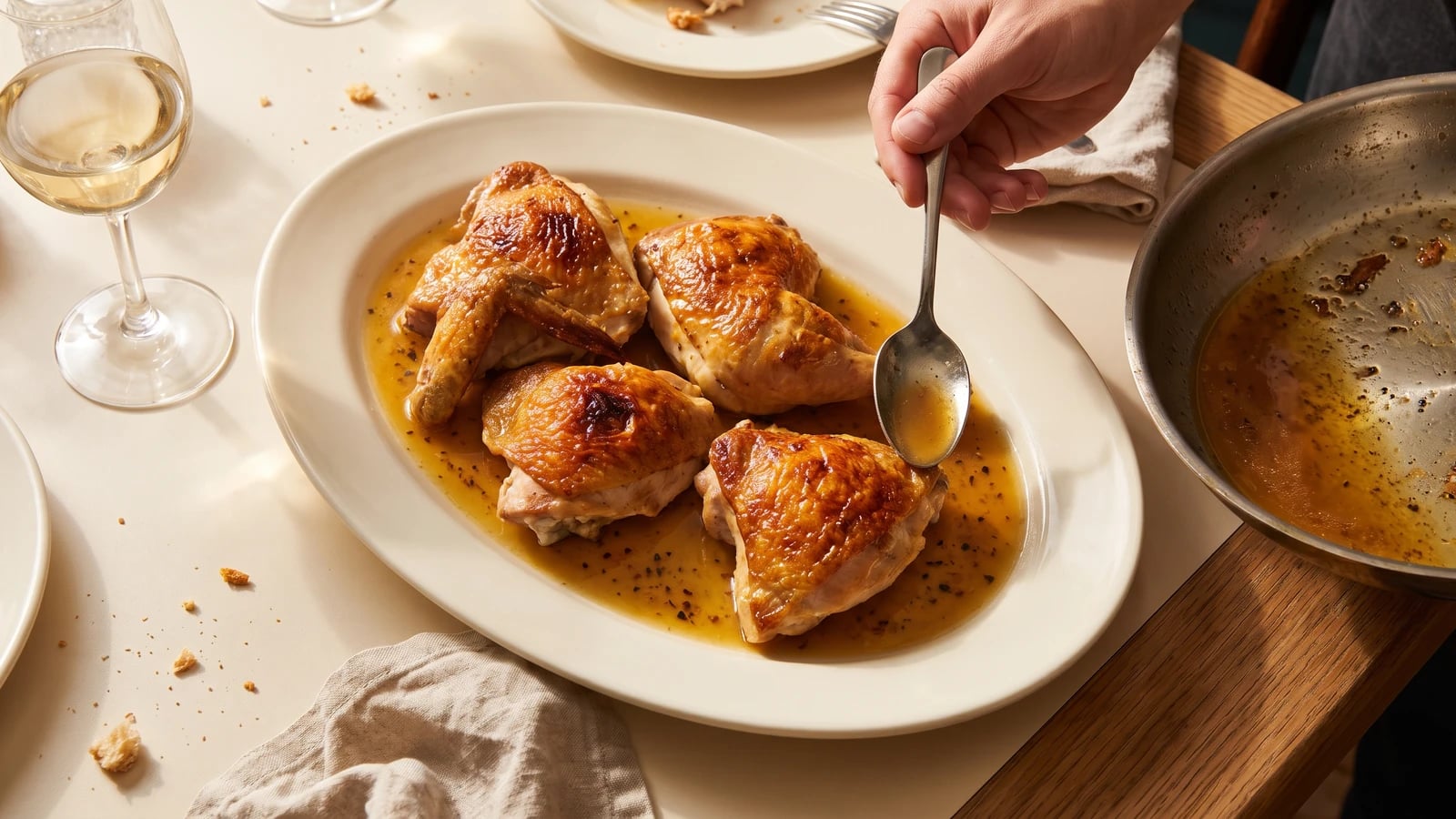
Hot clarified butter, a snug pan, and honest deglazing turn chicken into the master lesson of the sauté: bronze the meat, preserve the fond, and make the sauce where the cooking happened.
Sauté de volaille (pan-sautéed chicken) teaches one true thing: the fond is the sauce. The chicken must be dry, the clarified butter properly hot, and the pan only large enough to hold the pieces. Too cool and the chicken steams. Too broad and the uncovered fat burns before the fond can become anything worth eating. The source calls the first hard coloring “frizzling,” but don't mistake that for scorching; you want a deep bronze crust and a brown glaze beneath it.
The professional method assumed a saucier and a prepared accompanying sauce waiting beside the stove. At home, one cup of unsalted chicken stock reduced directly over the fond replaces that standing sauce. The prepared sauce was brigade scaffolding. Dry cooking, butter basting, a snug pan, and déglacer (loosening the fond with wine) are the dish itself, and all of them stay. This version is scaled to four people: one cook, one stove, one evening.
Dry every piece thoroughly before it meets the pan. That is the step that decides everything. A wet surface cannot color promptly, and without proper color there is no fond, no sauce, and no honest sauté.
The sauté belongs not to one province but to the shared grammar of the Parisian classical kitchen and the French cuisine bourgeoise table, where small pieces of meat were cooked quickly and their pan deposits made to pay for the sauce. Déglacer traveled easily from the professional sautoir, a straight-sided sauté pan, to the household skillet because the principle required attention rather than elaborate equipment. The traditional explanation said fierce heat sealed in juices; browning does not seal meat, but it builds the crust and fond while disciplined cooking protects the chicken from drying out.
Quantity
1, about 3½ lb (1.6 kg)
cut through the joints into 8 pieces
Quantity
2 teaspoons (10 ml / 12 g)
Quantity
¾ teaspoon (3.75 ml / 1.5 g)
Quantity
2 tablespoons (30 ml / 28 g)
Quantity
4 tablespoons (60 ml / 57 g)
divided, with half kept cold and cubed
Quantity
½ cup (120 ml / 120 g)
Quantity
1 cup (240 ml / 240 g)
| Ingredient | Quantity |
|---|---|
| whole chickencut through the joints into 8 pieces | 1, about 3½ lb (1.6 kg) |
| fine sea salt | 2 teaspoons (10 ml / 12 g) |
| freshly ground black pepper | ¾ teaspoon (3.75 ml / 1.5 g) |
| clarified butter | 2 tablespoons (30 ml / 28 g) |
| unsalted butterdivided, with half kept cold and cubed | 4 tablespoons (60 ml / 57 g) |
| dry white wine | ½ cup (120 ml / 120 g) |
| unsalted chicken stock | 1 cup (240 ml / 240 g) |
Heat the oven to 375°F (190°C). Pat every chicken piece completely dry, including the folds beside the joints, then season evenly with the salt and pepper. Leave the chicken uncovered while the pan heats so its surface stays dry. Wet chicken cannot take immediate color, and immediate color is what separates a sauté from chicken quietly boiling in its own juices.
Set a 12-inch (30 cm) heavy ovenproof sauté pan over medium-high heat for 2 minutes. Add the clarified butter and wait until it flows freely and shimmers. Saisir (sear) the chicken skin-side down, arranging the pieces in one snug layer without stacking them. Leave them undisturbed for 5 to 7 minutes, until the skin is deep bronze and releases cleanly, then turn and color the second side for 3 minutes. If a piece clings, don't pry at it; give it another minute and the crust will release when it is ready.
Add 2 tablespoons (30 ml / 28 g) of the unsalted butter. As it foams, tilt the pan and spoon the butter repeatedly over the chicken, then turn every piece skin-side up and place the pan in the oven, uncovered. Baste once more after 8 minutes. Begin checking the breast pieces after 12 minutes and remove each piece when its thickest part reaches 165°F (74°C), without touching bone. Let the thighs and drumsticks continue to 170 to 175°F (77 to 79°C), usually another 5 to 8 minutes, so their connective tissue softens. Use the thermometer, not the color of the juices; accuracy is the honest home equivalent of a brigade cook judging dozens of birds each service.
Transfer the cooked chicken to a warm platter, skin-side up, and cover it loosely while the sauce is made. Pour the clear cooking fat into a heatproof bowl, leaving the brown glaze attached to the pan. Keep brown deposits and remove isolated black specks. If the entire glaze has burned, don't make a bitter sauce from it; wipe the pan clean and reduce the wine and stock without the fond. You lose some depth, but dinner is saved.
Return the pan to medium-high heat and add the white wine. Let it boil while you scrape the pan firmly with a wooden spoon, dissolving every brown deposit into the liquid. Reduce the wine to about 3 tablespoons (45 ml), when its raw alcoholic smell has softened, then add the chicken stock. Boil steadily for 6 to 9 minutes, until roughly ⅔ cup (160 ml) remains and the sauce lightly coats a spoon. If it is thin, keep reducing. If it becomes too salty or sharp, loosen it with a tablespoon of water and taste again.
Take the pan off the heat. Monter au beurre (finish with butter) by whisking in the remaining 2 tablespoons (30 ml / 28 g) of cold butter, one cube at a time, until the sauce turns glossy and softly thickened. Don't boil it now or the emulsion may split. If oily droplets appear, whisk in 1 tablespoon (15 ml / 15 g) of cold water off the heat. Ça se rattrape. Taste for seasoning, then return the chicken skin-side up for only 1 to 2 minutes, just long enough to warm it in the sauce without softening its crust. Arrange it on the platter with the sauce pooled beneath and around the pieces. À table!
1 serving (about 340g)
Culinary guides, cultural storytelling, and the editorial depth that makes cooking meaningful.
Discover Culinary ExplorerChef Juliette
John Dory has the delicacy of sole and the firmness of turbot. A light flouring, a quick butter sauté, and nut-brown beurre noisette show exactly why looks never mattered.

Chef Juliette
Fresh haddock proves its delicacy in the meunière pan: a fine flour crust, moist pearly flakes, and beurre noisette sharpened with lemon and parsley, ready from one skillet in half an hour.

Chef Juliette
Éperlans à l’Anglaise turns small fish into a lesson in disciplined coating: boned smelts under a close, crisp crumb, pan-fried in clarified butter and finished with bright, half-melted maître d’hôtel butter.

Chef Juliette
Tiny smelts, shallot, mushrooms, white wine, gratin sauce, and fine bread raspings meet a fierce oven, where the fish must turn tender in the same breath the buttered crust bronzes.