Chef Juliette
Bouillabaisse à la Marseillaise
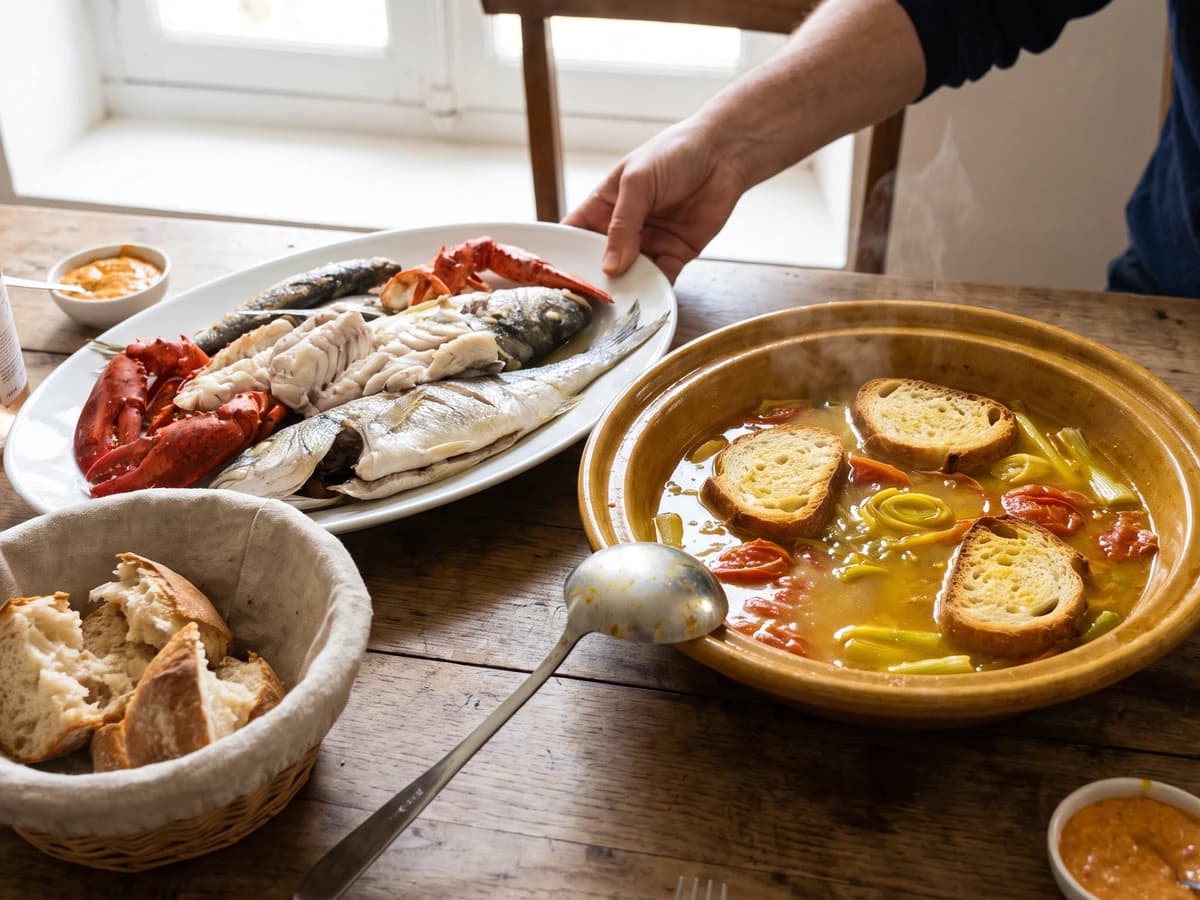
Marseille's great fish stew, saffron-gold and garlic-scented, proves that a hard boil can be the careful choice: it binds olive oil into broth before the whole pot meets bread.
A cooking platform built around craft, culture, and the stories behind what we eat.
Created by Chef Juliette
Based on No. 238, Thick Soups, from Le Guide Culinaire (1907) by Auguste Escoffier
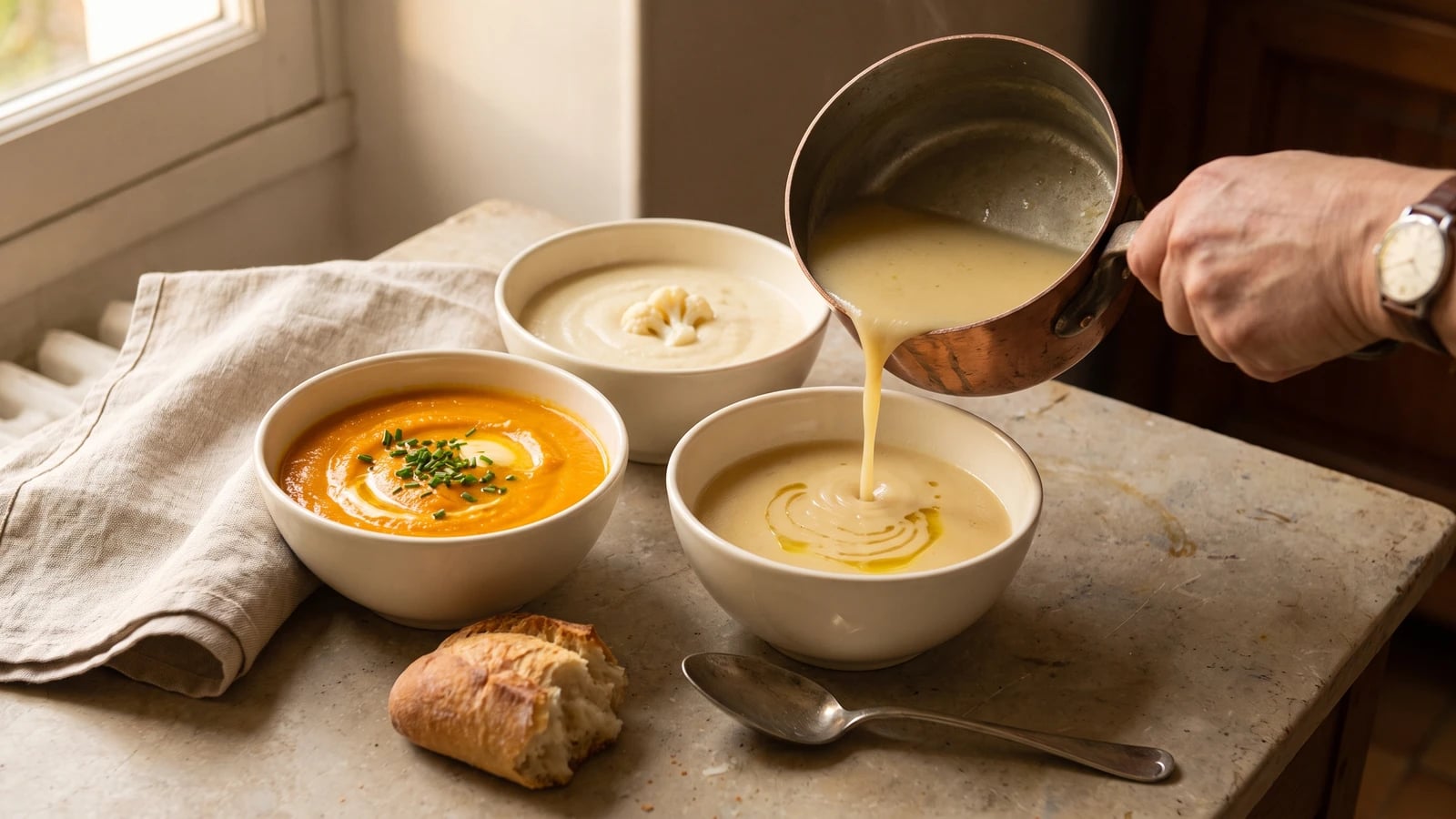
Three small pots teach the whole family: a vegetable purée, a stock-and-roux velouté, and a milk-softened crème, each thickened by its own logic and named for what truly gives it body.
Potages liés (thick soups) teach the one rule that prevents a smooth pot from losing its identity: name the soup for what gives it body. A vegetable base is a purée; poultry, game, or fish puréed into the body gives a coulis (cullis); shellfish gives a bisque. Veloutés take their silk from stock and roux, while crèmes begin from a milk-softened foundation. The word carries the technique.
The brigade entry assumes a saucier with finished stocks, prepared roux, and several pots held ready for service. Because this entry is a classification rather than one fixed formula, it supplies no original proportion to preserve. The honest home translation is three small foundation pots: Purée de Carottes (carrot purée), Velouté de Volaille (chicken velouté), and Crème de Chou-Fleur (cauliflower cream soup), about two quarts altogether. Three ordinary saucepans replace the staffed range. Repeated straining and separate holding pans are brigade scaffolding; the distinct thickening method is the dish and stays. One cook, one stove, one evening.
At the table, the purée is carrot-orange and earthy, the velouté pale gold and flowing, the crème ivory and softly rich. None should sit like paste. The one step that matters most is finishing each thickener before enrichment: cook the rice tender, cook the roux free of raw flour taste, and never let the liaison boil.
Potages liés belong to the Parisian grand-kitchen vocabulary, where soups were organized by the ingredient and technique that gave them body, then carried onto bourgeois tables throughout France. Vegetable bases took purée, poultry, game, or fish bases took coulis, called cullis in English culinary usage, and lobster, crayfish, or shrimp bases took bisque; veloutés and crèmes remained separate families built on roux-bound stock and a milk-softened foundation. Bisque has wandered across poultry and pigeon preparations in kitchen language, but the working canon reserves the name for shellfish, so smoothness alone never makes a bisque.
Quantity
1 tablespoon (15 ml / 14 g)
Quantity
1/2 cup (120 ml / 50 g)
white and pale green parts, thinly sliced
Quantity
2 cups (475 ml / 260 g)
peeled and thinly sliced
Quantity
2 tablespoons (30 ml / 25 g)
rinsed
Quantity
2 1/4 cups (530 ml / 530 g)
Quantity
1/2 teaspoon (2.5 ml / 3 g)
Quantity
1/8 teaspoon (0.6 ml / 0.3 g)
Quantity
1 tablespoon (15 ml / 3 g)
finely cut
Quantity
1 1/2 tablespoons (22 ml / 21 g)
Quantity
2 1/2 tablespoons (37 ml / 20 g)
Quantity
2 1/2 cups (590 ml / 590 g)
Quantity
1
Quantity
1/4 cup (60 ml / 60 g)
Quantity
1 tablespoon (15 ml / 14 g)
Quantity
1 teaspoon (5 ml / 5 g)
Quantity
1/4 teaspoon (1.25 ml / 1.5 g)
Quantity
1/8 teaspoon (0.6 ml / 0.3 g)
Quantity
1 tablespoon (15 ml / 14 g)
Quantity
1 1/2 tablespoons (22 ml / 12 g)
Quantity
2 cups (475 ml / 220 g)
cut small, with four tiny florets reserved for serving
Quantity
1 3/4 cups (415 ml / 425 g)
Quantity
3/4 cup (180 ml / 180 g)
Quantity
1/4 cup (60 ml / 60 g)
Quantity
1/2 teaspoon (2.5 ml / 3 g)
Quantity
1/16 teaspoon (0.3 ml / 0.1 g)
| Ingredient | Quantity |
|---|---|
| unsalted butter, Purée de Carottes batch | 1 tablespoon (15 ml / 14 g) |
| leek, Purée de Carottes batchwhite and pale green parts, thinly sliced | 1/2 cup (120 ml / 50 g) |
| carrots, Purée de Carottes batchpeeled and thinly sliced | 2 cups (475 ml / 260 g) |
| white rice, Purée de Carottes batchrinsed | 2 tablespoons (30 ml / 25 g) |
| light vegetable stock or water, Purée de Carottes batch | 2 1/4 cups (530 ml / 530 g) |
| fine salt, Purée de Carottes batch | 1/2 teaspoon (2.5 ml / 3 g) |
| ground white pepper, Purée de Carottes batch | 1/8 teaspoon (0.6 ml / 0.3 g) |
| chives, Purée de Carottes garnish (optional)finely cut | 1 tablespoon (15 ml / 3 g) |
| unsalted butter, Velouté de Volaille roux | 1 1/2 tablespoons (22 ml / 21 g) |
| all-purpose flour, Velouté de Volaille roux | 2 1/2 tablespoons (37 ml / 20 g) |
| light unsalted chicken stock, Velouté de Volaille batch | 2 1/2 cups (590 ml / 590 g) |
| large egg yolk, Velouté de Volaille liaison | 1 |
| heavy cream, Velouté de Volaille liaison | 1/4 cup (60 ml / 60 g) |
| cold unsalted butter, Velouté de Volaille finish | 1 tablespoon (15 ml / 14 g) |
| fresh lemon juice, Velouté de Volaille batch | 1 teaspoon (5 ml / 5 g) |
| fine salt, Velouté de Volaille batch | 1/4 teaspoon (1.25 ml / 1.5 g) |
| ground white pepper, Velouté de Volaille batch | 1/8 teaspoon (0.6 ml / 0.3 g) |
| unsalted butter, Crème de Chou-Fleur batch | 1 tablespoon (15 ml / 14 g) |
| all-purpose flour, Crème de Chou-Fleur batch | 1 1/2 tablespoons (22 ml / 12 g) |
| cauliflower florets, Crème de Chou-Fleur batchcut small, with four tiny florets reserved for serving | 2 cups (475 ml / 220 g) |
| whole milk, Crème de Chou-Fleur batch | 1 3/4 cups (415 ml / 425 g) |
| light vegetable stock or water, Crème de Chou-Fleur batch | 3/4 cup (180 ml / 180 g) |
| heavy cream, Crème de Chou-Fleur finish | 1/4 cup (60 ml / 60 g) |
| fine salt, Crème de Chou-Fleur batch | 1/2 teaspoon (2.5 ml / 3 g) |
| freshly grated nutmeg, Crème de Chou-Fleur batch | 1/16 teaspoon (0.3 ml / 0.1 g) |
Arrange the ingredients in three groups before lighting the stove. The purée receives rice and vegetables, the velouté receives stock and roux, and the crème receives milk and roux. Keep the groups distinct. Similar colour does not mean similar construction, and the construction decides the name.
Melt the Purée de Carottes butter over medium-low heat. Add the leek and carrots with a pinch of the measured salt, cover, and sweat for 8 minutes without browning. Stir in the rice, then add all but 1/4 cup (60 ml) of the stock or water. Bring to a bare simmer and cook uncovered for 25 minutes, until the rice has burst and a carrot slice crushes under a spoon. Blend until completely smooth, then season with the remaining salt and white pepper. If it stands like mash, blend in the reserved liquid a spoonful at a time; if it runs thin, return it to the pan and simmer gently. Ça se rattrape.
Melt the Velouté de Volaille roux butter in the second saucepan over medium-low heat. Stir in the flour and cook for 2 minutes without allowing it to colour. This roux must lose its raw smell while remaining pale. Remove the pan from the heat and whisk in the chicken stock gradually, beginning with a small splash and smoothing it completely before adding more. Return to a bare simmer for 20 minutes, whisking along the bottom often. If lumps appear, stop adding liquid, whisk firmly, then pass the soup through a fine sieve before continuing. Do not discard it. Ça se rattrape.
Reserve 1 tablespoon of the Velouté de Volaille cream. Whisk the remaining cream with the egg yolk in a heatproof bowl; this is the liaison, the enrichment that gives the velouté its final silk. Slowly whisk in two ladlefuls of the hot soup, then return the tempered mixture to the saucepan. Stir over the lowest heat until it reaches 160°F (71°C) and lightly coats a spoon, never allowing it to simmer. Remove from the heat and whisk in the cold butter, lemon juice, salt, and white pepper. If tiny curds appear, immediately whisk in the reserved cold cream, blend briefly, and strain. Severe heat causes the failure, so take the pan off first.
Melt the Crème de Chou-Fleur butter in the third saucepan over medium-low heat. Stir in the flour and cook for 1 minute without colour, then whisk in the milk little by little until smooth. Add the cauliflower, including the four reserved florets, the salt, nutmeg, and all but 1/4 cup (60 ml) of the stock or water. Hold at a gentle simmer for 20 to 25 minutes, stirring along the bottom, until the cauliflower yields completely. If the milk catches, do not scrape the scorched floor. Pour the clean soup into another saucepan and continue there.
Lift out four tidy cauliflower florets and keep them warm. Blend the remaining Crème de Chou-Fleur until smooth, pass it through a fine sieve if the cauliflower remains fibrous, then return it to low heat. Add the heavy cream and enough reserved stock to make a soup that coats the spoon lightly but pours without hesitation. Taste and correct the salt. Once the cream is in, heat gently and do not boil.
Warm the three soups gently and ladle them into small heated bowls. Finish the Purée de Carottes with chives, leave the glossy Velouté de Volaille bare, and set one cauliflower floret in each portion of Crème de Chou-Fleur. Taste them side by side: vegetable and rice give the purée its earthier body, roux and stock make the velouté flow like satin, and milk rounds the crème. For a comfort-food supper, serve larger bowls in the same order with bread. À table!
1 serving (about 470g)
Culinary guides, cultural storytelling, and the editorial depth that makes cooking meaningful.
Discover Culinary ExplorerChef Juliette
Marseille's great fish stew, saffron-gold and garlic-scented, proves that a hard boil can be the careful choice: it binds olive oil into broth before the whole pot meets bread.
Chef Juliette
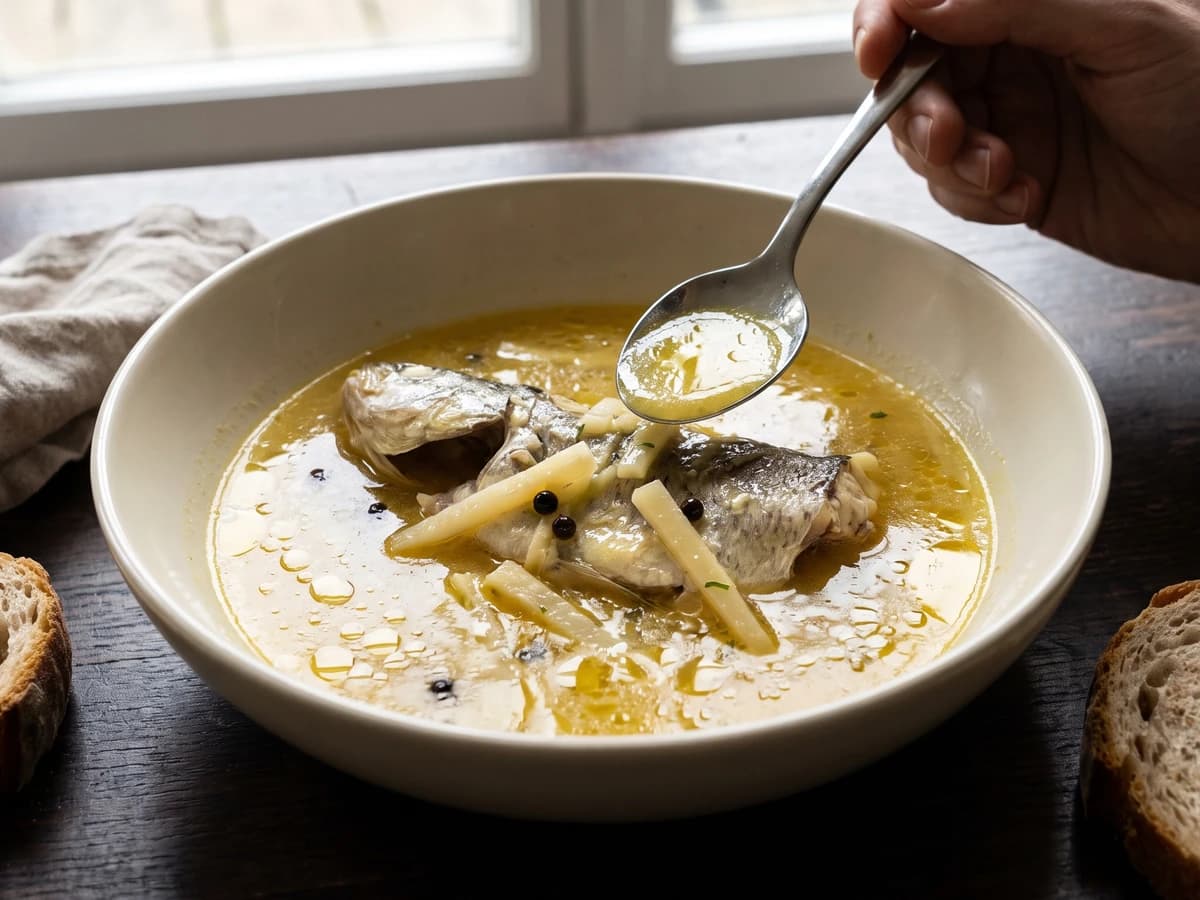
Waterzoi asks fresh, bone-in river fish to thicken its own buttery broth, with parsley root and pepper for company. No flour, no stockpot, just a brisk simmer watched closely.
Chef Juliette
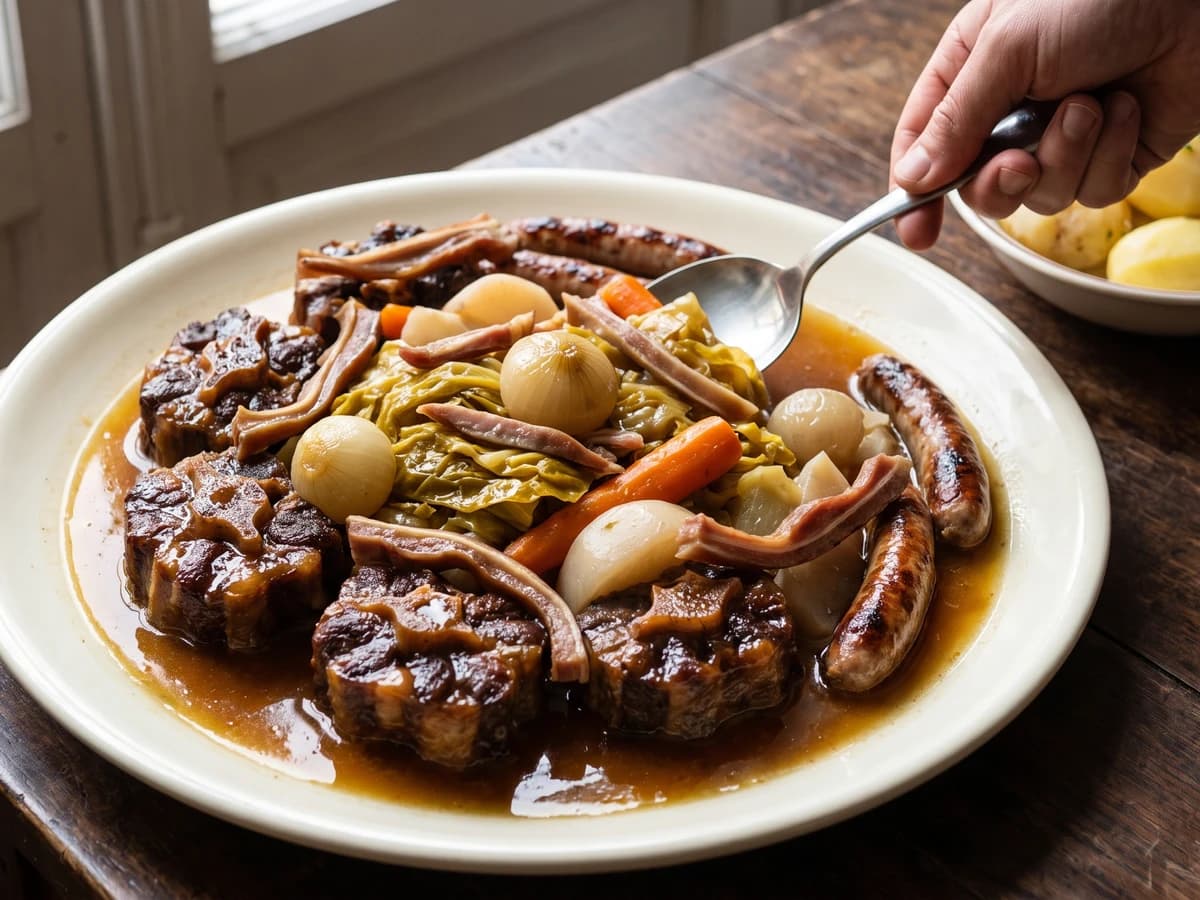
Queue de Bœuf en Hochepot gathers oxtail, pig's trotter and ear, cabbage, roots, and grilled chipolatas around a clear, gelatin-rich broth whose quiet simmer keeps every piece tender and distinct.
Chef Juliette
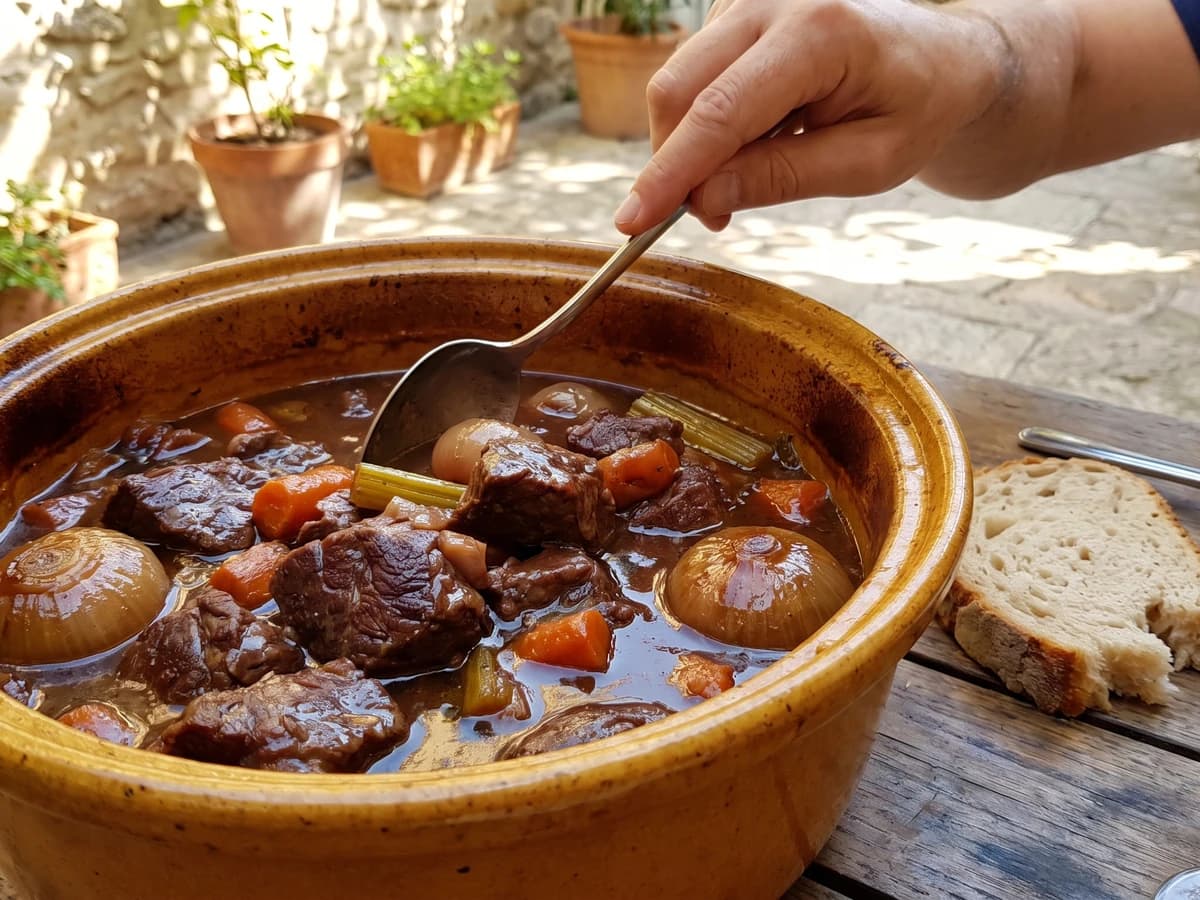
Beef shoulder larded with bacon, sharpened by red wine and vinegar, then sealed with garlic, vegetables, and dry lemon peel until the low oven turns it yielding and the gravy darkly glossy.