Chef Juliette
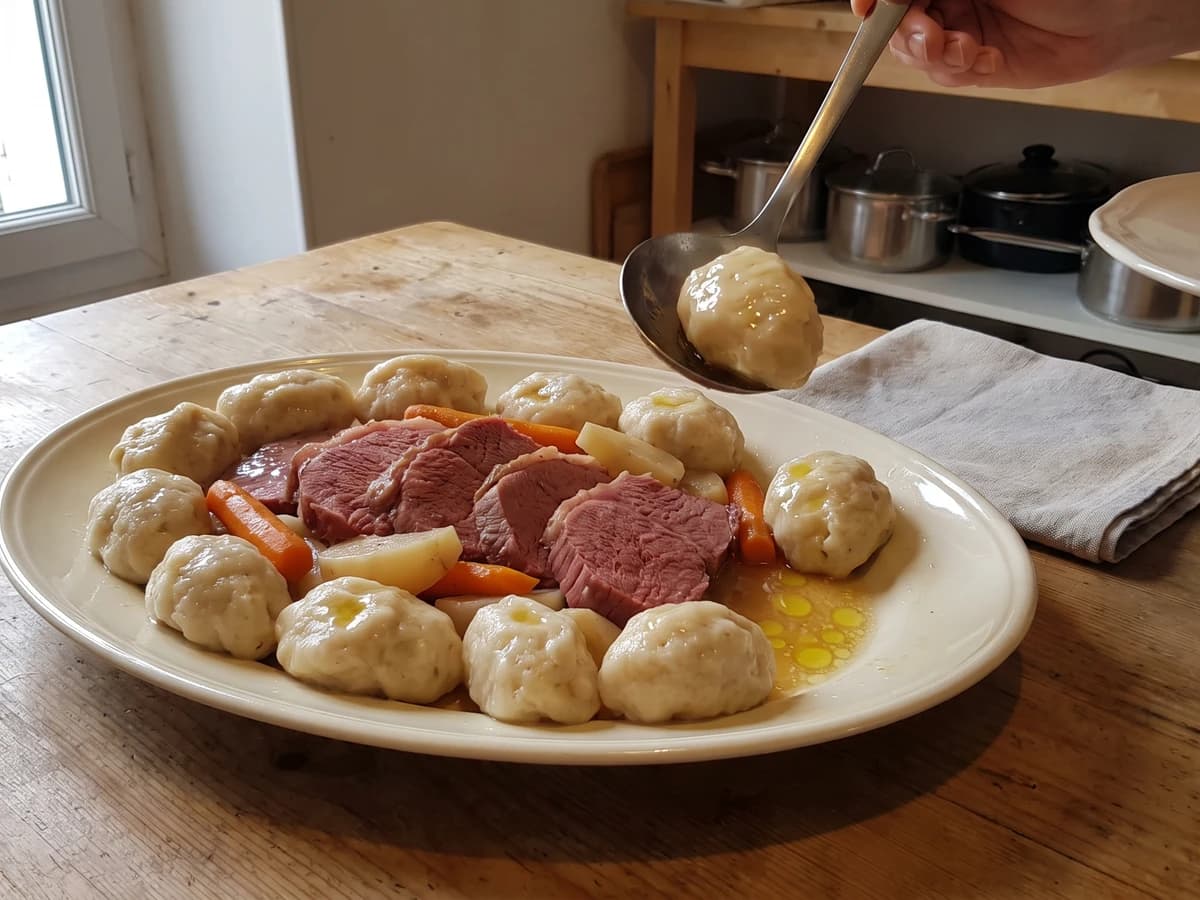
Suet Dumpling
Boulettes au suif, poached beside salt beef, turn equal weights of flour and finely chopped suet into tender, rich dumplings. Keep the beef liquor at a bare tremble and the old garnish works beautifully at home.
A cooking platform built around craft, culture, and the stories behind what we eat.

Created by Chef Juliette
Based on No. 2278, Truffes à la Serviette, from Le Guide Culinaire (1907) by Auguste Escoffier
Truffes à la Serviette gathers whole black truffles, Madeira, and butter beneath warm linen, where gentle covered cooking protects their perfume and the folded napkin turns table ceremony into useful technique.
Truffes à la Serviette (whole black truffles in a folded napkin) teaches that service can be technique. The linen is not decoration: warmed, unscented, and folded closely around the timbale, it holds the heat and Madeira-dark perfume until the parcel opens. The one true thing to know before touching the pan is this: truffles want a cuisson couverte (covered cooking) held at a tremble, never a hard boil, because violent heat spends their aroma before it reaches the table.
The source entry assumes Truffes au Champagne are already part of the kitchen's repertoire, then makes one exact change: Madeira replaces Champagne. It also assumes a brigade can spare hands to fold a napkin into an artichoke and carry a hot timbale at once. Here the quantity comes down to four, a snug covered saucepan handles the cooking, and a simply folded linen napkin does the useful work. The elaborate artichoke fold is brigade scaffolding; the closed, fragrant presentation is the dish and must stay. One cook, one stove, one evening.
Cook the truffles only until a fine skewer meets gentle resistance, then enclose them in the warmed timbale immediately. If the Madeira reduction becomes sharp or sticky, ça se rattrape: water softens it and cold butter restores its gloss. That quiet transfer from covered pan to covered linen, without surrendering the scent to the kitchen, is the step that matters most.
Truffes à la Serviette belongs to the ceremonial Parisian table, supplied by the black-truffle country of Périgord in south-western France. The source treats it not as a separate cuisson but as a service variation on Truffes au Champagne: Madeira replaces Champagne, and the cooked truffles are presented in a timbale surrounded by an artichoke-folded napkin. The canon even records an objection that Truffes à la Cendre would suit the title more logically, since truffles baked beneath ashes could be wrapped like Pommes de Terre en Robe de Chambre, but the Madeira preparation kept the name.
Quantity
12 small (12 oz / 340 g)
scrubbed just before cooking
Quantity
1¼ cups (300 ml / 300 g)
preferably dry or medium-dry
Quantity
2 tablespoons (30 ml / 28 g)
divided
Quantity
½ teaspoon (2.5 ml / 3 g)
Quantity
¼ cup (60 ml / 60 g)
as needed for rescuing the reduction
| Ingredient | Quantity |
|---|---|
| fresh Périgord black trufflesscrubbed just before cooking | 12 small (12 oz / 340 g) |
| Madeirapreferably dry or medium-dry | 1¼ cups (300 ml / 300 g) |
| cold unsalted butterdivided | 2 tablespoons (30 ml / 28 g) |
| fine sea salt | ½ teaspoon (2.5 ml / 3 g) |
| hot water (optional)as needed for rescuing the reduction | ¼ cup (60 ml / 60 g) |
Set a large, unscented linen napkin on the serving table and place a 1-quart timbale or heatproof bowl in its centre. Arrange the cloth in broad overlapping folds around the vessel, leaving one generous flap free to cover its opening. Fill the timbale with very hot water and let it warm while the truffles cook. The formal artichoke fold is optional; ample folds that insulate the vessel accomplish the intent. Keep the linen well away from the stove.
Rinse each truffle briefly under cool running water and scrub every crevice with a soft brush until no grit remains. Trim away only damaged spots, then dry the truffles thoroughly. Do not peel them. The dark, finely pebbled skin carries perfume and protects the flesh during cooking.
Rub a snug, heavy saucepan with 1 tablespoon (15 ml / 14 g) of the butter and arrange the truffles in one layer. Sprinkle with the salt. Take the pan away from any open flame before pouring in the Madeira, then fit a cartouche (parchment lid) directly over the truffles and cover the pan tightly. Bring the liquid just to a tremble over medium-low heat and cook for 12 to 18 minutes, turning the truffles once, until a fine skewer enters the centre with gentle resistance. Do not boil them hard. If the liquid surges, lift the pan from the heat, wait for it to settle, and continue over the lowest flame. Ça se rattrape after a brief boil; prolonged boiling spends the perfume and cannot be taken back.
Empty the hot water from the timbale and dry it completely. Lift the truffles from the saucepan with a slotted spoon, letting a little Madeira cling to them, and place them immediately in the warm vessel. Spoon over 1 tablespoon (15 ml / 15 g) of the cooking liquor, fold the loose napkin flap across the opening, and leave the truffles enclosed while the sauce is finished. Work promptly. The captured perfume is the reason for the serviette.
Boil the remaining cooking liquor uncovered until it reduces to about ⅓ cup (80 ml / 80 g), loses its raw alcoholic edge, and coats a spoon very lightly, about 5 to 7 minutes. Remove the pan from the heat and monter au beurre (mount with cold butter), whisking in the remaining 1 tablespoon (15 ml / 14 g) a little at a time until the sauce gleams. If it becomes sticky or tastes too forceful, whisk in hot water by the teaspoon. If the butter separates, add a teaspoon of cool water and whisk off the heat until the sauce comes together.
Pour the Madeira reduction into a warmed sauceboat. Carry the covered timbale to the table and open the linen only when everyone is seated, then serve three truffles per person with a restrained spoonful of sauce. Offer them beside a plainly roasted poularde or as their own small course. No scattered herbs, no decorative trimming. The truffles have already said everything. À table!
1 serving (about 110g)
Culinary guides, cultural storytelling, and the editorial depth that makes cooking meaningful.
Discover Culinary ExplorerChef Juliette
Boulettes au suif, poached beside salt beef, turn equal weights of flour and finely chopped suet into tender, rich dumplings. Keep the beef liquor at a bare tremble and the old garnish works beautifully at home.

Chef Juliette
Bread, flour, frangipane, and rice become four cool, supple panades for binding forcemeats, each changing body and flavor while preserving tenderness. The finest Mousselines need none, and knowing that distinction is the lesson.

Chef Juliette
Panade au pain is bread, milk, salt, heat, and attention: stir until the paste releases cleanly, butter it against a skin, and you have the quiet binder behind tender French farces.

Chef Juliette
Panade de farine teaches the drying stroke behind pâte à choux: flour meets boiling buttered water, then stays over the fire until the paste gathers, smooths, and quits the pan cleanly.