Chef Juliette
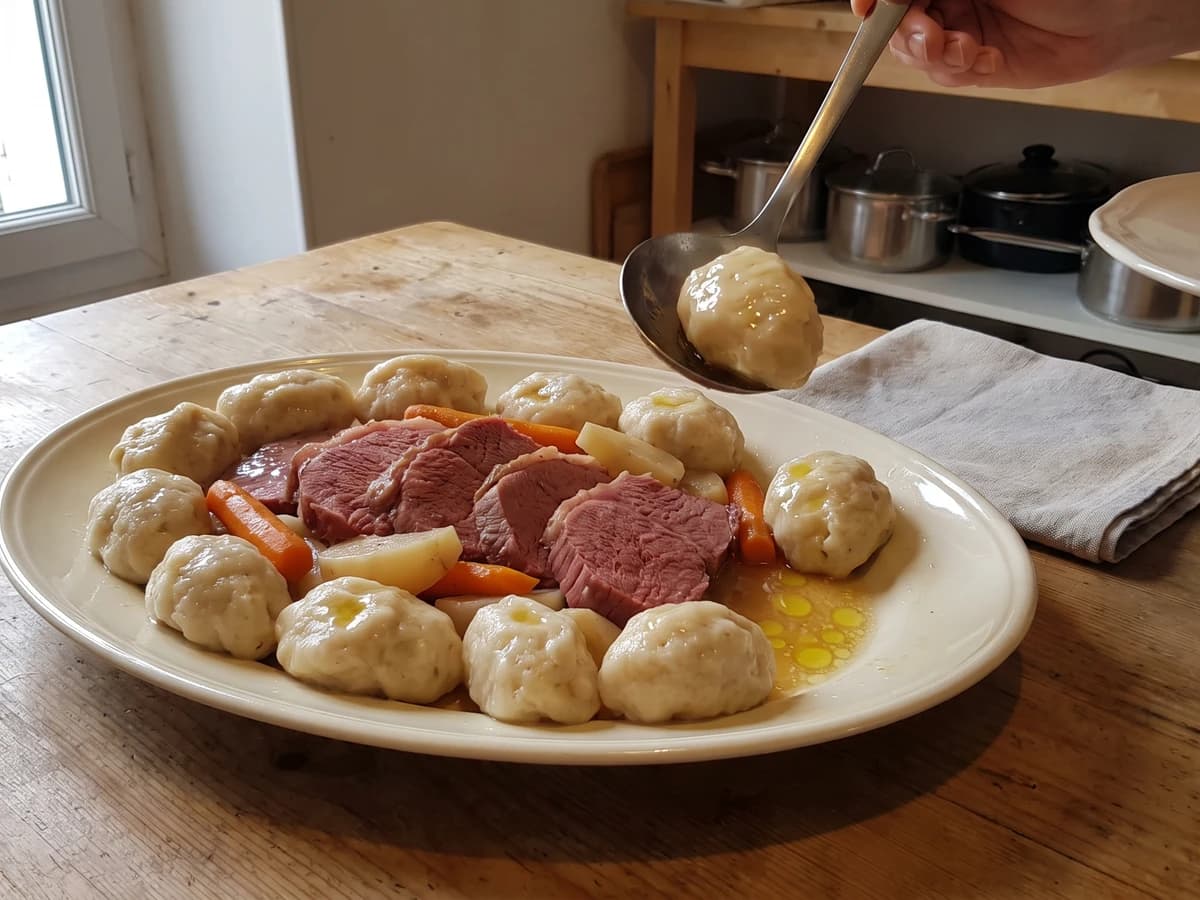
Suet Dumpling
Boulettes au suif, poached beside salt beef, turn equal weights of flour and finely chopped suet into tender, rich dumplings. Keep the beef liquor at a bare tremble and the old garnish works beautifully at home.
A cooking platform built around craft, culture, and the stories behind what we eat.

Created by Chef Juliette
Based on No. 2270, Soufflé de Tomates à la Napolitaine, from Le Guide Culinaire (1907) by Auguste Escoffier
Tomato reduced to a dense scarlet paste gives this Parmesan soufflé the strength to lift around tender, buttered macaroni, a generous baked side whose bronzed crown waits for no guest.
Soufflé de Tomates à la Napolitaine (tomato soufflé layered with buttered macaroni and Parmesan) teaches the hard truth behind every savory soufflé: water is weight. Beaten whites supply the lift, but they cannot carry loose tomato liquid. Reduce the purée until a spatula leaves a clean road across the pan and the mass gathers rather than flows. That reduction is not brigade scaffolding. It is the dish.
The old formula assumed a saucier with concentrated tomato purée and stiff Béchamel waiting within reach. It called for neither the stockpot kept perpetually on the fire nor the salamander, so we won't drag them into it. The honest home equivalents are a wide skillet, two spoonfuls of freshly made Béchamel, and a straight-sided ceramic dish in a steady oven. The three-egg quantity already suits four people, so its proportions remain intact; only the standing brigade components have become small preparations for one cook, one stove, one evening.
Inside the risen scarlet base, the macaroni forms buttery Parmesan-bound layers, tender but distinct beneath a deeply bronzed crown. If the measured purée still runs, keep reducing it; ça se rattrape. Before you touch the eggs, earn that dense purée. Everything after it is folding and nerve.
Soufflé de Tomates à la Napolitaine belongs to the French grand-kitchen table rather than to any single French province. In classical French vocabulary, à la Napolitaine signaled Naples through macaroni, tomato, and Parmesan, ingredients French cooks placed within their own soufflé method. It is sometimes mistaken for a Neapolitan household dish, but its construction is French: an egg-white soufflé layered like a baked timbale, with the Italian character carried by the garnish within.
Quantity
3¼ cups (800 ml / 800 g), yielding 1¼ cups (285 ml / about 340 g) after reduction
puréed
Quantity
2 tablespoons (30 ml / 28 g), divided
softened
Quantity
1½ teaspoons (7.5 ml / 4 g)
Quantity
3 tablespoons (45 ml / 45 g)
Quantity
½ cup (120 ml / 56 g)
Quantity
1 cup (240 ml / 85 g), divided
finely grated
Quantity
3
separated
Quantity
1¼ teaspoons (6 ml / 7.5 g), divided
Quantity
¼ teaspoon (1 ml / 0.5 g)
| Ingredient | Quantity |
|---|---|
| good-quality canned whole peeled tomatoes with their juicespuréed | 3¼ cups (800 ml / 800 g), yielding 1¼ cups (285 ml / about 340 g) after reduction |
| unsalted buttersoftened | 2 tablespoons (30 ml / 28 g), divided |
| all-purpose flour | 1½ teaspoons (7.5 ml / 4 g) |
| whole milk | 3 tablespoons (45 ml / 45 g) |
| dry small elbow macaroni | ½ cup (120 ml / 56 g) |
| Parmesanfinely grated | 1 cup (240 ml / 85 g), divided |
| large eggsseparated | 3 |
| fine salt | 1¼ teaspoons (6 ml / 7.5 g), divided |
| finely ground white pepper | ¼ teaspoon (1 ml / 0.5 g) |
Purée the tomatoes and their juices until smooth, then pour them into a wide skillet. Bring to a lively simmer over medium-high heat, lower the heat to medium, and cook for 35 to 45 minutes, stirring more frequently as the purée thickens. Stop only when you have 1¼ cups (285 ml / about 340 g), a spatula dragged across the pan leaves a clean path for three seconds, and the purée falls from a spoon in a heavy mound rather than a stream. If it still flows at the measured volume, trust the texture and keep reducing. If a patch catches, transfer the clean purée to another pan without scraping up the scorched film and continue over gentler heat. Ça se rattrape. Spread the finished purée in a wide bowl and cool it completely.
Melt 1½ teaspoons (7.5 ml / 7 g) of the butter in the smallest saucepan you own. Stir in the flour and cook this roux, the butter-and-flour foundation, for one minute without allowing it to color. Add the milk in three small additions, whisking each one smooth before adding the next. Simmer gently for 2 to 3 minutes until you have a very stiff Béchamel, the roux-bound milk sauce, which holds the ridges of the whisk. Measure exactly 2 tablespoons (30 ml / about 35 g) for the soufflé and let it cool. If it forms lumps, remove it from the heat and whisk firmly; strain it while warm if any remain.
Bring a small saucepan of water to a boil and season it with 1 teaspoon (5 ml / 6 g) of the salt. Add the macaroni and cook until just tender at the center but still holding its shape. Drain it thoroughly, return it to the dry hot pan for 30 seconds to drive away clinging water, then take it off the heat. Toss with 1 tablespoon (15 ml / 14 g) of the butter and ⅓ cup (80 ml / 28 g) of the Parmesan until lightly cohered. Spread the macaroni on a plate so it cools to just warm. If it looks wet after draining, dry it over low heat before adding the butter; loose water here would undo the tomato reduction.
Set a rack in the lower third of the oven and heat it to 375°F (190°C), without convection. Butter the inside of a 1-quart (950 ml) straight-sided soufflé dish with the remaining 1½ teaspoons (7.5 ml / 7 g) butter, brushing upward from base to rim. Set the dish on a rimmed baking sheet for an easy, level transfer. The straight sides replace the old metal timbale honestly: they give the mixture a wall to climb.
Combine the completely cooled tomato purée with the reserved 2 tablespoons of stiff Béchamel and the remaining ⅔ cup (160 ml / 57 g) Parmesan. Add the egg yolks one at a time, mixing each in fully before the next, then season with the remaining ¼ teaspoon (1 ml / 1.5 g) salt and the white pepper. The base should be dense enough to hold a furrow from the spoon. If it has loosened or begun to weep, return it to a clean pan before adding the yolks and reduce it gently again, then cool it completely.
Beat the egg whites in a spotless bowl until they form a firm, glossy froth whose peaks stand upright with only their tips bending. They must be stiff, as the original formula requires, but not dry or grainy. Fold one-third of the whites briskly into the tomato base to lighten it, then fold in the rest in two additions with broad strokes down through the center and up around the sides. Stop when only a few pale wisps remain. Chasing every streak presses out the air you have just built.
Spoon one-third of the soufflé mixture into the buttered dish and spread it lightly. Scatter half the macaroni over it in a loose, even layer, keeping a narrow margin around the edge so the egg mixture can rise freely. Repeat with another third of soufflé and the remaining macaroni, then cover with the final third of soufflé mixture. Smooth the top with one gentle pass and wipe the rim clean. Do not press the layers together. If the dish is more than three-quarters full, bake the excess in a small buttered ramekin rather than overfilling it.
Transfer the soufflé to the oven immediately and bake it like an ordinary Soufflé for 28 to 34 minutes. Do not open the door during the first 24 minutes. It is ready when the crown has risen above the rim and turned deeply bronze, the edges feel set, and the center trembles without sloshing. If the center still moves like liquid, close the door gently and give it another 3 minutes. Carry the whole dish straight to the table. It will settle after the first spoon enters; that is the nature of a soufflé, not an apology. À table!
1 serving (about 180g)
Culinary guides, cultural storytelling, and the editorial depth that makes cooking meaningful.
Discover Culinary ExplorerChef Juliette
Boulettes au suif, poached beside salt beef, turn equal weights of flour and finely chopped suet into tender, rich dumplings. Keep the beef liquor at a bare tremble and the old garnish works beautifully at home.

Chef Juliette
Bread, flour, frangipane, and rice become four cool, supple panades for binding forcemeats, each changing body and flavor while preserving tenderness. The finest Mousselines need none, and knowing that distinction is the lesson.

Chef Juliette
Panade au pain is bread, milk, salt, heat, and attention: stir until the paste releases cleanly, butter it against a skin, and you have the quiet binder behind tender French farces.

Chef Juliette
Panade de farine teaches the drying stroke behind pâte à choux: flour meets boiling buttered water, then stays over the fire until the paste gathers, smooths, and quits the pan cleanly.