Chef Juliette
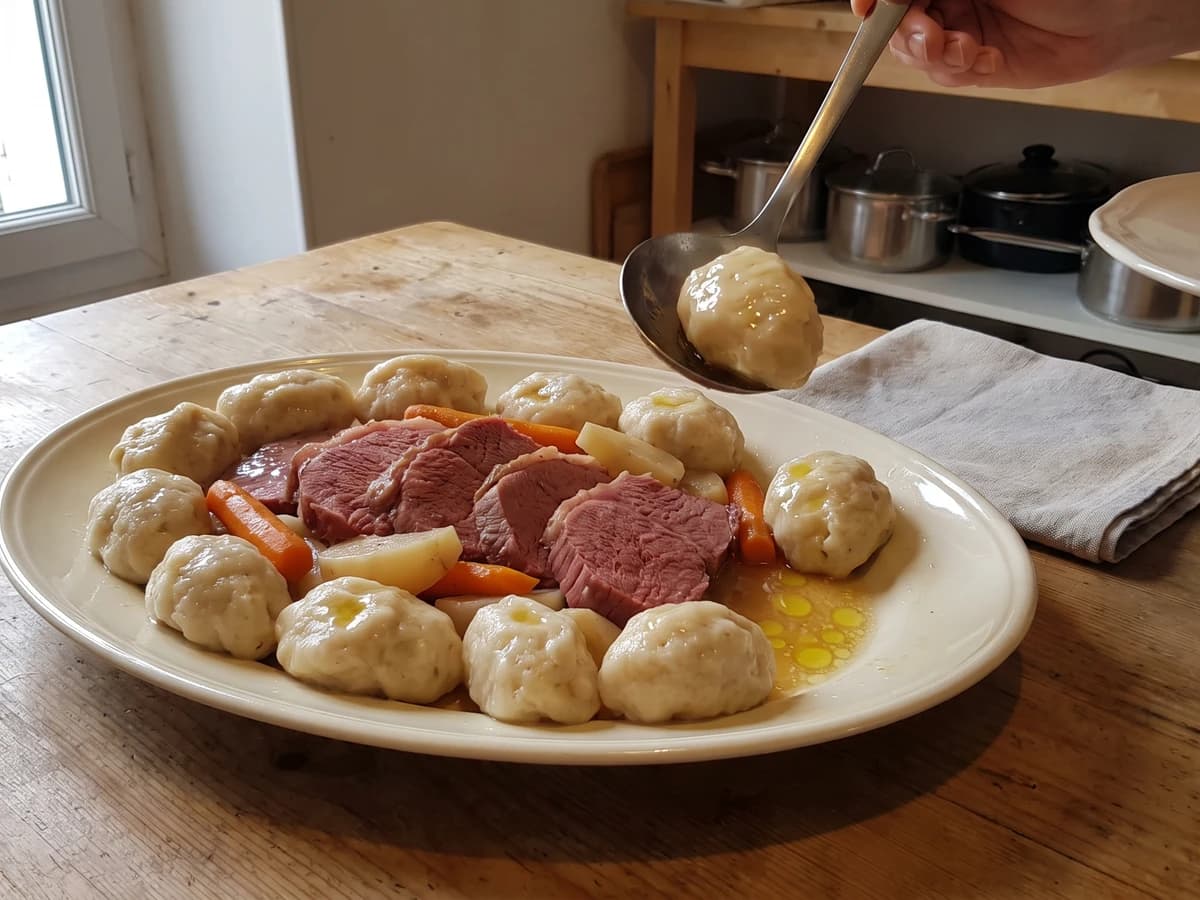
Suet Dumpling
Boulettes au suif, poached beside salt beef, turn equal weights of flour and finely chopped suet into tender, rich dumplings. Keep the beef liquor at a bare tremble and the old garnish works beautifully at home.
A cooking platform built around craft, culture, and the stories behind what we eat.
Created by Chef Juliette
Based on No. 2247, Pommes Nana (for Garnishing), from Le Guide Culinaire (1907) by Auguste Escoffier
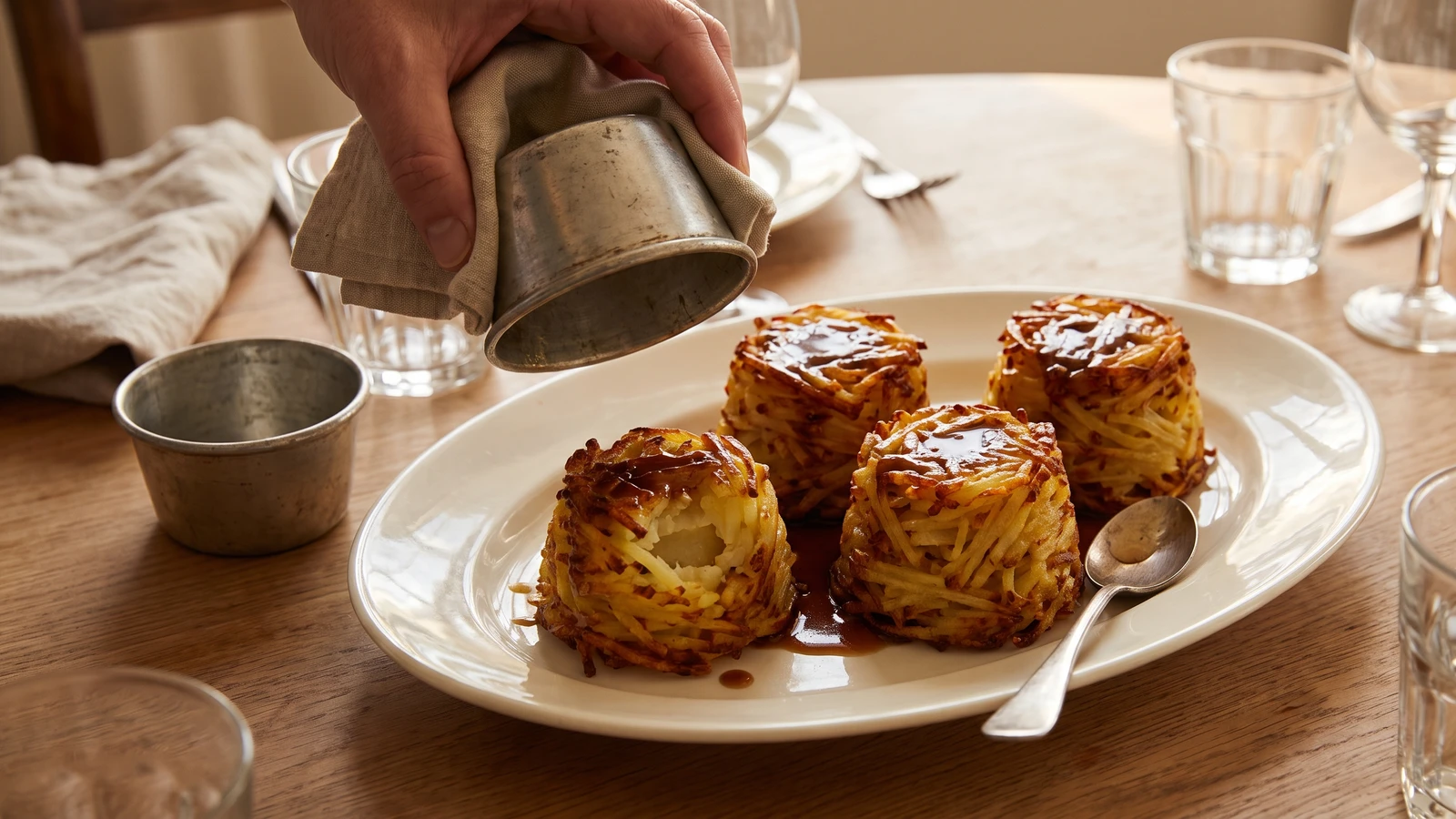
Fine potato julienne, packed into buttered dariole moulds and roasted over very hot clarified butter, emerges as four crisp bronze towers, ready for the glossy final spoonful of Château sauce.
Pommes Nana (butter-browned moulds of potato matchsticks) teaches the binding power of the potato itself. The one true thing to know before touching the pan is that the fresh-cut julienne must not be rinsed: its surface starch is the mortar that lets loose matchsticks become a crisp little tower. Wash it away and no quantity of hopeful pressing will replace it.
The book's kitchen assumed rows of dariole moulds, a tray of very hot fat, and a saucier holding Château sauce ready for service. At home, four small metal moulds sit in a snug roasting pan with measured clarified butter, while a small portion of finished Château sauce warms at the end. Clarified butter is the honest equivalent for the unspecified hot fat because it gives the required butter flavour without scorching. The bank of moulds is brigade scaffolding; the well-buttered metal, fierce fat, and final sauce are the dish. No stockpot or salamander has a job here. One cook, one stove, one evening.
When Pommes Nana is right, each mould turns out as a butter-gold lattice, bronzed at its edges, tender within, and just glossed with Château sauce. Before the knife comes down, keep the deciding step clear: once the julienne is cut, don't rinse it. That starch is what makes the form hold.
Pommes Nana belongs to the codified Parisian grand-kitchen repertoire, where individually moulded potato garnishes brought order and generosity to platters of roasted meat. It carries the Pommes Anna principle, potato, butter, close packing, and fierce heat, into dariole moulds, with julienne taking the place of Anna's overlapping rounds. The name denotes a service preparation rather than a regional potato dish, and the final Château sauce is part of its composed identity, not an optional flourish.
Quantity
1¼ pounds (565 g), about 4 medium
peeled
Quantity
2 tablespoons (30 ml / 28 g)
very soft, for the moulds
Quantity
¼ cup (60 ml / 55 g)
for the roasting pan
Quantity
¾ teaspoon (3.75 ml / 4 g)
Quantity
⅛ teaspoon (0.6 ml / 0.3 g)
Quantity
¼ cup (60 ml / 60 g)
warmed
| Ingredient | Quantity |
|---|---|
| Yukon Gold potatoespeeled | 1¼ pounds (565 g), about 4 medium |
| unsalted buttervery soft, for the moulds | 2 tablespoons (30 ml / 28 g) |
| clarified butterfor the roasting pan | ¼ cup (60 ml / 55 g) |
| fine sea salt | ¾ teaspoon (3.75 ml / 4 g) |
| ground white pepper | ⅛ teaspoon (0.6 ml / 0.3 g) |
| finished Château saucewarmed | ¼ cup (60 ml / 60 g) |
Set a rack in the lower-middle of the oven and heat it to 425°F (220°C). Place a warm serving platter nearby. Choose a small heavy metal roasting pan that holds the four dariole moulds closely, since a broad pan would spread the clarified butter too thinly.
Coat the insides and rims of four 5 to 6 fluid ounce (150 to 175 ml) metal dariole moulds generously with the softened butter. Work it into the angle where each side meets its base. A timid film encourages sticking, while a proper coat conducts heat and gives the potato its browned outer lattice. We don't apologize for butter.
Cut the potatoes julienne-fashion into even matchsticks about ⅛ inch (3 mm) thick and 2 to 2½ inches (5 to 6 cm) long. Do not rinse or soak them after cutting. Toss them at once with the salt and white pepper, using your fingers to distribute the seasoning without crushing the strands.
Divide the seasoned julienne among the buttered dariole moulds. Heap each portion about ½ inch (1 cm) above the rim, then press down firmly enough to remove large gaps while keeping the matchsticks distinct. Add any remaining strands and press once more. The potatoes settle as they cook, so a proud mound now becomes a full mould later.
Pour the clarified butter into the small roasting pan and heat it in the oven for 5 minutes, until fluid and visibly shimmering. Carefully set the filled moulds upright in the very hot fat and return the pan to the oven. Bake for 28 to 35 minutes, rotating the pan once, until the exposed potato is deep gold, the edges are bronzed, and a thin skewer passes through the centre without resistance. If the edges brown while the centre remains firm, cover the exposed tops loosely with foil and continue for 5 to 8 minutes. The tenderness must be settled before unmoulding.
Warm the finished Château sauce gently during the final 5 minutes. Lift the moulds from the fat and rest them for 2 minutes, then loosen only the top edge with a thin knife. Invert each mould onto the warm platter and lift it straight up. If one refuses to release, don't shake it into fragments. Ça se rattrape: return it upright to the oven for 3 minutes, loosen the rim again, and invert once more. Sprinkle each Pommes Nana lightly with about 1 tablespoon of the warm Château sauce and serve at once. À table!
1 serving (about 150g)
Culinary guides, cultural storytelling, and the editorial depth that makes cooking meaningful.
Discover Culinary ExplorerChef Juliette
Boulettes au suif, poached beside salt beef, turn equal weights of flour and finely chopped suet into tender, rich dumplings. Keep the beef liquor at a bare tremble and the old garnish works beautifully at home.

Chef Juliette
Bread, flour, frangipane, and rice become four cool, supple panades for binding forcemeats, each changing body and flavor while preserving tenderness. The finest Mousselines need none, and knowing that distinction is the lesson.

Chef Juliette
Panade au pain is bread, milk, salt, heat, and attention: stir until the paste releases cleanly, butter it against a skin, and you have the quiet binder behind tender French farces.

Chef Juliette
Panade de farine teaches the drying stroke behind pâte à choux: flour meets boiling buttered water, then stays over the fire until the paste gathers, smooths, and quits the pan cleanly.