Chef Juliette
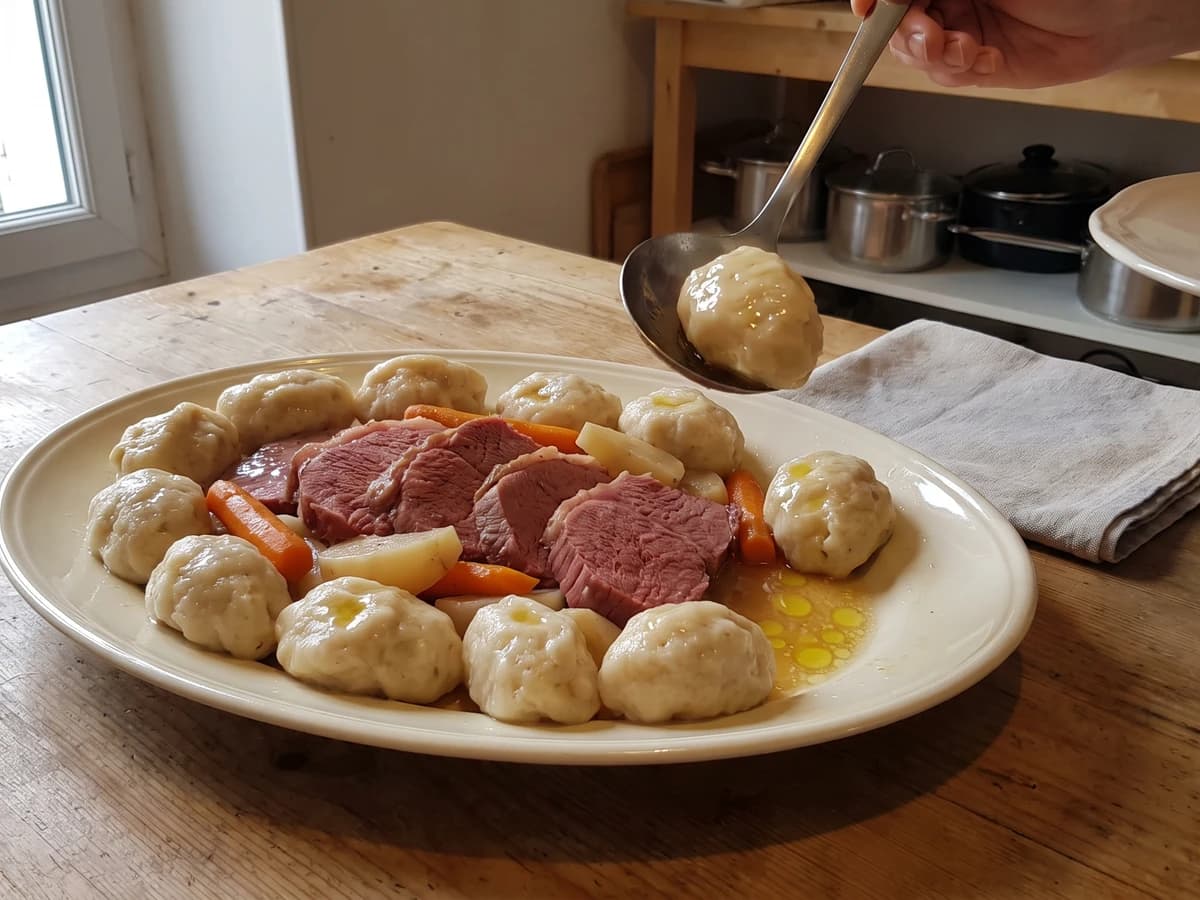
Suet Dumpling
Boulettes au suif, poached beside salt beef, turn equal weights of flour and finely chopped suet into tender, rich dumplings. Keep the beef liquor at a bare tremble and the old garnish works beautifully at home.
A cooking platform built around craft, culture, and the stories behind what we eat.

Created by Chef Juliette
Based on No. 2246, Pommes de Terre Voisin, from Le Guide Culinaire (1907) by Auguste Escoffier
Pommes de Terre Voisin turns evenly sliced potato roundels, real butter, and Gruyère into a compact cake, crisp and bronzed outside, tender within, with cheese binding every deliberate layer.
Pommes de Terre Voisin (a buttered potato cake layered with cheese) teaches that precision can be generous. The one true thing to know before touching the pan is this: every potato roundel must have the same thinness. Thick slices stay firm while thin ones collapse, and neither butter nor cheese can settle that argument afterward.
The book gives one instruction, make Pommes Anna and sprinkle grated cheese over every layer. It assumes a cook who already owns the method, quantities meant for service, and a two-part copper pommes Anna pan built for pressing and turning. This formula needs neither saucier nor stockpot, and no salamander belongs near it. For one cook, one stove, one evening, an ovenproof 20 cm skillet, buttered parchment, and a flat plate perform the same work. The special pan and brigade volume are scaffolding. Thin roundels, real butter, cheese on every layer, firm compression, and two-sided browning are the dish, so those stay.
The finished cake stands high and compact, its roundels arranged like burnished scales, with tender potato and fine seams of melted Gruyère beneath the crust. The turn may quicken your pulse, but if a few layers slip, ça se rattrape, and the warm cheese will bind them again. Set the mandoline to 2 mm, use its hand guard, and give the slicing your full attention. That is the step that decides everything.
Pommes de Terre Voisin belongs to the named potato preparations of the Parisian classical kitchen, where cooks created distinct dishes by changing one defining element while preserving a parent technique. Its parent is Pommes Anna: closely layered potato roundels, butter, pressure, and a deeply bronzed crust on both faces; Voisin changes only one thing, adding grated cheese to every layer. It is sometimes mistaken for a gratin, but there is no cream or loose casserole here, only a compact cake made to be turned out and cut into generous wedges.
Quantity
about 5 medium (2 lb / 900 g)
peeled
Quantity
10 tablespoons (150 ml / 142 g)
clarified before use
Quantity
1 cup (240 ml / 100 g)
finely grated
Quantity
1 teaspoon (5 ml / 6 g)
Quantity
¼ teaspoon (1 ml / 0.5 g)
| Ingredient | Quantity |
|---|---|
| yellow-fleshed potatoes, preferably Yukon Goldpeeled | about 5 medium (2 lb / 900 g) |
| unsalted butterclarified before use | 10 tablespoons (150 ml / 142 g) |
| Gruyèrefinely grated | 1 cup (240 ml / 100 g) |
| fine sea salt | 1 teaspoon (5 ml / 6 g) |
| ground white pepper | ¼ teaspoon (1 ml / 0.5 g) |
Set a rack in the lower middle of the oven and heat it to 425°F / 220°C. Melt the butter very gently in a small saucepan without stirring. Skim away the white foam, then pour the clear golden beurre clarifié (clarified butter) into a bowl, leaving the milky sediment behind. Clarifying matters because the cake cooks at assertive heat, and ordinary butter's milk solids would scorch before the potatoes bronze.
Combine the salt and white pepper in a small dish. Slice the potatoes crosswise into roundels exactly 2 mm thick, using a mandoline and its hand guard or a very sharp knife. Do not rinse them. Their surface starch helps the layers hold together, while added water works against browning. Slice only when the pan and remaining ingredients are ready so the potatoes do not discolor or shed moisture.
Brush a heavy 8-inch / 20 cm ovenproof skillet generously with clarified butter and leave the pan off the heat while you build. Arrange the first roundels in a tight overlapping spiral, covering the centre and leaving no bare pan. Brush lightly with butter, season with a small pinch of the salt mixture, and scatter over a thin, even veil of Gruyère. Repeat with every layer, pressing firmly with your palm or a flat spatula as you work. Every potato layer receives butter, seasoning, and cheese, exactly as the source directs. Finish with the thinnest veil of cheese and another brush of butter.
Set the skillet over medium heat. Once the butter bubbles steadily around the rim, cook for 7 to 8 minutes, rotating the pan every couple of minutes so the base colors evenly. Cover the potatoes with a buttered round of parchment, press firmly with the bottom of a smaller saucepan, then remove the press and cover the skillet tightly with foil. Bake for 25 minutes. A knife inserted at the centre should pass through most layers but meet a little resistance near the bottom; the second cooking will finish it.
Remove the foil and parchment. Run a thin spatula around the edge, then spoon any freely pooled butter into a heatproof bowl and reserve it. Shake the skillet gently to confirm the cake moves as one piece. Wearing dry oven mitts, cover the skillet with a flat heatproof plate and invert both together in one confident motion. If the cake clings, return it upright, warm it over medium heat for 60 seconds, loosen the rim, and try again. Ça se rattrape. If several roundels slip, nudge them back into place while everything is warm and press gently; the melted cheese will weld the cake as it finishes. Slide it back into the skillet with the paler face down and spoon a little reserved butter around the edge.
Return the uncovered skillet to the oven for 18 to 22 minutes, until a knife passes through the centre without resistance and the upper face is deeply bronzed. If the underside remains pale, set the skillet over medium heat for 2 to 3 minutes, rotating it once. Spoon away any loose butter, invert the cake onto a warm platter, and let it settle for 8 to 10 minutes before cutting. The rest keeps the layers together and gives the cheese time to set into fine seams. Cut into four generous wedges and serve while the crust is crisp. À table!
1 serving (about 250g)
Culinary guides, cultural storytelling, and the editorial depth that makes cooking meaningful.
Discover Culinary ExplorerChef Juliette
Boulettes au suif, poached beside salt beef, turn equal weights of flour and finely chopped suet into tender, rich dumplings. Keep the beef liquor at a bare tremble and the old garnish works beautifully at home.

Chef Juliette
Bread, flour, frangipane, and rice become four cool, supple panades for binding forcemeats, each changing body and flavor while preserving tenderness. The finest Mousselines need none, and knowing that distinction is the lesson.

Chef Juliette
Panade au pain is bread, milk, salt, heat, and attention: stir until the paste releases cleanly, butter it against a skin, and you have the quiet binder behind tender French farces.

Chef Juliette
Panade de farine teaches the drying stroke behind pâte à choux: flour meets boiling buttered water, then stays over the fire until the paste gathers, smooths, and quits the pan cleanly.